
How to write a rock song: riffs, power chords and lyrics
Published
Write a rock song step by step: start from a riff or a line, use power chords, choose a form and tempo, write lyrics with attitude and test the song with your band.
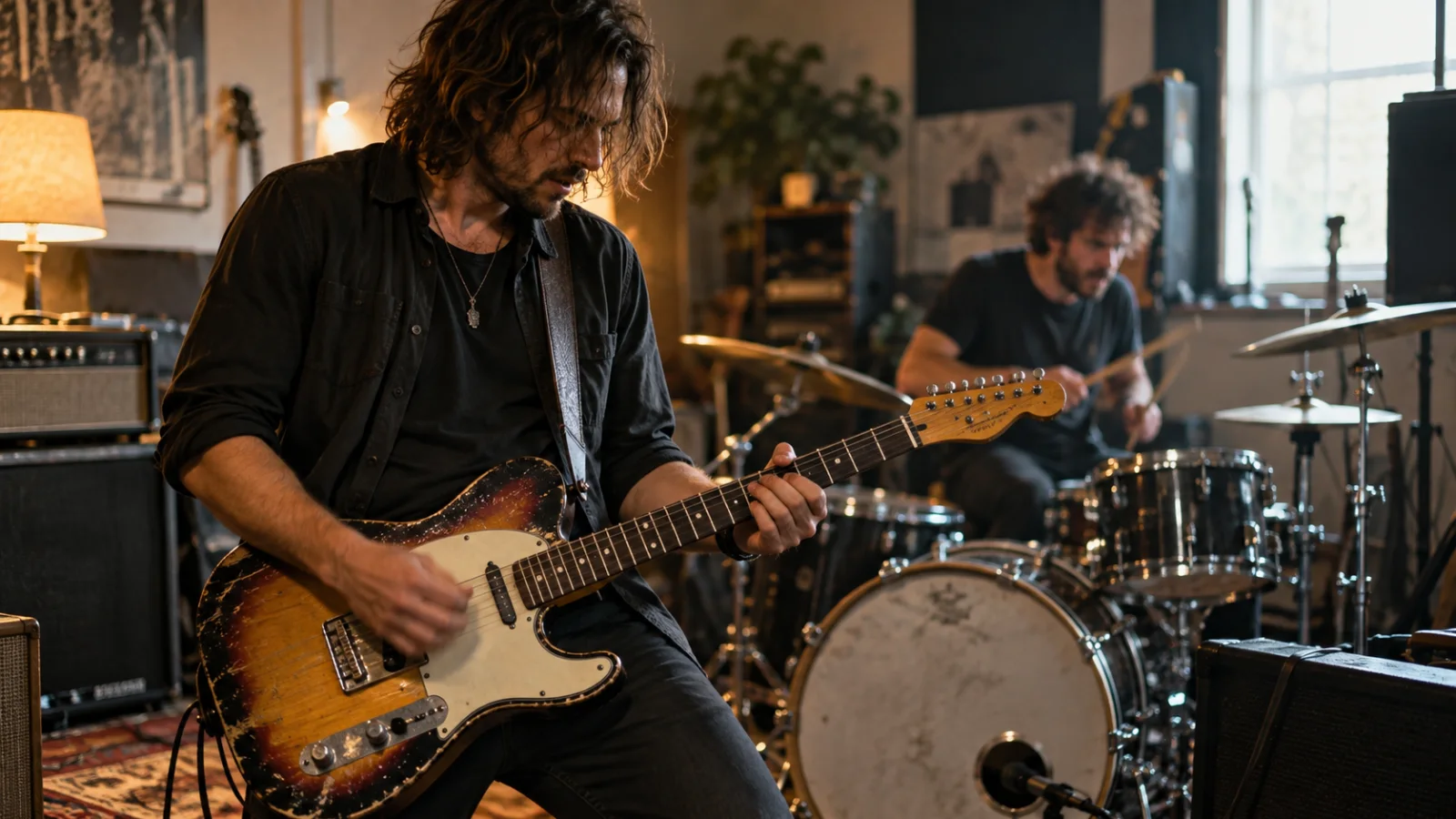
To write a rock song, start from a riff or from a line you’d shout, not from a finished lyric. Loop a one- or two-bar guitar riff built on power chords (just the root and the fifth, such as E5 or A5), set a tempo on a metronome, and find a chorus that lifts: a new chord, a higher melody and the title repeated. Keep the form simple (riff intro, verse, chorus, verse, chorus, solo, a quiet break, last chorus). Write the lyric in plain, physical words with one clear attitude. Then play it with the band before you polish anything, and record a rough full take the same day.
Below: the traits of the genre, power chord shapes, five progressions to loop with rock drums in the free chord player, a form with bar counts, an original verse and chorus, and how to take the song to rehearsal and to a first demo.
What makes a song sound like rock
Rock is less a set of rules than a handful of habits. Reference works describe the same ones again and again:
| Trait | What rock usually does | Try this |
|---|---|---|
| Instruments | Electric guitar, bass, drums and voice; sometimes organ, piano or synth | Write the riff on guitar or bass, not on piano |
| Rhythm | 4/4 with the snare on beats 2 and 4 (the backbeat) | Clap on 2 and 4 while you sing the verse |
| Harmony | Triads and power chords; the Mixolydian and Dorian modes next to major and minor | Try the ♭VII chord: D in the key of E |
| Form | Verse–chorus, borrowed from blues and folk, often with a riff intro and a solo | One riff, one chorus, one solo |
| Lyrics | Love, rebellion, social concerns, ways of living | One situation, one stance |
Subgenres pull these habits in different directions. Punk keeps songs shorter and faster than other rock, with one or two guitars, bass, drums and voice; a 1976 fanzine summed up its spirit with three chord diagrams and an invitation to start a band. The Pixies built songs on sudden loud–quiet–loud shifts, and Kurt Cobain said Nirvana borrowed that sense of dynamics. Hard rock and metal lean on low riffs and dropped tunings. Pick one band as a style reference for the song, to borrow its energy and its instruments, not its melodies.
Riff first or lyrics first?
Both work. Rock leans riff first, because the riff sets the energy the words then have to match. A riff is a short, repeated figure, often low on the guitar, that carries the song and usually opens it.
Riff first:
- Set the metronome to 120 BPM and loop four beats.
- Stay on the three thickest strings. Move between E5, G5 and A5 and the open low E.
- Keep it to one or two bars, with a gap (a rest) where the drums or the voice can answer.
- Play it 20 times in a row. If you still like it, record it. If your hand drifts into a variation you prefer, record that one.
- Sing vowels and nonsense syllables over it until a rhythm sticks, then turn them into words.
What to listen for: after the count-in (0:00–0:02), the same one-bar figure comes back in every bar until 0:21 while the chords change under it. This synthesized example uses pop drums, but the principle is the rock one: repetition turns a figure into a hook. Move a figure like that low on the guitar, play it harder, and you have a riff.
Lyrics first:
- Write the title as something you’d shout at a gig: two to four words.
- Say it out loud at different speeds and clap its rhythm. Mark the stressed syllables.
- Build a riff that copies that rhythm, so the accents of the guitar and of the words land together.
- Only then write the verse, filling in the story that leads to the title.
If you usually write on an acoustic guitar with open chords, the guide to writing a song on guitar covers strumming, capo and first progressions.
Power chords: the sound of rock guitar
A power chord has two notes, the root and the fifth, often with the root doubled an octave up. It’s written with a 5: E5, A5, C5. Without the third it’s neither major nor minor, so it fits over almost any riff. Distortion is the other reason: root and fifth vibrate in a ratio close to 3:2, so the extra tones distortion adds match the chord instead of clashing with it. A full chord through the same amp turns to mud much sooner.
Shapes in standard tuning, from the 6th string (thickest) to the 1st; x means don’t play that string:
| Chord | Frets | Root |
|---|---|---|
| E5 | 0 2 2 x x x | Open 6th string |
| A5 | x 0 2 2 x x | Open 5th string |
| D5 | x x 0 2 3 x | Open 4th string |
| G5 | 3 5 5 x x x | 6th string, 3rd fret |
| C5 | x 3 5 5 x x | 5th string, 3rd fret |
The closed shapes move: slide G5 up two frets and you get A5 (5 7 7), two more and it’s B5 (7 9 9). Two techniques change the sound without new gear:
- Palm muting. Rest the edge of your picking hand on the strings next to the bridge. The chord turns short and percussive, ideal for a verse. Lift the hand in the chorus and let the chords ring: instant contrast.
- Drop D. Tune only the 6th string down a whole step (D A D G B E). One finger across the three thickest strings now gives a power chord at any fret. Alternative bands such as Soundgarden and Melvins used it heavily. The guitar tuning guide explains it, and the online tuner gets you there in a minute.
For the full family of chords, from sus4 to add9, see types of chords.
Five rock progressions to loop
The chord player sounds full triads, not power chords. Use it to hear the movement and to sing over it; on the guitar, play the same roots as power chords.
| Progression | Example | Feel | Loop it |
|---|---|---|---|
| I–IV–V–IV | A–D–E–D | Classic, straight ahead | Play at 126 BPM |
| I–♭VII–IV–I | E–D–A–E | Swagger, bluesy major | Play at 120 BPM |
| IV–♭VI–♭VII–I | A–C–D–E | A chorus that climbs home | Play at 128 BPM |
| i–♭III–♭VII–iv | Em–G–D–Am | Dark and driving | Play at 136 BPM |
| i–♭VII–♭VI–♭VII | Am–G–F–G | Heavy, circular | Play at 100 BPM |
What to listen for: after the count-in, G and then C play over rock drums, the D arrives around 0:06 and pushes forward, and the C behind it lets the tension down before G returns around 0:11. That back-and-forth between I, IV and V is the most basic rock loop there is.
What to listen for: rock took its verse–chorus shape from blues and folk, and this is the blues form behind it. A7 for four bars, D7 around 0:11, back to A7, then E7 around 0:20 and D7 right after, closing on the turnaround. Play it with A5, D5 and E5 and it’s already rock and roll.
The ♭VII chord in the second row (D in the key of E) comes from the Mixolydian mode, common in rock; The Troggs’ “Wild Thing” is often cited as an example of that sound. The guide to musical modes shows how to build a whole riff on it. And when ♭VII goes straight to I (D–E), it closes the phrase without the V: that’s the ♭VII–I ending covered in the guide to cadences in music.
Song form: verse, chorus, solo
Most rock songs don’t need a pre-chorus or a bridge. They need a riff that returns, a chorus that hits harder than the verse, and one moment of contrast. A form that works, at 128 BPM:
| Section | Bars | What happens |
|---|---|---|
| Intro | 4 | The riff alone, then with drums |
| Verse 1 | 16 | Riff under the voice, palm-muted; bass locked to the kick drum |
| Chorus | 8 | Chords ring open, the melody goes up, the title repeats |
| Verse 2 | 16 | Same riff, new details in the lyric, one extra layer |
| Chorus | 8 | As before |
| Solo | 8 | Over the verse or chorus chords |
| Break | 8 | Only bass and drums, or voice and one guitar: the quiet part |
| Last chorus ×2 | 16 | The loudest point of the song |
| Outro | 4 | The riff again, ending on a hit |
That’s 88 bars. At 128 BPM a 4/4 bar lasts 1.875 seconds, so the song runs about 2:45. The break is the loud–quiet–loud idea in miniature: take almost everything away so the last chorus feels bigger without anyone playing more notes.
A solo in a song is a section, not a showcase: 8 bars, one idea that develops, often the chorus melody bent and pushed higher. If nobody plays lead, the riff twice with a different drum pattern does the same job. For other forms and section names, see song structure, and for the chorus itself, how to write a chorus.
Tempo and feel
Tempo decides the attitude before the lyric does. Loop your riff on the metronome at 100, 125 and 160 BPM for a minute each: the same notes go from heavy to driving to frantic. If a reference song has the energy you want, tap along to it with the tap tempo button and start from its number.
Two decisions to make with the drummer:
- Half-time for contrast. In the break, the snare moves from beats 2 and 4 to beat 3 only. Same tempo, twice the weight. The BPM guide explains half-time.
- A click at rehearsal. Songs speed up when the band gets excited. Rehearse with the click and write the final tempo at the top of the lyric.
Writing rock lyrics with attitude
Rock covers love, rebellion, social issues and the way people live. What makes a lyric sound like rock is the stance. Five rules:
- Pick one stance and write it above the lyric: defiant, restless, hurt, amused.
- Use physical words: a name tag, a slammed door, a night bus, a borrowed amp. Skip “freedom”, “destiny”, burning nights and breaking chains; if you’ve heard it in ten songs, nobody hears it in yours.
- Keep lines short and verbs strong. Talking to someone (“you”) gives the lyric a target.
- Leave space. A riff needs gaps; don’t fill every beat with syllables.
- Make the title shoutable: two or three words, with an open vowel on the long note (“now”, “go”, “crown”).
Stuck for a rhyme? The rhyming dictionary lists options by sound; pick one you’d actually say.
Worked example: “Paper Crown”
Written for this article in E at 128 BPM. The riff: palm-mute the open low E in eighth notes on beats 1 and 2, hit G5 (3 5 5) on beat 3, A5 (5 7 7) on the “and” of 3, and let it ring through beat 4. It plays under the whole verse.
Verse, I–♭VII–IV–I (E–D–A–E), one chord per line:
E5
Punch card, plastic coffee, same four walls
D5
Boss in a paper crown yelling down the hall
A5
I keep a guitar pick where the name tag goes
E5
Counting every minute till the shutter's closed
Chorus, IV–♭VI–♭VII–I (A–C–D–E), with open chords that ring:
A            C
Paper crown, paper crown
D                        E
You can't rule me with a paper crown
A               C
Friday night, the volume's mine
D                          E
I'll be louder than your closing time
Loop the chorus at 128 BPM and sing it over the player.
Why it works:
- The verse is made of objects (punch card, name tag, guitar pick), so the listener sees the job before any complaint. The rhymes are plain and a little loose (walls/hall, goes/closed), as if spoken.
- The title has two words, an open “ow” on the long note, and appears twice in the first chorus line. A crowd can shout it the second time.
- The chords climb A–C–D and land on E exactly on “closing time”: harmony and words arrive home together.
- The stance is defiant but funny. No sermon, just a person with a pick in their pocket.
Sing the verse low, close to your speaking voice, and start the chorus several notes higher: the jump in register does half of the lift.
Take it to the band
Bring the song in a form the band can learn in ten minutes: a phone recording of the riff and the chorus, the key, the tempo and the form table. Then:
- Tune everyone to the same reference; the online tuner works on any phone.
- First pass: everyone plays the riff over a plain backbeat. Lock it before anyone decorates.
- Set the roles: bass on roots in eighth notes with the kick drum in the verse; hi-hat in the verse, ride or crash in the chorus, half-time in the break.
- Play the whole form three times and record each pass on a phone in the middle of the room. Listen together before you argue.
- Write down the final tempo, key and form. When the song joins the set, add it with the setlist maker.
If the song is still half-built and everyone is writing, the band songwriting guide covers roles, jamming with limits and deciding between versions.
Record the first demo
The first demo only has to answer one question: does the song work from start to finish? Put a phone where you’d stand to listen, away from the drums, and record a full take at rehearsal volume. Test the loudest chorus first; if the recording distorts, move the phone back. Add a guide vocal at home over that take so the words are clear, and name the file with song, tempo, key and date. For room, levels and cheap gear, follow the home demo guide.
Common mistakes and how to fix them
- A riff nobody can hum. If you can’t sing it, cut notes until you can.
- A chorus with the same energy as the verse. Change at least two things: chords, register, drum pattern, muted or open guitars.
- Full chords under heavy distortion. Switch to power chords or play fewer strings.
- Lyrics built from stock phrases. Replace each abstract word with an object or an action.
- A key that suits the guitar but not the singer. Try the highest chorus note before the first rehearsal and move the whole song if it strains.
Where Zoundroom fits: the riff, the lyric and every rehearsal take
Zoundroom doesn’t play chords, keep time or tune your guitar; the chord player, the metronome and the tuner on this site do that in the browser. It isn’t a DAW either, so mixing and effects belong in a tool such as GarageBand or BandLab. Where it helps is keeping the song in one place while it changes shape. Each song is a project with its recordings, lyrics, notes and files: open a note called “Paper Crown”, type the key, tempo and form, and record the riff inside the note with the app on your phone, so the audio lands at the cursor under the chords. Paste the lyric below, import the rehearsal takes into the same project and share it with the band (Free shares with up to 2 artists, Pro with up to 5, and the Band plan covers up to 7 members). With Pro, bandmates can leave timestamped comments on a take; Auralis, the app’s assistant, can suggest rhymes or a second verse as text, never audio. Your next step: record the riff in a note tonight, so everyone arrives at rehearsal having heard the same version.
Frequently asked questions
How do I write a rock song on guitar?
Start with a one- or two-bar riff on the three thickest strings using power chords (E5, A5, G5). Loop it with a metronome, find a chorus with open, ringing chords, and hum a melody over both before writing words.
How do I write rock lyrics?
Choose one stance (defiant, restless, hurt) and one concrete situation. Use short lines, physical words and a shoutable title of two or three words that repeats in the chorus. Avoid stock rock phrases; a specific detail sounds more rebellious than any slogan.
What chords are used in rock songs?
Mostly power chords and major and minor triads. Typical movements are I–IV–V (A–D–E), the Mixolydian I–♭VII–IV (E–D–A) and, in minor keys, i–♭VII–♭VI (Am–G–F). Many rock songs also grow from the 12-bar blues.
How long should a rock song be?
There’s no rule. The form in this article lasts about 2:45 at 128 BPM, and punk songs tend to be shorter than other rock. Cut anything that repeats without adding energy. The guide to song length gives section timings.
Can I write a rock song without a band?
Yes. Write the riff, chords and lyric alone, loop the progression with rock drums in the chord player and sing over it. That’s enough to know if the song works; the band adds the energy later.
Sources
All pages checked on September 28, 2026.
- Wikipedia, “Rock music”: electric guitar, bass, drums and singers; 4/4 with a snare backbeat on beats two and four; verse–refrain structure derived from blues and folk; Dorian and Mixolydian modes; themes such as romantic love, rebellion, social concerns and lifestyles. wikipedia.org
- Wikipedia, “Power chord”: root and fifth, notated C5, neither major nor minor; common with distortion in rock, heavy metal and punk; the near 3:2 ratio that keeps it coherent through distortion. wikipedia.org
- Wikipedia, “Riff”: a short, repeated figure, in rock often pitched low on the guitar and used as the main hook that opens the song. wikipedia.org
- Wikipedia, “Backbeat (music)”: accent on beats 2 and 4 in 4/4, usually on the snare drum. wikipedia.org
- Wikipedia, “Mixolydian mode”: common in rock; I–♭VII–IV–V as a classic Mixolydian progression; “Wild Thing” by The Troggs as an example. wikipedia.org
- Wikipedia, “Drop D tuning”: D A D G B E; the three open bass strings form D5 and one finger barres other fifth chords; extensive use by King’s X, Soundgarden and Melvins. wikipedia.org
- Wikipedia, “Pixies (band)”: “loud-quiet-loud” shifts; Kurt Cobain on borrowing their sense of dynamics for Nirvana. wikipedia.org
- Wikipedia, “Punk rock”: shorter songs at fast tempos, instrumentation stripped down to one or two guitars, bass, drums and vocals; the 1976 fanzine illustration of three chords. wikipedia.org