What is BPM in music? Tempo meaning, examples and ranges
Published
BPM means beats per minute: 60 BPM is one beat per second. Find a song's BPM by tapping, see tempos by genre and Italian terms, and choose yours.
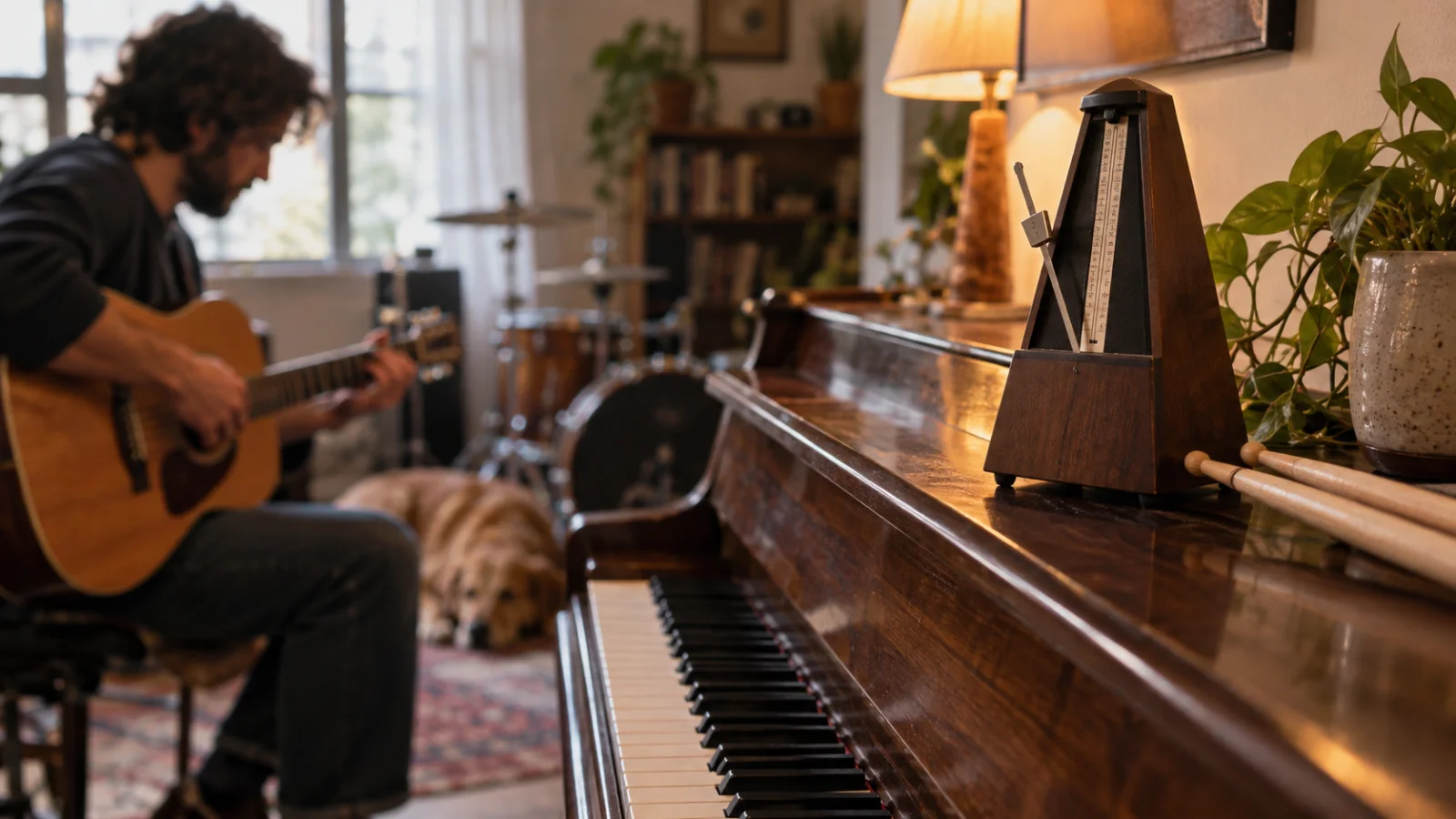
BPM stands for beats per minute: how many steady pulses, the ones you tap your foot to, fit into one minute. It is how musicians measure tempo, the speed of a piece. At 60 BPM there is exactly one beat per second; at 120 BPM there are two, and at 100 BPM a beat arrives every 0.6 seconds. To find a song’s BPM, tap along with its beat on the free tap tempo metronome at least four times. To choose a tempo for your own song, sing its busiest line and its longest note over a click at two or three tempos, and keep the one where the words fit and you can still breathe.
Below: the numbers in milliseconds, ranges by genre (and why trap at 140 feels like 70), the Italian terms, audio at different tempos and a method to pick yours.
What 60, 100 and 120 BPM mean
One beat lasts 60 ÷ BPM seconds, or 60,000 ÷ BPM milliseconds. A bar of 4/4 has four beats, so it lasts 240 ÷ BPM seconds.
| BPM | Beats per second | One beat | One bar of 4/4 |
|---|---|---|---|
| 60 | 1 | 1,000 ms | 4 s |
| 80 | 1.33 | 750 ms | 3 s |
| 90 | 1.5 | 666.7 ms | 2.67 s |
| 100 | 1.67 | 600 ms | 2.4 s |
| 120 | 2 | 500 ms | 2 s |
| 140 | 2.33 | 428.6 ms | 1.71 s |
Producers use the millisecond column all the time: at 100 BPM a delay of one beat is 600 ms, an eighth note 300 ms and a sixteenth 150 ms, so the echoes fall in time with the song.
Sheet music writes tempo as a note and a number, such as ♩ = 96: ninety-six quarter notes per minute. Older scores add “M.M.” for Maelzel’s metronome, patented in 1815. The number is guidance, not law: a 2020 study in PLOS One compared 36 recordings of Beethoven’s symphonies with his metronome marks and found conductors consistently slower than written. The authors suggest Beethoven may have read his metronome’s scale at the wrong edge of the sliding weight.
How to find the BPM of a song
- Tap it. Open the tap tempo metronome, play the song and tap the button (or press T) on every beat, at least four times. Tap the pulse you would clap to, usually the kick drum, not every hi-hat. After four to eight taps the average settles.
- Check half and double. If the number feels twice as fast or twice as slow as the song, press ÷2 or ×2. A trap beat can read as 70 or 140; both are defensible, so agree on one with whoever you work with.
- Count without a tool. Count beats for 15 seconds and multiply by 4, or for 30 seconds and multiply by 2: 23 beats in 15 seconds is 92 BPM. It is rougher, because missing one beat in 15 seconds puts you 4 BPM off, and in 30 seconds 2 BPM off.
- Read the label. Producers often name files like “nightloop_140_Am.wav”, and a DAW shows the project tempo on screen.
Then press “Play click” and compare it with the recording; if they drift apart, move one BPM at a time. Songs recorded without a click can drift between sections, so tap the verse and the chorus separately.
Typical tempo ranges by genre
Genres have no official tempo. These are common working ranges, not rules; the hip-hop and electronic rows follow Ableton’s Learning Music guide, and plenty of great songs sit outside them.
| Style | Typical BPM | Feel |
|---|---|---|
| Ballad | 60–80 | Room for long notes and breaths |
| Hip-hop | 60–100 | Boom bap often around 85–95, snare on 2 and 4 |
| Reggaeton | around 88–100 | Dembow pattern, kick on every beat |
| Pop | 95–130 | From mid-tempo to dance-pop |
| Rock | 100–140 | Driving eighth notes |
| House | 115–130 | Kick on every beat |
| Techno, trance | 120–140 | Steady four-on-the-floor |
| Trap | 130–170 | Felt in half-time, 65–85 |
| Dubstep | 135–145 | Usually felt in half-time |
| Drum and bass | 160–180 | Fast breakbeats |
Feel matters as much as the number: a swung boom bap beat at 90 and a piano ballad at 90 share a tempo and nothing else. And many styles can be counted two ways.
Half-time and double-time: why trap at 140 feels like 70
In most pop and rock the snare hits on beats 2 and 4, the backbeat. In half-time the snare moves to beat 3 only, once per bar. At 140 BPM a bar lasts 1.71 seconds, and so does the gap between snares. A song at 70 BPM with its snare on 2 and 4 has a snare every two beats of 0.857 seconds: the same 1.71 seconds. That is why trap is programmed at 140 but makes heads nod at 70, while the hi-hats run at 140’s speed on top.
What to listen for: four fast clicks (0:00–0:01) give you the 140 count. Am starts at about 0:02 and F at 0:05, and the loop comes round again at 0:09. The snare hits once per bar, on beat 3, the first at about 0:03. Nod on each snare and you are moving at 70; tap with the count-in clicks and you are at 140. The hi-hats run in sixteenths.
Double-time is the opposite: when a drummer switches an 85 BPM groove to a snare on every beat, or a rapper moves from eighth notes to sixteenths, that section feels like 170 without the tempo changing. When you tell a band the tempo, say which you mean: “140, half-time” saves an argument.
Italian tempo terms and their BPM
Before metronomes, composers described speed with Italian words, and scores still use them. Metronome makers print a scale pairing each term with a range; this one is from Wittner, a German manufacturer.
| Term | Meaning | BPM on Wittner’s scale |
|---|---|---|
| Largo | broad, very slow | 40–60 |
| Larghetto | a little less slow | 60–66 |
| Adagio | slow, at ease | 66–76 |
| Andante | at a walking pace | 76–108 |
| Moderato | moderate | 108–120 |
| Allegro | fast and bright | 120–168 |
| Presto | very fast | 168–200 |
| Prestissimo | as fast as possible | 200–208 |
Treat these ranges as approximate: the Lumen Learning music appreciation textbook gives andante as 73–77 and allegro as 109–132. The words describe character as much as speed. Andante is a walk, not a number.
How tempo changes a song: listen at different speeds
Tempo decides how many words fit, how long notes ring and how the body wants to move.
The same chords at three tempos
What to listen for: after the count-in (0:00–0:02), the four chords play twice, one per bar, and each bar lasts exactly 2.5 seconds. Hum a simple line over it. Then open the same progression, with the same sound and drums, at 72 BPM and at 128 BPM, and hum the same line. At 72 a bar lasts 3.33 seconds and long notes have room to ring; at 128 it shrinks to 1.875 seconds and the same tune starts to push forward. Only the number changed.
The same bar length, very different density
What to listen for: after the count-in (0:00–0:02), four bars run from about 0:03 to 0:13. Short beeps stand in for syllables, six per bar on eighth notes, with a gap at the end of each bar to breathe.
What to listen for: after the count-in (0:00–0:01), four bars run from about 0:02 to 0:09, with three beeps on each of beats 1, 2 and 3 and beat 4 left empty.
Six syllables in a 2.67-second bar is 2.25 syllables per second; nine in a 1.71-second bar is 5.25, more than twice as many. How dense a lyric feels depends on the tempo as much as on the word count. For writing bars over a beat, see how to write lyrics to a beat and how to write a rap song.
How to choose a tempo for your song
Start from your song, not from the genre table.
- Lyric density. Count the syllables of your busiest line with the syllable counter, then speak it in rhythm over the click. If you have to rush, slow down or cut words.
- Groove. Play the main riff or chords over the click and notice your foot. If it wants to go faster than the click, raise the tempo; if the groove feels hurried, lower it.
- Breath. Sing the longest phrase and the longest held note. Slow tempos stretch both: a four-beat note lasts 4 seconds at 60 BPM and 2 seconds at 120. Fast tempos shrink the rests: a one-beat gap to breathe is 0.43 seconds at 140.
- Three takes. Record the chorus on your phone at your first guess, 8 BPM slower and 8 BPM faster. Listen the next day without looking at the numbers.
- Fine-tune. Once a take wins, move 2 or 3 BPM at a time.
Worked example: “Last Bus Home”
The verse’s busiest line has 10 syllables sung inside one bar: “The window’s cold, I write your name in it” (the-win-dow’s-cold-I-write-your-name-in-it). The chorus ends on a held word that rings for a whole bar: “Leave the light on in the hall”. The first guess was 92, so the takes are at 84, 92 and 100:
| Tempo | One bar | Verse line: syllables per second | Held “hall” |
|---|---|---|---|
| 84 BPM | 2.86 s | 3.5 | 2.86 s |
| 92 BPM | 2.61 s | 3.83 | 2.61 s |
| 100 BPM | 2.4 s | 4.17 | 2.4 s |
In this example the 84 take lets “hall” sag, and at 100 the verse trips over “window’s cold”. The 92 take keeps both in shape, so 92 becomes the working tempo. Your numbers will differ; the method stays the same.
Recording with a click, and when to drop it
Record a demo to a click when other parts will be added later (bass, a second guitar, a producer’s drums), when you plan to edit, because cutting or copying a section only works on a steady grid, and when you share the idea, so a co-writer can open the chord player or a DAW at the same BPM.
Set the tempo in the metronome, give yourself one bar of count-in and listen on headphones so the click stays out of the take; the vocal recording guide covers mic distance and levels. At slow tempos a click on every beat leaves long gaps where you can drift: press ×2 and treat every second click as the beat, so a 60 BPM ballad plays against a 120 BPM click.
Drop the click when the song needs to breathe, like a free intro or a voice-and-piano ballad that slows at the end of phrases. Drop it too the first time you capture an idea: record, then tap the tempo from the recording and write it down. And if your band lifts the chorus a few BPM and it sounds better, keep it and note each section’s tempo.
BPM and song length: seconds per bar
Seconds per bar = 60 ÷ BPM × beats per bar
- 4/4 at 90 BPM: 60 ÷ 90 × 4 = 2.67 seconds per bar, so an 8-bar chorus lasts 21.3 seconds.
- 3/4 at 120 BPM: 60 ÷ 120 × 3 = 1.5 seconds per bar, so 16 bars last 24 seconds.
- 4/4 at 128 BPM: 60 ÷ 128 × 4 = 1.875 seconds per bar, so an 8-bar build lasts 15 seconds.
- A whole song of 72 bars in 4/4 at 96 BPM: 72 × 2.5 = 180 seconds, exactly 3:00. The same 72 bars at 120 BPM take 144 seconds, 2:24.
A change of tempo is also a change of length. For typical section lengths and what radio, streaming or a wedding asks for, see how long should a song be. The free song structure planner adds up the sections for you once you enter the tempo.
BPM is only one of the terms you’ll hear in a session; the songwriting glossary covers the rest on one page.
Where Zoundroom fits: the BPM in the song note, the takes at that tempo
A tempo you chose last week is useless if nobody wrote it down. In Zoundroom each song is a project that keeps its recordings, lyric and notes together. Write the tempo at the top of the song’s note, for example “92 BPM, 4/4, capo 2”, then record your takes inside that note: the audio lands at the cursor, right under the BPM and the lyric. Zoundroom doesn’t play a click, so run the free metronome on a second device with headphones.
Record the chorus at 84, 92 and 100 in the same note, with the tempo above each take, and the comparison sits in one place. Invite a co-writer to the project; on Pro and Band they can comment at an exact second of a take (“rushing at 0:41”). Zoundroom is not a DAW: set the grid, edit and mix in one, then import the bounce into the same project.
Frequently asked questions
What BPM is a normal song?
There is no normal tempo, but most pop, rock and hip-hop falls roughly between 60 and 140 BPM: ballads around 60–80, hip-hop often 80–100 and pop 95–130. Dance styles go higher, such as drum and bass at 160–180.
Is a higher BPM always faster?
On the grid, yes. To the ear, not always. A trap beat at 140 in half-time has a snare every 1.71 seconds, while a pop song at 110 with the snare on 2 and 4 has one every 1.09 seconds, so the pop song can feel faster.
How do I find the BPM of a song?
Tap along with the beat in a tap-tempo tool four to eight times, or count beats for 15 seconds and multiply by 4. If the result feels twice as fast or slow as the song, halve or double it.
What BPM is good for rap or a ballad?
Boom bap usually sits around 85–95 BPM and trap around 130–170, felt in half-time; ballads around 60–80. Test your own lyric at three tempos: the right one is where the words fit and the singer can breathe.
Sources
All pages checked on September 27, 2026.
- Ableton Learning Music: Tempo and genre (hip-hop 60–100, house 115–130, techno and trance 120–140, dubstep 135–145, drum and bass 160–180 BPM).
- Wittner: Metronome System Maelzel, instruction manual (Largo 40–60 up to Prestissimo 200–208).
- Lumen Learning, Music Appreciation II, on LibreTexts: Tempo markings and changes (andante 73–77, allegro 109–132).
- Almudena Martín-Castro and Iñaki Ucar: Conductors’ tempo choices shed light over Beethoven’s metronome, PLOS One, 2020 (Maelzel’s patent in 1815, 36 recordings, conductors slower than the marks, the misreading hypothesis).