
How to write a metal song: riffs, tunings and lyrics
Published
How to write a metal song on guitar: a palm-muted riff in drop D, a song form with a breakdown, lyrics built on real images and how to scream without hurting your voice.
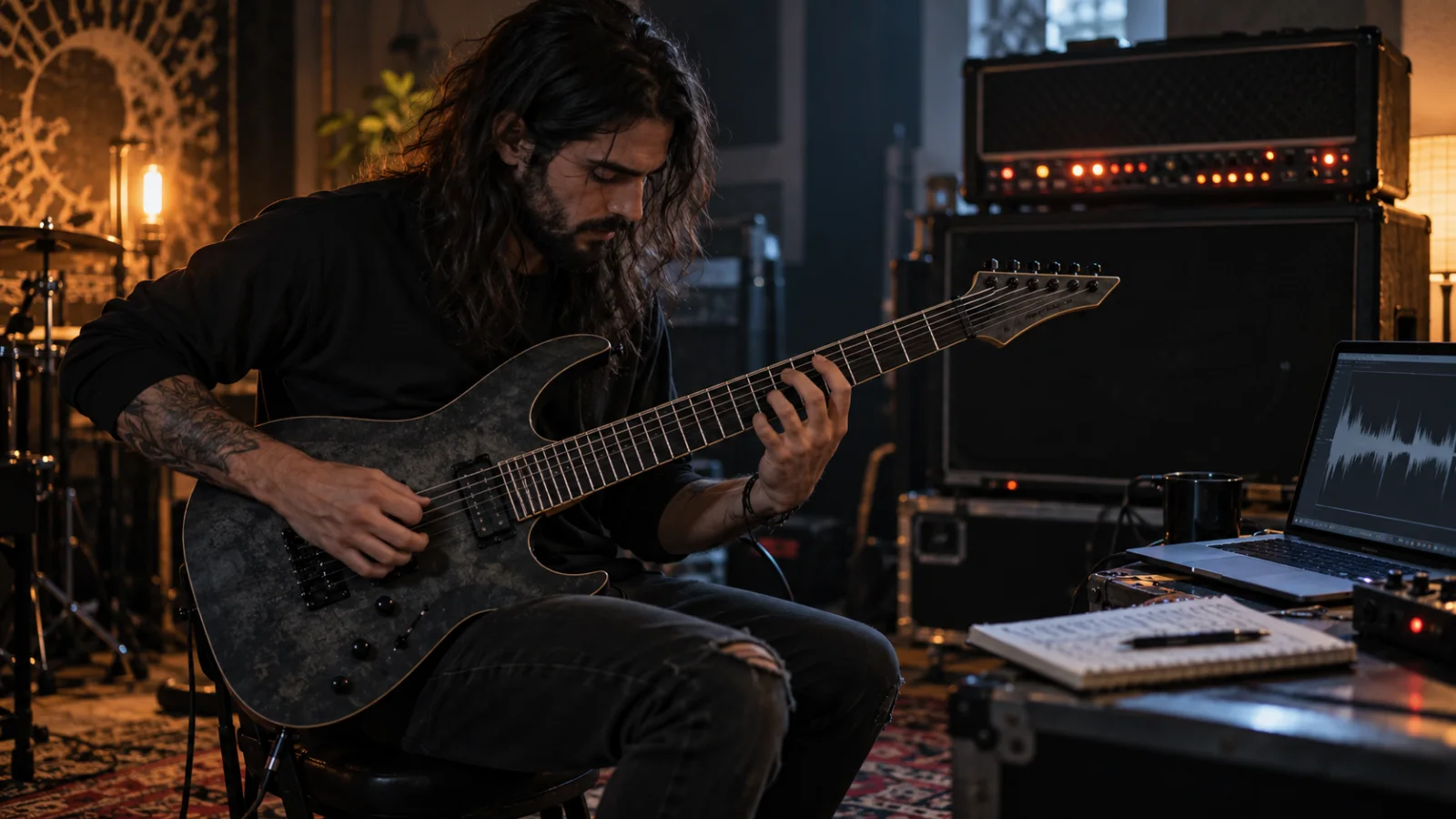
To write a metal song, start with a riff, not a lyric. Tune down to drop D, palm-mute the open low string in a steady chug, and break the chug with one-finger power chords a half step, a minor third or a tritone above it: those intervals are where the darkness comes from. Set a tempo, then build the song from two or three riffs: a palm-muted verse, a chorus where the chords ring and the vocal finds a melody, and a half-time breakdown before the last chorus. Write the lyrics around one concrete image and a clear point of view, with short, hard words for harsh vocals and open vowels for a clean chorus. And learn to scream with technique, not with force.
Below: what separates metal from rock, an original riff in drop D with its tab, a table of tunings with a tuner you can use on this page, a full song form with a breakdown, tempo and double kick in plain words, the main subgenres in one table, an original lyric with notes, and how to look after your voice.
What makes a song sound like metal
Metal grew out of rock, so the basics carry over: power chords, riffs and a verse–chorus form. If you’ve never written a rock song, how to write a rock song covers them. What changes is where the weight sits.
| Element | Rock | Metal |
|---|---|---|
| Guitar | Power chords and open chords, riffs in the middle of the neck | Riffs on the lowest strings, palm muting, often a lower tuning |
| Harmony | Major and minor, the bluesy ♭VII | Minor modes (Aeolian and Phrygian), chromatic steps and the tritone |
| Drums | Backbeat on 2 and 4 | From ballad tempos around 60 BPM to blast beats; double kick |
| Vocals | Sung | Clean, harsh, or both in the same song |
| Lyrics | Love, rebellion, everyday life | Darkness, war, myth, trauma, nature, politics, fantasy |
The tritone deserves a word. It’s the interval of three whole steps (C to F♯), so unstable that it was nicknamed “the devil in music.” The riff of Black Sabbath’s song “Black Sabbath” (1970) plays a G power chord, the same G an octave up, then the note a tritone away, and it’s one of the earliest heavy metal uses of that interval; the genre has leaned on it ever since. You’ll use it in the riff below.
Step 1: build the riff (palm muting and the dark intervals)
Most metal riffs are a conversation between a muted low note and a few chords that interrupt it. The muted note is the engine; the chords are the words.
Palm muting first. Rest the edge of your picking hand (the side, not the palm) on the strings right where they leave the bridge, and pick the open low string. Too far toward the neck and the note dies into a thud; too light and it rings like a normal note. You want a tight, percussive “chug” that still has pitch. Use downstrokes at moderate tempos for an even attack, and alternate picking once the riff gets fast.
Now the intervals. In drop D (next section), one finger across the three lowest strings at any fret gives you a power chord, so the fret number is the interval above the open D:
| Fret | Power chord | Interval from D | What it feels like |
|---|---|---|---|
| 1 | E♭5 | Half step (♭2, the Phrygian note) | Claustrophobic, menacing |
| 3 | F5 | Minor third | The basic dark minor sound |
| 5 | G5 | Fourth | Heavy and stable |
| 6 | A♭5 | Tritone | Unsettled, wants to move |
| 7 | A5 | Fifth | Pushes back home to D |
Here is an original two-phrase riff that uses four of them. Play it slowly first.
Riff A · drop D (D A D G B E) · 160 BPM · one symbol = one eighth note
0 = open low D, palm-muted · number = one-finger power chord on that fret · – = let it ring

Bar 1:  0  0  0  0  0  0  3  5     (F5, G5)
Bar 2:  0  0  0  0  0  0  1  –     (E♭5, the half step above D)
Bar 3:  0  0  0  0  0  0  3  5     (same as bar 1)
Bar 4:  0  0  0  0  6  –  5  3     (A♭5, the tritone; then G5 and F5 walk back down)
Why it works: three bars repeat and only the end of each changes, so the ear learns the pattern and then gets surprised. That’s call and response inside one riff. Bars 1 and 3 ask the question, bar 2 answers with the creepy half step, and bar 4 answers with the tritone before falling back to the open D.
Ways to vary a riff once you have it:
- Change the rhythm of the chug, not the notes: straight eighths, a gallop (one eighth note and two sixteenths, “da-da-da, da-da-da”), or sixteenths.
- Move the accents off the beat: chug, chug, rest, chug. Syncopation makes a slow riff feel heavier.
- Play the same notes tremolo-picked (very fast repeated picking) for a black metal colour.
- Keep the riff, change the drums under it. Same riff, half-time drums: instant breakdown.
Here is the gallop, with a double kick under it:
What to listen for: after the count-in (0:00–0:02), D5 gallops for two bars from 0:02, B♭5 takes over at 0:05 and C5 at 0:06, then the riff starts again on D5 at 0:08 (B♭5 at 0:11, C5 at 0:13) and ends around 0:16. Every beat is one eighth note and two sixteenths, the “da-da-da” from the list above. Under it the kick plays every sixteenth, 10 kicks per second at 150 BPM, and the snare lands on 2 and 4. It’s a synthesized teaching example: the power chords (root and fifth, no third) are clean and plucked, not a distorted guitar, so listen to the rhythm and the way the roots move, not to the tone. Play the same pattern palm-muted through a distorted amp and you have a gallop riff.
To try those roots at your own tempo, loop them in the free chord player, for example D minor i–♭VI–♭VII–i at 160 BPM (Dm–B♭–C–Dm; in drop D those roots are frets 0, 8 and 10). It plays clean triads, not distorted power chords, so use it to test the harmony and to hum a chorus melody over it.
And for a different shade of dark, listen to a descending minor line that metal uses a lot:
What to listen for: it’s a synthesized, strummed teaching example with no drums. After the count-in (0:00–0:02), the chords step down from A minor through G and F, and the E major chord arrives around 0:11 and again around 0:21. Its G♯ doesn’t belong to plain A minor, and that’s what gives the line its dramatic pull back to Am. Play the same roots as power chords (A5, G5, F5, E5) with the palm-muted gallop from the first example and it already sounds like metal.
Step 2: pick a tuning (drop D, drop C or seven strings)
Low tunings are part of the metal sound, and they started out of necessity: Tony Iommi of Black Sabbath tuned down after an injury to his fretting hand, to make fretting easier, and leaned on power chords because their fingering is simple. Today the choice is mostly about weight and comfort.
| Tuning | Strings, low to high | Why players use it |
|---|---|---|
| Standard | E A D G B E | Classic heavy metal and thrash; all common chord shapes work |
| Drop D | D A D G B E | Only the 6th string changes; one-finger power chords; the easiest start |
| D standard | D G C F A D | Everything a whole step down: heavier, and easier on a singer’s top notes |
| Drop C | C G C F A D | Drop D a whole step lower; common in metalcore |
| Seven-string | B E A D G B E | A low B string added under a standard six |
Drop D needs one finger for a power chord where standard tuning needs two or three, which is why so many riffs are built on it. Lower drop tunings (drop C, drop B and below) became common in nu metal and metalcore, and seven-string guitars spread after Korn used them on their 1994 debut album.
Start with drop D: it costs you one string and ten seconds. Use the tuner below, set to Drop D, before you write the riff. The free online guitar tuner also has a half-step-down preset (E♭ A♭ D♭ G♭ B♭ E♭). For drop C or a seven-string’s low B it still names the note it hears, but it has no preset for those, so a clip-on chromatic tuner is quicker there. If you go below D for good, ask for a heavier set of strings so the low ones don’t feel floppy.
The guide to tuning a guitar explains drop D step by step if you’ve never retuned a string.
Step 3: shape the song: verse, chorus and a breakdown
A metal song is two or three riffs arranged so each one hits harder when it comes back. Here is a form that works at 160 BPM (one bar lasts 1.5 seconds), using Riff A from step 1:
| Section | Bars | What happens |
|---|---|---|
| Intro | 8 | Riff A, guitar alone for 4 bars, then the full band |
| Verse 1 | 16 | Riff A palm-muted under a harsh vocal |
| Pre-chorus | 8 | A new riff: power chords held longer, building tension |
| Chorus | 16 | Chords ring (no palm mute), clean or melodic vocal with the title |
| Verse 2 | 16 | Riff A with a variation in bar 4 |
| Pre-chorus | 8 | Same as before |
| Chorus | 16 | Same as before |
| Breakdown | 8 | Half-time: open low D chugs locked with the kick drum |
| Solo or bridge | 16 | A melody over the pre-chorus chords, or a quiet clean break |
| Final chorus | 16 | Biggest version, maybe a key change up a step |
| Outro | 4 | Riff A once more, ending on a ringing D5 |
That’s 132 bars, about 3 minutes 20 seconds. Two things hold it together. The chorus is the opposite of the verse: open, ringing chords instead of mutes, a sung melody instead of a scream. And the main riff returns at least three times, so the listener leaves with it. The song structure guide explains each section in more depth, and how to write a chorus helps when yours doesn’t lift.
The breakdown is the section people mosh to. In metalcore and similar styles it’s slow-feeling, palm-muted and played on the lowest strings, with the snare on beat 3 instead of 2 and 4. To write one:
- Keep the tempo, halve the feel. The drummer moves the snare to beat 3, so 160 BPM feels like 80.
- Use only the open low string and one or two power chords. Fewer notes, more weight.
- Write the rhythm, not the melody: chugs and rests in a pattern you could clap, with gaps where the silence hits.
- Lock the kick drum to every chug. When guitar, bass and kick land together, the breakdown sounds like one instrument.
- Give it 4 or 8 bars, then return to the chorus. A breakdown that never ends stops being a surprise.
Sketch the whole form in the free song structure planner and play the riffs through it before you write a single word.
Tempo and double kick, explained simply
Metal covers a huge tempo range: from ballad tempos around 60 BPM to blast beats around 350 BPM. You don’t need the extremes to write a good song. Many riffs feel right somewhere between 100 and 180 BPM; doom goes much slower, and thrash and death often go faster. Find yours on a metronome: play the riff at a speed where every chug is clean, then raise it 5 BPM at a time. The day it smears, go back 10.
Three drum ideas explain most of what you hear:
- Half-time feel. The snare hits on beat 3 only, so the music feels half as fast as the count. That’s how a song keeps its tempo and suddenly feels twice as heavy. What BPM means explains half-time and double-time with numbers.
- Double kick. Two bass drum pedals (or one double pedal) let the drummer play a steady stream of kick notes. In sixteenth notes that’s 8 kicks per second at 120 BPM and 12 at 180 BPM. It’s the rumbling carpet under a lot of death, thrash and power metal, and you can hear it under the gallop example in step 1.
- Blast beat. A very fast run of sixteenth notes split between kick, snare and cymbal. It came from hardcore punk and grindcore and lives mostly in black and death metal.
If you write without a drummer, write the kick into the riff: put a kick under every palm-muted chug and let the snare mark 2 and 4 (or 3 in a breakdown). A drummer can start from that and make it better.
Metal subgenres in one table
Pick one subgenre as the target for each song. It tells you the tempo, the vocal style and what the lyric is likely to be about.
| Subgenre (a reference) | Tempo and feel | Guitar | Vocals | Typical lyric themes |
|---|---|---|---|---|
| Heavy metal (Black Sabbath) | Mid-tempo, emphatic beats | Distorted riffs, long solos | Sung | Darkness, war, personal trauma |
| Thrash (Metallica, Slayer) | Fast, aggressive | Low, percussive riffs, shredding leads | From melodic singing to shouts and screams | War, corruption, injustice, politics |
| Death (Gojira for its progressive side) | Fast with abrupt changes, double kick, blasts | Low-tuned, palm muting, tremolo picking, chromatic | Growls | Violence, politics, nature, philosophy, science fiction |
| Black | Fast, atmospheric, raw lo-fi sound | Tremolo picking | Shrieks | Anti-religion, misanthropy, war, death and rebirth |
| Doom (Candlemass) | Slow and thick | Low-tuned, heavy sustain | Mournful clean singing, growls in death-doom | Despair, dread, impending doom |
| Power (Helloween) | Fast, uplifting, anthemic choruses | Melodic leads | High, wide-range clean singing | Fantasy |
| Metalcore | Aggressive verses, slow breakdowns | Low-tuned, percussive | Harsh verses, clean choruses | Personal, inward-looking |
| Nu metal (Korn) | Syncopated grooves, few solos | Down-tuned seven-strings | Singing, rapping, screaming | Pain, angst, betrayal, alienation |
These borders blur, and plenty of bands cross them. Treat the table as a starting point, not a rulebook.
Write metal lyrics: themes and imagery
Metal lyrics have a reputation for clichés: darkness, fire, souls, eternity in every line. The good ones do the opposite. They pick one subject, look at it from a specific point of view and show it through physical images. Themes the genre has always used: war and violence, myth and fantasy, religion and doubt, personal trauma, nature and the environment, politics, science fiction. Gojira, for example, writes a lot about spirituality and the environment.
A method that works:
- One subject, one voice. Not “destruction” but “a village drowned by a dam, speaking from under the water.”
- One concrete image per line. Things you can see, hear or touch: rust, a bell, a concrete wall. Swap “darkness” for “the hallway light that never works.”
- Physical verbs. Crack, drown, grind, tear. Fewer adjectives.
- Write for the vocal style. Harsh vocals blur vowels, so use short words with hard consonants (k, t, g, r) and few syllables per bar; put one word on each chug group. A clean chorus wants long, open vowels (“oh”, “ah”) that you can hold.
- Read it over the riff. Count the syllables of each verse line in the free syllable counter so the verses match, and find rhymes or near rhymes in the rhyming dictionary. Near rhymes often sound heavier than perfect ones.
Worked example: “Under the Reservoir”
An original lyric for the form above: drop D, 160 BPM, Riff A in the verse.
Verse 1 (harsh, on Riff A)
Bells ring under water
Streets of silt and stone
They signed away the valley
Never asked whose home

Pre-chorus (half sung, chords held)
Concrete wall, a thousand tons
Holding back our names

Chorus (clean, chords ringing)
We are under the reservoir
Still singing where the light won't go
You can drown a town
But you can't drown its song
We are under the reservoir

Breakdown (shouted, one word per chug group)
Open the gates
Open the gates
Let the valley breathe
What makes it work:
- A point of view. The drowned village speaks as “we”, which turns an environmental theme into a story with a side to take.
- Concrete images. Bells, silt, stone, a concrete wall, names. No “darkness”, no “eternal”.
- Harsh lines are short. Five to seven syllables each, with hard sounds (ring, silt, stone) that cut through distortion.
- The chorus sings. “Reservoir”, “go” and “song” end on vowels you can hold over ringing chords, and the title opens and closes the chorus.
- The breakdown is a chant. “Open the gates” is four syllables, easy for a room to shout back on the chugs.
Vocals: clean, harsh, and how to protect your voice
Most metal uses one of two voices, or both: clean singing, from melodic mid-range to the high, powerful style of power metal, and harsh vocals such as growls, screams and distortion. Metalcore often switches between them inside one song, harsh in the verse and clean in the chorus, and that contrast is a writing tool: it tells the listener where the chorus is.
Harsh vocals don’t have to damage your voice, if they’re done with technique. A laryngoscopy study of 20 trained singers published in the Journal of Voice found that distortion, growl, rattle and grunt are produced by structures above the vocal folds (the ventricular folds, the arytenoid cartilages, the aryepiglottic folds) vibrating in specific patterns, with no visible damage. A follow-up of the same group over 14 years found healthy larynges and normal voice scores. The catch: these were professionals who teach the techniques. Shouting from the throat without that control is a different thing.
Rules to keep your voice working:
- Warm up every time, with the free vocal warm-up, and do breath work: breathing exercises for singing has a routine.
- Learn harsh vocals with a teacher, at least for the first months. Videos can’t tell you what your larynx is doing.
- Let the microphone do the volume. Stay close to the mic, and get a monitor or earplugs so you don’t over-sing to hear yourself.
- Stop if it hurts or you go hoarse. Drink water, rest your voice, and if hoarseness doesn’t go away, see an ear, nose and throat doctor.
- Write the clean parts in your key. Find your range with the free vocal key finder. If the chorus sits too high, tuning the whole band a whole step down (D standard) lowers it without changing a single chord shape.
Common mistakes and how to fix them
| Mistake | What it sounds like | Fix |
|---|---|---|
| Riff salad | Six riffs, none comes back, nobody remembers the song | Two or three riffs per song; bring the main one back at least three times |
| Everything at full blast | No section feels heavy because nothing is light | A clean intro or a quiet bridge: heaviness needs contrast |
| Sloppy chugs | Muted notes smear together | Drop the metronome 20 BPM; mute unused strings with the fretting hand |
| Mud in low tunings | The riff turns into a rumble | Fewer notes, tighter palm mute, kick and bass locked to the chug |
| Cliché lyrics | Fire, souls and eternity in every line | One concrete image per line and one point of view |
| A chorus with no melody | The chorus is just louder than the verse | Open ringing chords and a clean line or a guitar melody on top |
| Screaming from the throat | Hoarse after one rehearsal | Stop, warm up, and learn the technique with a teacher |
Record the riff before you lose it
Riffs disappear fast: you play one, change a note, and twenty minutes later neither version exists. Record every riff the moment it works, even on a phone in front of the amp. The free online voice recorder runs in the browser with a count-in and a click at your tempo, lets you name each take (“Riff A, drop D, 160 BPM”) and downloads it as WAV; nothing is uploaded, and takes disappear when you close the tab, so download the ones you keep. Hum the vocal melody over the riff right after, so the chorus idea doesn’t vanish either.
Where Zoundroom fits: riffs, lyrics and rehearsal takes in one project
Zoundroom doesn’t generate audio, has no virtual instruments, amp simulators or beats, and isn’t where you mix and master the final track; that’s a DAW such as GarageBand or BandLab. The app has no tuner either, so for drop D use the free tuner above. What it does is keep a metal song together while it changes from riff to finished song, because each song is a project with its recordings, lyrics, notes and files. Create a project called “Under the Reservoir”, write the tuning, the tempo and the form at the top of a note, and record Riff A inside that note, where the audio lands at your cursor, right above the verse lyric. Import the rehearsal takes into the same project and share it with the band: Free lets you share with up to two artists, Pro with up to four and adds timestamped feedback, so the drummer, if they also have Pro, can mark the exact second the breakdown should start, and the Band plan covers up to seven members under one subscription. It’s the same account on iOS, Android and the web, and the web app records in the browser too. Auralis, the app’s assistant, can suggest images or a second verse as text, never audio. Your next step: create the project tonight and record Riff A in its note before you change a single fret.
Frequently asked questions
How do I write a metal song on guitar?
Tune to drop D, write a riff that chugs on the palm-muted open low string and answers with one-finger power chords on frets 1, 3, 5 or 6. Repeat it three times and change only the end. Add a pre-chorus riff, a chorus with ringing chords, and a half-time breakdown, then write the lyric over the finished riffs.
How do I write metal lyrics?
Pick one subject and a point of view, then show it with one concrete image per line and physical verbs. Keep harsh-vocal lines short, with hard consonants and few syllables, and give the clean chorus open vowels you can hold. Cut words like darkness, souls and eternity unless they earn their place.
What tuning is best for metal?
Drop D (D A D G B E) is the easiest start: only one string changes and every power chord takes one finger. For a heavier sound try D standard or drop C; for the lowest riffs, a seven-string guitar adds a low B. Classic heavy metal and much thrash still use standard tuning.
Is screaming bad for your voice?
Not necessarily. Studies of trained singers show that growls and distortion can be produced by structures above the vocal folds without damage, even over 14 years. Untrained shouting from the throat is what hurts. Warm up, learn the technique with a teacher, let the mic do the volume and stop if you get hoarse.
What is a breakdown in metal?
A section, usually before the last chorus, where the song switches to a half-time feel: palm-muted chugs on the lowest strings, locked with the kick drum, with the snare on beat 3. It feels slower and heavier at the same tempo, and it’s where the crowd starts moving.
Sources
All pages checked on October 2, 2026.
- Wikipedia, “Heavy metal music”: the power chord as a signature of the genre, palm muting, the tritone (“diabolus in musica”), the Aeolian and Phrygian modes, tempos from about 60 to 350 BPM, the dependence of black, death and mainstream metal on double kicks and blast beats, Tony Iommi tuning down after his injury, dark lyrical subject matter. wikipedia.org
- Wikipedia, “Black Sabbath (song)”: the riff (a G power chord, an octave, then a tritone), one of the earliest heavy metal uses of the interval. wikipedia.org
- Wikipedia, “Drop D tuning”: D A D G B E, one finger for a power chord instead of two or three, drop C, drop B and lower tunings in nu metal and metalcore. wikipedia.org
- Wikipedia, “Seven-string guitar”: standard tuning B E A D G B E; Korn’s Ibanez Universe guitars on their 1994 debut album. wikipedia.org
- Wikipedia, “Palm mute”: the side of the picking hand across the strings near the bridge. wikipedia.org
- Wikipedia, “Breakdown (music)”: palm-muted chugs on the lowest strings, snare on the third beat, chugs with the kick drum, moshing. wikipedia.org
- Wikipedia, “Blast beat”: a fast sixteenth-note figure divided among kick, snare and cymbal, from hardcore punk and grindcore. wikipedia.org
- Wikipedia, subgenre articles “Thrash metal”, “Death metal”, “Black metal”, “Doom metal”, “Power metal”, “Metalcore” and “Nu metal”: tempo, guitar, vocal and lyric traits in the table. wikipedia.org
- Wikipedia, “Gojira (band)”: French band from Ondres, progressive and technical death metal, lyrics on spirituality, philosophy and the environment. wikipedia.org
- Aaen, M., McGlashan, J. and Sadolin, C., “Laryngostroboscopic Exploration of Rough Vocal Effects in Singing…”, Journal of Voice 34(1), 2020: 20 singers; distortion, growl, rattle and grunt as vibrations of supraglottic structures, no visible pathology. pubmed.ncbi.nlm.nih.gov
- Aaen, M. et al., “Extreme Vocals: A Retrospective Longitudinal Study of Vocal Health in 20 Professional Singers Performing and Teaching Rough Vocal Effects”, Journal of Voice 38(6), 2024: 14-year follow-up, healthy laryngeal mechanisms with correct technique. pubmed.ncbi.nlm.nih.gov
- NIDCD (US National Institutes of Health), “Taking care of your voice”: hydration, vocal rest, avoiding the extremes of your range, seeing an ENT for a voice problem. nidcd.nih.gov