
How to tune a guitar: string notes, by ear and in Drop D
Published
Standard tuning is E A D G B E. Tune with your phone's mic, by ear with the 5th-fret method or harmonics, and switch to Drop D, DADGAD or open G.
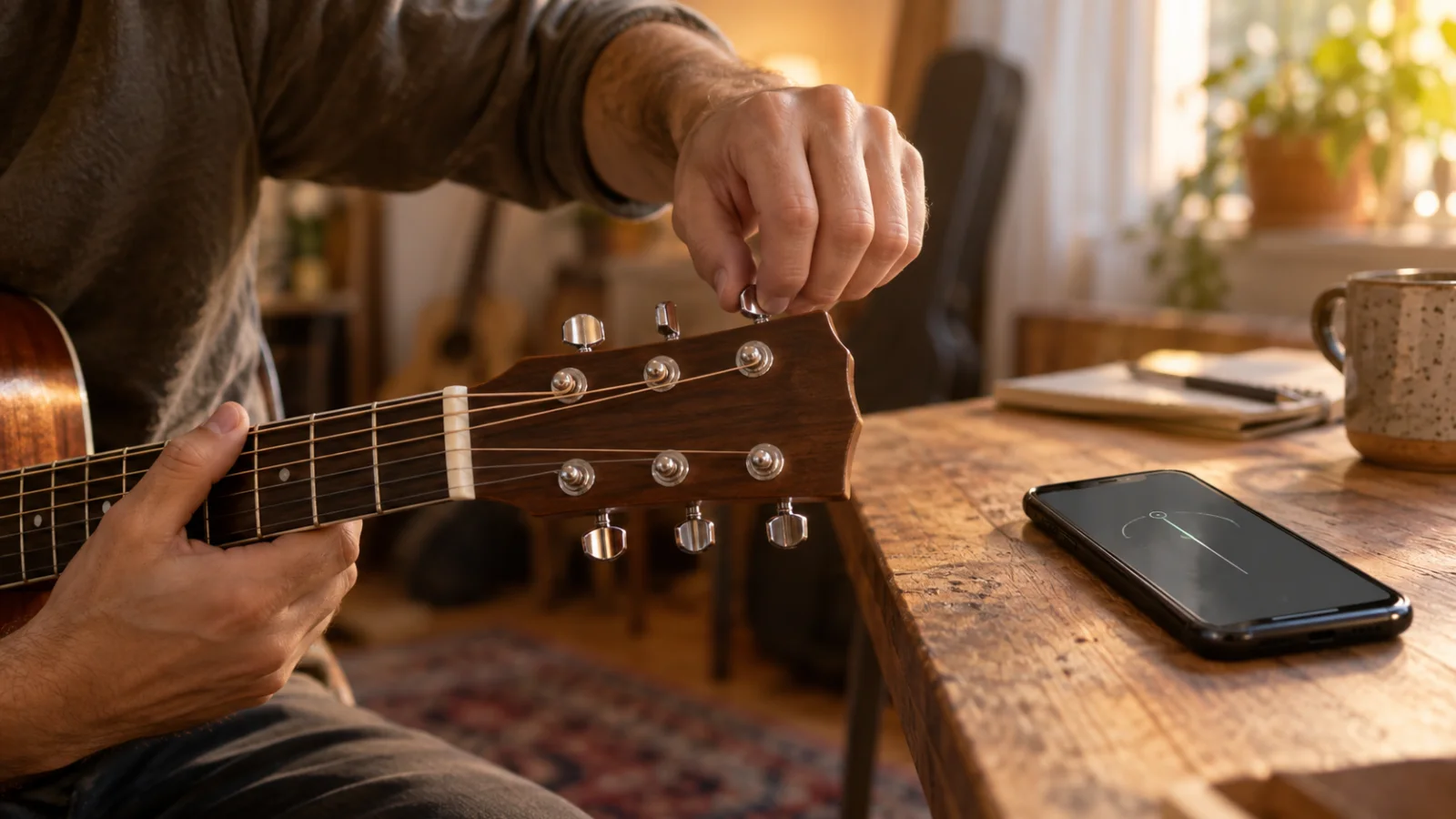
Standard guitar tuning is E A D G B E, from the 6th string (the thickest one) to the 1st (the thinnest). The quickest way to get there is a tuner: open the free online guitar tuner, allow the microphone, pluck one string and turn its peg until the needle sits in the middle. Left of center means flat, so tighten; right of center means sharp, so loosen. No tuner around? Tune the 6th string to any reference note, then press each string at the 5th fret and match the next open string to it. The one exception is the G string: press it at the 4th fret to match the open B.
Guitar string notes and frequencies in standard tuning
String 1 is the thinnest, even though it’s the one closest to the floor when you hold the guitar. Every tab and chord chart counts that way.
| String | Note | Frequency | Mnemonic |
|---|---|---|---|
| 6th (thickest) | E2 (low E) | 82.41 Hz | Every |
| 5th | A2 | 110.00 Hz | Amateur |
| 4th | D3 | 146.83 Hz | Does |
| 3rd | G3 | 196.00 Hz | Get |
| 2nd | B3 | 246.94 Hz | Better |
| 1st (thinnest) | E4 (high E) | 329.63 Hz | Eventually |
Read the last column from top to bottom: “Every Amateur Does Get Better Eventually.” The frequencies assume the usual reference, A4 = 440 Hz. The number after each letter is the octave: E2 and E4 are the same note two octaves apart, and 329.63 is exactly four times 82.41. The hertz also explain the by-ear method: the 5th fret of the low E sounds at 110 Hz, like the open A string.
How to tune a guitar with a tuner, step by step
A phone and a browser are enough; the sound is analyzed on your device and never sent.
- Pick the instrument and the tuning. Guitar and Standard, or an alternate tuning. Leave the reference at 440 Hz.
- Get close and get quiet. Hold the phone near the soundhole or the amp, and rest your fretting hand lightly on the strings you aren’t tuning.
- Start with the 6th string. Pluck it once, firmly, and let it ring; each new attack makes the reading jump.
- Check the letter before the needle. If the tuner shows D♯ or F when you want E, you’re more than half a semitone away. Turn until the letter reads E, then fine-tune.
- Read the needle. The center is 0 cents. Left is flat: tighten. Right is sharp: loosen. The tuner turns green within 5 cents of the note.
- Tune up to the note. If you go past it, drop the string clearly below and come back up. Adding tension as your last move keeps the string secure at the post, so it stays in tune longer. Locking tuners are the exception: Fender suggests going past the note and tuning down.
- Go from the 6th string to the 1st, then do a second pass. Changing one string’s tension moves the neck slightly and nudges the others. Not sure which way a peg tightens? If the needle moves left as you turn, you’re loosening.
How to read cents: what “close enough” means
A cent is a hundredth of a semitone, so neighboring frets are 100 cents apart, and a needle pinned at the end of the ±50 scale means a quarter tone or more: fix the letter first. Listeners start to notice differences at around 5 to 6 cents, so a green zone of ±5 is tight enough to record. Then strum an open G and an open E chord: if both ring clean, you’re ready.
How to tune a guitar by ear, without a tuner
Every by-ear method needs one string in tune. Use a piano, another guitar or the reference tones on the tuner page. An A 440 tuning fork matches the harmonic at the 5th fret of the A string. With no reference at all, leave the 6th string as it is: the guitar will be in tune with itself, just not with anybody else.
The 5th-fret method
Press the lower string at the 5th fret and play that note. Then play the next open string and turn its peg until the two sound the same.
| Press this string | At fret | Tune this open string to it |
|---|---|---|
| 6th (E) | 5 (A) | 5th (A) |
| 5th (A) | 5 (D) | 4th (D) |
| 4th (D) | 5 (G) | 3rd (G) |
| 3rd (G) | 4 (B) | 2nd (B) |
| 2nd (B) | 5 (E) | 1st (E) |
The 4th fret on the G string isn’t a typo. G and B are four semitones apart, while every other pair of neighboring strings is five apart. It’s the step beginners miss, and a B tuned to the 5th fret of the G ends up a semitone sharp, on C.
To hear “the same”, let both notes ring together. When they’re close but not equal, you hear a slow wobble; turning the peg the right way slows it until it disappears. Can’t tell whether a string is sharp or flat? Lower it clearly flat and bring it up. Finish by playing the open 6th and 1st strings together: two octaves apart, they should blend into one sound.
Harmonics at the 5th and 7th frets
Harmonics let you compare two strings while both hands stay free. Touch the string lightly right above the fret wire without pressing, pluck, and lift the finger: a bell-like tone rings on. The 5th-fret harmonic of each lower string matches the 7th-fret harmonic of the next one, for the pairs 6th–5th (E), 5th–4th (A) and 4th–3rd (D). For the B string, compare the 6th string’s 7th-fret harmonic with the open 2nd string. For the high E, compare the 6th string’s 5th-fret harmonic with the open 1st string.
There’s a catch. Harmonics give pure intervals, while frets are spaced for equal temperament, so each pair tuned this way lands about 2 cents flat, and by the G string you can be around 6 cents under. Skip the old trick of matching the G string’s 4th-fret harmonic with the B: it’s a pure major third and leaves the B about 14 cents flat. Use harmonics to get close fast, then confirm with the tuner.
Tune every string to its own reference tone
On the tuner page, tap a string’s button to hear its note and match the string to it. It’s the fallback when the browser blocks the microphone, and good ear training: after a few weeks you’ll hear a flat G before you look at a screen.
Alternate tunings for songwriting: Drop D, half step down, DADGAD, open G and open D
A new tuning is a fast way out of a writing rut: familiar shapes, different notes. The tuner has all five in its Tuning menu.
| Tuning | Notes, 6th to 1st | What changes | Good for |
|---|---|---|---|
| Drop D | D A D G B E | 6th string down a whole step | Low D riffs, one-finger power chords |
| Half step down | E♭ A♭ D♭ G♭ B♭ E♭ | All six down a semitone | Same shapes, a semitone lower |
| DADGAD | D A D G A D | 6th, 2nd and 1st down a whole step | Ringing drones, ambiguous chords |
| Open G | D G D G B D | 6th, 5th and 1st down a whole step | Slide, one-finger major chords |
| Open D | D A D F♯ A D | 6th, 2nd and 1st down a whole step, 3rd down a semitone | A full open D chord, fingerpicking |
Drop D. Only the low string changes, so it’s the easiest way in. The three lowest strings form a D5 power chord, open or with one finger across all three at any fret, and songs in D or D minor get a deep bass note. Try a D–C–G–D riff over the chord progression player in D, letting the open low string ring on the D chords.
Half step down. Every shape you know sounds a semitone lower: a G shape sounds as G♭. It does what a capo can’t, because a capo only raises the key (see the capo chart). If a chorus sits a semitone too high for the singer, this keeps your shapes and lowers the song; what key should I sing in shows how far a key should move. A record that seems to sit between two frets may be tuned down: how to find the key of a song explains how to check.
DADGAD. The open strings form a Dsus4 chord with no third, so it’s neither major nor minor. That helps when you write: the same two-finger shape can sit under a hopeful melody or a sad one, while the open 1st and 2nd strings ring as a drone. British guitarist Davey Graham devised it in the late 1950s.
Open G. The six open strings sound G major. One finger across all six gives C at the 5th fret and D at the 7th, which makes it a natural slide tuning and a fast way to write three-chord songs. Keith Richards uses it on a five-string guitar, 6th string removed, on songs such as “Brown Sugar” and “Start Me Up”.
Open D. Four strings change, including the G, which drops a semitone to F♯. The open strings form a full D major chord with a deep root, and the same one-finger bar gives G at the 5th fret and A at the 7th. It suits slow fingerpicked songs.
When you switch, bring each string a little below its new note, tune up and do a second pass. Write the tuning at the top of the chord sheet; how to write a song on guitar shows how Drop D and DADGAD change the shapes you know.
Why your guitar goes out of tune, and quick fixes
- New strings. Fresh strings keep settling at the bridge and the tuning posts. After tuning, gently pull each one away from the fretboard around the 12th fret, retune and repeat two or three times, as D’Addario recommends.
- Temperature and humidity. Wood and metal move with the room, so a guitar that comes in from a cold car needs a few minutes before the careful tuning. Taylor recommends keeping acoustics at 45–55% relative humidity.
- Tuning down to the note. It leaves slack at the post, and the string creeps flat as you play. Always finish by tightening.
- Old strings. Worn strings sound dull and hold their tuning less well. If a string won’t settle, change the set.
- The capo. Clamping pulls strings sharp, more so when it’s too tight or crooked.
Tuning with a capo on
Place the capo just behind the fret, parallel to it and with no more pressure than it needs; Kyser recommends a quick retune afterwards, because the capo changes the string tension. The tuner page measures each string against its open note, so with a capo on it reads everything as sharp. For this check, use what note am I singing, which reads any note with its cents. With the capo on the 2nd fret in standard tuning, the strings should read F♯2, B2, E3, A3, C♯4 and F♯4.
How to tune a bass or a ukulele
A four-string bass uses the letters of the four lowest guitar strings, one octave lower: E1 (41.20 Hz), A1 (55.00 Hz), D2 (73.42 Hz) and G2 (98.00 Hz). The 5th-fret method works as on guitar, with no exception, since there’s no B string. In the tuner, choose Bass, then Standard or Drop D.
Standard ukulele tuning is G C E A: G4 (392.00 Hz), C4 (261.63 Hz), E4 (329.63 Hz) and A4 (440.00 Hz). Most soprano, concert and tenor ukuleles use it re-entrant: the 4th string, G, is higher than the 3rd, C, so the lowest note is the C in the middle. By ear, start from C: its 4th fret matches the open E, the E string’s 5th fret matches the open A, and the C string’s 7th fret matches the open G. The tuner’s Ukulele option covers G C E A.
Where Zoundroom fits: record the idea with its tuning written down
The riff that turns up two minutes after you drop to D is the part worth keeping, and it’s the part you can’t play again if you forget how the guitar was tuned. Zoundroom has no tuner inside the app, since the free web tuner does that job, but it keeps what comes next. Each song is a project with its recordings, lyrics, notes and files. Open the song’s note, type the tuning on the first line, for example “Drop D, capo 2”, and record the take inside the note right below it: the audio lands at the cursor, under the line that says how to play it. When you reopen the project on your phone or on the web, or share it with your bass player, “how was this tuned?” is answered before anyone presses play. Zoundroom won’t mix, add effects or correct pitch; that part belongs in your DAW.
Frequently asked questions
Can I tune a guitar with my phone?
Yes. A browser tuner such as the online guitar tuner uses the phone’s microphone, with nothing to install. Work in a quiet room, keep the phone close and pluck one string at a time. If the browser blocks the microphone, tune by ear to the reference tones.
What are the notes of the guitar strings?
From the 6th string (thickest) to the 1st (thinnest): E A D G B E, or E2, A2, D3, G3, B3 and E4 with their octaves. “Every Amateur Does Get Better Eventually” keeps the order. In Drop D, only the 6th string changes, to D.
How often should I tune my guitar?
Every time you pick it up, and again after new strings, a capo or a move to a warmer or colder room. A check takes 30 seconds; an out-of-tune take usually means recording it again.
Why does my guitar sound out of tune when the tuner says it’s in tune?
Usually it’s intonation: the open strings are right, but fretted notes drift higher up the neck. Compare each string’s 12th-fret harmonic with the same string pressed at the 12th fret; what note am I singing shows both with their cents. Fender’s setup guide says a sharp fretted note means moving the saddle back, and a flat one, forward; on most acoustics, ask a technician. First rule out a tight capo, pressing too hard and old strings.
How do I tune to Drop D?
With the tuner, choose Drop D and lower the 6th string until the needle centers on D. By ear, play the open 4th string (D) and lower the 6th until it sounds the same note an octave lower, then check that the 6th string at the 7th fret matches the open A.
Sources
- muted.io, “Note Frequency Chart”: frequencies of the guitar, bass and ukulele notes, with A4 = 440 Hz in equal temperament. Checked September 27, 2026. muted.io
- Seventh String, “Note Frequencies”: the same table, with A4 = 440 Hz as the standard reference. Checked September 27, 2026. seventhstring.com
- Mark Phillips and Jon Chappell, “How to Tune a Guitar to Itself Using the Fifth-Fret Method,” Dummies: the 5th-fret method and the 4th-fret exception on the G string. Checked September 27, 2026. dummies.com
- D’Addario, “How to Tune a Guitar”: bring each note up to pitch from below, harmonics at the 5th and 7th frets, stretching new strings, and how one string affects the others. Checked September 27, 2026. daddario.com
- Fender, “Tuning Guitar Strings by Tuning Flat to Sharp”: tune up to pitch, except with locking tuners. Checked September 27, 2026. fender.com
- Paul Guy, “Tuning the Guitar,” Guitar Moderne: pure harmonics against tempered frets (about 2 cents per fourth or fifth, 14 cents on the major third). Checked September 27, 2026. guitarmoderne.com
- Wikipedia, “Cent (music)”: 100 cents per semitone and the 5–6 cent threshold of pitch discrimination. Checked September 27, 2026. wikipedia.org
- Wikipedia, “List of guitar tunings”: notes of Drop D, E♭ (half step down), DADGAD (Davey Graham), open G and open D. Checked September 27, 2026. wikipedia.org
- Wikipedia, “Drop D tuning”: the open D5 power chord on the three lowest strings. Checked September 27, 2026. wikipedia.org
- Wikipedia, “Open G tuning”: the open G major chord and Keith Richards’s five-string use. Checked September 27, 2026. wikipedia.org
- Taylor Guitars, “Symptoms of a Dry Guitar”: 45–55% relative humidity. Checked September 27, 2026. taylorguitars.com
- Kyser Musical, “Beginner’s guide to using Kyser capos”: place the capo just behind the fret, parallel to it, and retune. Checked September 27, 2026. kysermusical.com
- Fender Support, “How do I set up my Stratocaster guitar properly?”: checking intonation at the 12th fret and moving the saddle. Checked September 27, 2026. support.fender.com
- Wikipedia, “Bass guitar tuning”: E A D G, one octave below the four lowest guitar strings. Checked September 27, 2026. wikipedia.org
- Kala Brand Music Co., “Ukulele Tuning” and “What Is the Difference Between High G and Low G Tuning?”: G C E A and re-entrant tuning. Checked September 27, 2026. kalabrand.com