Capo chart for guitar: chords, keys and how to use a capo
Published
A full capo chart: the chord each open shape sounds like on frets 1–7, the capo and shapes for all 12 keys, and a worked example in B♭ with G shapes.
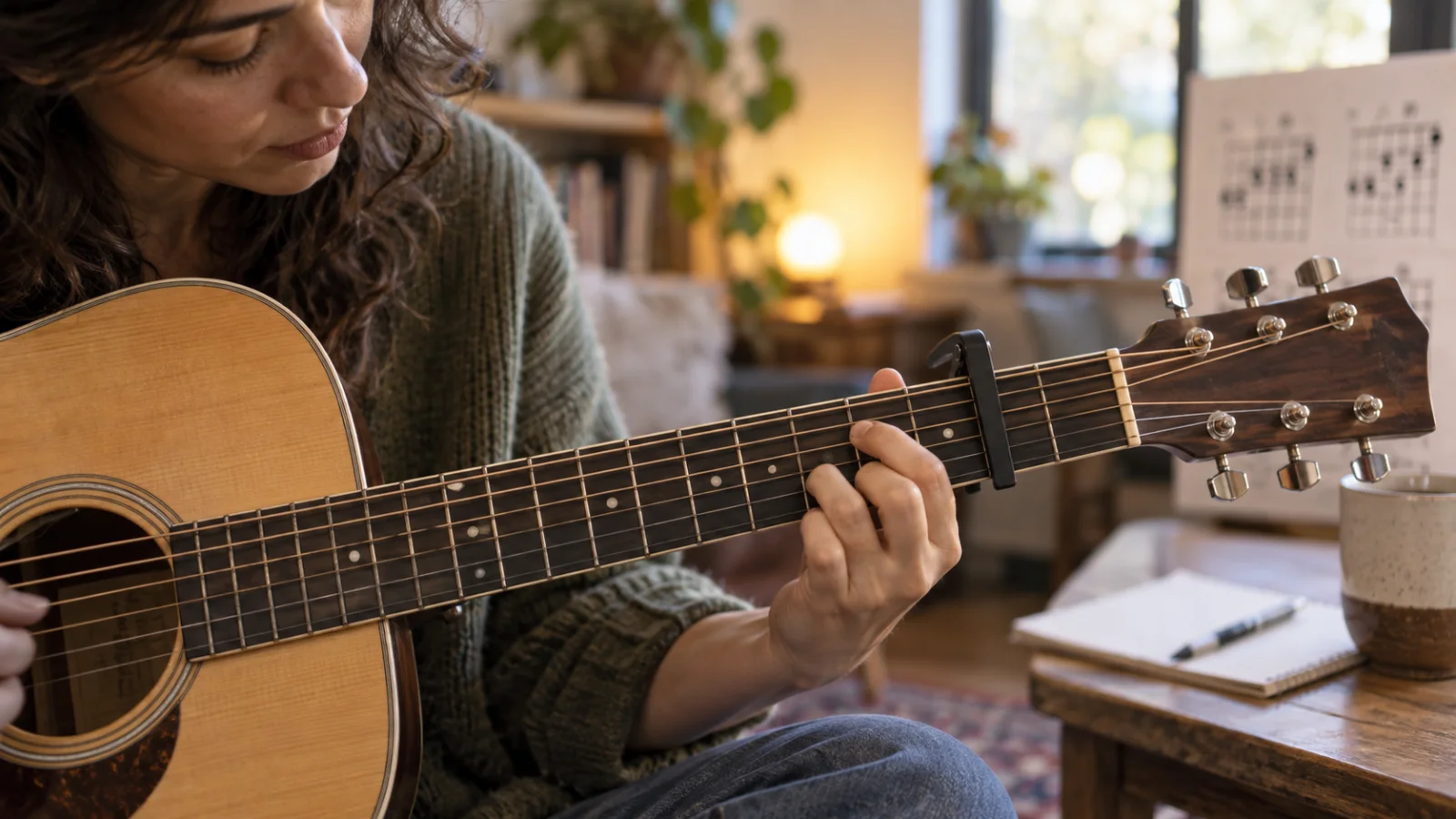
Each fret raises the pitch by one semitone, so with the capo on fret N, every chord shape you play sounds N semitones higher. A G shape with the capo on the 2nd fret sounds as A; on the 3rd fret it sounds as B♭. To read the capo chart below, find the shape you’re fingering in the left column and the capo fret along the top: the cell is the chord the listener hears. To go the other way, use the reverse table: pick the key your singer needs and it gives you the fret and the family of shapes.
- Row: the shape your fingers make (G, C, D, Em…).
- Column: the fret where the capo sits.
- Cell: the sounding chord, which is what the singer, the bass player and the piano hear.
How a capo changes the key: count semitones
A capo is a movable nut. Clamp it on the 3rd fret and every open string sounds three semitones higher, so every shape you know moves up with it. That gives you one formula in each direction:
- Sounding chord = shape + capo fret (in semitones). Em shape, capo 2: Em, F, F♯ → F♯m.
- Shape to play = sounding chord − capo fret. You need Cm with the capo on 3: C, B, B♭, A → Am shape.
The twelve semitones in order are C, C♯/D♭, D, D♯/E♭, E, F, F♯/G♭, G, G♯/A♭, A, A♯/B♭, B, then C again. There’s no sharp between E and F or between B and C, so those steps are a single fret. The quality never changes: a major shape gives a major chord, a minor shape a minor one, a 7th shape a 7th.
The chart spells each chord the way its key signature does: B♭ rather than A♯, E♭ rather than D♯, D♭ rather than C♯. F♯ and G♭ are the same sound and both keys use six accidentals; this chart writes F♯. If a song sheet says A♯, read B♭.
The capo chart: open chord shapes on frets 1 to 7
Split in two so it fits on a phone screen. The shapes are the eight open chords most beginners learn first; for their fingerings, see how to write a song on guitar, which also has a short capo table for G, C and D shapes.
| Shape you play | Capo 1 | Capo 2 | Capo 3 | Capo 4 |
|---|---|---|---|---|
| C | D♭ | D | E♭ | E |
| D | E♭ | E | F | F♯ |
| E | F | F♯ | G | A♭ |
| G | A♭ | A | B♭ | B |
| A | B♭ | B | C | D♭ |
| Am | B♭m | Bm | Cm | C♯m |
| Em | Fm | F♯m | Gm | G♯m |
| Dm | E♭m | Em | Fm | F♯m |
| Shape you play | Capo 5 | Capo 6 | Capo 7 |
|---|---|---|---|
| C | F | F♯ | G |
| D | G | A♭ | A |
| E | A | B♭ | B |
| G | C | D♭ | D |
| A | D | E♭ | E |
| Am | Dm | E♭m | Em |
| Em | Am | B♭m | Bm |
| Dm | Gm | G♯m | Am |
A whole song moves together: G–Em–C–D with the capo on 2 sounds as A–F♯m–D–E, and on 5 as C–Am–F–G. Chords outside the chart follow the same rule: a B7 shape on the 2nd fret sounds as C♯7.
Why stop at 7? A capo works up to the 12th fret, where the shapes sound an octave above their own names, but past the 7th the frets get narrow and the guitar starts to sound thin. A lower family of shapes gives the same key with more body.
Reverse lookup: which capo and shapes for each key
Start from the key the song needs and read across. Options 1 and 2 are the two easiest ways to play it: shape families with the fewest barre chords (G first, then C and D, then A, then E) at the lowest fret, with a small bonus for no capo at all. The last column lists every other position up to the 7th fret.
| Key you need | Option 1 | Option 2 | Also possible |
|---|---|---|---|
| C | No capo · C shapes | Capo 5 · G shapes | Capo 3 · A shapes |
| D♭ | Capo 1 · C shapes | Capo 6 · G shapes | Capo 4 · A shapes |
| D | No capo · D shapes | Capo 2 · C shapes | Capo 5 · A shapes, Capo 7 · G shapes |
| E♭ | Capo 1 · D shapes | Capo 3 · C shapes | Capo 6 · A shapes |
| E | No capo · E shapes | Capo 2 · D shapes | Capo 4 · C shapes, Capo 7 · A shapes |
| F | Capo 3 · D shapes | Capo 1 · E shapes | Capo 5 · C shapes |
| F♯ / G♭ | Capo 4 · D shapes | Capo 2 · E shapes | Capo 6 · C shapes |
| G | No capo · G shapes | Capo 5 · D shapes | Capo 3 · E shapes, Capo 7 · C shapes |
| A♭ | Capo 1 · G shapes | Capo 6 · D shapes | Capo 4 · E shapes |
| A | No capo · A shapes | Capo 2 · G shapes | Capo 5 · E shapes, Capo 7 · D shapes |
| B♭ | Capo 3 · G shapes | Capo 1 · A shapes | Capo 6 · E shapes |
| B | Capo 4 · G shapes | Capo 2 · A shapes | Capo 7 · E shapes |
Enharmonic names are the same key: C♯ is D♭, D♯ is E♭, G♯ is A♭ and A♯ is B♭.
Why G shapes rank first: the four main chords of G (G, C, D, Em) are all open. In C you meet F, in D and A a barred Bm or F♯m, and in E a B and a C♯m. That’s why so many songwriters capo G shapes into A, B♭ or B.
Minor keys work the same way with the three open minor shapes. Em shapes keep every main chord open (Em, Am, C, D, G and B7). Am shapes are nearly as easy (Am, Dm, E, G and C), with F as the only barre, or an easy Fmaj7. The Dm family brings Gm, B♭ and F, all barre chords on guitar.
| Minor key you need | Capo and shapes (up to fret 7) |
|---|---|
| Cm | Capo 3 · Am shapes |
| C♯m | Capo 4 · Am shapes |
| Dm | No capo · Dm shapes / Capo 5 · Am shapes |
| E♭m | Capo 1 · Dm shapes / Capo 6 · Am shapes |
| Em | No capo · Em shapes / Capo 2 · Dm shapes / Capo 7 · Am shapes |
| Fm | Capo 1 · Em shapes / Capo 3 · Dm shapes |
| F♯m | Capo 2 · Em shapes / Capo 4 · Dm shapes |
| Gm | Capo 3 · Em shapes / Capo 5 · Dm shapes |
| G♯m | Capo 4 · Em shapes / Capo 6 · Dm shapes |
| Am | No capo · Am shapes / Capo 5 · Em shapes / Capo 7 · Dm shapes |
| B♭m | Capo 1 · Am shapes / Capo 6 · Em shapes |
| Bm | Capo 2 · Am shapes / Capo 7 · Em shapes |
You don’t have to count by hand. Enter your range and the melody’s lowest and highest notes in what key should I sing in, and it lists every key that fits your voice and, for each one, the capo positions up to the 7th fret with open G, C, D, A or E shapes (Am, Em or Dm for minor keys).
Hear what three semitones do to a song
These two clips are the same melody and chords, one in C and one three semitones lower, in A. On guitar, that’s exactly the difference between G shapes (G–G–D–Bm–Em–C–D–G) with the capo on the 5th fret and the same shapes on the 2nd.
What to listen for: after the count-in (0:00–0:02), one chord per bar, about 2.5 seconds each, in four two-bar phrases starting near 0:02, 0:07, 0:12 and 0:17. The highest note is an A: a quick one near 0:04 and a long one over the F chord around 0:15. Sing along and notice where that note sits in your voice.
What to listen for: the same count-in (0:00–0:02) and the same melody, now in A major. The top note near 0:15 drops from A to F♯. If the first clip strained your voice and this one doesn’t, the capo belongs three frets lower. Nothing else changed: same melody, same rhythm, same chord functions.
When a capo helps, and when to transpose instead
Use a capo when:
- The singer needs a key full of barre chords. Without a capo, B♭, E♭ or A♭ mean barres almost everywhere; with a capo and G, D or C shapes, every chord is an open shape.
- You want a brighter, ringing sound. Higher up, the strings are shorter and the open strings still ring, so the guitar sounds lighter and more shimmering than the same key played with barres.
- Two guitars should sound different. Guitar 1 plays G shapes with no capo; guitar 2 plays D shapes on the 5th fret or C shapes on the 7th. Both sound in G, but in different registers and voicings, so the parts don’t smear together.
- The song lives on open-string riffs. A capo keeps the drones and hammer-ons of the open position in the new key.
Transpose without a capo when:
- The key has to go down. A capo can only raise the pitch. If G is too high, you need a lower family (D shapes on 3 sound in F) or a transposed sheet.
- The capo would sit above the 7th fret. Change the shape family instead.
- The sheet is for piano, bass or anyone who doesn’t use a capo. They need the sounding chords, so give them the transposed sheet.
- You already play barre chords comfortably, and the new key is F or B♭ played in barres with a full, low sound.
Put the capo just behind the fret, not on top of it, keep it parallel to the fret, and check your tuning after clamping it: the pressure can pull the strings slightly sharp.
Worked example: a song in B♭ played with G shapes, capo 3
A singer has worked out that her new song sits best in B♭: in G the chorus was too low, in C the top note strained. Here’s the sheet as she wrote it at the keyboard, in the sounding key:
Porch Light
Key: Bb

[Verse]
Bb                     Gm
I left the porch light on all winter
Eb               F
just in case you drove this way

[Chorus]
Eb      F         Bb      Gm
Come on home, the door is open
Cm                  F      Bb
the key is where it always stayed
On guitar, this is B♭, Gm, E♭, F and Cm: five chords, five barres. Read the reverse table: B♭, option 1, capo 3 with G shapes. Subtract three semitones from every chord (B♭ → G, Gm → Em, E♭ → C, F → D, Cm → Am) and the guitar sheet becomes:
Porch Light
Key: Bb · Capo 3 (shapes G)

[Verse]
G                      Em
I left the porch light on all winter
C                D
just in case you drove this way

[Chorus]
C       D         G       Em
Come on home, the door is open
Am                  D      G
the key is where it always stayed
Every chord is now an open shape, and the song still sounds in B♭ for the singer and the band. That header line, “Key: Bb · Capo 3 (shapes G)”, is what the chord sheet maker prints. Paste the verse and chorus of the first version (the maker writes its own title and key line) and it suggests the capo itself (“Suggested capo: 3 (5 of 5 chords as open shapes)”). Press “Use it” and it rewrites the chords as shapes. It also reads Brazilian cifra (C7M, A7/4) and German sheets with H and B, and you can switch the notation to Do-Re-Mi. The lyric and chord sheet guide explains how to lay out the rest of the sheet.
Before you settle, play the verse loop in B♭ in the chord progression player and sing the chorus over it. If B♭ still feels high, try A (G shapes, capo 2); if it feels low, try B (capo 4). For more loops to try the same way, see chord progressions for songwriting.
Where Zoundroom fits: the key, the capo and the take in one note
The capo position is the first thing you forget. Six months later, you play along to a voice memo of “Porch Light” with open G shapes and no capo, and everything sounds three semitones off. In Zoundroom, each song is a project: paste the chord sheet into the song’s note with “Key: B♭ · Capo 3 (G shapes)” as its first line, then record a take inside the note, right under the chorus. The audio lands at the cursor, so the take and the capo position stay together. When you invite the band to the project, they open the note and read the key and the fret before they press play.
Frequently asked questions
What capo position gives the key of G?
With G shapes, no capo. Otherwise: D shapes with the capo on the 5th fret, E shapes on the 3rd, or C shapes on the 7th. If you meant the opposite, G shapes sound as A on the 2nd fret, B♭ on the 3rd, B on the 4th, C on the 5th and D on the 7th.
Does a capo change the key of a song?
Yes. The song sounds one semitone higher per fret. What doesn’t change is the fingering: your hands still play the shapes of the original key. That’s why a sheet needs both: the sounding key (“Key: B♭”) and the capo with the shapes (“Capo 3, G shapes”). The ChordPro chord sheet format works the same way: its capo directive leaves the written chords alone, and the song sounds higher.
Can I use a capo on any guitar?
On any fretted guitar, yes, but the capo has to match the neck. Steel-string acoustics and electrics have a curved fretboard and use standard guitar capos. Classical and flamenco guitars have a wider, flat fretboard, so they need a flat capo made for nylon strings. A 12-string needs a capo strong enough to hold all twelve strings clean. Check your tuning after clamping any of them.
How do minor chords work with a capo?
Exactly like major ones: the shape moves up and keeps its quality. An Am shape on the 3rd fret sounds as Cm, an Em shape on the 2nd as F♯m. For a minor song, use the minor table above: Cm, for example, is Am shapes with the capo on 3.
Sources
- ChordPro, “Directives: capo”: the capo directive and how the written key relates to the sounding key. Checked September 26, 2026. chordpro.org
- Shubb Capos, “For classical & nylon guitars”: flat, 2.25-inch capos for classical, flamenco and other wide, flat fretboards. Checked September 26, 2026. shubb.com
- Kyser Musical, “Beginner’s guide to using Kyser capos”: place the capo just behind the fret, parallel to it, and retune. Checked September 26, 2026. kysermusical.com
- Kyser Musical, “Tips for using Kyser capos on your 12-string guitar”: even pressure on all twelve strings and regular tuning checks. Checked September 26, 2026. kysermusical.com