
How to write a punk song: three chords, a shout and a point
Published
Write a punk song: fast tempo, power chords and three-chord loops, a shout-along chorus, lyrics with a point of view, pop punk tips and a phone demo.
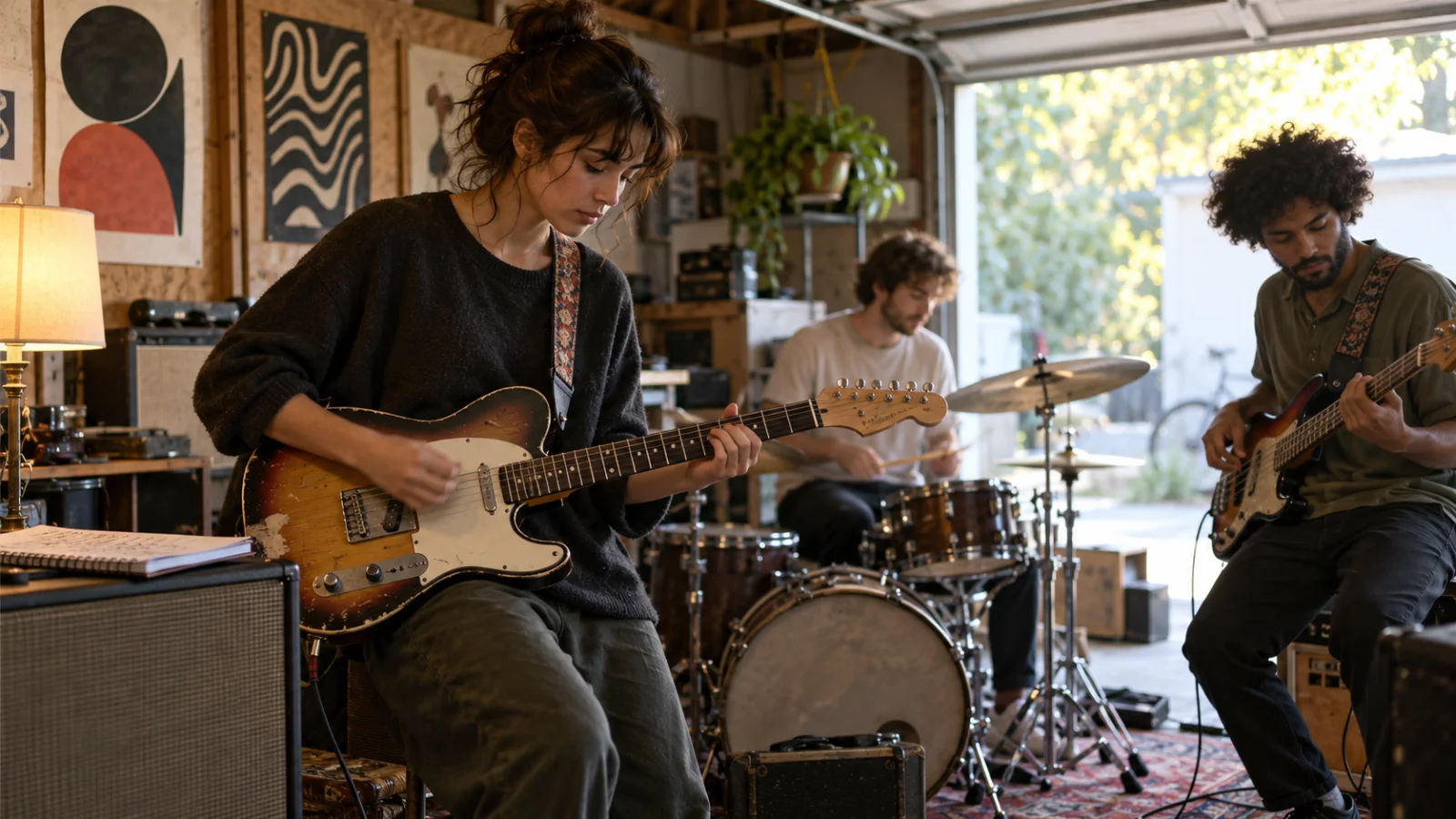
To write a punk song, start with something you want to say (a complaint, a joke, a stand) and squeeze it into a title you could shout: two to four words. Put it over three power chords, such as D5, G5 and A5, played in steady downstrokes at a fast tempo; try 160 to 180 BPM, where many tracks on the Ramones’ 1976 debut sit. Make the chorus the title, chanted by everyone in the room. Keep the verses short and concrete, skip anything that doesn’t add energy, and finish in about two minutes. Then record it on a phone the same day, rough edges included.
Below: what makes a song sound punk, a form that fits in under two minutes, five progressions to loop at punk speed in the free chord player, how to write a chorus a crowd can shout, an original worked example, the pop punk variant and a DIY phone demo.
What makes a song sound punk
Punk is rock stripped down on purpose. Reference works list the same habits again and again:
| Trait | What punk usually does | Try this |
|---|---|---|
| Tempo | Fast; many songs on the Ramones’ first album run above 160 BPM | Start at 160 and push until it feels urgent, not sloppy |
| Length | Shorter than other rock; that album fits 14 songs into 29 minutes | Aim for 1:45 to 2:30 |
| Instruments | One or two guitars, bass, drums and voice | No pads or strings to hide behind |
| Guitar | Distorted power chords or barre chords, a “buzzsaw” wall | Downstrokes on every eighth note |
| Vocals | Often shouted or snarled, rarely polished | Sing like you mean it, not like an audition |
| Lyrics | Blunt and confrontational, often social or political | One target, one stance |
| Production | DIY: cheap, fast, often self-released | Record at rehearsal and keep the take with the most energy |
The spirit fits in one famous image: in December 1976 a fanzine printed three chord diagrams with a caption telling readers that was enough to form a band. You don’t need permission or technique. You need an idea, three chords and a deadline.
Start from what you want to say
A punk song is too short to wander, so decide what it’s about before you touch the guitar. Write one sentence: who you’re talking to and what you want to tell them. Three angles work:
- Social: something you see every week that’s wrong. Write it from street level (the broken lift, the rent letter, the youth club that closed), not as a headline.
- Personal: boredom, a dead-end job, a breakup, a town that’s too small. Say the uncomfortable part out loud.
- Humor: the absurd side of the same things. Punk has always had room for jokes, and a funny song often hits harder than a sermon.
Turn the sentence into a title of two to four words that sounds good shouted: “Out of Order”, “Not My Problem”, “Last Bus Gone”. An open vowel on the last word (“o”, “ah”, “ow”) carries better over loud guitars. If nothing comes, the song title generator gives you raw material to argue with.
Tempo and form: fast, short, no filler
Set the metronome to 160 BPM and play eighth-note downstrokes on one chord for a minute. Then try 170 and 180. Somewhere in that range the song starts to feel urgent. If your picking hand tightens or the band drifts apart, go back five clicks: fast and tight beats faster and blurry every time.
The drums can stay simple. The basic punk beat is a rock beat played fast: kick on 1 and 3, snare on 2 and 4, eighth notes on the hi-hat or the ride. For more push, the drummer can alternate kick and snare on every eighth note. With no drummer, the metronome is the drummer.
A form that fits in under two minutes at 180 BPM, where a bar of 4/4 lasts 1.33 seconds:
| Section | Bars | What happens |
|---|---|---|
| Intro | 4 | Guitar alone on the verse chords; the band crashes in on bar 5 |
| Verse 1 | 16 | Palm-muted power chords, voice close to speech |
| Chorus | 8 | Chords ring open, everyone shouts the title |
| Verse 2 | 16 | New details over the same chords |
| Chorus | 8 | As before |
| Break | 8 | Drums and a chant, or bass alone |
| Chorus ×2 | 16 | The loudest point; the last hit stops dead |
That’s 76 bars, about 1:41. If the song has said everything by then, it’s finished. No solo is required; if someone wants one, eight bars over the verse chords is enough. The guide to song length has timings for longer forms.
Power chords and downstrokes
A power chord is the root and the fifth with no third, written with a 5: D5, G5, A5. It stays clear under distortion and fits almost any melody. The rock songwriting guide covers the shapes in depth; for punk, one movable shape and the open low strings will do:
| Chord | Frets, 6th to 1st string (x = don’t play) | Root |
|---|---|---|
| E5 | 0 2 2 x x x | Open 6th string |
| A5 | x 0 2 2 x x | Open 5th string |
| G5 | 3 5 5 x x x | 6th string, 3rd fret |
| A5 | 5 7 7 x x x | Same shape, two frets up |
| D5 | x 5 7 7 x x | 5th string, 5th fret |
With the last three shapes you can play the whole worked example below without lifting your hand far: G5 to A5 is a two-fret slide, and D5 sits right under it.
The right hand matters as much as the left. Johnny Ramone played almost only downstrokes, through entire songs, often on full barre chords, and that relentless motion is a big part of the punk sound. To build it, play eighth-note downstrokes at 140 BPM for two minutes, then 150, then 160, with a loose wrist and small strokes. Palm-mute the verse (rest the edge of your picking hand on the strings by the bridge) and lift the hand for the chorus: instant contrast with the same chords.
Tune before every take, too. A fast song out of tune sounds like an accident; the online tuner also handles bass and drop D.
Five progressions to loop at punk speed
The chord player sounds full chords, not power chords, and goes up to 180 BPM: enough to hear the movement and shout over it. On the guitar, play the same roots as power chords.
| Progression | Example | Use it for | Loop it |
|---|---|---|---|
| I–IV | D–G | A two-chord verse that drives | Play at 180 BPM |
| I–IV–V–IV | D–G–A–G | The classic three-chord loop | Play at 176 BPM |
| IV–V–I | G–A–D | A chorus that lands on the title | Play at 176 BPM |
| I–V–vi–IV | G–D–Em–C | Pop punk, bright and singable | Play at 168 BPM |
| i–♭VI–♭VII | Em–C–D | Darker and angrier | Play at 180 BPM |
What to listen for: after a one-bar count-in (0:00–0:01), D comes in at 0:01, G at 0:03, A at 0:04 and G again at 0:05, then the loop starts over on D at 0:07 (G at 0:08, A at 0:10, G at 0:11) and stops around 0:13. The four chords go by in under six seconds, which is why punk songs are over so fast. Unlike the chord player, this example plays palm-muted power chords in eighth-note downstrokes, and the drums play the pushier punk beat from the tempo section: kick on every beat, snare on every off-beat. It’s synthesized, so the power chords sound clean and plucked rather than distorted; listen for the speed and for a right hand that never stops. It’s also the verse of the worked example below.
Three chords aren’t a limit; they’re a decision. The fewer the changes, the more the rhythm and the words carry the song. For the theory behind each loop, see chord progressions for songwriting.
How to write a chorus a crowd can shout
A punk chorus is closer to a chant than to a melody. It works when people who heard the song once can join in on the second chorus.
- Put the title in the first line and repeat it. Three times in eight bars isn’t too many.
- Keep the melody within about five notes, in the middle of most voices. Shouting high notes for two minutes is how singers lose their voice.
- Use call and response: the singer shouts a line and the band, or the crowd, answers with the title or one word. That’s gang vocals, several people shouting the same thing slightly out of sync. Oi! bands built their sing-along choruses on the sound of football terrace chants.
- Leave space for a “hey!” or an “oh-oh”: sounds anyone can sing without knowing the words.
- Change the guitars instead of the key: palm-muted verse, open ringing chorus. Texture does the lift that a higher melody does in pop.
To record gang vocals, put everyone around one phone, two steps back, and shout the chorus together three times. Shout from the breath, not the throat; do a short vocal warm-up before rehearsal and stop for the day if your throat hurts. The chorus guide has eight more techniques.
Lyrics with attitude: say one thing and mean it
- Pick a target and talk to it. “You” (the landlord, the ex, the boss, yourself) gives every line a direction.
- Use objects, not slogans. “Rent letter on the doormat” beats “the system is unfair”: the listener reaches the anger on their own.
- Keep the lines short. Six to nine syllables leave room to breathe at 176 BPM.
- Rhyme loosely. Perfect rhymes can sound cute; near rhymes sound spoken. The rhyming dictionary lists options by sound.
- Earn the anger. If the verse shows a concrete situation, the shouted chorus feels deserved; if it’s all slogans, it sounds like a T-shirt.
- Let humor in. Self-mockery and absurd details are punk too, and they keep a political song from preaching.
Worked example: “Out of Order”
Written for this article, in D at 176 BPM. The verse uses I–IV–V–IV (D5–G5–A5–G5) with palm-muted eighth notes, one chord per bar. The chorus uses IV–V–I (G5–A5–D5) with open, ringing chords.
Verse 1:
D5                      G5
Swiped my card, the gate stays shut
A5                        G5
Lift's been broken since the fall
D5                       G5
Phoned the council, held the line
A5                          G5
Forty minutes, no one at all
Chorus, with the gang vocal in brackets:
G5     A5         D5
Out of order! (Out of order!)
G5            A5              D5
Every button in this town is out of order
G5     A5         D5
Out of order! (Out of order!)
G5          A5          D5
Kick it till it works again
Verse 2:
D5                     G5
Mom says get a proper job
A5                      G5
Doctor says I need some rest
D5                        G5
Every gadget that I own is dead
A5                         G5
And honestly, I'm not the best
Break: eight bars of drums and handclaps, with the whole band shouting “Fix it!” on the first beat of every bar. Then the chorus twice, and the last “again” ends on a single D5 hit and silence.
Loop the verse at 176 BPM and the chorus, and shout the lines over them.
Why it works:
- The first verse is a list of small, real failures (the gate, the lift, the phone line). Nobody has to be told the town is neglected.
- The title has two words and comes back four times per chorus with the answer, so a crowd can join on the second chorus.
- The second verse turns the joke on the singer: social and personal at once, and funny enough not to preach.
- The chords never get clever. Starting the chorus on G instead of D gives it a lift without adding a fourth chord.
Pop punk: same speed, more melody
Pop punk joins punk’s speed and textures to classic pop songcraft: melodies you can sing, hooks and the chord changes of power pop. The lyrics often deal with adolescence: heartbreak, boredom, suburbia and rebellion. Green Day’s Dookie (1994) took it to the mainstream, Blink-182’s Enema of the State (1999) started a new wave, and in 2021 Olivia Rodrigo’s “Good 4 U” reached number one on the Billboard Hot 100.
| Punk | Pop punk | |
|---|---|---|
| Chords | Three power chords, I–IV–V | I–V–vi–IV or vi–IV–I–V, still as power chords |
| Melody | Shouted, narrow range | Sung, wider range, a hook in the chorus |
| Lyrics | Social, angry, blunt | Personal, self-mocking, very specific |
| Form | Verse–chorus, often no bridge | Often a pre-chorus and a quiet break before the last chorus |
| Sound | Rough, one take | Tighter, with doubled vocals and guitars |
What to listen for: after the count-in, Am starts at 0:02, F comes in around 0:04, C around 0:07 and G around 0:09, and the loop starts again around 0:12. Starting on the minor chord gives the bittersweet color behind many pop punk choruses. At 100 BPM it’s almost a ballad; give it the speed and the muted downstrokes of the D–G–A–G example above and you’re in pop punk territory.
A pop punk chorus written for this article, on I–V–vi–IV in C (C–G–Am–F, one chord per line):
C
I'm not mad, I just changed the locks
G
Left your hoodie in a cardboard box
Am
Told our friends that I'm doing fine
F
Said it sixteen times tonight
The joke is in the details: the hoodie, the box, the number sixteen. The singer claims to be fine and the facts say otherwise, which is the whole song. For pre-choruses and hooks, the pop songwriting guide goes further.
Record it the DIY way, on a phone
Punk was built on cheap records. In January 1977 Buzzcocks released their first EP, Spiral Scratch, on their own label, paid for with about £750 borrowed from friends and family; the recording session took three hours. Your first demo can be cheaper still:
- Put the phone where you’d stand to listen, away from the drums, with the microphone facing the band.
- Record a test of the loudest chorus. If it distorts, move the phone back or turn it away from the drums.
- Record three full takes in a row and keep the one with the most energy, not the cleanest.
- At home, sing a guide vocal over the best take so the words are clear. For a lyric or a melody that just came to you, the free online voice recorder records in the browser, with no account, and the audio never leaves your device.
- Name the file with song, tempo, key and date: out-of-order_176bpm_D_2026-10-02.
The guide to recording a song on your phone covers levels, placement and apps in more detail.
Common mistakes and how to fix them
- Fast but blurry. If the downstrokes smear, drop 10 BPM. Tight at 160 beats sloppy at 190.
- A chorus nobody can shout. Too many words, or the title hidden mid-line. Cut until the title is the chorus.
- Slogans instead of scenes. Replace each abstract word with an object, a place or an action.
- Borrowing the notes instead of the energy. Use a band as a reference for tempo and attitude, never copy its riff or melody.
- A song that keeps going. If the second verse says nothing new, cut it and go to the break.
Where Zoundroom fits: the chords, the chant and the garage take
Zoundroom doesn’t generate audio and has no virtual instruments or beats, so the chord player and the metronome on this site keep time while you write, and it isn’t where you mix and master the final track; a DAW such as GarageBand or BandLab is. It has no tuner either: for guitar, bass or drop D, use the online one. Where it helps is keeping a fast-moving song in one place. Each song is a project with its recordings, lyrics, notes and files: open a note called “Out of Order”, type “D, 176 BPM, verse D5–G5–A5–G5, chorus G5–A5–D5” at the top, and record the riff and the shouted chorus inside that note, so the audio lands at the cursor right under the chords. It’s the same account on iOS, Android and the web, and the web app records in the browser too. After rehearsal, import the three phone takes into the project and share it with the band: Free shares with up to 2 artists, Pro with up to 4 and adds timestamped feedback, so the drummer, if they also have Pro, can point to the second where the break drags, and the Band plan covers up to 7 members. Auralis, the app’s assistant, can suggest alternative lines or a second verse as text, never audio. Your next step: create the project with your title tonight and record the chorus chant in its note before the next rehearsal.
Frequently asked questions
How do I write a punk song on guitar?
Pick three power chords that sit close together, such as D5, G5 and A5, and play them in eighth-note downstrokes at 160 to 180 BPM. Palm-mute the verse, let the chorus ring, and shout a melody over the loop before you write the words.
How do I write a pop punk song?
Keep the punk tempo and power chords, but use a progression like I–V–vi–IV, sing a real melody with a hook in the chorus, and write personal, specific lyrics with some humor. Many pop punk songs add a pre-chorus and a quiet break before the last chorus.
How do I write punk song lyrics?
Choose one target and one stance, and talk directly to someone: a boss, a landlord, an ex, yourself. Show concrete situations instead of slogans, keep lines short, rhyme loosely and let the title be the chant.
How long should a punk song be?
There’s no rule, but punk is shorter than most rock. The form in this article lasts about 1:41 at 180 BPM, and on the Ramones’ first album the songs run from about 1:30 to 2:40.
Do I need to play well to write punk?
No. Three chords, steady downstrokes and something to say are enough. Play tight rather than fancy: a simple part played with total conviction is the sound of punk.
Sources
All pages checked on October 2, 2026.
- Wikipedia, “Punk rock”: shorter songs at fast tempos, instrumentation stripped down to one or two guitars, bass, drums and vocals; distorted power chords or barre chords; shouted vocals; blunt, confrontational, often political lyrics; DIY recordings and independent labels; the December 1976 fanzine illustration of three chords. wikipedia.org
- Wikipedia, “Ramones (album)”: released in April 1976; 14 tracks in 29:04, from 1:32 to 2:40; many tracks above 160 BPM; recorded in seven days. wikipedia.org
- Wikipedia, “Johnny Ramone”: almost exclusively downstrokes through whole songs; full six-string barre chords and occasional power chords. wikipedia.org
- Wikipedia, “Pop-punk”: punk tempos and textures combined with pop songcraft and power pop melodies and chord changes; adolescent themes; Green Day’s Dookie (1994); Blink-182’s Enema of the State (1999); Olivia Rodrigo’s “Good 4 U” (2021) at number one. wikipedia.org
- Wikipedia, “Oi!”: sing-along choruses and gang vocals reminiscent of football terrace chants. wikipedia.org
- Wikipedia, “Spiral Scratch”: Buzzcocks EP released on 28 January 1977 on their own label, New Hormones, financed with about £750 borrowed from friends and family; recorded in a three-hour session. wikipedia.org