
How to write a pop song: structure, chords and a worked example
Published
Write a pop song step by step: title-first hook, verse, pre-chorus and chorus, I–V–vi–IV on piano or guitar, prosody, a topline over a loop and a first demo.
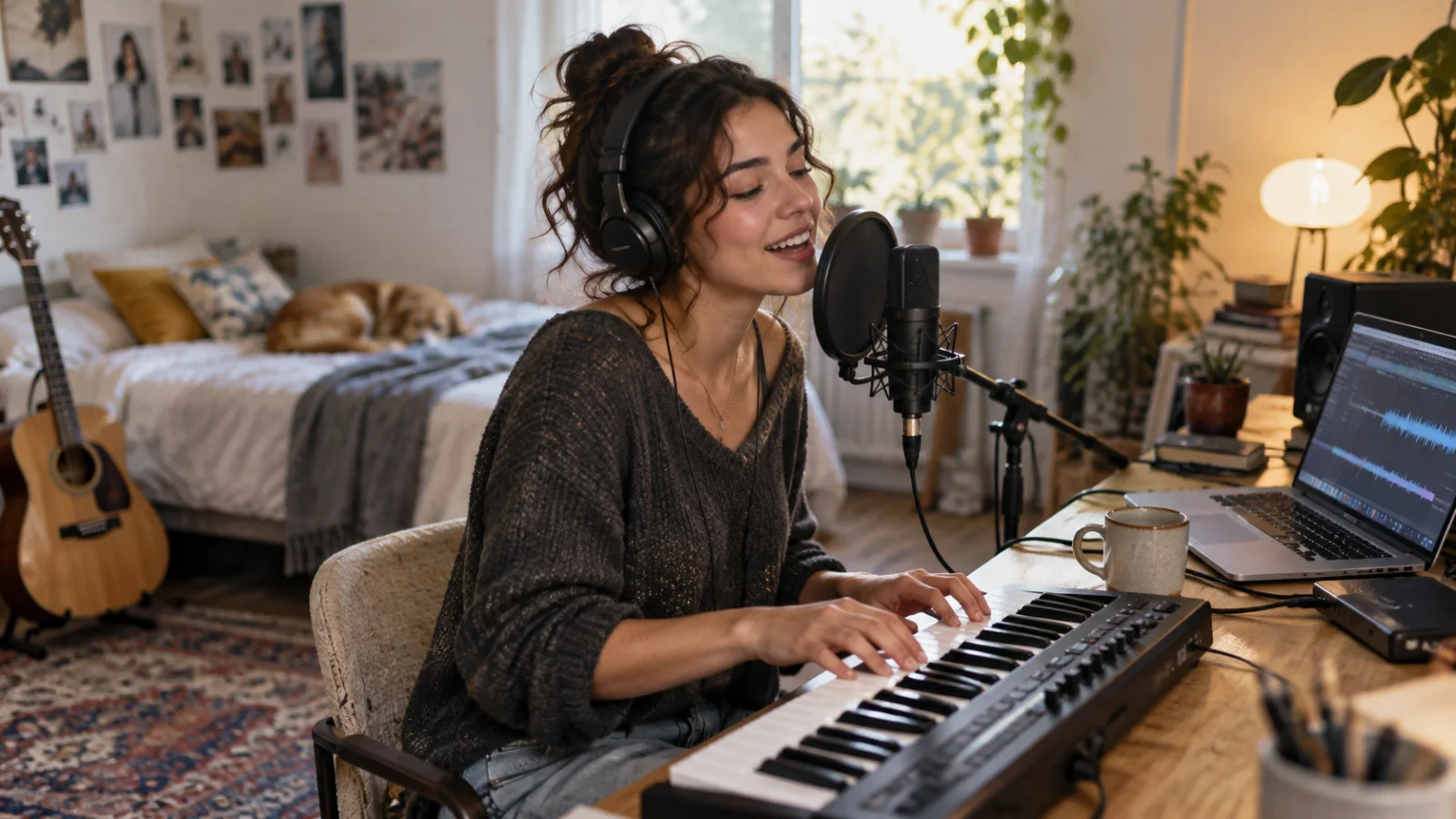
To write a pop song, start with a short title that can be the hook, loop four chords (I–V–vi–IV or vi–IV–I–V) somewhere between 90 and 125 BPM, and sing melodies over the loop until the chorus sits higher, simpler and more repetitive than the verse. Build the song as verse, pre-chorus and chorus, and reach that chorus early. Write the verse in plain, concrete language, put the title at the start or end of the chorus, and make every stressed syllable land on a strong beat. Then record a rough demo the same day. Everything after that is rewriting.
Below: two audio examples, loops for the free chord player, an original song written for this article and the mistakes that make pop sound flat.
What makes a song “pop”: the traits at a glance
Pop is less a sound than a set of choices that make a song easy to remember after one listen: short songs, verse–chorus form, repeated choruses and hooks.
| Element | Typical pop choice | Why it works |
|---|---|---|
| Form | Verse → pre-chorus → chorus, twice, then bridge → final chorus | Contrast, then payoff, then one surprise |
| Tempo | 90–125 BPM as a starting window | Easy to move to, room for words |
| Chords | One four-chord loop, often the same all song | The melody and lyric carry the change |
| Hook | The title, sung in the chorus two to four times | People search for what they can sing back |
| Lyrics | Conversational, one situation, concrete details | Sounds like a real person talking |
| Length | About 2:30–3:30 | Enough for two choruses and a bridge |
| First chorus | Within the first 30–45 seconds | Listeners skip fast |
Treat the tempo as a starting point, not a law. In Soundfly’s analysis of the 40 songs that reached the Billboard Top 5 in 2018, the most common tempo was 77–78 BPM, although many such songs feel twice as fast because hi-hats and vocals move in double time. The loop is more constant: 22 of those 40 songs were built on a single one.
Hear the pop shape: verse, pre-chorus, chorus
Press play and follow the times. These are short, synthesized teaching examples, not finished productions.
| Time | Section | Chords | What to listen for |
|---|---|---|---|
| 0:00–0:02 | Count-in | — | Clicks at 100 BPM |
| 0:02–0:12 | Verse | Am–F–C–G (vi–IV–I–V) | Quiet keys, no drums: the song is still talking |
| 0:12–0:21 | Pre-chorus | Dm–F–G–G (ii–IV–V–V) | Arpeggios and a light beat; the G held for two bars asks a question |
| 0:21–0:31 | Chorus | C–G–Am–F (I–V–vi–IV) | Strummed guitar and a full pop beat: the answer |
The verse and the chorus use the same four chords in a different order. Starting on Am makes the verse cloudier; starting on C makes the chorus sound like an arrival. That trick alone gives many pop songs their lift.
At 100 BPM one bar of 4/4 lasts 2.4 seconds. A two-bar intro, an eight-bar verse and a four-bar pre-chorus put your first chorus at about 34 seconds, well inside the window above.
Step 1: start with a title that can be the hook
In pop the title usually is the hook: the two to five words people sing in the car. Writing it first gives the song a target: the verse sets up a situation, the pre-chorus makes you want the answer and the chorus delivers the title. A good pop title is short, singable on open vowels (“yes”, “night”, “stay”) and hints at a story without telling all of it. “Half a Yes” works: you instantly wonder who said it.
If you’re stuck, spin a few in the song title generator, browse the 110 song title ideas or pull a situation from the songwriting prompts. Say each candidate out loud in a few rhythms and keep the one that already sounds like a melody. The hook guide has a memory test for choosing.
Get to that hook early. An Ohio State study of top-10 singles from 1986 to 2015 found that instrumental intros fell from more than 20 seconds in the mid-1980s to about 5 seconds, and that the title arrived about 18 percent sooner.
Step 2: loop four chords (the two pop progressions)
You don’t need a new progression for each section. Two orders of the same four chords cover most of pop:
| Progression | In C | In G (guitar) | Feel | Try it |
|---|---|---|---|---|
| I–V–vi–IV | C–G–Am–F | G–D–Em–C | Bright, confident, arriving | Loop it at 100 BPM |
| vi–IV–I–V | Am–F–C–G | Em–C–G–D | Wistful, restless, moving | Loop it at 100 BPM |
| ii–IV–Vsus4–V | Dm–F–Gsus4–G | Am–C–Dsus4–D | A pre-chorus that builds | Loop the build |
I–V–vi–IV is the progression under “Let It Be” by The Beatles, U2’s “With or Without You” and Adele’s “Someone Like You”. Chords can’t be owned, so you’re free to use it; what makes the song yours is the melody and the lyric. The chord progressions guide has nine more loops if you want a darker or older color.
On piano: left hand on the roots (C, G, A, F), right hand moving as little as possible: C–E–G, B–D–G, C–E–A, C–F–A. Your eyes stay on the lyric, not your hands. The piano songwriting guide goes deeper. On guitar: play G–D–Em–C in open position, with a capo if the key doesn’t suit your voice.
For tempo, start at 100 BPM and move it until your head nods without effort: 90–100 feels relaxed, 100–115 upbeat, 115–125 close to dance-pop. If a tempo is already in your head, tap it into the tap tempo metronome.
Step 3: sing a topline over the loop
A topline is the vocal melody plus the words, written over a track that already exists, and much of pop is written this way (the topline guide explains producer–writer sessions). The solo version:
- Loop the chorus chords and sing on vowels or nonsense syllables for five minutes, recording everything on your phone.
- Listen back and mark the moment where the melody felt obvious. That’s your chorus.
- Put the title on the longest, highest note of that phrase.
- Loop the verse chords and sing lower, with shorter notes and more words, closer to speech.
- Make the pre-chorus climb and stop on something unresolved.
After the count-in (0:00–0:02), an eight-note phrase repeats four times over C–G–Am–F until 0:21: C–C–D–G, then B–B–C–D. It’s barely a melody, and by the third time you can sing it back. Short, repeated, rhythmically clear: that’s what a pop hook needs before any lyric goes on it. The melody guide shows how to make it less predictable.
Step 4: write lyrics that sound like talking
Pop lyrics usually tell one simple situation, very often about love, in everyday words. The craft is in the details and in the fit with the melody. If that story wants to move slowly and build to a last big chorus, go on to how to write a ballad.
- Verse: one scene with objects, places and times (“on the bus”, “coat still wet”). No summaries yet. If one of those objects comes back in the chorus, it can become the metaphor that carries the song.
- Pre-chorus: the tension in one or two lines, repeated before every chorus (see the pre-chorus guide).
- Chorus: the title, a line that reacts to it, the title again. The chorus guide has eight techniques.
- Rhymes: perfect rhymes where the chorus resolves, near rhymes where the verse should feel unsettled. The rhyming dictionary gives you a chain of options. To choose between them without a forced rhyme, see how to rhyme in songs.
Prosody means every element supports what the song says; at the smallest scale, each word’s natural stress falls on a strong beat. Say “half a yes” out loud: HALF and YES are stressed, “a” isn’t. Give “a” the long note and listeners hear something wrong without knowing why. Check that matching lines have matching lengths in the syllable counter, and see the syllables and stress guide when a line fights the melody.
Worked example: “Half a Yes”
A first draft written for this article over the chords of the first audio example, at 100 BPM.
Verse 1 (Am–F–C–G, low and talky)
You typed “maybe Friday” and then “we’ll see,”
three dots on the screen for a minute or three,
I read it on the bus with my coat still wet,
and I haven’t put my phone in my pocket yet.
Pre-chorus (Dm–F–G–G, climbing)
I know how it sounds, I know what it’s not,
but I’m keeping the little bit I’ve got.
Chorus (C–G–Am–F, high and long)
Half a yes, half a yes,
it’s more than I had last night.
Half a yes, half a yes,
I’m holding it up to the light.
What each part does:
- Verse: four details (the text, the dots, the bus, the wet coat) and no feeling named. Two rhymed couplets keep it moving.
- Pre-chorus: it admits the doubt, then “the little bit I’ve got” points straight at the title while the G hangs for two bars.
- Chorus: eight bars, two per line. The title lands on beat 1 of bars 1 and 5, both times over C, and “yes” gets the long note. “Night” and “light” rhyme on an open vowel that’s easy to hold.
- Next: verse 2 moves the story on (Friday arrives) while the chorus stays word for word; the bridge, over F–G–Am–G, is the first time the singer asks for a full yes.
Map the full form in the song structure planner (intro 2 bars, verse 8, pre 4, chorus 8, verse 8, pre 4, chorus 8, bridge 8, chorus 8, about 2:20 at 100 BPM) and compare it with the common forms in the song structure guide.
Common mistakes when writing pop (and the fix)
| Symptom | Likely cause | Fix |
|---|---|---|
| The chorus doesn’t lift | Verse and chorus in the same range | Start the chorus 3–5 notes higher, or drop the verse lower |
| The chorus arrives too late | Long intro, 16-bar verse | Two-bar intro, eight-bar verse, four-bar pre |
| People can’t remember the title | Title buried in the middle of a line | Put it first or last in the chorus and repeat it |
| Lyrics sound “written” | Abstract words: soul, forever, destiny | Swap in an object, a place, a time of day |
| A line feels awkward to sing | Stressed syllable on a weak beat | Reorder the words or move the note |
| It sounds like another song | Copying a reference’s melody | Keep its tempo and mood, write a new melody rhythm |
Record your first pop demo today
A first pop demo only has to prove three things: the chorus lifts, the title is clear and the form holds together. No studio needed.
- Play your loop in the chord player on a laptop or tablet at the final tempo.
- Record the whole song once on your phone, 15–20 cm from your mouth, with the loop playing quietly from the speakers. One full take, mistakes included.
- Record the chorus three more times with different melodic endings.
- Listen the next day, pick the best chorus and note the lyric changes.
For a cleaner version with a separate vocal track, the home demo guide covers the room, the levels and free apps.
Where Zoundroom fits: the lyric, the loop and every take of the hook
Zoundroom doesn’t make beats, play loops or produce your track. It isn’t a DAW, so there’s no mixing, effects, pitch correction or multitrack; GarageBand or another DAW is the place for the finished production. It helps with the part of a pop song that usually gets lost: ten takes of a hook and the lyric version each one belongs to. Each song is a project with its recordings, lyrics, notes and files, so create a project called “Half a Yes”, write the chorus in a note with the chords above each line and, with the loop playing from the chord player, record the topline inside that note on your phone. The audio lands at the cursor, under the lines it belongs to. Import the voice memo from the bus or a GarageBand bounce into the same project and open it later on iOS, Android or the web. Free lets you share a project with up to two artists; Pro adds timestamped feedback, so a co-writer can point at the exact second the chorus drops. Auralis, the app’s assistant, can suggest rhymes, alternative lines or a structure as text, never audio. Your next step: create the project with your title today and record three versions of the chorus in that note.
Frequently asked questions
How do you write a pop song for beginners?
Pick a short title, loop C–G–Am–F at about 100 BPM and hum until a melody sticks. Put the title on its strongest note and you have a chorus. Then write a verse that sets up the title with concrete details, add a two-line pre-chorus and record it all on your phone. Polish only once the full song exists.
What chords are used in pop songs?
Mostly the I, IV, V and vi chords of a major key: C, F, G and Am in C, or G, C, D and Em in G. The most common orders are I–V–vi–IV and vi–IV–I–V. Many pop songs keep one four-chord loop from start to finish and create contrast with melody, rhythm and arrangement.
What is the structure of a pop song?
The most common form is intro, verse, pre-chorus, chorus, verse, pre-chorus, chorus, bridge and final chorus. Some songs drop the pre-chorus or add a post-chorus (a short hook after the chorus). The chorus holds the title and returns with the same words each time.
How do you write a pop song on piano?
Play root notes in the left hand and triads in the right, with inversions that keep the right hand still: C–E–G, B–D–G, C–E–A, C–F–A for C–G–Am–F. Loop it in steady quarter or eighth notes and sing over it. Once the chorus works, try the verse with the same chords starting on Am.
How long should a pop song be?
Most pop songs last two and a half to three and a half minutes. At 100 BPM, the form in the worked example runs about 2:20 before any outro. Past four minutes, look for a long intro, a second verse that repeats the first or a chorus repeated more than it needs.
Sources
All pages checked on September 28, 2026.
- Wikipedia, “Pop music”: songs often between two and a half and three and a half minutes; verse–chorus structure, repeated choruses and hooks; lyrics often about love and relationships; danceable rhythms. wikipedia.org
- Wikipedia, “Song structure”: verse–chorus form; the pre-chorus as a build or channel, often on IV or ii; the chorus usually contains the hook; the bridge after the second chorus; intro–verse–pre-chorus–chorus–verse–pre-chorus–chorus–bridge–chorus in modern pop. wikipedia.org
- Wikipedia, “I–V–vi–IV progression”: C–G–Am–F in C; the vi–IV–I–V rotation; examples including “With or Without You” (U2) and “Someone Like You” (Adele). wikipedia.org
- The Ohio State University News, “Has music streaming killed the instrumental intro?” (April 4, 2017), on Hubert Léveillé Gauvin’s study in Musicae Scientiae: top-10 singles 1986–2015, intros from more than 20 seconds to about 5 seconds, title heard about 18 percent sooner, tempo up about 8 percent. news.osu.edu
- Hypebot, guest post by Dean Olivet of Soundfly’s Flypaper, analysis of every Billboard Top 5 song in 2018: 40 songs, most common tempo 77–78 BPM, 22 of 40 built on a single loop, the four-chord song still the norm. hypebot.com
- Berklee Online Take Note, “Prosody in Music and Songwriting” (Pat Pattison): prosody as all elements supporting the central message; perfect rhymes for resolved meaning, assonance for unresolved. online.berklee.edu