
How to write a ballad song: structure, chords and a full example
Published
Write a ballad step by step: one concrete moment, 60–80 BPM on piano or guitar, a melody that breathes, the bridge, the power ballad build and a careful key change.
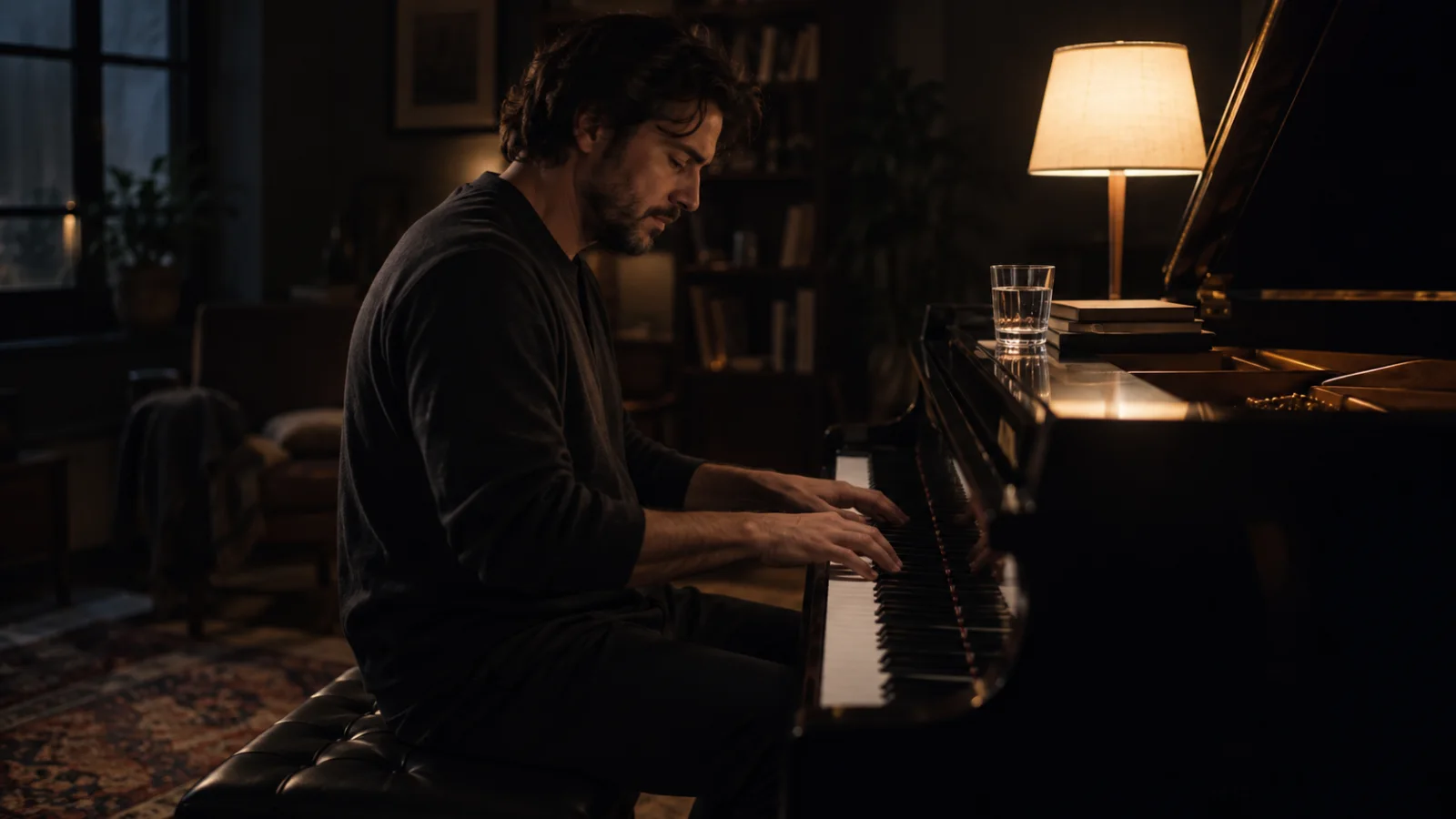
To write a ballad, choose one concrete moment and let the whole song stay inside it. Set a slow tempo, usually between 60 and 80 BPM, and accompany yourself on piano or guitar with a simple progression such as I–vi–IV–V (C–Am–F–G). Keep the verse low and close to speech, then lift the chorus higher on long notes, with rests so the singer can breathe. Use verse–chorus–verse–chorus–bridge–final chorus and make each section a little bigger than the one before. For the ending, lift the last chorus with the arrangement, a higher melody or, carefully, a key change a whole step up. Then record a voice-and-piano demo before you polish anything.
Below: two audio examples, loops for the free chord player, an original ballad written for this article from the first line to the key change, and the mistakes that make ballads drag.
What makes a ballad: the traits at a glance
“Ballad” once meant a song that tells a story in verses. In the late 19th century it came to mean a slow popular love song, and today it covers almost any slow, emotional song in pop, rock, soul or country. The power ballad is its loud relative: a slow song that builds to a big chorus with drums, electric guitars and sometimes choirs. It appeared in the early 1970s (Styx’s “Lady”, from 1973, is often credited as the first) and peaked in 1980s rock with bands like Journey and Foreigner.
| Element | Typical ballad choice | Why it works |
|---|---|---|
| Tempo | 60–80 BPM, sometimes slower | Room for long notes and every word |
| Feel | 4/4, or 6/8 and 12/8 for a rocking sway | Slow but never static |
| Form | Verse–chorus–verse–chorus–bridge–final chorus | The song grows in steps |
| Chords | I–vi–IV–V, I–V–vi–IV, a borrowed iv | Familiar harmony keeps the melody in front |
| Melody | Low verse; chorus up to an octave higher | The jump in register is the emotion |
| Lyric | One moment, concrete details | The listener sits inside the scene |
| Ending | A last chorus that lifts: fuller, higher or in a new key | The payoff the song prepared |
Two style references show the range. Adele’s “Someone Like You” (2011, written with Dan Wilson) is the stripped version: voice and piano in A major at about 67 BPM, with a chorus that climbs an octave above the verse. Whitney Houston’s 1992 recording of “I Will Always Love You”, a song Dolly Parton wrote in 1973, is the full arc: about 45 seconds of unaccompanied voice and, before the last chorus, a jump from A major to B major.
Hear the ballad feel: two audio examples
These are short, synthesized teaching examples, not finished productions.
After a one-bar count-in, an arpeggiated keyboard and a soft ballad beat play C, Am, F and G, one bar each, and the loop starts again on C at about 0:14. Notice how the arpeggio keeps moving while the harmony stays put: that motion under a slow chord lets a singer hold a long note without the song going still. At 84 BPM this sits at the quick end of ballad tempo; take it down to 70 in the player and hear the space open up.
A sustained pad plays C at about 0:03, F at 0:06, F minor at about 0:09 and C again at 0:13. Only one note changes between F and Fm (A drops to A♭), yet the mood darkens for a moment before home returns. Ballads use that borrowed iv on the line where hope cracks.
Step 1: stay inside one moment
A ballad slows time down, so the listener notices everything. That’s why the lyric works best inside one moment rather than summarizing a relationship. Before you touch the piano, answer five questions in a note: where are you, what time is it, what are you holding, what just happened, and what can’t you say out loud?
| Summary (tells) | Moment (shows) |
|---|---|
| We grew apart over the years | You fold the map the wrong way and I don’t fix it anymore |
| I miss you every day | Your number is still first in my favorites |
| Thank you for everything | You drove me to every audition and waited in the car |
The feeling lives in the gap between the small detail and what it points to. If one detail ends up carrying the whole song, it has become a metaphor, and the guide to metaphors in songs shows how to hold it without mixing it. The songwriting prompts generator can hand you a situation to start from, the love song guide shows how to swap clichés for details, and the sad song guide covers restraint.
Step 2: tempo, feel and your instrument
At 70 BPM one bar of 4/4 lasts about 3.4 seconds, so a two-bar phrase takes almost seven seconds to sing. That’s a long breath, which is why ballad lines are short and full of rests. Tap the tempo you hear in your head into the tap tempo metronome: if the words feel stretched, go up four beats per minute; if they feel rushed, come down.
In 6/8 or 12/8 each beat splits into three, which gives the lullaby sway of many soul and rock ballads. The chord player plays in 4/4, so sketch those ideas on your own instrument and count “one-and-a, two-and-a”.
On piano, hold one chord per bar in the verse (root in the left hand, chord in the right) and move to broken chords or repeated chords in the chorus. On guitar, fingerpick the verse and let the strings ring, then strum softly in the chorus. Either way, add one layer per section, not three. The piano songwriting guide has four accompaniment patterns with audio.
Step 3: ballad chord progressions (with loops)
Ballad harmony stays familiar so the melody and the lyric can carry the feeling. Every link opens the progression in the free player at a ballad tempo.
| Progression | In C | Feel | Try it |
|---|---|---|---|
| I–vi–IV–V | C–Am–F–G | Classic, tender | Loop it at 72 BPM |
| I–V–vi–IV | C–G–Am–F | Modern pop ballad | Loop it at 70 BPM |
| I–V–vi–iii–IV–I–IV–V | C–G–Am–Em–F–C–F–G | The Canon pattern, a slow walk down | Loop it at 66 BPM |
| IV–V–iii–vi | F–G–Em–Am | A chorus that lifts and aches | Loop it at 70 BPM |
| I–IV–iv–I | C–F–Fm–C | Hope with a shadow | Loop it at 64 BPM |
| i–♭VI–♭III–♭VII | Am–F–C–G | Minor and cinematic, power ballad verse | Loop it at 76 BPM |
A rule that works: loop one progression in the verse and start the chorus on a different chord, often IV. A verse that begins on C and a chorus that begins on F already sound like a door opening. To end the chorus, V–I sounds final and IV–I sounds gentle; the cadences guide lets you hear both, and the sad chord progressions article has darker options.
Step 4: write a melody that breathes
A ballad melody lives on contrast. Keep the verse low, near your speaking range and mostly stepwise. Take the chorus up, anywhere from a fourth to an octave, with fewer words and longer notes. The listener feels that jump before they understand a single line.
- Short lines, real rests. End every chorus line with at least one beat of silence. That’s where the singer breathes and the words land.
- Mark the breaths. Put a slash in the lyric wherever you’ll breathe; if a line has nowhere to breathe, cut words. The breathing exercises for singing include a drill for this.
- Long notes on easy vowels. Many singers find “ah”, “oh” or the “ay” of “late” easier to hold high than a tight “ee”. Sing the chorus both ways and keep what opens up.
- Leave room at the top. If you plan a key change, every note will rise two more semitones.
Find the right key by entering your lowest and highest comfortable notes in what key should I sing in (the example range is C3–G4; replace it with yours), and use the vocal warm-up before you record. If you’re not sure yet which part of your range sounds most like you, the guide on how to find your singing voice helps you decide with three takes.
Step 5: ballad structure and the build
Most ballads follow verse–chorus–verse–chorus–bridge–final chorus. What makes it a ballad is the build: each section adds one thing, so the last chorus has somewhere to go.
| Section | Bars | Arrangement | Job |
|---|---|---|---|
| Intro | 2–4 | Piano or guitar alone | Set mood and tempo |
| Verse 1 | 8 | Voice and one instrument | Place us in the moment |
| Chorus 1 | 8 | Add bass or a pad, no drums yet | The title, the first time |
| Verse 2 | 8 | Light drums enter | Move forward by minutes, not years |
| Chorus 2 | 8 | Fuller, with harmonies | The title, heavier now |
| Bridge | 4–8 | New chords, or everything drops out | What the song hasn’t said yet |
| Final chorus | 8–12 | The biggest section, or suddenly the smallest | The payoff |
At 70 BPM this map, with a short outro, runs a little over three minutes. Sketch yours in the song structure planner.
A power ballad uses the same map with more contrast: a quiet first half, drums and distorted guitars from chorus 2, often a guitar solo, and a last chorus at full volume. The bridge guide has seven ways to write the middle section; if your song keeps speeding up, see the pop song guide.
The final key change: when and how
A direct jump into a new key near the end of a song, with no transition, is nicknamed the “truck driver’s gear change”. Done well, it feels like the singer finding one more gear. Done by habit, it sounds like a costume change.
- Choose the distance. A whole step up (C to D) is a safe start. A half step is subtler; more than a whole step is hard to sing.
- Choose the door. Jump directly into the new key; or use a shared chord (G is V in C and IV in D, so a bridge ending on G can flow into a chorus in D that starts on G); or set it up with one bar of the new key’s V (A before D).
- Check the range. Sing the last chorus two semitones up before you commit.
- Earn it with the lyric. Change one line. If the words don’t move, the key change has nothing to carry.
Loop the chorus in C, then the same chorus in D, and sing one melody over both. If the lift strains your voice, lift the ending another way: drop to voice and piano for half the chorus, hold the title longer or repeat the last line as a tag.
Worked example: “Twenty-Eight Seconds”
A ballad written for this article, in C at 68 BPM on piano. The moment: someone parked in a car, the phone saying storage is full, and a voicemail from a person who’s gone. Loop the verse while you read.
Verse 1 (C–G–Am–Em–F–C–F–G)
Parked outside the pharmacy, the engine ticking cold,
my phone says it’s out of space and asks me what to hold.
A list of things I could delete, I scroll past every one
to a message from a Tuesday, from a number that’s gone.
Chorus (F–G–Em–Am–F–G–C–C)
Twenty-eight seconds,
you’re running late,
you tell me “save a seat for me,”
and I still wait.
Verse 2
I play it with the windows up so no one sees my face,
the light goes green, then red, then green, and I stay in my place.
You laugh at something off the phone, a door, a dog, a car,
and for twenty-eight seconds I know where you are.
Bridge (Am–F–C–G, twice)
The screen asks me one more time: delete or keep.
I press the only answer that still lets me breathe.
Final chorus (in D: G–A–F♯m–Bm–G–A–D–D)
Twenty-eight seconds,
you’re running late,
you tell me “save a seat for me,”
I saved it, and I wait.
What each part does:
- One moment: the song never leaves the car; verse 2 moves forward by minutes.
- Details, not feelings: the pharmacy, the cold engine, the traffic light, the laugh off the phone. The lyric never says “grief”.
- Room to breathe: short chorus lines, each followed by a rest; the long notes fall on “late” and “wait”.
- The lift: the bridge ends on G, which is also IV in D, so the final chorus starts on that same chord while the melody jumps a whole step. The lyric earns it: “I still wait” becomes “I saved it”, the voicemail and the seat at once.
With a two-bar intro and outro, 8-bar sections and a 4-bar tag, the song runs about 56 bars, or 3:18 at 68 BPM.
Common mistakes when writing a ballad (and the fix)
| Symptom | Likely cause | Fix |
|---|---|---|
| It drags | Empty bars between lines, or a tempo too slow for the words | Cut instrumental bars, try 4 BPM faster, reach the chorus before 1:00 |
| Verse and chorus sound alike | Same register, same first chord | Start the chorus on IV and sing it higher |
| It’s vague | The lyric names feelings | One place, one hour, three objects |
| The singer runs out of air | Long lines, no rests | One breath per line, a beat of silence after it |
| The key change sounds cheesy | Nothing changes in the lyric | Change one line, or lift with the arrangement |
| It’s big from bar one | Every instrument starts at once | Begin with one and add one per section |
Record your first ballad demo
A ballad demo needs a piano or guitar, a voice and a phone. Its job is to prove that the melody breathes and the last chorus lifts.
- Choose the key with the vocal key tool, leaving two semitones of headroom if you plan a key change, and warm up for five minutes.
- Record the whole song once, with the phone steady and a little away from the instrument so the voice isn’t buried. If you don’t play, sing over the chord player loop in headphones.
- Record the final chorus twice, in the original key and a whole step up. Listen the next day and keep the one that sounds inevitable.
For a cleaner take later, the guide to recording vocals at home covers the room, mic distance and levels.
Where Zoundroom fits: the moment, the chords and every take of the last chorus
Zoundroom won’t write or produce the ballad for you. It isn’t a DAW (no mixing, effects, pitch correction or multitrack; use GarageBand or another DAW for that) and has no tuner or vocal coach inside, so warm up and find your key with the free web tools. What it keeps together is what tends to scatter: the lyric with its breath marks, the chords, the tempo and the takes of the last chorus in two keys. Each song is a project with its recordings, lyrics, notes and files, so create a project called “Twenty-Eight Seconds”, write the lyric in a note with the chords and “C, 68 BPM, final chorus in D” at the top, and record the first voice-and-piano pass inside that note on your phone: the audio lands at the cursor, right under its section. Open it later on iOS, Android or the web. Free lets you share a project with up to two artists; Pro adds timestamped feedback, so a co-writer can point at the second the key change lands. Auralis, the app’s assistant, suggests rhymes, lines or structure as text, never audio. Your next step: create the project today and record the last chorus in both keys inside that note.
Frequently asked questions
How do you write a ballad song step by step?
Pick one moment and list five concrete details. Loop C–Am–F–G at around 70 BPM, hum until a low verse and a higher chorus appear, and put the title on the chorus’s longest note. Write verse 1 as a scene with short lines and rests, add a bridge that says what the song held back, and record a rough demo the same day.
What is the structure of a ballad?
Most modern ballads use verse, chorus, verse, chorus, bridge and a final chorus. The build matters more than the order: each section adds one layer, and the last chorus is the biggest or, as a surprise, the smallest.
What tempo is a ballad?
Usually between 60 and 80 BPM, sometimes slower; “Someone Like You” moves at about 67. Start around 70 and adjust by ear: faster if the words feel stretched, slower if the singer can’t breathe between lines.
What is a power ballad?
A slow song, usually about love or heartache, that builds to a loud, emotional chorus with drums, electric guitars and sometimes choirs. It appeared in the early 1970s and peaked in 1980s rock. Start with piano or a clean guitar, bring in the band in the second half and save full volume for the last chorus.
Does a ballad need a key change?
No. A key change before the last chorus can lift the ending if the singer’s range allows it and the lyric changes too. Many ballads lift with the arrangement instead: voice and piano alone, a longer title note or a repeated last line.
Sources
All pages checked on September 28, 2026.
- Wikipedia, “Ballad”: in the later 19th century the term took on the meaning of a slow popular love song; today used for pop, rock, R&B and power ballads. wikipedia.org
- Wikipedia, “Power ballad”: slow songs building to a loud, emotive chorus with drums, electric guitars and sometimes choirs; emerged in the early 1970s; Styx’s “Lady” (1973) credited as the first; a 1980s hard rock staple with Foreigner, Journey and REO Speedwagon. wikipedia.org
- Wikipedia, “Someone like You (Adele song)”: written by Adele and Dan Wilson, released in 2011; A major, 67.5 BPM; voice and piano; the voice rises an octave in the chorus. wikipedia.org
- Wikipedia, “I Will Always Love You”: written and first recorded by Dolly Parton in 1973. wikipedia.org
- Wikipedia, “I Will Always Love You (Whitney Houston song)”: 1992 recording; a cappella for about 45 seconds; A major, 66–68 BPM; shifts to B major before the final chorus. wikipedia.org
- Wikipedia, “Truck driver’s gear change”: a modulation where one phrase ends in the original key and the next begins in the new key with no transition, usually at or near the end of a song. wikipedia.org