
How to write a lullaby for your baby (with a template)
Published
Write a lullaby for your baby: a slow rocking 3/4 or 6/8 feel, a small range, soft repeated words and their name. With an original example and a template.
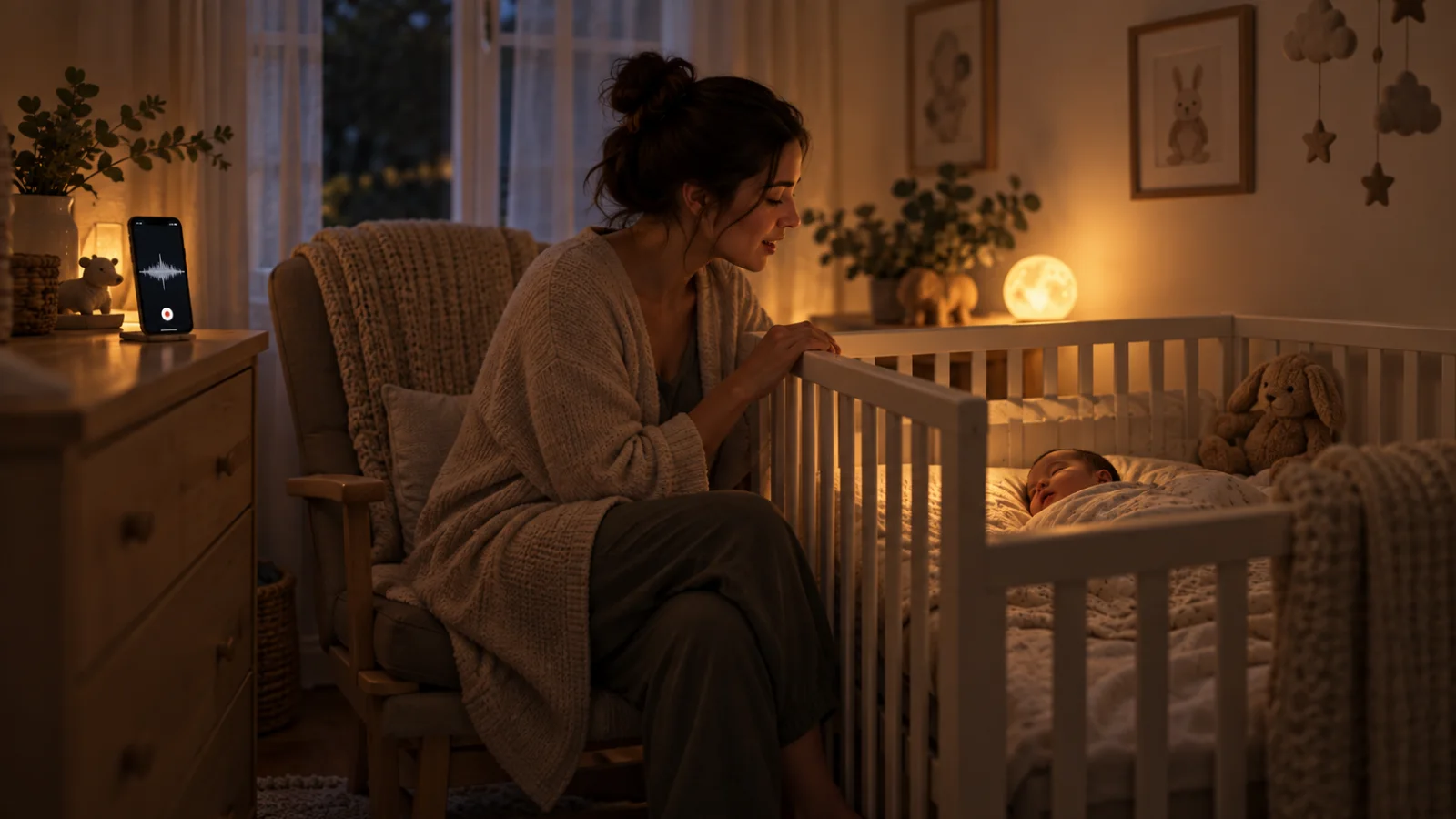
To write a lullaby, start from the way you already rock your baby. Turn that sway into a slow, steady pulse in three (3/4 or 6/8), keep the melody inside five or six neighboring notes, and let each phrase drift down to the home note. Write one short refrain with your baby’s name in it and repeat it more than feels necessary: repetition is the point. Choose soft sounds (m, n, l, “hush”, long “oo” and “ah”) and fill the verses with family words: the dog, the blanket, the walk you took today. Two chords are enough. Sing it for a week, fix what doesn’t flow, then record it so anyone who puts the baby to bed can play it.
Below: what makes a lullaby soothing (and what research says about it), how to find your tempo by tapping while you rock, melody and words, the method step by step, an original lullaby written for this article, a template you can copy, and how to record it and play it safely at bedtime.
What makes a lullaby a lullaby
Lullabies sound alike across the world. A 2019 study in Science that compared songs from many societies found that lullabies are soft and slow everywhere, and that songs with the same job, such as lullabies or dance songs, share musical features. You don’t need a famous one, either: in a 2021 study, 144 infants in the US relaxed more (lower heart rate, smaller pupils) to unfamiliar lullabies from other cultures than to other songs from those same cultures. The shape does the work, so a lullaby you invent tonight can do it too.
| Ingredient | What to do | Why it helps |
|---|---|---|
| A slow, steady pulse | The speed you rock at, never rushing | Babies follow a regular beat; it’s predictable |
| A rocking meter | 3/4 or 6/8, one sway per strong beat | The music and your arms move together |
| A small range | Five or six notes, mostly by steps | Easy to sing quietly, half asleep, in the dark |
| Repetition | One refrain, the same tune for every verse | Nothing new to process; it signals the end of the day |
| Soft sounds | m, n, l, h, sh; long vowels | Nothing sharp to startle |
| Falling endings | Phrases that settle on the home note | They sound like a full stop |
| Quiet dynamics | Get softer and slower each round | It fades out instead of finishing with a bang |
Two more findings worth knowing. When mothers and fathers sing to their own baby, they naturally sing higher and slower than when they pretend to (Trehub and colleagues, 1997), so your instinct is already right. And in a 2016 experiment, babies aged 7 to 10 months stayed calm roughly twice as long listening to singing as to speech; the authors point to its regular beat and tempo. None of this makes a lullaby a sleep method or a guarantee: it’s a ritual, and it works best as one.
If you’re writing for toddlers or a group of older children rather than a baby, the guide to writing a song for kids covers actions, call-and-response and school projects.
Tempo and rocking feel: 3/4 or 6/8?
Most lullabies sway in three. Brahms’s famous “Wiegenlied” (“Lullaby”, published in 1868) is in 3/4, and he wrote it for one specific baby: the second son of his friend Bertha Faber. That’s exactly what you’re doing.
- 3/4 counts ONE-two-three, ONE-two-three: one long sway per bar. It feels like a slow waltz. Good for lines where each stressed syllable gets a long note.
- 6/8 counts ONE-and-a-TWO-and-a: two sways per bar, each split into three. It feels like a boat on gentle water and suits lines with more small syllables.
To pick your tempo, don’t guess a number. Open the tap tempo metronome, hold your baby (or a pillow) and rock as you normally would, tapping the button on each swing. The number you get is your tempo. Then choose 3/4 or 6/8 in the same tool and press play: in 6/8 the metronome’s BPM is the big beat (the swing), with the small clicks in between. As a practical starting point, not a scientific rule, slow rocking usually lands somewhere around 60 to 80 swings a minute; if your number is higher, try singing at the slower end and let your arms follow.
Melody, key and chords: keep it small
A lullaby is sung tired, quietly, at night. That decides the melody:
- Five or six notes. From the home note up to the fifth or sixth above it covers most of what you need.
- Steps, not leaps. Move to the neighboring note; one small leap per phrase is plenty.
- Peak in the middle, rest at the end. Let the highest note arrive in the second line, then walk back down so the last line lands on the home note.
- Low to middle of your voice. Singing softly is easier there. Find your range with the vocal range test, then type your lowest and highest comfortable notes into what key should I sing in and choose a key that keeps the lullaby in the lower half.
For chords, two are enough: the home chord (I) and the fifth (V), with the fourth (IV) for color. In D major that’s D, A and G; the D major page shows all its chords. If you play guitar or piano, rock the chords on beat one only. If you don’t play anything, hum the melody first and find chords later with the guide to writing a song without an instrument; for more on shaping a tune, see how to write a melody.
Lullaby lyrics for your baby: the name, family words and soft sounds
The words are where your lullaby stops being any lullaby and becomes theirs.
The name. Count its syllables and find the stress: EM-ma and LU-cas stress the first syllable; ma-RIE and e-LI-jah stress the second. Put the stressed syllable on beat one, where you rock. Two-syllable names stressed on the first fit almost any lullaby rhythm; for longer ones, use the nickname you actually say. Check your lines in the syllable counter.
Family words. Make a five-minute list before you write a single line: the pet, the toy, the blanket’s pattern, the walk you took today, a word only your family says, the grandparent who calls every Sunday, what the baby sees from the crib. Three to five of these will carry the verses.
Soft sounds. Choose words with m, n, l, h, s and sh, and long vowels you can hold: “moon”, “slow”, “dream”, “hush”, “warm”. Save the hard k, t and p sounds for the middle of lines, not the long notes. Nonsense syllables are allowed and traditional: “la-la”, “mm”, “loo-loo”.
What to leave out. Plenty of old lullabies have surprisingly dark lines; yours doesn’t need any. Leave out anything loud, scary or worried, and keep adult worries for another song. A promise (“I’m here”) works better than a lesson.
For rhymes that stay simple, the rhyming dictionary gives options in seconds; pick the shortest, softest word.
How to write a lullaby, step by step
- Find your tempo. Rock and tap, as above. Write the number down.
- Choose the meter. 3/4 for long, simple lines; 6/8 if your lines have more small words.
- Collect family words. Five minutes, a list of ten; circle the best four.
- Write the refrain around the name. Four lines. Start lines 1 and 3 the same way, with the name, and end line 4 with a promise. Keep each line to about 7 to 9 syllables.
- Hum the melody right away. Inside five or six notes, peak in line 2, land on the home note at the end of line 4. Record it on your phone or in the free online voice recorder before you forget it.
- Add two chords. I and V, with IV if a line wants a lift.
- Write one or two verses on the same tune. Same syllable counts as the refrain, so you never need a second melody: one about the day that’s ending, one about tomorrow.
- Sing it at bedtime for a week. Change the word you stumble on, lower the key if you strain, and keep the order the same every night.
Worked example: an original lullaby for Emma
Written for this article. Emma is five months old; the family has a dog called Biscuit, a toy boat from Grandpa and a blanket covered in little fish, and they walk to the duck pond most mornings.
The plan. Meter: 3/4. Tempo: 66 BPM (tapped while rocking). Key: D major, with the melody inside D to B, six notes. Chords: D, G and A. Form: refrain, verse 1, refrain, verse 2, refrain hummed.
REFRAIN
Sleep now, Emma, close your eyes,
the moon is rocking across the skies.
Sleep now, Emma, sleep, my dear,
Mama is singing, Mama is here.

VERSE 1 (the day that's ending)
Biscuit sleeps down by the door,
Grandpa's old boat is safe on the shore,
fish on your blanket drift slow,
drifting round to where the dreams all go.

VERSE 2 (tomorrow)
Tomorrow: the pond again,
we'll count the ducks up to nine or ten.
Now all the ducks tuck their heads,
and all the ducklings are in their beds.

ENDING
The refrain once more, hummed on "mm", slower and quieter.
The refrain’s melody, line by line. Each line is four bars of 3/4, with the stressed syllable on beat one (SLEEP now | EM-ma | CLOSE your | EYES):
| Line | Chords | Sung notes |
|---|---|---|
| Sleep now, Emma, close your eyes | D → A | A F♯ · A F♯ · G F♯ E |
| the moon is rocking across the skies | G → A | D G A B A G G F♯ E |
| Sleep now, Emma, sleep, my dear | D → G | A F♯ · A F♯ · A G G |
| Mama is singing, Mama is here | A → D | E E F♯ G F♯ E E E D |
Hear the chords under it in the chord progression player, which opens on that order at 66 BPM with soft arpeggios and no drums. The player counts in four, so it won’t sway in three; use it to hear the harmony and the metronome to feel the rock.
What each choice does:
- The name sits on the strong beat of lines 1 and 3, the same moment every time, so it becomes the anchor of the song.
- Lines 1 and 3 start identically. Half the refrain is already learned the second time round.
- The only high note (B) is in line 2, on “rocking”, and the last line walks down to D. The song ends where it rests.
- Six notes, D to B. Higher voices sing them as written; lower voices sing the same tune an octave down.
- Long, open vowels on the long notes: “eyes”, “skies”, “dear”, “here”, “slow”, “go”.
- The verses keep the refrain’s counts (7, 9, 7, 9 syllables), so the same tune serves the whole lullaby. “Mama” can become Papa, Daddy or Grandma: any two-syllable word stressed on the first syllable fits.
- Family words do the personal work: Biscuit, Grandpa’s boat, the fish blanket and the duck pond are hers alone.
At 66 BPM each line lasts about 11 seconds, so the whole form runs a little under four minutes. If she’s still awake, loop the hummed refrain.
A lullaby template you can copy
LULLABY TEMPLATE
For: (name / nickname)              Syllables:      Stress on: 1st / 2nd
Meter: 3/4 / 6/8                    Tempo (tapped while rocking): ___ BPM
Key: ___    My comfortable low note: ___    high note: ___
Chords: I ___   V ___   (IV ___)

FAMILY WORDS (circle 3–5)
Pet / toy / blanket:
A place or walk we share:
A word only our family says:
Someone who loves the baby:
What the baby sees from the crib:

REFRAIN (lines 1 and 3 start the same; name on the strong beat)
1. ____ now, [NAME], ______________        (__ syllables)
2. ________________________________        (__)   highest note here
3. ____ now, [NAME], ______________        (__)
4. ________________________________        (__)   a promise; ends on the home note

VERSE 1: the day that's ending (same counts as the refrain)
VERSE 2: something for tomorrow
ENDING: refrain hummed on "mm" or "la", slower and softer

CHECK
[ ] I can sing it in a whisper      [ ] Every line fits in one easy breath
[ ] Five or six notes               [ ] Nothing loud or scary in the words
[ ] Same order every night          [ ] Recorded, named and saved
How to record your lullaby to play at bedtime
Singing it yourself is the ritual; a recording is for the nights someone else does bedtime, for the other parent or a grandparent to learn it, and for keeping. A phone is enough.
- Record in the evening voice you’ll use, not a performance voice. Quiet room, curtains closed, phone a hand span away (15–20 cm, 6–8 inches) at mouth height.
- Use a count-in so the tempo is right. The online voice recorder has a count-in and a click in 3/4; wear headphones so the click stays out. Its takes live only in that browser tab, so download the one you keep (WAV is one of the options) before you close it.
- Record two versions: the full lullaby, and a few minutes of the refrain hummed, for the end of the night.
- Name the file with the baby’s name, the meter and the tempo (“Emma lullaby, 3/4, 66 BPM”) so nobody plays the wrong one.
- Play it low and far. A 2014 study in Pediatrics measured 14 infant sleep machines at full volume and found that every one went over 50 decibels at 30 cm (about a foot), the limit recommended for hospital nurseries. The advice that came with it applies to any speaker: keep it as far from the baby as practical and never in the crib or on the rail, use the lowest volume that works, and switch it off once they’re sound asleep.
For more on recording a voice well with a phone, the comparison of voice recorder apps for singing covers the options on iPhone and Android.
Common mistakes when writing a lullaby
- Too fast. If your arms can’t rock to it, slow it down. Tap the tempo while rocking, not while sitting at a desk.
- Too high. At 9 p.m. and whispering, your voice sits lower than in the shower. Move the key down.
- A big chorus. A lullaby has no climax; the strongest moment is a soft high note in the middle, then down.
- Too many words. If a line needs a deep breath, cut a word.
- Hard or scary images. Thunder, wolves, falling and “don’t cry” lines wake up the adult brain, and you sing them every night.
- Changing it every night. Improvising is lovely, but keep the refrain and the order fixed: that’s what makes it a signal.
Where Zoundroom fits: the words, the melody and the versions in one project
A lullaby written at 3 a.m. ends up in three places: a line in your notes app, the melody in a voice memo called “New Recording 14” and the chords in your head. In Zoundroom each song is a project that keeps its recordings, lyrics, notes and files together, so create one for the lullaby and write the words in a note, with the meter, tempo, key and chords at the top. Record the melody inside that note, on iPhone, Android or in the browser at app.zoundroom.com: the audio lands at the cursor, right under the refrain, and you can import the bedtime recording you made with another app into the same project. When the baby grows and you add a verse about the first steps or the new sibling, the new take sits next to the old ones. To teach it to your partner or a grandparent, invite them to the project (Free shares with up to two artists). Auralis, Zoundroom’s AI assistant, can suggest a gentler word for a line, as text only. Be clear about the limits: Zoundroom doesn’t generate audio, has no virtual instruments or beats, isn’t a sleep or white-noise app, and isn’t where you mix and master a finished track (a DAW such as GarageBand or BandLab is). Your next step: create the project and record the refrain inside its note tonight, before you forget the tune. See how notes and lyrics work with audio.
As your child grows, how to write a song for your son or daughter carries the same idea from a baby on the way to their wedding day. If you’d like to write songs for other people in the family too, the guide to writing a song for someone starts from memories and details in the same way.
Frequently asked questions
How do you write a simple lullaby?
Rock your baby and tap the tempo, choose 3/4 or 6/8, and write a four-line refrain with the baby’s name at the start of lines 1 and 3. Hum a melody inside five or six notes that ends on the home note, add two chords (I and V) and repeat the refrain as often as you like.
What time signature is best for a lullaby?
Three-beat meters: 3/4 (one sway per bar, like a slow waltz) or 6/8 (two sways per bar, each split into three). Brahms’s “Lullaby” is in 3/4. A lullaby in 4/4 can work too, as long as it’s slow and steady.
How long should a lullaby be?
As long as it takes. A refrain and two verses run about three to four minutes at a slow tempo, and you can loop the refrain, hummed, until the baby is asleep. Short and repeated works better than long and varied.
I can’t sing. Does my baby care?
The studies on singing to babies point to a slow tempo and a regular beat, not to vocal technique. Keep the melody small and low, sing softly, and your lullaby will sound like what it is: you, singing to them.
Can I put new words to a famous lullaby melody?
Traditional lullaby tunes and Brahms’s 1868 melody are old enough to be free to use as melodies, which makes new words about your baby a lovely shortcut. A specific modern arrangement or recording can still be protected, so sing the tune yourself rather than reusing someone’s track, especially if you share it online.
Sources
All pages checked on October 2, 2026.
- Mehr et al., “Universality and diversity in human song,” Science, 2019, and Harvard’s summary on ScienceDaily: lullabies are soft and slow around the world, and songs with the same function share acoustic features. science.org · sciencedaily.com
- Bainbridge et al., “Infants relax in response to unfamiliar foreign lullabies,” Nature Human Behaviour, 2021: 144 US infants relaxed to eight unfamiliar foreign lullabies, compared with matched non-lullabies, measured by heart rate, pupil size and electrodermal activity. nature.com
- Trehub et al., “Mothers’ and fathers’ singing to infants,” Developmental Psychology, 1997: pitch was higher and tempo slower when parents sang to their infant than in a simulated version. pubmed.ncbi.nlm.nih.gov
- Corbeil, Trehub and Peretz, “Singing delays the onset of infant distress,” Infancy, 2016: infants aged 7–10 months listened to singing roughly twice as long as to speech before distress; the authors point to its regular beat, meter and tempo. peretzlab.ca
- Wikipedia, “Wiegenlied (Brahms)”: first published in 1868, in 3/4, dedicated to Bertha Faber on the birth of her second son. en.wikipedia.org
- Hugh et al., “Infant sleep machines and hazardous sound pressure levels,” Pediatrics, 2014, and the NEJM Journal Watch summary: all 14 devices exceeded 50 dBA at 30 cm at maximum volume; advice to place them far from the infant and never in the crib, at the lowest volume, for a short time. pediatrics.aappublications.org · nejm.org