
How to write a song for kids (and for a school project)
Published
Write a song kids can sing: simple words, repetition, actions and a short range. With a worked example, a school project template and easy recording tips.
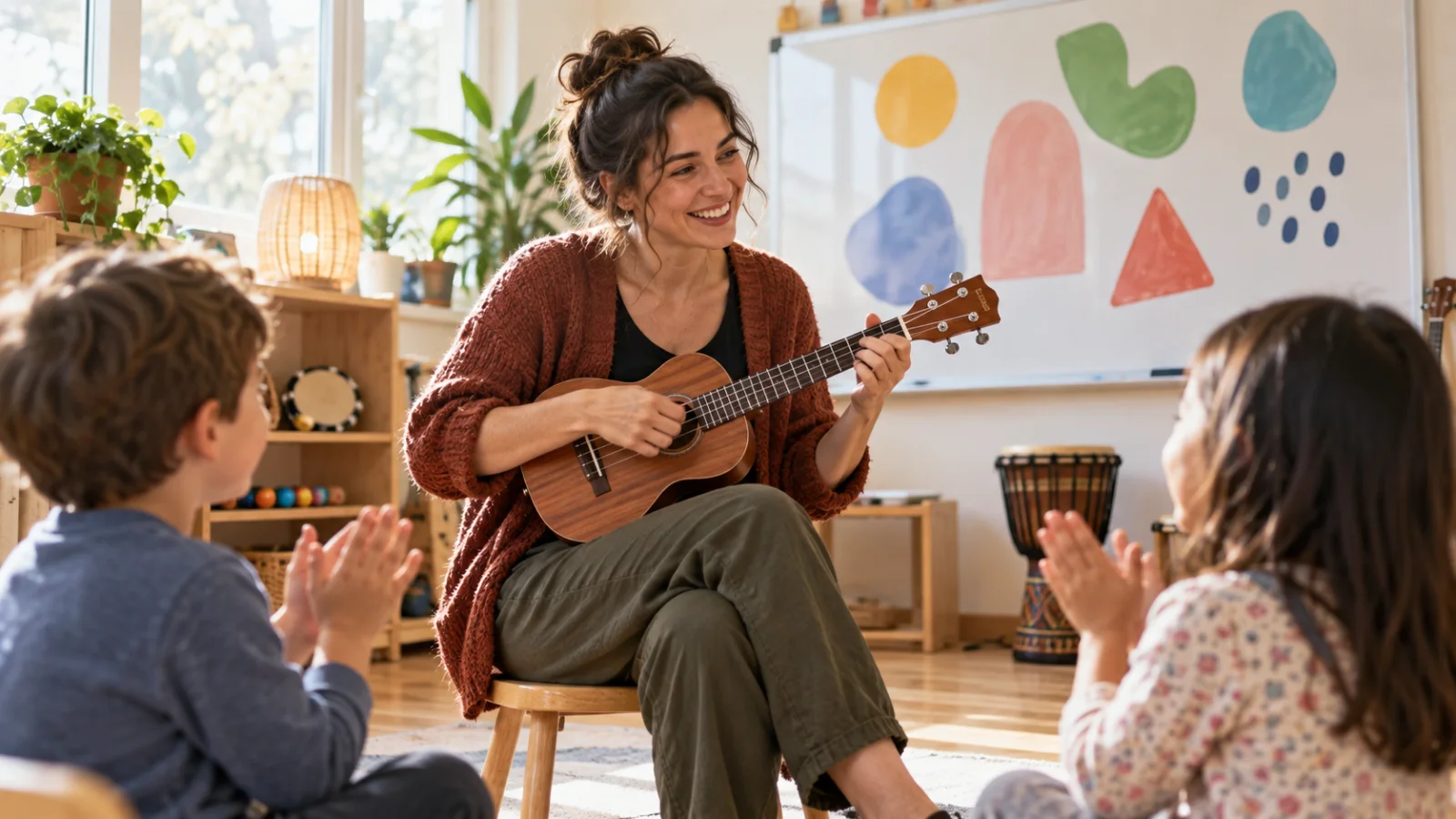
To write a song for kids, keep it short, simple and repetitive. Pick one topic, use words the children already say, and write a chorus of two to four short lines that comes back at least three times. Give every line an action (a clap, a stomp, a gesture) and add a call-and-response part so the group can answer you instead of learning every word. Keep the melody in small steps inside five or six notes: for preschoolers, that’s roughly middle C up to the A above it. Put it on two or three chords, try it with the children and change the line where they stop singing. For a school project, the same recipe works: one fact per verse and the main idea in the chorus.
Below, for teachers, parents and students: what makes a song easy to sing, words and range by age (with two short audio examples), the method step by step, a worked example about the water cycle, a template for a school project, how to record it simply, and what AI can and can’t do here.
What makes a song easy for kids to sing
Children’s songs that work share a handful of ingredients. You don’t need all of them in every song, but each one you drop makes the song harder for a group of children.
| Ingredient | What to do | Why it helps |
|---|---|---|
| One topic | One idea per song: tidying up, the planets, a classmate’s birthday | Kids follow a single thread |
| Familiar words | Words they use every day; one new word per verse at most | They sing what they understand |
| Repetition | A chorus that returns three or more times, repeated lines inside verses | They join in from the second time |
| Actions | A gesture, clap or stomp for each line | Every child has a job, even those not singing yet |
| Call-and-response | You sing a line, they answer with a short reply | They don’t need to know the whole song |
| A small range | Five or six notes, moving by steps | Young voices find the notes |
| Short length | One to three minutes, depending on age | It ends before attention does |
Rhyme helps too, as long as it stays simple: end the second and fourth lines on words that rhyme, and keep both words in the children’s vocabulary. The rhyming dictionary gives you options in seconds; pick the shortest, most common one.
Choose the age first: words, length and range
The same song idea changes a lot between a group of four-year-olds and a class of ten-year-olds. Decide who will sing it before you write a line.
| Age | Lines and words | Length | Comfortable range (approx.) |
|---|---|---|---|
| 3–5 (preschool) | 3–5 syllables per line, everyday nouns and verbs, many repeats | Up to 1–2 minutes | Middle C to A (C4–A4) |
| 6–8 | 5–8 syllables per line, one new word per verse, a simple story | 1–3 minutes | C4 to C5 |
| 9–11 | Longer lines, wordplay, facts, even a rap part | 2–3 minutes | B♭3 to E5 |
The ranges come from Natalie Sarrazin’s open textbook Music and the Child, which also notes that children’s strongest notes sit in the middle of their range, around F and G above middle C. The same chapter warns about the most common mistake: adults pitch songs where they are comfortable, which is usually too low for children.
To check your own voice before teaching, take the vocal range test. To choose a key for the children, enter their range in what key should I sing in; the link opens with C4 to C5, the range of six- to eight-year-olds.
Hear the difference between a melody that fits young voices and one that doesn’t. First, a melody that moves only by small steps:
After the count-in, the melody plays twice, from about 0:03 to 0:14 and again until the end. Each note moves to its neighbor, and the whole tune stays inside five notes, C to G: a preschool group can sing all of it.
Now a melody over the same chords that leaps:
Listen at 0:04, where it jumps up to a high C, and at about 0:09, where it reaches a high D. Both notes sit above the A that tops a preschooler’s range. It’s a fine melody for older kids or adults, but a group of four-year-olds would drop out on those notes. Both examples are synthesized for teaching, not finished recordings.
How to write a song for kids, step by step
- Choose one topic and one job. Decide what the song is for and write it in one sentence: “After this song, they can name the three stages of the water cycle.” The table below has ideas for each moment of the day.
- Write the chorus first. Two to four short lines, with the title in the first or the last line. Count syllables with the syllable counter: lines sung to the same tune should have about the same count. The guide to writing a chorus goes deeper on making it stick.
- Give each line an action. Use verbs you can act out: jump, spin, rain down, fall asleep. If a line can’t be acted, it’s probably too abstract for little ones; rewrite it. Note the action in brackets next to the line.
- Build the verses by changing one thing. Keep the same line pattern and swap one word per verse (an animal, a day, a part of the body), or add one item each time, so the song grows. Children predict the pattern and sing ahead of you.
- Add a call-and-response part. You sing a line, they answer with a short reply that never changes, or echo what you sang. It’s also the way teachers usually teach a new song: the whole song or one phrase at a time, with the class echoing back.
- Hum a melody in small steps. Sing the chorus inside five notes and record it at once, in your phone’s recorder or the free online voice recorder. A two-note chant like a playground call (sol–mi) makes a strong hook. If you don’t play anything, the guide to writing a song without an instrument shows how to find chords for a hummed tune.
- Put two or three chords under it. I, IV and V are enough for many children’s songs: D, G and A in D major. Hear them in the chord progression player, which opens on D–G–A–D at 100 BPM.
- Test it with children and fix one thing. Sing it once, then teach the chorus. Watch where voices drop out: that’s the line to shorten or the note to lower.
Song ideas by moment of the day, with an original hook to start from:
| Moment | Job | Hook idea | Action |
|---|---|---|---|
| Morning circle | Say hello to each child | ”Who’s here today? Clap if it’s you!” | Children clap when they hear their name |
| Tidy-up time | Turn a chore into a game | ”Blocks in the box, one, two, three” | Put away one toy per count |
| Lining up | A calm transition | ”Feet on the floor, hands by your side” | Freeze like statues at the end |
| Topic of the week | Teach a fact or new words | ”Eight planets spinning round the sun” | Walk in a circle around a “sun” |
| A birthday | Celebrate a classmate | The child’s name, sung three times | Everyone jumps on the name (birthday song guide) |
| Bedtime | Calm down | ”Close your eyes, the moon is high” | Hands under the cheek |
| The holiday show | Sing for the families | A bell line everyone can join | Shake jingle bells on the chorus (Christmas song guide) |
| A teacher’s last day | Say thank you | The teacher’s own catchphrase | Each group sings one line (song for your teacher) |
Worked example: a water cycle song for a class of 6–8-year-olds
A song written for this article, following the steps above.
The brief. Goal: by the end, the class can name evaporation, condensation and precipitation. Format: a chorus everyone sings, and three call-and-response verses where the teacher sings the information and the class answers with the science word. Key: D major, five notes from D to A. Chords: D–G–A–D. Tempo: 100 BPM.
The chorus, with its actions:
CHORUS (everyone)                         ACTION
Round and round, round and round,         roll your arms
water goes around,                        draw a big circle in the air
up to the sky and down again,             arms up, then wiggle your fingers down like rain
back into the ground.                     touch the floor
The melody, note by note. It never leaves the five notes from D to A, and each line ends on a note of its chord:
| Line | Chord | Sung notes |
|---|---|---|
| Round and round, round and round | D | A A F♯ · A A F♯ |
| water goes around | G | G G F♯ E D |
| up to the sky and down again | A | E E E A G F♯ E E |
| back into the ground | D | F♯ E E E D |
The verses, in call-and-response over D and A:
VERSE 1: EVAPORATION
Teacher: The sun is hot, the sea is warm,
Class:   e-va-po-ra-tion! (clap each syllable)
Teacher: The water rises, light as air,
Class:   e-va-po-ra-tion!

VERSE 2: CONDENSATION
Teacher: High in the sky, it's cold up there,
Class:   con-den-sa-tion!
Teacher: The drops hold hands and make a cloud,
Class:   con-den-sa-tion!

VERSE 3: PRECIPITATION
Teacher: The cloud gets heavy, gray and full,
Class:   pre-cip-i-ta-tion!
Teacher: Here comes the rain, here comes the snow,
Class:   pre-cip-i-ta-tion!
Structure: chorus, verse 1, chorus, verse 2, chorus, verse 3, chorus. At 100 BPM, with two bars per line, that’s a little over two minutes.
What each choice does:
- The science words are the children’s part. They shout each one twice per verse, clapping the syllables, so by the end they’ve said all three words several times without a single explanation.
- The teacher carries the long lines. The information lives in the verses; the class only needs the chorus and one word per verse.
- “Round and round” is a sol–mi chant. A–A–F♯ in D is the same two-note shape as a playground call, the easiest hook for young voices.
- Five notes, D to A, inside the C4–C5 range of six- to eight-year-olds and close to their strongest notes.
- Every chorus line has an action, and each action also reminds them of the next words.
How to write a song for a school project
When students write the song themselves, the job changes: the song has to show what they learned. This method works for one student or a group of four.
- List five facts about your topic and circle the three most important. The most important one becomes the chorus; the other two become the verses.
- Choose the format. Your own melody, a rap over a beat (the chord player has drum styles, from pop to boom bap), or new words to a traditional tune. The melody of “Twinkle, Twinkle, Little Star” was first published in France in 1761 and already carries the alphabet song, so an old tune like that is a classic shortcut. Ask your teacher whether an original melody earns more credit; it usually shows more work.
- Write one fact per verse in your own words. Check every fact in your textbook. A rhyme is never a reason to change a fact.
- Make the lines fit. Count syllables so each line fits the tune, and look for rhymes that keep the meaning.
- Rehearse and record (see the next section).
- Prepare a 30-second introduction: what the song teaches, who wrote what and, if you used a traditional tune, which one.
In a group, split the roles: one or two lyricists, one person for the melody or the beat, one fact checker and one person in charge of the recording.
Copy this template:
SCHOOL PROJECT SONG: TEMPLATE
Topic:                         Class / age:
Title:
Main idea (this goes in the chorus):

FACTS (checked in: textbook / website)
1.
2.
3.

FORMAT: own melody / rap over a beat / traditional tune (name it):
Key:          Tempo (BPM):          Chords:

CHORUS (2–4 lines, syllables per line)
1.                                   ( )
2.                                   ( )

VERSE 1 = fact 1                     VERSE 2 = fact 2
Action or call-and-response part:

WHO DID WHAT
Lyrics:            Melody/beat:            Facts:            Recording:

CHECK BEFORE HANDING IN
[ ] Every fact is correct            [ ] The chorus says the main idea
[ ] Each line fits in one breath     [ ] Under 3 minutes
[ ] Recorded and named               [ ] 30-second introduction ready
If you’d rather print the lyric with chords above the words for the class, the chord sheet maker does it in the browser. When the project grows into a whole show with several songs, how to write a song for a musical has a 12-week plan for a school musical.
How to record a kids’ song simply
You don’t need a studio. A phone and a quiet room are enough, as long as you record in the right order.
- Record a guide track first. Sing the whole song yourself, with the chords if you play them, at the final tempo. It lets parents, colleagues or the class practice at home. Find the tempo with the tap tempo metronome, and use the online voice recorder if you want a count-in and a click: it keeps several named takes, downloads them as WAV and never uploads your audio.
- For one voice, hold the phone a hand span away (15–20 cm, 6–8 inches), at mouth height, in a room with curtains or a sofa rather than bare walls.
- For a class, place the phone three to six feet (one to two meters) in front of the group, at the children’s mouth height, not next to the loudest singer. Close the windows, switch off fans and put the phone in airplane mode.
- Do a ten-second test and listen with headphones before the real take.
- Record two or three takes. The second one is often more relaxed, once the novelty wears off.
- Before sharing anything with children’s voices or faces, follow your school’s rules and get the parents’ agreement. When in doubt, share audio only, without names.
For a fuller demo, the comparison of voice recorder apps for singing covers the options on iPhone and Android.
Can AI make a kids’ song? What you gain and what you lose
Plenty of people search for ways to make kids’ songs with AI. Audio generators such as Suno can turn a written description into a finished track with a synthetic voice. Suno’s free plan gives 50 credits a day and no commercial rights, so it’s not an option for a song you plan to sell or publish on a monetized channel. The list of AI apps that create songs compares the main ones.
The trade-off is bigger with children than with adults. A generated track gives you a voice and a melody that aren’t yours or theirs, often pitched for an adult singer and full of words a four-year-old doesn’t know. For a school project, the learning is in writing the song, so a generated song defeats the purpose. The useful middle ground: ask a chat assistant for ten rhymes for “cloud” or a simpler way to say a fact, check the facts yourself, and keep your own melody, sung in the children’s key.
Common mistakes when writing for children
- Pitching it in your own key. Adult voices sit lower; check the children’s range and move the song up if needed.
- Too many words per line. If you can’t sing a line in one easy breath, a child can’t either.
- A chorus that appears only once. Repetition is what lets them join in; bring it back at least three times.
- Big leaps and high peaks. Keep the melody in steps and below the top of their range.
- Long verses with nothing for the children to do. Give them a reply, an echo or an action in every verse.
- Teaching the whole song at once to little ones. Start with the chorus, then add one verse at a time, echo by echo.
- Bending facts to rhyme. In an educational song, the fact wins; change the rhyme.
Where Zoundroom fits: the lyric, the actions and the guide track in one project
A song for a class ends up scattered: the lyric on the whiteboard, the actions on a sticky note, the melody in your head and the guide track somewhere in your phone. In Zoundroom each song is a project that keeps its recordings, lyrics, notes and files together, so create one per song and write the lyric in a note, with the action in brackets after each line and the key, chords and tempo at the top. Record the guide track inside that note, on your phone or in the browser at app.zoundroom.com: the audio lands where the cursor is, under the verse it belongs to, and you can import the class recording into the same project afterwards. If a colleague will teach the same song, invite them to the project (Free shares with up to two artists; if they have Pro, they can leave feedback at the exact second of a take, handy for “the class rushes here”). Auralis, Zoundroom’s AI assistant, can suggest simpler wordings for a science word, as text only. Be clear about the limits: Zoundroom isn’t a classroom platform for pupils, doesn’t generate audio, has no virtual instruments or beats, and isn’t where you mix and master a finished track (a DAW such as GarageBand or BandLab is). Your next step: create the project for your song and record the chorus inside its note before you teach it. See how notes and lyrics work with audio.
If you’re writing for one particular child rather than for a group, the guide to writing a song for someone focuses on personal details and memories.
Frequently asked questions
How do you write a simple song for kids?
Choose one topic, write a two- to four-line chorus with familiar words, and repeat it at least three times. Add an action for each line and a call-and-response part. Keep the melody inside five or six notes, moving by steps, and use two or three chords such as D, G and A.
How do I write a song for a school project?
List five facts, put the main one in the chorus and one fact in each verse, in your own words. Pick a format (your own melody, a rap over a beat or a traditional tune), check the facts, count syllables so the lines fit, then rehearse, record and prepare a short introduction.
What key is best for a children’s song?
The one that keeps the melody inside the children’s range: about middle C to A for preschoolers and middle C to the C above for six- to eight-year-olds. A five-note melody starting on its home note fits in C, D or F major. Check it in what key should I sing in.
How long should a song for kids be?
For preschoolers, under one or two minutes, with one verse pattern and lots of repeats. For six- to eight-year-olds, one to three minutes. Older children can handle two or three minutes with more verses, as long as the chorus keeps coming back.
Can I put new words to a famous tune?
Traditional melodies, like the 1761 tune behind “Twinkle, Twinkle”, are centuries old and free to use. Recent songs belong to their writers, and reusing them with new words, especially online, can need permission. For a school project, an original melody is the safest choice and shows more of your work.
Sources
All pages checked on October 2, 2026.
- Natalie Sarrazin, Music and the Child, Open SUNY Textbooks, 2016, chapter 5, “Children Singing and Children’s Songs”: general ranges by age (C to A at 3–5 years, C to C’ at 6–8, B♭ to E’ at 9–11), strongest notes around F and G, adults pitching songs too low, and teaching a song by echo, whole or phrase by phrase. milnepublishing.geneseo.edu
- Chicago Symphony Orchestra, “Mozart wished upon a star, and it sounds just like that ‘Twinkle, Twinkle’ song”: the French melody “Ah! vous dirai-je, maman”, first published in 1761, shared by “Baa, Baa, Black Sheep” and “The Alphabet Song”. chicagosymphony.org
- Suno, “Pricing”: free plan with 50 credits per day and no commercial rights. suno.com