
How to write a Christmas song (for kids, school or the family)
Published
Write your own Christmas song or carol: a singable chorus, bells, a kids' range, a template, a school-show timeline and old carol tunes you can reuse.
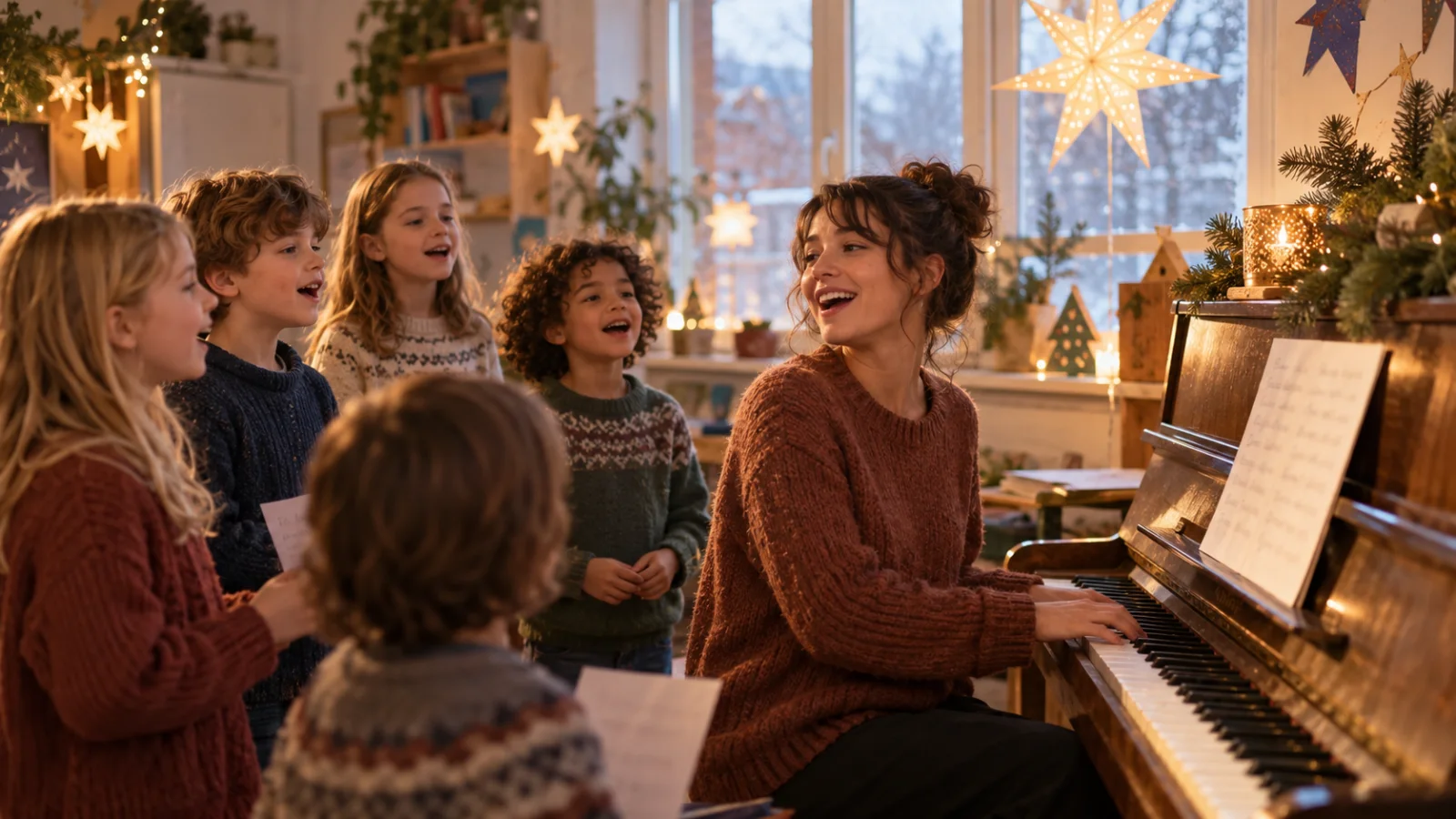
To write a Christmas song, decide first who will sing it: a class of five-year-olds, a children’s choir or the family around the table. Then pick one concrete picture of the season instead of a list of snow, bells and presents, and write a short chorus with the title in it that comes back three or four times. Give it a bell moment everyone can join (a sung “ding, dong” or a shake of jingle bells), keep the melody inside five or six notes if children will sing it, and set it on three chords such as D, G and A. Don’t want to write a melody? Put new words to a traditional carol whose tune is in the public domain, like “Jingle Bells” (1857) or “Silent Night” (1818). Modern hits like “Feliz Navidad” (1970) are still protected.
Below: the version for each kind of singer, what makes a song sound like Christmas without the clichés, how to make a Christmas song step by step, a worked example for a class (with melody and actions), a funny family song on an old tune, a template to copy, a timeline for a December school show and how to record it for the family.
First decide who will sing it
The same idea becomes a different song for a kindergarten class, a children’s choir or a brother-in-law. Decide this before you write a line.
| Who sings | Length | Range | What works |
|---|---|---|---|
| Preschool or kindergarten class (3–5) | 1–2 minutes | Five or six notes, about middle C to A | One short chorus, lots of repeats, an action per line, a bell part |
| Elementary class (6–8) | 2–3 minutes | Middle C to the C above | Call-and-response verses, a simple story, one or two solo lines |
| Children’s choir | 2–3 minutes | The same, with an easy second part | Verses in unison, a harmony or an echo only in the last chorus |
| School show or nativity play | Under 2 minutes per song | Whatever the youngest group can sing | Each song says what its scene is about; the narration does the rest |
| The family at the table | About 1 minute | Any tune they already know | A familiar carol tune with new words and the person’s name |
| Church or adult choir | About 3 minutes | An octave or a little more | A fresh angle on the story and a chorus the congregation can pick up |
The ranges for children come from Natalie Sarrazin’s open textbook Music and the Child, which also warns that adults tend to pitch songs where they are comfortable, usually too low for children. Check your own voice with the vocal range test, then choose the key for the class in what key should I sing in, which opens with middle C to A. The guide to writing a song for kids goes deeper into words and range by age.
What makes a song sound like Christmas (without the clichés)
Four things do most of the work.
One concrete picture. Christmas songs that last describe something you can see: a table, a journey, a window. A list of seasonal words only sounds like every other song. Swap the cliché for a detail that belongs to your singers:
| Cliché | Why it falls flat | Try instead |
|---|---|---|
| Snow falling softly | Generic, and odd if it doesn’t snow where you live | The real weather: rain on the bus window, a frosty playground |
| Presents under the tree | Every song has them | One gift with a story: the scarf Grandma knits every year |
| Joy, cheer, magic | Abstract words with nothing to see | An action: setting the table, the first lights on your street |
| Santa’s sleigh in the sky | Seen a thousand times | Something only your class or family does: the paper chain in the hallway |
| night / bright, snow / glow | The rhyme everyone expects | Keep it once if you like, with a fresh detail right next to it |
Bells and a steady pulse. Most carols you know have a bright, regular beat or a gentle rocking one. For a lively song, 90 to 110 BPM feels like walking; find it with the tap tempo metronome. Then write a bell line: a two-note “ding, dong” on a falling interval, short enough for every child to sing even before they know the words. If the class has jingle bells, let them ring only on that line. Bells that ring through the whole song cover the words.
A chorus everyone can sing. Put the title in its first or last line, keep it to two or four short lines and bring it back after every verse. The guide to writing a chorus has more ways to make it stick.
Religious or secular, on purpose. Both are Christmas songs. A religious carol works best when it tells the story from one point of view: a shepherd’s child, the innkeeper, the donkey on the road. If you write for a church, the guide to writing a worship song covers singable keys and lyric care. A secular song can be about family, winter, light or coming home. Many schools ask for a secular winter song for their show, so check with the school before you write.
How to make a Christmas song in 8 steps
- Write the job in one sentence. “A song of about a minute and a half for 24 five-year-olds to sing at the December show, with bells.” Or “A one-minute song for Uncle Dave on Christmas Eve, to the tune of ‘Jingle Bells’.”
- Find the picture and the title. List ten details of your Christmas: who is there, what you can hear, what you make, what always goes wrong. Circle one. That’s your title. If you’re stuck, the songwriting prompts generator gives you a starting point.
- Write the chorus first. Two to four lines with the title in them. Count the syllables with the syllable counter: lines sung to the same tune need about the same count.
- Add the bell line. A short sound word on two notes, sung by everyone after the chorus.
- Write two or three verses that move. Before, during and after (making the decorations, hanging them, the night), or a call-and-response where you sing the line and the group answers. Look for simple rhymes in the rhyming dictionary and pick the shortest word the singers already know.
- Hum the melody and record it at once. Sing the chorus on a few neighboring notes and record it in the free online voice recorder before you forget it. For little ones, stay inside five notes.
- Put three chords under it. I, IV and V are enough for most carols: D, G and A in D major. Hear the progression of the example below in the chord progression player, which opens on D–A–G–D at 100 BPM.
- Try it with the singers and fix one thing. Teach the chorus, sing it twice and watch where voices drop out. That’s the line to shorten or the note to lower.
Worked example: “Paper Stars”, a Christmas song for five- and six-year-olds
A song written for this article, following the steps above.
The job. A class of five- and six-year-olds sings it at the school show in mid-December. It’s secular, about one picture: the paper stars the class makes and hangs in the window for the street to see. Key: D major. Melody: only the five notes from D to A. Chords: D, A and G. Tempo: 100 BPM.
The chorus and the bell line, with their actions:
CHORUS (everyone)                     ACTION
Paper stars, paper stars,             open and close your hands like twinkling stars
shining on the door,                  point at the door
one for you and one for me            point at a friend, then at yourself
and one for someone more.             arms open wide

BELL LINE (everyone)
Ding, dong! Ding, dong!               shake the bells twice
The melody, note by note. Each line ends on a note of its chord, and the bell line uses only two notes, A and F♯:
| Line | Chord | Sung notes |
|---|---|---|
| Paper stars, paper stars | D | F♯ G A · F♯ G A |
| shining on the door | A | E E E F♯ E |
| one for you and one for me | G | G G G A G F♯ G |
| and one for someone more | D | E E F♯ E E D |
| Ding, dong! Ding, dong! | D | A F♯ · A F♯ |
The verses, in call-and-response. The teacher sings the long lines on the same five notes (or says them in rhythm) and the class answers on A and F♯, like the bell line:
VERSE 1
Teacher: Fold the paper, one, two, three,
Class:   snip, snip, snip!                 (scissor fingers)
Teacher: Open it slowly. What do we see?
Class:   A star! A star!                   (hands burst open)

VERSE 2
Teacher: Up in the window, nice and high,
Class:   stretch, stretch, stretch!        (reach up on tiptoe)
Teacher: Now it can wave to the people going by,
Class:   Hello! Hello!                     (wave)

VERSE 3
Teacher: The night comes early, dark and long,
Class:   shh, shh, shh!                    (finger on your lips)
Teacher: So we light it up with a Christmas song!
Class:   Ding, dong! Ding, dong!           (bells)
Structure: chorus and bell line, verse 1, chorus, verse 2, chorus, verse 3, chorus. With one bar per chorus line, one for the bell line, two for each teacher line and one for each answer, that’s 38 bars: about a minute and a half at 100 BPM, right for this age.
What each choice does:
- One picture, no clichés. No snow, no sleigh: the stars are something the children actually make, so they know what they are singing about.
- The children’s part is tiny. The chorus, the bell line and three-word answers. The teacher carries the information.
- Every line has an action, and each action reminds them of the next words.
- Five notes, D to A, inside the range of this age group, with no leap bigger than three notes.
- The last verse ends on the bell line, so the song finishes on the moment every child can do.
A funny Christmas song for the family, on an old tune
A personalized song for a relative is the other big reason people write Christmas songs, and humor works. The quickest route is new words to a tune everyone at the table already knows. “Jingle Bells” is ideal: the melody is from 1857 and free to use, and its chorus has a clear grid.
| Chorus line | Syllables | Where the stress falls |
|---|---|---|
| Line 1 | 3 + 3 + 5 | The last syllable of each group is on a strong beat |
| Line 2 | 7 + 7 | The 7th syllable of each half is on a strong beat and rhymes with the end of line 1 |
| Lines 3 and 4 | The same as lines 1 and 2 | The same |
An example for an uncle who carves the turkey every year:
Uncle Dave, Uncle Dave, carving like a pro,                       (3 + 3 + 5)
watched a video at noon, now he's running the whole show.         (7 + 7)
Uncle Dave, Uncle Dave, master of the rolls,                      (3 + 3 + 5)
burned a little, like his jokes, and we love him, bless his soul. (7 + 7)
Rules for teasing with love:
- Pick what they would laugh at themselves: a habit, a hobby, a running family joke. Leave out weight, money, exes, work trouble and anything told in confidence.
- Three true details beat ten generic jokes. The video at noon is funnier than any joke about turkeys in general.
- End warm. Let the last line turn the joke into affection.
- Print the words big for everyone. The person being sung to just listens.
- Check it with someone who knows them before Christmas Eve.
For a serious song for a relative, the hub on how to write a song for someone walks through memories, details and structure.
New words to a traditional carol: which tunes are free to use
Writing your own lyric on an old carol tune is the easiest way to get a Christmas song without composing a melody. Before you pick the tune, check that it’s really old.
- In the United States, works published in 1930 or earlier are in the public domain as of January 1, 2026, and sound recordings from 1925 entered it the same day.
- In the United Kingdom, the standard term for words and music is 70 years after the author’s death, counted from the end of the year.
- Free tunes: “Jingle Bells” was published by James Lord Pierpont in 1857, and the Library of Congress is not aware of any US copyright on it. “Silent Night” was first sung on December 24, 1818, in Oberndorf, Austria, with words by Joseph Mohr and music by Franz Xaver Gruber.
- Not free: “Feliz Navidad” (1970) and most Christmas songs you hear on the radio still belong to their writers. To publish new words on them, you need permission or a real parody, and the guide to writing a parody song explains the rules.
- Watch the extras. A modern arrangement and a recording have their own rights even when the tune is old. Sing over your own accompaniment, not a downloaded backing track, if the video will go online.
This isn’t legal advice. For a ticketed or broadcast show, ask the school or the venue how it handles music licensing.
The method: sing the first line of the original, count its syllables and mark the stressed ones, then write your own line with the same count and the stresses in the same places. Paste your new words below and compare each line with the original:
Template: copy it and fill it in
CHRISTMAS SONG: TEMPLATE
Who sings:                    How many:            Age:
Occasion and date:
Religious / secular:          Length (minutes):
The job in one sentence:

THE PICTURE (one concrete detail, not a list):
Title:

MELODY: my own / traditional tune (name it, check it's public domain):
Key:            Lowest and highest note:            Tempo (BPM):
Chords:

CHORUS (2–4 lines, title included)            syllables
1.                                            ( )
2.                                            ( )
3.                                            ( )
4.                                            ( )
BELL LINE:

VERSE 1 (before):
VERSE 2 (during):
VERSE 3 (after):
Call-and-response answers:
Actions (one per line):

CHECK
[ ] The chorus comes back after every verse
[ ] Every line fits in one easy breath
[ ] The melody stays inside the singers' range
[ ] No cliché without a real detail next to it
[ ] Guide track recorded
Timeline for a December school show (start in November)
A short song learned well beats a long one learned in a panic. If the show is in mid-December, start in the first week of November.
| Week | What to do |
|---|---|
| 1 (early November) | Agree on the occasion, the length, who sings and whether it’s religious or secular. Write the job sentence and the title. |
| 2 | Write the chorus, the bell line and the verses. Check the syllables and choose the key for the class range. |
| 3 | Record the guide track and share it with colleagues and families. Start teaching the chorus by echo, ten minutes a day. |
| 4 | Add one verse at a time, then the actions and the bells. |
| 5 | Sing it standing where you’ll perform, with the entrances, the exits and any solo lines. |
| 6 (show week) | Dress rehearsal, then the show. Record it for families, with the school’s permission. |
If the show grows into a story with several songs, how to write a song for a musical has a 12-week plan for a school musical.
Recording it for the family
- Record a guide track first. Sing the whole song yourself at the final tempo, with chords if you play. Families can practice at home with it.
- At the show, put the phone one to two meters (three to six feet) in front of the group, at the children’s mouth height, in airplane mode. The guide to writing a song for kids has more recording tips.
- Before sharing children’s voices or faces, follow the school’s rules and get the parents’ agreement. When in doubt, share audio only, in a private group.
- For relatives far away, film the family singing the song and send it as a video message. It’s a favorite with grandparents; the guide to writing a song for your grandparents has ideas for a song just for them.
Personalized Christmas songs made with AI
Apps and websites that turn a name and a few details into a finished Christmas song with a synthetic voice exist, and they’re fast. What you get is a generic melody and a voice that belongs to nobody at the table. A homemade song, even sung a little off-key, is the one people remember, because the details and the voices are real. If you use AI, use it for ideas (twenty rhymes for “Dave”, a list of traditions to jog your memory), then write your own lines and sing them yourself.
Common mistakes
- Pitching it in your own key. Adult voices sit lower than children’s. Check their range and move the song up if needed.
- A list of Christmas words instead of one picture. Snow, bells, presents and joy in four lines make a song nobody remembers.
- A chorus that appears once. Repetition is what lets a group join in.
- Starting in December. Children need several weeks of short, daily practice.
- Bells everywhere. Keep them for the bell line, so the words come through.
- A modern hit for a video that will go online. Use your own melody or a public-domain tune.
Where Zoundroom fits: the lyric, the guide track and the rehearsal takes in one project
A school Christmas song gets scattered fast: the lyric in a document, the actions on a sticky note, the melody in your head, the guide track somewhere in your camera roll and a colleague’s version on another phone. In Zoundroom each song is a project that keeps its recordings, lyrics, notes and files together. Create one for your song in early November and write the lyric in a note, with the action in brackets after each line, the bell cues marked and the key, chords and tempo at the top. Record the guide track inside that note, on your phone or in the browser at app.zoundroom.com: the audio is inserted where the cursor is, under the chorus it belongs to. After rehearsals, import the class takes into the same project to hear the progress week by week. If a colleague teaches the song to another class, invite them to the project (Free shares with up to two artists; if they have Pro, they can leave feedback at the exact second of a take). Auralis, Zoundroom’s AI assistant, can suggest simpler words for a verse, as text only. Be clear about the limits: Zoundroom isn’t a classroom platform for pupils, doesn’t generate audio, has no virtual instruments or beats and isn’t where you mix and master a finished track (a DAW such as GarageBand or BandLab is). Your next step: create the project and record the chorus inside its note before your first rehearsal. See how notes and lyrics work with audio.
Frequently asked questions
How do you write a Christmas song for kids to sing?
Pick one concrete picture, write a two- to four-line chorus with the title in it and repeat it after every verse. Add a two-note bell line, an action for each line and call-and-response verses. Keep the melody inside five notes, about middle C to A for preschoolers, on three chords such as D, G and A.
What makes a song sound like a Christmas song?
A concrete seasonal picture rather than a list of clichés, a steady bright or rocking pulse, a bell sound (sung or played) and a chorus everyone can sing. Three simple chords and a melody that moves by small steps help it sound like a carol.
Can I write new words to a Christmas carol?
Yes. With a public-domain tune such as “Jingle Bells” (1857) or “Silent Night” (1818), you can sing and share your own words; use your own accompaniment rather than a modern recording. Recent songs such as “Feliz Navidad” (1970) are protected, so publishing new words on them needs permission or a real parody.
When should we start preparing a school Christmas song?
About six weeks before the show: the first week of November for a show in mid-December. Write it in the first two weeks, record a guide track, then teach it in short daily sessions, the chorus first and one verse at a time.
Sources
All pages checked on October 2, 2026.
- Natalie Sarrazin, Music and the Child, Open SUNY Textbooks, 2016, chapter 5, “Children Singing and Children’s Songs”: general ranges by age (C to A at 3–5 years, C to C’ at 6–8, B♭ to E’ at 9–11) and adults pitching songs too low for children. milnepublishing.geneseo.edu
- Library of Congress, “The one horse open sleigh”: James Lord Pierpont’s song, published by Oliver Ditson in Boston in 1857; the Library is not aware of any US copyright protection on it. loc.gov
- Silent Night Association, “Oberndorf”: first performance on December 24, 1818, at Christmas mass in the church of St. Nikola in Oberndorf, words by Joseph Mohr, music by Franz Xaver Gruber. stillenacht.at
- Yale University Library, “Public Domain Day 2026”: works published in 1930 and sound recordings from 1925 entered the US public domain on January 1, 2026. campuspress.yale.edu
- The National Archives (UK), “Copyright and related rights”: the standard term for literary, dramatic, musical and artistic works is 70 years from the end of the year following the author’s death, with many variations. nationalarchives.gov.uk
- Chicago Symphony Orchestra, “Latin icon José Feliciano returns with his first new holiday song in 50 years”: Feliciano released “Feliz Navidad” in 1970. chicagosymphony.org