
How to write a song for someone: steps, example and template
Published
Write a personal song for someone you love: turn memories into a lyric, a sing-along chorus with their name, simple chords and a phone recording they'll keep.
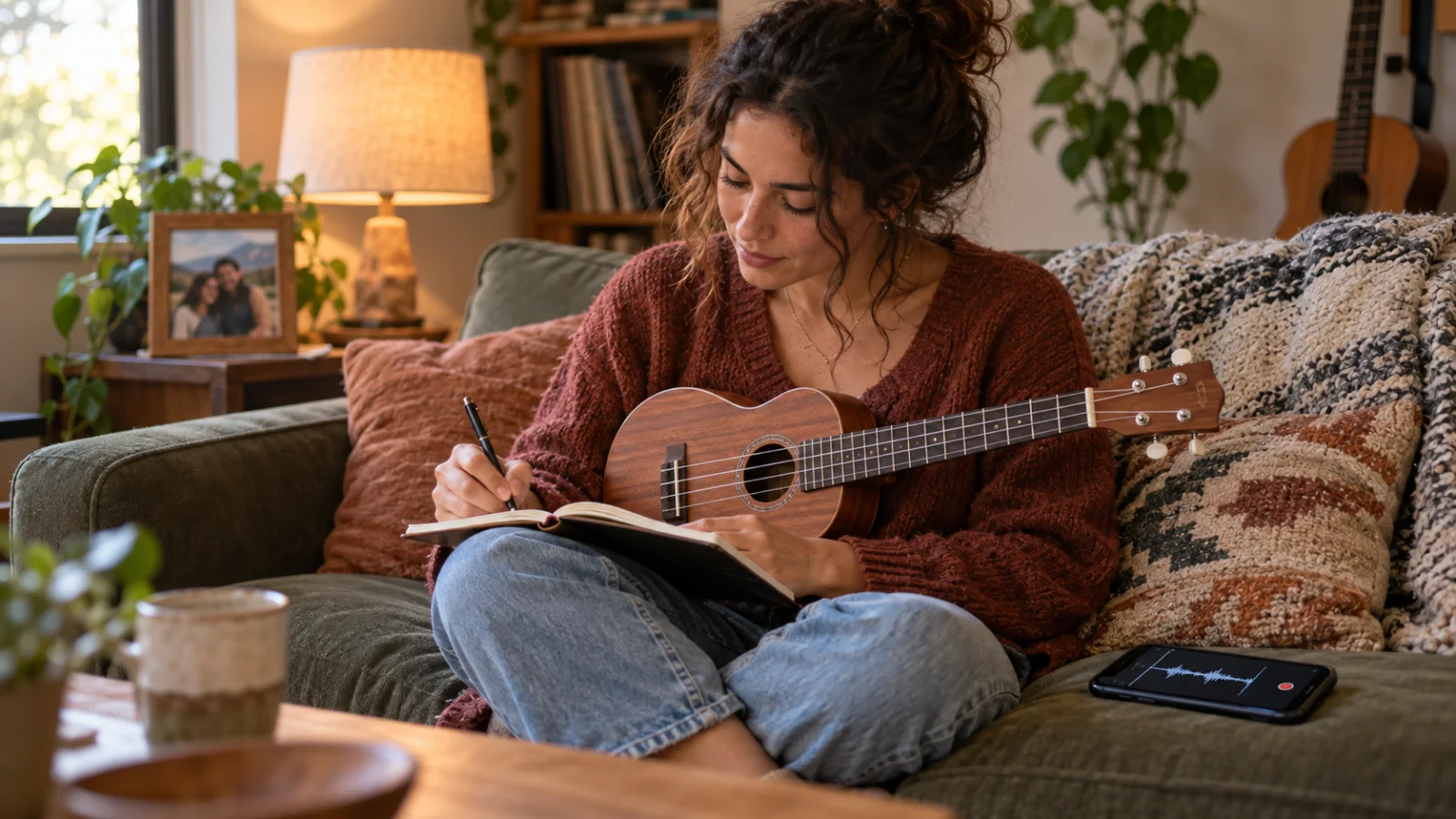
To write a song for someone, start from memories, not from big feelings. Spend twenty minutes listing specific details about the person: a phrase they always say, a place, an object, a habit, one moment you shared. Pick one story from that list, tell it in two short verses, and write a chorus with one simple line everyone can sing back, often their name or a phrase only they would recognize. Put it on three or four chords in a style they already love, keep the melody in a comfortable range and record it on your phone. It doesn’t need to be perfect: a simple song about someone you love, written by you, means more than a polished one made to order.
Below: who the song is for and what changes with each person, a memory list that turns into lyrics, how to fit a name into a melody, a worked example with chords, how to record and share it, an honest look at personalized songs made with AI, and a template you can copy.
First, who is it for? Seven people, seven angles
The same method works for everyone, but the angle changes with the person and the occasion. Choose before you write a single line.
| Who it’s for | Best angle | Tone | Watch out for |
|---|---|---|---|
| Partner | The moment you knew | Intimate, specific | Clichés about forever (love song guide; as a gift, song for your girlfriend or boyfriend) |
| Mother or father | Something they did that you only understood later | Grateful | A list of thank-yous (song for your dad) |
| Friend | One shared adventure, one inside joke | Playful | Jokes only two people get |
| Child | A promise, their small habits | Gentle, like a lullaby | Adult worries in the lyric (song for your son or daughter) |
| Grandparent | Their hands, their house, their sayings | Warm, a little nostalgic | Writing as if they were already gone |
| Someone who passed away | One ordinary day with them | Quiet and honest | Trying to sum up a whole life (sad song guide) |
| Colleague retiring, friend moving away | Funny stories, then thanks | Light, made for a group | A speech set to music |
Then the practical questions: Is it a surprise? Will you sing it live, or send a recording? Will other people sing along? Your answers decide the length, the key and how private the details can be.
If the song is for a specific occasion, each one has its own guide:
- Birthday song: their name in the chorus, sung to the Happy Birthday tune or to a melody of your own.
- Wedding song: for the ceremony, the first dance or a toast.
- Song for your mom: for Mother’s Day or any other day.
- Song for kids: for your own children, a class or a school project.
Step 1: turn memories into a details list
Set a timer for twenty minutes and write fast, without judging. Aim for fifteen details. Use these prompts:
- A sentence they always say. The exact words, not a summary.
- A place: a kitchen, a car, a bench, a street, a beach in winter.
- An object: a mug, a jacket, a radio, a pocket full of something.
- A sound or a smell: whistling, keys, coffee, sunscreen, sawdust.
- A first: the first time you met, the first time they trusted you with something.
- A ritual: Sunday calls, the same song in the car, the same joke every Christmas.
- A hard day they helped with, and what they actually did.
- Something they don’t know you noticed.
Good details are things a camera could film. “You were always there for me” can’t be filmed. “You drove four hours with a spare key” can. If the song is a surprise, ask a sibling or a friend for one story you don’t know; it often becomes the best line.
Then circle three details: the most specific, the most surprising and the one that makes you smile or swallow hard. Those three carry the song. Keep one inside joke at most, and give it a door: a stranger should understand what is happening even if they don’t know why it matters.
Step 2: pick one story and a simple arc
A personal song is not a biography. It is one story told well, with the person at the center. Four arcs that work for almost anyone:
- Then, now, always. Verse 1 is a memory, verse 2 is today, the chorus is what never changed.
- The day I understood. Verse 1 is what they did, verse 2 is when you finally understood why.
- A letter. You speak to them directly, as if they were across the table: “You don’t know this, but…”
- The list. Each verse is three small images of them; the chorus says what the list adds up to.
Write the arc as three sentences before writing lyrics. Example: “Verse 1: Grandpa teaching me to ride a bike. Verse 2: I’m teaching my own kid now. Chorus: he let go, and I didn’t fall.” If those three sentences move you a little, the song will.
Step 3: write a chorus they can sing along to
The chorus is what the person and everyone in the room will remember. Write it before the verses.
- One line, repeated. Put the main line at the start or the end of the chorus, and sing it twice. The chorus guide has eight techniques for making it stick.
- Short lines, around six to nine syllables. Check them with the syllable counter when a line feels crowded.
- Simple rhymes. Plain words sound sincere; the rhyming dictionary gives near rhymes as well as perfect ones.
- A range other people can sing. Worship leader Bob Kauflin keeps songs for untrained groups between a low A and a high D, which is A3 to D5 (men naturally sing it an octave lower). If friends and family will join in, stay inside that window. The free what key should I sing in tool opens with that range entered and tells you which key fits your melody.
How to put their name in the song
People search for a “song with my name” because hearing your own name sung is powerful. It is also where many personal songs stumble. Three rules:
- Count the syllables and find the stress. Sam has one syllable. EL-ea-nor has three, stressed on the first. o-LIV-i-a has four, stressed on the second.
- Put the stressed syllable on a strong beat, and on a long note if it ends a line. “Oh, Olivia” works when “LIV” lands on the beat; “OL-i-VI-a” sounds wrong to every listener, even if they can’t say why.
- If the name won’t fit, use what they are to you. Grandpa, little sister, my old friend. A nickname often sounds warmer than the full name anyway.
Use the name once or twice per chorus, not in every line. In a verse it feels intimate; in the chorus it turns the song into theirs forever, which is exactly what you want for a gift.
Step 4: choose a style they already love and keep the music simple
Ask yourself what they listen to in the car. A grandfather who loves old country will feel more at home with three chords and a steady strum than with a modern ballad. You don’t need complex harmony: three or four chords in a loop are enough for a personal song. If you don’t play an instrument, open a loop in the free chord progression player, hum over it and record what you hum.
| If they love… | Try | Loop it |
|---|---|---|
| Acoustic, folk, singer-songwriters | I–V–vi–IV, strummed, 92 BPM | G–D–Em–C |
| Slow, emotional ballads | I–vi–IV–V, arpeggio, 76 BPM | C–Am–F–G |
| Old country and rock’n’roll | I–IV–V–IV, 112 BPM | G–C–D–C |
| Upbeat pop for a party | I–V–vi–IV, pop drums, 116 BPM | C–G–Am–F |
| A lullaby for a child | I–IV–I–V, no drums, 66 BPM | D–G–D–A |
Listen to the warm, slightly nostalgic loop that suits many songs for family:
After the two-second count-in, an arpeggio plays C, Am, F and G, one bar each, over a soft ballad beat, and the loop starts again at about 0:13. Listen for the Am at around 0:05: the one minor chord gives the loop its tenderness, and the G at the end of each round pulls you back to the start. It’s a synthesized teaching example, not a finished production.
A word on borrowed tunes: new words on a famous melody can be fun at a family dinner, but the melody still belongs to whoever wrote it unless it’s an old traditional tune. If you plan to post the video publicly, write your own. The guide on how to put music to lyrics shows six steps to find a melody from the words.
Worked example: “Go, Kid, Go” for a grandfather
A song written for this article. The details list, cut to the three that made it into the lyric: he whistled while fixing bikes in the garage, he said “measure twice” about everything, and he let go of my bike on Maple Street without telling me. The arc is then, now, always. Key of G, 84 BPM, I–vi–IV–V (loop it).
Verse 1:
G                       Em
Saturday, the garage door open,
C                         D
radio low on the ballgame,
G                         Em
you were whistling through a bike chain,
C                       D
grease in the lines of your hands.
Verse 2:
G                          Em
Down on Maple with no training wheels,
C                          D
you said, "Measure twice, then go,"
G                            Em
I was yelling, "Don't you let me fall,"
C                         D
and you'd already let go.
Chorus (the family sings the last line):
G           Em
You let go, you let go,
C                         D
and the whole street was mine to roll;
G                         Em
every time I'm scared to try,
C                   D         G
I hear you whistle, "Go, kid, go."
Bridge, then a last chorus:
Em               C
Now there's a red bike in my driveway
G                  D
and a small voice saying, "Hold on tight,"
Em                  C
I've got peppermints in my pocket,
G                       D
and I'm whistling, and I let go.
What each part does:
- Camera details: the garage door, the radio, the grease in the lines of his hands. No line says “you were a great grandfather”; the details say it.
- His own words: “Measure twice, then go” is his saying, bent slightly to fit the story. Everyone who knows him will smile at that line.
- A sing-along hook: “Go, kid, go” is three one-syllable words on the last notes, easy for a room to shout back from the second chorus on.
- The turn: the bridge moves to the present, with the writer now in his place. That’s the “now” of the arc, and it’s what makes the last chorus land.
Step 5: record it simply on your phone
You don’t need a studio. A clear phone recording of your voice and one instrument is the version they’ll keep and replay.
- Find your key: take the free vocal range test, then enter your range in what key should I sing in; guitarists also get the capo position.
- Rehearse until you don’t need the paper. Set the tempo with the tap tempo metronome if you rush when you’re nervous.
- Pick a soft, quiet room. A bedroom with curtains and a bed beats a kitchen or a bathroom.
- Place the phone a hand span (15–20 cm) from your mouth, slightly to one side. On iPhone, open Voice Memos and tap Record; Apple’s guide says to move the microphone closer or farther to adjust the level. On Android, use the recorder app that came with your phone.
- No instrument? Play the chord player loop quietly on a speaker behind you and record voice and loop in one take.
- Record three full takes and keep the one with the most feeling, not the most polished.
The phone recording guide covers placement when you also play guitar, and how to avoid the usual mistakes.
Step 6: share it so the moment lands
How you deliver the song matters almost as much as the song.
- Live, in person: sing it once, without an introduction that explains every line. Print the lyric so they can keep it, and hand copies of the chorus to the room if you want people to join in.
- As a recording: send it with a short message, or film yourself singing so they can see your face. In Voice Memos, tap the More Actions button, then Share, and pick Messages, Mail or AirDrop.
- For a surprise: record it beforehand even if you’ll sing live. If your voice breaks on the day, you can still play it.
- For someone who passed away: sing or play the recording at a quiet moment, or keep it for the family. A recorded version is kinder to you at a funeral than a live one.
Personalized song with AI: what you gain and what you lose
Many people now look for a “personalized song with AI”, and the tools are real. A generator such as Suno turns a text prompt into a full song with vocals in minutes. According to its pricing page, the free plan gives 50 credits per day with no commercial rights, and its terms say free-tier output may only be used for personal, non-commercial purposes; paid plans assign you Suno’s rights to the output and allow commercial use, within monthly download limits. In the US, the Copyright Office concluded in January 2025 that prompts alone don’t give enough human control for the output to be protected by copyright.
The trade-off for a gift is simple. An AI song sounds polished, but the voice isn’t yours, the melody isn’t yours and the details are only as good as what you type. Research backs up the instinct that effort shows: in four studies, Fuchs, Schreier and van Osselaer found that people value handmade products more because they feel those products symbolically “contain love”, especially as gifts for loved ones. A song you wrote and sang yourself, even with a shaky voice, carries that.
If you do use AI, use it for words and keep your melody:
- Brainstorm, don’t outsource. Paste your details list and ask for ten rhymes for one line, or three other ways to say it. Choose and rewrite.
- Keep your details in. Anything generic the AI adds (“you light up my world”) is exactly what to cut.
- Find your own melody: hum over a chord loop and record it. The AI never needs to touch the music.
The guide to writing lyrics with AI shows how to use it without losing your own voice.
Copy this template for your song
SONG FOR SOMEONE: WORKSHEET
For: ____________   Occasion: ____________   Date: ________
Surprise?  yes / no      Live or recorded?  live / recorded
Will others sing along?  yes / no  (if yes: melody within A3–D5)

DETAILS (aim for 15, circle 3)
A sentence they always say:
A place:                 An object:
A sound or smell:        A first:
A ritual:                A hard day they helped with:
Something they don't know I noticed:
One inside joke (with a door):

ARC (three sentences)
Verse 1:
Verse 2:
Chorus:

CHORUS LINE (6–9 syllables):
Their name: ___ syllables, stress on ___
Style they love:          Chords:          Key:       BPM:
Length: about 2–3 minutes (V1 / C / V2 / C / Bridge / C)
Takes recorded:      Best take:
Where Zoundroom fits: the details, the lyric and the takes of one song
A song for someone usually starts in pieces: the details in a notes app, a hummed chorus in voice memos, the chords in a browser tab. In Zoundroom each song is a project with its recordings, lyrics, notes and files, so create one named after the person and open a note with your details list at the top. Write the verses and chorus underneath, and when a melody comes, record it inside that same note: the audio is inserted where your cursor is, right under the lines it belongs to. Import voice memos you already have, or the take you recorded over the chord player, into the project. It’s the same account on iOS, Android and the web, so you can write on a laptop and record on your phone. Keeping it a surprise? Don’t share the project until the day, or invite only the sibling who is helping with the memories (Free shares with up to two artists). When a line won’t come, Auralis, Zoundroom’s AI assistant, suggests other wordings in text; the details still come from you. Be clear about the limits: Zoundroom doesn’t generate audio, has no virtual instruments or beats, and isn’t where you mix and master a final track (a DAW like GarageBand or BandLab is). Your next step: create the project today and write your fifteen details in its first note. See how notes and lyrics work with audio.
Frequently asked questions
How do I write a song about someone I love?
Start with a list of specific details about them, pick one moment, and tell it in two short verses. Put one simple line in the chorus that sums up what that moment means, repeat it, and sing it over three or four chords. Details make it theirs; the chorus makes it singable.
Can I write a song for someone if I can’t sing or play?
Yes. Write the lyric first, then hum a melody over a loop in a free chord player and record it on your phone. If you’d rather not sing, ask a friend who plays to perform it, or play your recording quietly at the moment. Sincerity matters more than technique.
How long should a song for someone be?
Two to three minutes is plenty: two verses, a chorus sung three times and a short bridge. Longer songs lose the room, especially at a party or a ceremony. If you have more memories than fit, keep the best three and save the rest for a card.
How do I write a song for someone who passed away?
Choose one ordinary day with them instead of their whole life: a meal, a car ride, a sentence they said. Write it in the present tense, as if it were happening, and let the chorus say what you miss in plain words. Record it beforehand if you plan to share it at a service.
How do I make a personalized song with someone’s name?
Count the name’s syllables and find the stressed one, then place that syllable on a strong beat, ideally on a long note at the end of a chorus line. Use the name once or twice per chorus. If it doesn’t fit, a nickname or “Grandpa” or “my friend” works just as well.
Sources
All pages checked on October 2, 2026.
- Bob Kauflin, “Finding the Right Key to Sing In”, Worship Matters: songs for a congregation kept “from a low A to a high D”. worshipmatters.com
- Apple Support, “Make a recording in Voice Memos on iPhone” and “Share a recording in Voice Memos on iPhone”: Record and Stop buttons, moving the microphone to adjust the level, sharing through More Actions with AirDrop, Mail or Messages. support.apple.com · support.apple.com
- Suno, “Pricing”: Free plan with 50 credits per day and no commercial rights; Pro and Premier plans with commercial use rights. suno.com
- Suno, “Terms of Service” (last updated August 10, 2026): free and basic tier output only for lawful, personal and non-commercial purposes; on paid tiers Suno assigns its rights in the output to the user. suno.com
- US Copyright Office, “Copyright and Artificial Intelligence, Part 2: Copyrightability” (January 2025): prompts alone do not provide sufficient human control. copyright.gov
- Christoph Fuchs, Martin Schreier and Stijn M. J. van Osselaer, “The Handmade Effect: What’s Love Got to Do with It?”, Journal of Marketing 79(2), 2015: handmade products are perceived to symbolically contain love, with a stronger effect for gifts to loved ones. pure.eur.nl