
How to write a song for your girlfriend or boyfriend as a gift
Published
Write a song for your girlfriend, boyfriend or partner: real details, a chorus that sounds like a promise, anniversary and long-distance versions, and a template.
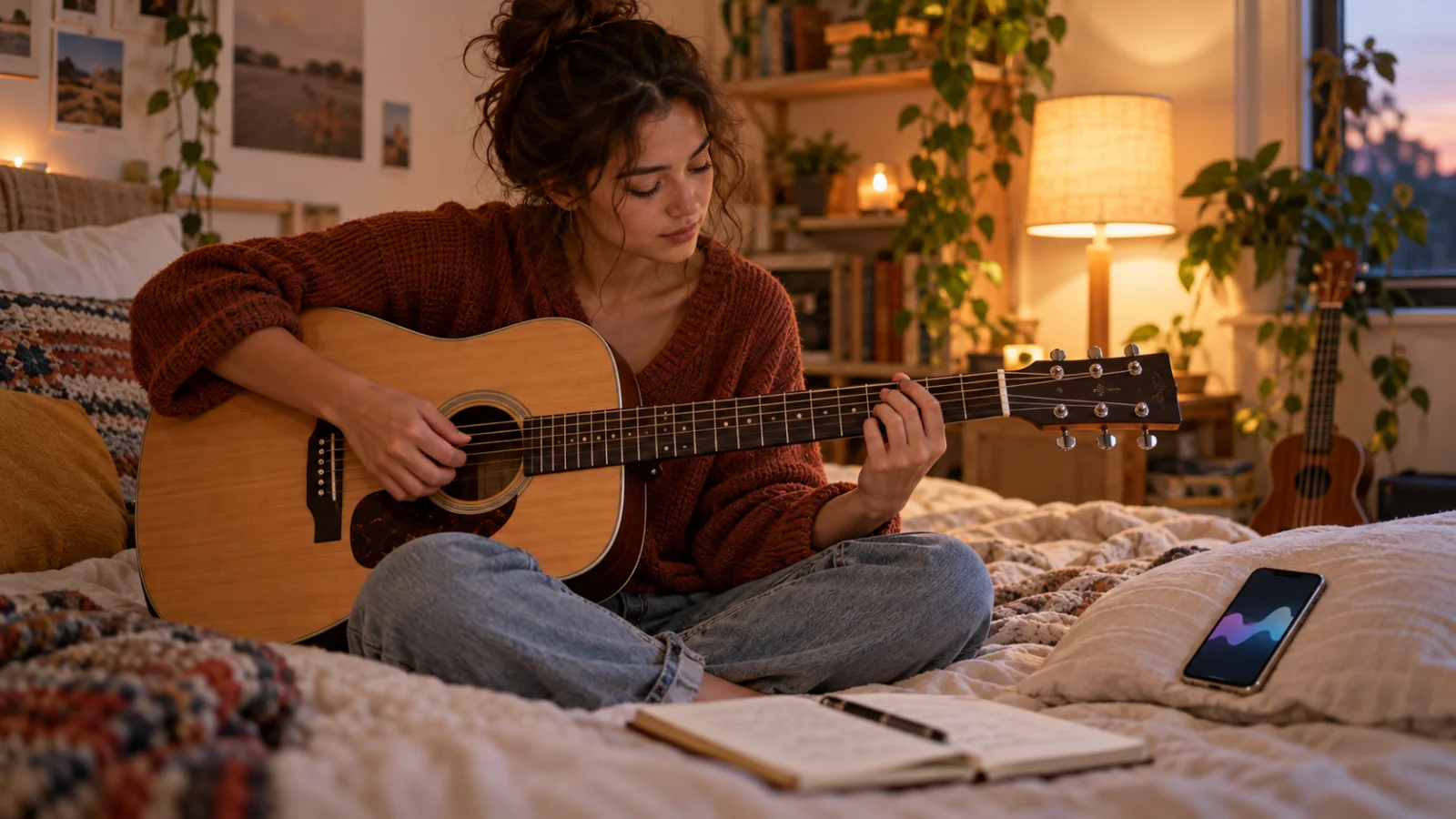
To write a song for your girlfriend or boyfriend, skip the big love words and use what only the two of you know: the way they say your name on the phone, the hoodie you never gave back, the bus stop where it started. Put that evidence in two short verses, and make the chorus a promise you can actually keep, like “I’ll stay up for your six a.m. call,” not “I’ll love you forever.” Keep the melody inside a few notes so you can sing it even if you’re not a singer, record it on your phone and send the file with the lyric. Two to three minutes is plenty, for an anniversary, a birthday or a relationship at a distance.
Below: the steps, a list of questions about you two, how to turn love words into details, how to write a promise chorus, a melody you can listen to, a worked example with chords, a template to copy, versions for anniversaries, long distance and saying sorry, and how to record and send it.
How to write a song for your girlfriend or boyfriend in 7 steps
- Answer the couple questions in step 1 below: fifteen minutes, phone notes, no judging.
- Pick three details: one from the beginning, one from now, one that will still be true next year.
- Swap every love word for evidence: if a line says “love,” “heart” or “forever,” replace it with something a camera could film.
- Write the chorus as a promise: small, specific, keepable.
- Write two short verses that show why the promise makes sense.
- Hum a melody inside five notes over three or four chords, and test the key for your voice.
- Record three takes and send the best one, with the lyric written out.
First, what kind of partner song is it?
The method is the same, but the angle changes with where you are as a couple. Decide before the first line.
| Your situation | What the song is about | Watch out for |
|---|---|---|
| New relationship (a few months) | One small moment and the feeling of not knowing yet | Promising forever to someone you met in spring |
| Long relationship, husband or wife | A routine that repeats, and what time has and hasn’t changed | Pure nostalgia: include who they are today |
| Anniversary | Then and now: the first year next to this one | Listing every year like a timeline |
| Long distance | The gap (hours, miles, screens) and the day it closes | Making the song only about missing them |
| Their birthday | Who they are this year, plus one line for the age | Turning it into a love song with a cake on top |
| After a fight | One specific thing you’re sorry for | Using the song to win the argument |
If you’re after a love song in general, for an album or an open mic, how to write a love song covers angles and clichés. This guide is about a gift for one person, who will hear every line as a message.
Step 1: questions only the two of you can answer
Set a timer for fifteen minutes and answer in a note on your phone. Write the exact words and places, not summaries.
| Ask yourself | Example answer |
|---|---|
| Where exactly did it start? | The bus stop outside the dentist, in the rain |
| What was the first thing they said that made you laugh? | ”Is this umbrella yours or are we sharing now?” |
| What do they call you that nobody else does? | ”Trouble” |
| What of theirs do you have? | The gray hoodie, and I’m not giving it back |
| What’s your ritual? | Saturday pancakes, always burnt on one side |
| What do they do when you’re having a bad day? | Sends a photo of a dog, any dog, no words |
| What do they say before hanging up? | ”Go to sleep, Trouble” |
| What small thing do they do that you never mention? | Turns my side of the pillow to the cold side in summer |
| What did they give up for you? | Drove back from their sister’s a day early |
| What place do you want to go to together? | The lake house in the photo on their phone |
| What did a fight teach you? | That they need ten minutes before they can talk |
| What will still be true in a year? | I’ll still burn the pancakes |
Then circle three: one from the beginning, one from now, one for the future. The beginning detail goes in verse 1, the now detail in verse 2, the future one becomes your chorus promise. A private nickname works well in one line; a whole song of inside jokes turns into a code they have to decode. If you’d play it for their friends too, give every private detail enough context that a stranger can picture it.
Step 2: replace love words with evidence
“I love you so much” is true, and it’s in thousands of songs. Your partner already knows you love them: what they don’t have is proof set to music. Every time a love word sneaks into a line, ask “what’s the evidence?” and write that instead.
| Generic line | The evidence version |
|---|---|
| ”You’re always there for me" | "A dog photo at 3 p.m., no words, and somehow I’m fine" |
| "You make me so happy" | "I laugh at the burnt side of the pancake now" |
| "I miss you every day" | "Two clocks on my phone, and one of them is yours" |
| "You’re my everything" | "You gave up a day at your sister’s to drive me home” |
You can keep one plain “I love you” in the song, usually at the end, once the details have earned it. It hits harder after three lines of evidence than in the first line. For a full list of love song clichés and what to write instead, see the love song guide.
Step 3: write a chorus that sounds like a promise
Here’s the structure that makes a partner song work: the verses look back, the chorus looks forward. The verses are evidence of what you two already are; the chorus is what you promise next. That forward turn is what makes it sound like a gift instead of a memory.
Write the promise with this test: could you actually keep it, and could someone film it? “I’ll love you till the end of time” fails both. “I’ll keep the porch light on till your train gets in” passes both. Three sizes of promise, from smallest to biggest:
- Everyday: “I’ll save you the last slice,” “I’ll warm up your side of the car.”
- This year: “I’ll learn to say good morning in your mother’s language,” “I’ll be at every one of your shows, even the 11 p.m. ones.”
- The future, but with a picture: “One day the lake house in your phone will be the view from ours.”
Mix one everyday promise with one bigger one and the chorus feels both true and generous. Some practical rules:
- Put the promise in the first or last line of the chorus, and use it as the title. “Your Side of the Car” is a title they’ll remember.
- Use “I’ll,” not “you’ll.” A promise about what they will do sounds like a request.
- Keep chorus lines at six to nine syllables and within one or two syllables of each other; check them in the lyric syllable counter.
- Rhyme simply, only lines two and four if you like. If you’re stuck, the rhyming dictionary opens with “light” filled in, a word that shows up in a lot of promises.
- Write the chorus first, then the verses that prove it. The chorus guide has more ways to make it stick.
If the promise is a proposal or wedding vows, the song has a different job; how to write a wedding song covers the ceremony, the first dance and a timeline.
Step 4: a melody you can sing even if you’re not a singer
Most people who write a song for their partner don’t consider themselves singers. You don’t need to be: the person listening wants your voice, not a better one. In a 2007 study by Peter Pfordresher and Steven Brown, only 10–15% of participants sang pitches back a semitone or more off, so if you’re nervous, you’re most likely in the other 85–90%. These choices make it easier:
- Stay inside five notes. A melody that moves mostly to the next note up or down is easy to sing and to remember. Listen to this example:
What to listen for: after the count-in (0:00–0:02), there’s one chord per bar. The melody goes E–F–G–E over C at 0:02, E–D–C over Am around 0:05 with the C held, C–D–E–F over F around 0:08 and a long D over G around 0:10; the loop repeats from about 0:13. The whole tune stays between C and G, five neighboring notes, and that’s enough for a verse. The long D sounds unfinished, which pulls you into the next line.
- Sing the verses almost like speech. Let the melody follow how you’d say the line, and save longer notes for the chorus, on the promise.
- Keep lines short and breathe at every comma. Five to seven syllables in the verses leave room for air.
- Find your key, don’t fight it. Take the vocal range test, then enter your range in what key should I sing in (the link fills in C3–G4; replace it with yours). It tells you which key fits your melody and, for guitarists, where to put a capo.
- Sing softly, close to the phone. A song for one person works at speaking volume; you don’t have to project.
- Warm up for five minutes with the free vocal warm-up before you record.
If you can’t play an instrument, open the chord progression player (G–Em–C–D at 80 BPM, arpeggiated, no drums), hum over it and record what you hum; how to write a song without an instrument walks through the whole process. If you keep going flat, how to sing in tune has a 10-minute routine.
Worked example: “Six A.M., Midnight”
A long-distance song: the partner lives six hours ahead. Verses loop G–Em–C–D and the chorus C–D–G–Em, one chord per bar at 80 BPM, so each lyric line covers two chords. Try the chorus chords in the player.
Verse 1 (now)
G                  Em
Two clocks on my phone,
C                 D
and one of them is yours,
G                 Em
your voice note from the tram,
C                  D
the beeping of the doors
Chorus (the promise)
C                  D
Your six a.m. is my midnight,
G                     Em
so I stay up with the kitchen light,
C                  D
I'll be the first voice you wake to,
G                  Em
till the morning I wake next to you
Verse 2 (evidence)
G                  Em
You fall asleep mid-sentence
C                  D
with the call still on,
G                  Em
I listen to you breathing
C                  D
till my battery's gone
Chorus again, then the bridge:
Bridge (the date)
Em                 C
Thirty-one squares on the calendar,
G                  D
I cross one off before I sleep,
Em                 C
arrivals, Thursday, six-fifteen:
G                  D
that's a promise I can keep
Last chorus (the promise, kept)
C                  D
Your six a.m. was my midnight,
G                     Em
I stayed up with the kitchen light,
C                  D
now I'm the first voice you wake to,
G                  Em
'cause this morning I woke next to you
Why it works: the verses never say “I miss you”; they show it with two clocks, the tram doors in a voice note and a call left on all night. The chorus is a promise with a picture (staying up with the kitchen light so they hear you first), and “till the morning I wake next to you” points to the reunion without the word “forever.” The bridge gives the promise a date and a time. The last chorus switches to the past tense: the promise has been kept. Verse lines are five to seven syllables, easy to breathe through; chorus lines are eight or nine, held a little longer. Verse, chorus, verse, chorus, bridge and last chorus make 48 bars, about 2:24 at 80 BPM.
Template to copy
Fill in the brackets with your own answers from step 1 and cut anything that doesn’t sound like you. If you need a title, the song title generator can give you a starting point, but your promise is usually the best title.
Title: [your promise, in four words or fewer]
Situation: new / long relationship / anniversary / long distance / birthday / sorry
Chords: verse G–Em–C–D, chorus C–D–G–Em, 76–90 BPM

Verse 1 (where you are now, or where it started)
[A place, exact]
[An object or a sound that's theirs]
[Something they do or say]
[A small detail that leads into the chorus]

Chorus (the promise)
[Your promise, an everyday one]
[What it looks like: a light, a time, a place]
[A second, bigger promise with a picture]
[A short line that brings back the title]

Verse 2 (evidence)
[Something they did for you]
[A detail a camera could film]
[A moment from this year]
[What it told you about them]

Bridge (optional: a date, a number, a change)
[A countdown, an anniversary, a plan]

Last chorus
[The promise again, kept, or made bigger]
Checklist before you rehearse:
- No line says “love,” “heart” or “forever” without evidence next to it.
- The promise is something you could actually do, and the title says it.
- Every private detail would make sense to a stranger.
- Verse lines are short enough to sing in one breath.
- The melody stays inside a few notes, in a key that fits your voice.
- It lasts under three minutes.
Versions: anniversary, long distance, husband or wife, sorry
- Anniversary. Write verse 1 about year one and verse 2 about now: the same kitchen, different mugs. Put the number of years in the bridge (“three years, two apartments, one cat”), and make the chorus promise something for year four.
- Long distance. Use the gap as material: time zones, miles, the airport, the call ritual. Let the chorus promise how you’ll get through it and the bridge name the day it ends. Send it so it arrives at a good moment in their time zone, like their morning or right before a hard day.
- Husband or wife. Long love lives in routines. Write about something you’ve done a thousand times (the school run, who makes the coffee) and what it means now. A new promise after years together lands harder than a memory.
- New relationship. Keep it light and curious: one moment, one detail, a promise about the next few weeks (“I’ll learn your coffee order by heart”). Big promises this early can feel like pressure.
- Their birthday. Who they are this year, plus one line for the age; for fitting their name into the melody, see how to write a birthday song.
- To say sorry. Name one specific thing you got wrong, without explaining it away, and make the chorus promise one change you’ll actually make. A song works as an opening, not as a replacement for the conversation.
For songs for other people in your life (your parents, a friend, a child), start from how to write a song for someone.
When to give it: Valentine’s Day and other dates
Valentine’s Day falls on Sunday, February 14, 2027, in the US, the UK, Canada and Australia. Start two weeks before: that’s enough for the questions, two verses, a chorus and a few days of rehearsal. If your partner grew up elsewhere, their date may be different: Brazil celebrates Dia dos Namorados on June 12, Colombia celebrates love and friendship on the third Saturday of September, and in Catalonia couples exchange a rose and a book on Sant Jordi, April 23. Still, a song with your details works on any day, and an ordinary Tuesday surprise is often the one people remember.
How to record it and send it
Choose the format first:
| Format | Best when | Watch out for |
|---|---|---|
| Live, in person | You’ll be together and you’re fine with nerves | Your voice may shake; that’s part of it |
| Recorded audio | Long distance, or you want to pick the best take | Send the file, not just a link that may expire |
| Video message | You want them to see your face while you sing | Light in front of you, phone at eye level |
| Live on a video call | You both like the moment happening in real time | Call apps often filter background sound to clean up speech, which can cut your guitar |
Steps for a clean recording:
- Lock the tempo. Tap the speed you rehearsed in the tap tempo metronome and play along for a minute.
- Pick a soft room. A bedroom with curtains, a rug or a sofa sounds better than a kitchen or a bathroom.
- Keep the phone about 15–20 cm from your mouth, a little to one side so your breath doesn’t hit it.
- Record three full takes and keep the one with the most feeling, not the cleanest. For audio only, the free online voice recorder records in your browser with a count-in and a click, keeps several takes and downloads the one you choose as a WAV file. Nothing is uploaded.
- Open with one sentence. “This one’s for you, from the bus stop to now” makes it personal before the first chord.
- Send the lyric too, typed or handwritten, so they can read the lines they want to hear again.
- Keep it private unless they say otherwise. It’s their song; let them decide whether it goes on social media.
Singing live on a FaceTime call from an iPhone? Apple’s Voice Isolation mic mode blocks ambient sound, while Wide Spectrum leaves it unfiltered, so pick Wide Spectrum in Control Center if you play an instrument. For phone placement when you sing and play at once, see how to record demos with your phone.
Why it’s worth the effort: in a 2015 study published in the Journal of Marketing, people preferred handmade products when buying for a loved one, because they saw them as “containing love.” A song you wrote and sang yourself is about as handmade as a gift gets.
Where Zoundroom fits: one project for the song for your partner
A partner song tends to arrive in pieces: the answers to the couple questions in one note, the chorus hummed into a voice memo on the way home, the chords on a scrap of paper you hope they don’t find. In Zoundroom each song is a project with its recordings, lyrics, notes and files, so create one with the working title (your promise), write the questions and the lyric in a note, and record the chorus melody inside that same note: the audio is inserted at the cursor, right under the words it belongs to. Keep the rehearsal takes and the final one in the same project, and leave everyone else out of it until the day if it’s a surprise; if a friend who plays guitar is helping, share the project with them (Free shares with up to two artists). The same account works on iPhone, Android and the web, so you can write on your laptop at lunch and record on your phone at night. What it doesn’t do: Zoundroom doesn’t generate audio, has no virtual instruments or beats, and isn’t where you mix and master a polished track (a DAW such as GarageBand or BandLab is). Your next step: create the project tonight and write your promise as the first line.
FAQ
Is it better to dedicate a song or write my own?
Dedicating a song you both love is a lovely gesture. Writing one adds what no existing song has: your bus stop, their nickname, the promise only you can make. Even a short song with one verse and a chorus means more to most people than a famous song they’ve heard a hundred times.
How do I write a song for my girlfriend if I can’t sing?
Keep the melody inside five notes, sing the verses almost like speech and choose a key that fits your voice with a free key finder. Record several takes and send the warmest one. You can also say the verses and sing only the chorus.
How do I write a song for my boyfriend that he’ll actually like?
Use his details, not general romance: his phrase, his habits, the thing he does that you’ve never thanked him for. Choose a style he listens to, and keep the tone close to how the two of you talk; if you joke a lot, a funny verse before the serious chorus fits.
How long should a song for your partner be?
Two to three minutes: two verses and a chorus that comes back two or three times, with an optional short bridge. At 80 BPM, 48 bars last about 2:24, short enough to replay.
How do I write a song for a long-distance relationship?
Write about the gap with concrete details (time zones, the call ritual, the airport) and make the chorus promise how you’ll handle it or when it ends. Record it beforehand and send it so it arrives at a good time in their time zone.
Sources
Pages checked on October 2, 2026.
- Peter Q. Pfordresher and Steven Brown, “Poor-Pitch Singing in the Absence of ‘Tone Deafness’”, Music Perception 25(2), 2007: in each experiment, 10–15% of participants imitated pitch at least a semitone off and were classed as poor-pitch singers. online.ucpress.edu
- Christoph Fuchs, Martin Schreier and Stijn M. J. van Osselaer, “The Handmade Effect: What’s Love Got to Do with It?”, Journal of Marketing 79(2), 2015, pp. 98–110, and its summary in ScienceDaily: participants favored handmade items when buying for a loved one, perceived as “containing love.” pure.eur.nl · sciencedaily.com
- Apple Support, “Use Voice Isolation, Wide Spectrum, or Automatic Mic Mode on your iPhone and iPad”: Voice Isolation blocks ambient noise, Wide Spectrum leaves it unfiltered; works in FaceTime calls, chosen in Control Center. support.apple.com
- Wikipedia (Spanish), “Día de San Valentín”: February 14 in most countries; Colombia’s Día del Amor y la Amistad on the third Saturday of September; Brazil on June 12. es.wikipedia.org
- Wikipedia (Portuguese), “Dia dos Namorados”: June 12 in Brazil, the eve of St. Anthony’s Day. pt.wikipedia.org
- Viquipèdia (Catalan), “Diada de Sant Jordi”: April 23, the day of lovers in Catalonia, with the rose and the book. ca.wikipedia.org