
How to write a birthday song for someone, with their name
Published
Write a birthday song in one evening: fit their name into the melody, choose funny or heartfelt, copy the template and record it on your phone for a video.
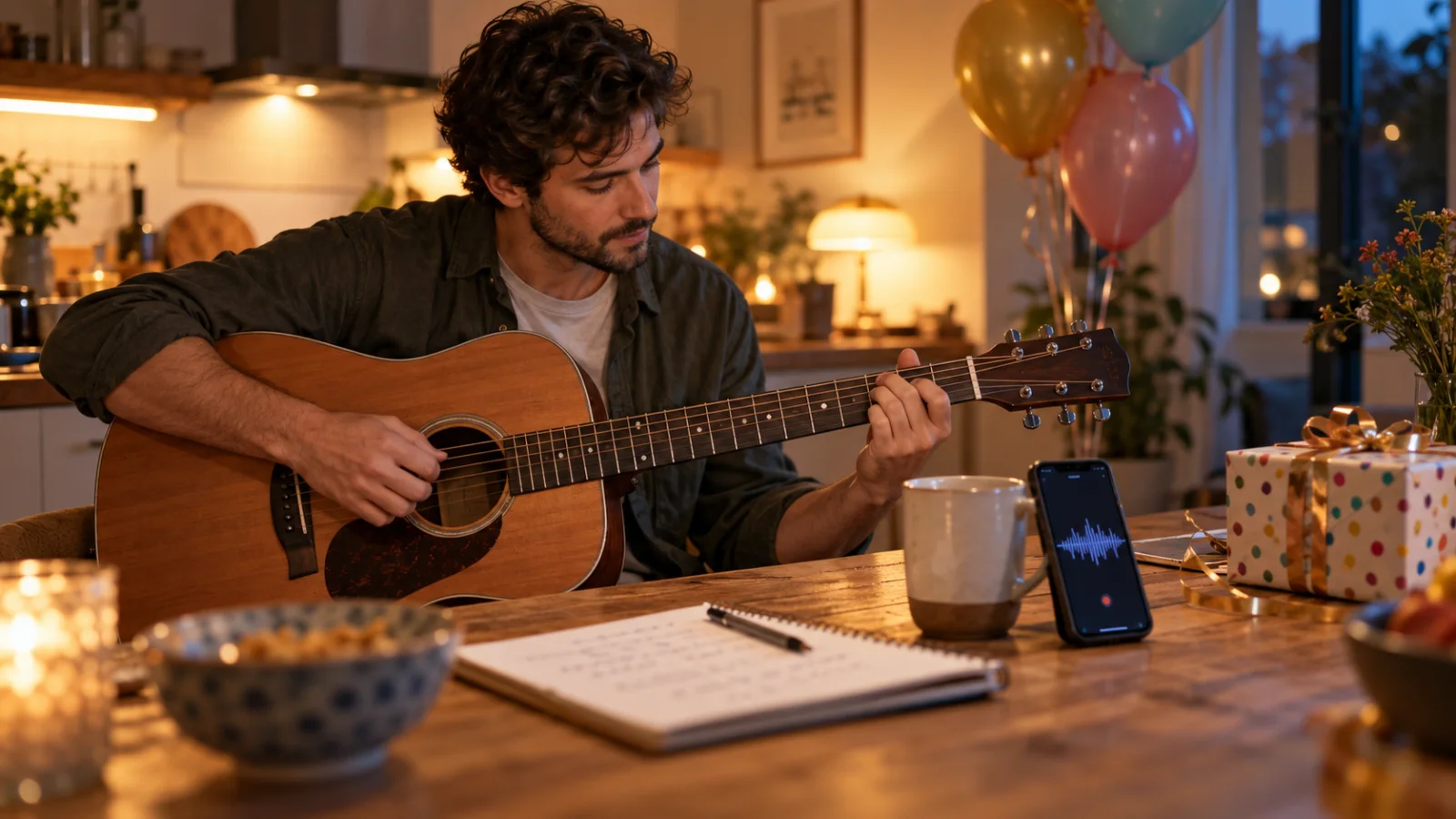
To write a birthday song for someone, collect five true details about them, decide whether the song is funny or heartfelt, and build a short chorus around their name. Put the stressed syllable of the name on a strong beat, add two short verses with the details, and keep the whole thing to about two minutes. You can sing new words to the Happy Birthday melody, which is in the public domain in the US and the EU, or hum your own melody over three or four chords such as C–Am–F–G. Rehearse it three times out loud, then sing it live at the party or record it on your phone for a video message.
Below you’ll find a method to fit any name into a melody (with a free syllable counter), a worked example that starts funny and turns heartfelt, a template you can copy, ideas for 40th, 50th, 60th and 70th birthdays, and a phone recording checklist. You don’t need to read music. If you can play three chords on guitar or piano, or just hum in tune, you have everything the song needs.
How to write a birthday song in 7 steps
- List five details only someone close to them would know: a habit, a phrase they always say, a place, an object, a moment from this year.
- Pick one tone: funny, heartfelt, or funny first and heartfelt at the end.
- Write the chorus first, with their name and the birthday line in it. Four short lines that guests can sing after hearing them once.
- Fit the name so its stressed syllable lands on a strong beat.
- Write two verses, one detail per line, each verse ending on a line that leads into the chorus.
- Choose the melody: the Happy Birthday tune with your words, or your own over three or four chords.
- Rehearse and record: three run-throughs standing up, then two or three takes on your phone. Keep the most alive one.
The rest of this guide expands each step with an example you can adapt.
Step 1: collect details, not adjectives
“You’re kind, you’re funny, you’re the best” fits every person on earth, which is why it moves nobody. A birthday song lands when the person hears something that could only be about them. Spend ten minutes answering these questions in a note on your phone:
| Ask yourself | Example answer (Grandpa Ray, turning 70) |
|---|---|
| What do they always say? | ”Measure twice, cut once.” |
| What do they do every week? | Burns the Sunday pancakes, on purpose, he claims |
| What object is “theirs”? | A red pickup from 1994 that still starts first time |
| What happened this year? | Learned to video call, and now calls at 6 a.m. |
| What would you thank them for? | Teaching you to drive in that pickup |
Five answers are enough for a whole song. Use the three most specific ones in the lyric and save the rest for the card. If you’re writing with siblings or friends, ask each person for one detail: the song becomes a gift from the whole group, and nobody has to write it alone. And if you can’t get to five, the guide on how to write a song for someone has more prompts to jog your memory.
Step 2: funny or heartfelt? Choose the order
Both work. Switching between them line by line doesn’t.
| Tone | Works best for | Watch out for |
|---|---|---|
| Funny | Friends, siblings, 30th, 40th and 50th parties, a crowd that will sing along | Jokes about age, weight or exes only work if the person already laughs at them |
| Heartfelt | Partners, parents, grandparents, a child’s milestone, a video from far away | Big abstract words; one true detail beats three adjectives |
| Funny, then heartfelt | Most milestone birthdays | Put the turn in the last verse or the bridge, not in the first line |
Funny-then-heartfelt is the safest shape for a party. Two verses of affectionate teasing make the room laugh, then one line of thanks makes it quiet, and that contrast is what people remember. A simple rule for the jokes: tease the habit, not the person. “You burn the pancakes” is affectionate; “you’re getting old and forgetful” lands differently depending on who’s in the room.
If the birthday is your partner’s, the love song guide helps with the heartfelt lines. For a mother’s birthday, see how to write a song for your mom, and for a child’s party, how to write a song for kids. And if the birthday is your dog’s, how to write a song for your dog builds the chorus around its name.
Step 3: a birthday song with their name, fitted to the melody
The name is the hook of a birthday song, so it has to sound natural, not squeezed. Do three checks:
- Count its syllables. Paste the name and the line around it into the lyric syllable counter. “Ray” has one, “Emma” two, “Olivia” four.
- Find the stressed syllable. Say the name as if you were calling across a park: EM-ma, o-LIV-i-a, ni-COLE.
- Put that syllable on a strong beat, the first beat of a bar or the beat you’d clap on. Unstressed syllables before it go in as a pickup.
| Name | Syllables | Stress | Where it goes |
|---|---|---|---|
| Ray, Max, Grace | 1 | The only one | On a long note, so it can ring |
| Emma, Lucas | 2 | First | The name starts on the strong beat |
| Nicole, Michelle | 2 | Second | First syllable as a pickup, second on the beat |
| Natalie, Jonathan | 3 | First | Strong beat, then two quick notes |
| Olivia, Elizabeth | 4 | Second | One pickup, the stress on the beat, quick notes after |
With the Happy Birthday melody, the name goes in the third line, the one that jumps up an octave and then steps down. After the word dear there are two notes for the name, and that bar is traditionally written with a fermata, a hold that lets everyone stretch it. A two-syllable name with the stress first (Emma) fits exactly. A one-syllable name stretches over both notes. For a longer name, split the notes into quicker ones, or drop dear and start the name on that note: “ni-” goes where dear was and “-COLE” lands on the first name note.
With your own melody, put the name at the start or the end of a chorus line, where it’s easiest to hear, and give it a long note. If nothing rhymes with the name, don’t rhyme the name: rhyme the line after it. The rhyming dictionary opens with “Ray” filled in; type your person’s name or nickname instead. For the theory behind stress and syllables, see song syllables and stress.
Happy Birthday melody or your own? The copyright status today
“Happy Birthday to You” uses the melody of “Good Morning to All”, which Mildred and Patty Hill published in 1893. In the US, a federal judge ruled in September 2015 that Warner/Chappell had no enforceable copyright in the song, and under the 2016 settlement it was declared to be in the public domain. In the European Union, the copyright expired on January 1, 2017, 70 years after Patty Hill’s death. So in the US and the EU you can sing new words to the melody, film it and post it.
Two caveats. Translations and local versions can have rights of their own: in Brazil, for example, the Portuguese version is treated as a separate work that is still protected. And a recording is a separate copyright from the song, so sing it yourself instead of using someone else’s track. Rules vary by country and this isn’t legal advice, but for a family video with your own voice and your own words, the melody isn’t the problem.
| Happy Birthday melody, your words | Your own melody | |
|---|---|---|
| Time needed | 30–60 minutes | One or two evenings |
| Guests sing along | Right away | After hearing the chorus once or twice |
| Room for details | Little: four short lines per round | As much as you want |
| Feels like | A personalized classic | A song that belongs to them |
| Best for | A toast, a kids’ party, a last-minute video | Milestone birthdays, a partner, a recorded gift |
A good middle ground: sing your own verses and chorus, then end with one round of Happy Birthday that the whole room joins.
Worked example: “Seventy, Grandpa Ray”
This song for Grandpa Ray uses the details from step 1. It loops C–Am–F–G (I–vi–IV–V), one chord per bar, at 84 BPM. Change the key later to fit your voice.
What to listen for: after the count-in (0:00–0:02), the loop plays C–Am–F–G twice, one bar per chord, so each lyric line below covers two chords. Hum along on the second pass and notice how the G at the end of each round pulls back to C. The chorus starts on that return, and the name lands on the next bar, the Am, where a long note has room to ring. To keep the loop running while you write, open it in the chord progression player.
Verse 1 (funny)
C                       Am
Sunday smells like smoke again,
F                          G
you swear the black ones are the best,
C                          Am
a red truck older than my car
F                     G
still starts before the rest
Chorus (guests sing this)
C              Am
Seventy, Grandpa Ray,
F                  G
turn the music up today,
C                  Am
every candle, every year,
F             G          C
we're so glad you're here
Verse 2 (the turn)
C                        Am
Now you call at six a.m.
F                            G
to prove you've finally learned the phone,
C                          Am
you taught me driving in that truck
F                       G
and how to get myself back home
Bridge (heartfelt)
Am                 F
Measure twice and cut once,
C                       G
that's the way you said it to me,
Am                   F
I measured all the years you gave,
C                    G
it comes out more than seventy
Then the chorus twice, with everyone singing, and one round of Happy Birthday to finish.
Why it works: every verse line is a detail only Ray fits (the pancakes, the truck, the 6 a.m. calls). “Ray” sits at the end of the first chorus line on a long note over Am, and it rhymes with “today”, so the name is easy to sing and easy to hear. The jokes come first and the thanks come last: “how to get myself back home” is still about the truck, but it means more. The bridge reuses his own saying and switches to Am–F–C–G, the same chords in a new order, which makes it feel different without new shapes to learn. In this form (verse, chorus, verse, chorus, bridge, chorus) the song lasts about two and a half minutes; drop the bridge for a two-minute video. If your chorus doesn’t lift, the guide on how to write a chorus has eight techniques to try. For a grandparent on any other day, how to write a song for your grandparents starts from the same kind of details.
Milestone birthdays: ideas for 18, 30, 40, 50, 60, 70 and beyond
A round number is a gift to the songwriter: it’s a ready-made hook that fits naturally in the chorus (“fifty” has two syllables, “seventy” three).
| Birthday | Song idea | Structure trick |
|---|---|---|
| 18 or 21 | A list of everything they can do now | The chorus adds one item to the list each time |
| 30 or 40 | The decade in review | One verse per era: school, first job, today |
| 50 | Then and now | Each verse compares 20-year-old them with today; the chorus says what never changed |
| 60 or 70 | A thank-you from kids and grandkids | Every branch of the family writes one line of the bridge |
| 80 and up | Their own stories: a place, a saying, the music of their youth | Slow tempo, a low key, short lines and the lyric printed in large type |
For a big party, print the chorus on cards or a sheet on each table, and teach it once before you start: sing it, then let the room repeat it. Groups sing quietly at first, so the chorus with the name should come back at least three times.
Birthday song template you can copy
Fill in the brackets, then cut anything that doesn’t sound like you. If the song still needs a name, the song title generator can give you a starting point.
Title: [Name], [age or nickname]
Tone: funny / heartfelt / funny, then heartfelt
Chords: C–Am–F–G, one per bar, 80–100 BPM

Verse 1 (funny)
[A habit they have]
[Something they always say]
[An object that's theirs]
[A line that leads into the chorus]

Chorus (guests sing this)
[Age or "happy birthday"], [Name]
[A line that rhymes with the name or the line above]
[A wish for this year]
[A short last line: "we're glad you're here"]

Verse 2 (the turn)
[Something that happened this year]
[What they taught you or gave you]
[One specific moment]
[A line that leads into the chorus]

Bridge (optional)
[A thank-you in one sentence, split over 2–4 lines]

Chorus ×2, then one round of Happy Birthday together
Checklist before you rehearse:
- Every verse line contains a detail that only this person fits.
- The stressed syllable of the name falls on a strong beat (say it out loud and clap).
- The chorus lines have similar syllable counts, within one or two of each other.
- The chorus has no word a guest could trip over.
- The song lasts about two minutes.
- Any joke that could hurt someone in the room is out.
- You’ve sung it through three times, out loud and standing up.
How to sing and record a birthday song on your phone
- Find a comfortable key. Sing the lowest and highest notes of the chorus; if the top strains, move everything down. The Happy Birthday melody spans a full octave, so a group that starts high can’t reach the jump in the third line: start on a low, comfortable note. Enter your range in what key should I sing in (the link fills in C3–G4; replace it with yours). On guitar, a capo changes the key without new chord shapes.
- Set a tempo and keep it. Tap the speed that feels right in the tap tempo metronome and play along for a minute before you sing. Something around 80–110 BPM suits a sing-along. For audio-only rehearsal takes, the free online voice recorder records in the browser with a count-in and a click, keeps several takes and lets you download the one you like as a WAV file. Nothing is uploaded.
- Set up the phone. Prop it at eye level about an arm’s length away, with the light (a window or a lamp) in front of you, not behind you. Turn on Do Not Disturb so a notification doesn’t interrupt the take.
- Choose a quiet, soft room. Curtains, a sofa and a rug soak up echo better than bare walls and tiles. Turn off the TV and anything that hums.
- Say who it’s for. Open with one sentence, “Grandpa, this one is from all of us”, and the video is personal before the first chord.
- Record three takes and keep the most alive one, not the most perfect. A cracked note with a smile beats a careful, flat take.
- For a group video, sing the chorus together in one room. Stitching separate recordings together takes a video editor and a lot more time.
If you want cleaner sound for a recorded gift, record the audio with the phone closer (about 15–20 cm, mic pointing at your mouth) and film the video separately. The guide on how to record a song on your phone covers levels and settings.
Where Zoundroom fits: one project for the birthday song
A birthday song usually comes together in pieces: the detail list in one app, the chorus hummed into a voice memo at a red light, the chords on a sticky note. In Zoundroom each song is a project with its recordings, lyrics, notes and files, so create one called “Seventy, Grandpa Ray”, put the detail list and the lyric in a note, and record the chorus melody inside that note: the audio is inserted at the cursor, right under the lines it belongs to. Import older voice memos into the project, keep the rehearsal takes next to the lyric, and share the project with the sibling who’s writing verse 2. Free shares with up to two artists; Pro shares with up to four and adds timestamped feedback, so, if they also have Pro, they can mark the exact second where the name sounds rushed. The same account works on iOS, Android and the web. What it doesn’t do: Zoundroom doesn’t generate audio, has no virtual instruments or beats, and isn’t where you mix and master a polished final track (a DAW such as GarageBand or BandLab is). It doesn’t edit the video either. Your next step: create the project tonight and record the chorus before you forget the melody.
FAQ
How do I make a birthday song with someone’s name?
Either sing the Happy Birthday melody and put the name in the third line, or write a four-line chorus with the name at the start or end of the first line, on a long note. Check the syllables and the stress with a syllable counter. If the name is stressed on its second syllable, like Nicole, sing the first syllable as a pickup before the beat.
Can I use the Happy Birthday melody in a video I post online?
In the US and the EU the song is in the public domain: a US court ruled in 2015 that Warner/Chappell had no valid copyright, and in the EU protection ended on January 1, 2017. Sing it with your own voice rather than someone else’s recording, and remember that some translated versions have rights of their own. This isn’t legal advice.
How long should a birthday song be?
Between one and three minutes. For a video message, about two minutes is right. For a toast at a party, one verse and two choruses, about a minute, keeps everyone’s attention.
Can AI make a birthday song for me?
AI song generators can turn a prompt with a name into a finished track in minutes. It’s fast, but the voice and the melody aren’t yours, and each service has its own terms; our comparison of AI apps that create songs covers them. A simple song you write and sing yourself, even a little off-key, usually means more to the person. If you use AI, use it for rhyme ideas and keep your own melody and details.
What chords should I use for a birthday song?
Three or four are enough. C–Am–F–G (I–vi–IV–V) at 80–90 BPM suits a heartfelt song. For an upbeat, funny one, try G–C–D–C (I–IV–V–IV) at about 110 BPM in the chord progression player.
Sources
Pages checked on October 2, 2026.
- WIPO Magazine, “In the courts: Court confirms legal status of Happy Birthday to You!”: Judge King’s ruling of September 22, 2015 (Warner/Chappell had no enforceable copyright in the song), the melody of “Good Morning to All” was unprotected, and the settlement filed in February 2016 refunds up to $14 million in licensing fees. wipo.int
- Wikipedia, “Happy Birthday to You”: the Hill sisters published the tune in 1893 in Song Stories for the Kindergarten; public domain in the US after the court case; copyright expired in the EU on January 1, 2017 (Patty Hill died in 1946); the name bar is traditionally written with a fermata. en.wikipedia.org
- CRB-6, “‘Parabéns a Você’ segue protegida mesmo após canção original cair em domínio público nos EUA” (citing ECAD and BBC Brasil): the Portuguese version is a new, protected work under Brazilian Law 9,610/98. crb6.org.br