
How to write a song for your dog: funny, birthday or in memory
Published
Write a song for your dog in an afternoon: put its name in the chorus, turn its habits into jokes, copy the template and film it. Plus a gentle version in memory.
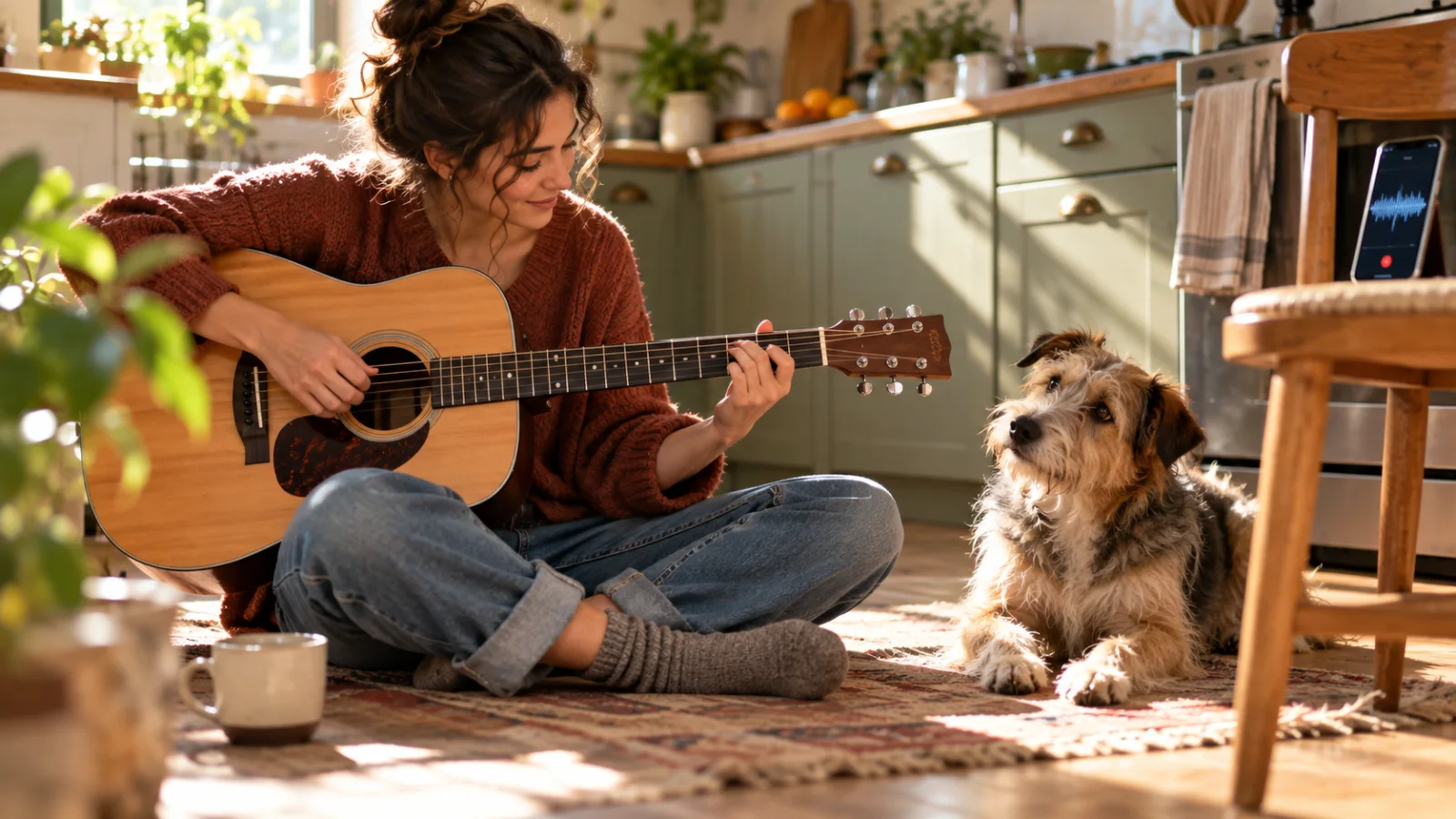
To write a song for your dog, list five habits only your dog has, build a short chorus around its name with the stressed syllable on the beat, and fill two verses with the funniest habits. Keep it to about two minutes. You can hum a melody over three chords such as G–C–D, or sing new words to a public-domain tune like “Bingo”, the 18th-century song that already spells out a dog’s name. Then sing it softly at your dog’s eye level and film it on your phone. For a song for a dog that passed away, the method is the same, only slower, and there’s a gentle section for that below.
Below you’ll find a way to fit any name into a melody (with a free syllable counter), a complete funny example about a sock thief called Daisy, a version for a birthday or an adoption day, a template to copy and a short guide to filming. You don’t need to read music. If you can hum in tune or play three chords, you have everything this song needs.
Why a song you write beats a “song for my dog” playlist
There are plenty of songs about dogs, and they’re all about dogs in general. Yours can be about the left sock that keeps going missing, the war against the vacuum and the way she looks at the ceiling when a sandwich disappears. That’s what makes people laugh at the family dinner and what makes the video worth keeping in ten years. A simple song with real details beats a polished one that could be about anybody’s dog. It also takes less time than you think: an hour for the words, an evening to find the tune.
Step 1: collect the details, not the adjectives
“You’re so cute, you’re so sweet, you’re the best” fits every dog on the planet. Spend ten minutes answering these questions in a phone note. One answer per question is enough.
| Ask yourself | Example (Daisy, four years old, scruffy mutt) |
|---|---|
| What does it steal? | Socks, only ever the left one |
| What does it bark at? | The vacuum, every time, like it’s the first time |
| Which word makes it lose its mind? | ”Walk”. We started spelling it, and now she knows the spelling too |
| Where and how does it sleep? | Upside down on the couch, all four legs in the air |
| What does it do when you come home? | Brings you a shoe, as a gift |
| What do you call it? | Daisy-Doo, Miss Daisy, the Sock Goblin |
Keep the three most specific answers for the song and the rest for the caption. If you’re writing it with your kids or your partner, ask each person for one detail: the song becomes a family project, and the dog gets a better song. The guide to writing a song for someone has more questions if you get stuck.
Step 2: fit your dog’s name into the rhythm
The name is the hook, so it has to sound the way you say it. Shout it as if your dog had just run off at the park: DAI-sy, COO-per, mar-CEL. That loud syllable is the stressed one, and it goes on a strong beat, the one you’d clap on.
| Name | Syllables | Stress | Where it goes |
|---|---|---|---|
| Max, Bear, Finn | 1 | The only one | On a long note at the end of a line, or twice in a row: “Max, Max” |
| Daisy, Cooper, Biscuit | 2 | First | On beat 1, with the second syllable right after |
| Marcel, Bernard | 2 | Second | The first syllable just before the beat, the second on it |
| Oliver, Penelope | 3–4 | First or second | Count the syllables and let the unstressed ones run fast |
| Mister Pickles | 4 | First and third | Two strong beats: MIS-ter PICK-les |
Paste the name and the line it sits in into the counter below to check that your chorus lines have a similar number of syllables.
Then look for rhymes. “Daisy” gives you lazy, crazy and maybe, which are perfect for a dog song. If nothing rhymes with your dog’s name, don’t rhyme the name: rhyme the line after it. The rhyming dictionary opens with “daisy” already typed; swap it for your dog’s name or nickname.
A simple structure for a song about your dog
A dog song doesn’t need a bridge, a key change or a guitar solo. This shape works for almost any dog and lasts about two minutes:
| Section | Its job | Length |
|---|---|---|
| Verse 1 | A daily scene: the morning, the meal, the walk | 4 lines |
| Chorus | The name, two signature habits and a punchline | 4 lines, sung three times |
| Verse 2 | The crime story: what it stole, broke or ate | 4 lines |
| Bridge (optional) | The sweet turn: why you love it anyway | 2–4 lines |
| Last chorus | Everyone sings, and the dog barks if it wants | 4 lines |
Write the chorus first. If the chorus works on its own, you could stop there and still have a song for the video.
Example: a funny song about my dog’s habits
This song for Daisy uses the details from step 1. It loops G–C–D–C (I–IV–V–IV), one chord per bar, at 112 BPM, a bouncy tempo that suits a dog with too much energy. Each line takes two chords.
What to listen for: after the count-in (0:00–0:02), the loop plays G–C–D–C twice, and that’s exactly one chorus. “Daisy, Daisy” starts on the G at 0:02, “growls at the vacuum” on the D at 0:06, “tilts her head” back on the G at 0:11 and the punchline on the D at 0:15. Notice how the D lifts the line and the C lets it land: that’s where the joke goes. To keep the loop running while you write, open it in the chord progression player.
Verse 1
G                         C
Six in the morning, a nose in my ear,
D                          C
one paw, then two, now the whole dog is here,
G                          C
the alarm didn't ring, but she clearly decides
D                          C
the sun's up enough for a walk outside
Chorus
G               C
Daisy, Daisy, queen of the socks,
D                    C
growls at the vacuum, sleeps like a rock,
G                    C
tilts her head when I sing her name,
D                  C              G
Daisy, Daisy, you're the one to blame
Verse 2
G                       C
I made a sandwich, I turned around,
D                         C
now there's a crumb and a very good hound,
G                         C
she looks at the ceiling, she looks at the door,
D                          C
like bread never happened in this house before
Bridge
Em                 C
And on the days when I come home slow,
G                   D
she's at the window, she already knows,
Em                  C
she doesn't ask how it went or why,
G                    D
she leans on my leg till the day goes by
Then the chorus twice, and leave a gap after the last “blame” in case Daisy wants to answer.
Why it works: every line holds a detail that fits only Daisy (the socks, the vacuum, the sandwich, the head tilt). “DAI” lands on beat 1 of the G, so the name sounds the way you call it. The chorus rhyme pairs her name with “blame”, and verse 2 proves the point with a stolen sandwich and a dog staring at the ceiling. The jokes come first and the warmth comes last. The bridge swaps in E minor (Em–C–G–D, vi–IV–I–V), one easy new chord that makes the sweet part sound different. With verse, chorus, verse, chorus, bridge and two choruses, it runs about two minutes.
Birthday, adoption day or an old dog: change the chorus
The same song works for other moments if you rewrite the chorus and keep the verses.
| Moment | What changes | Idea |
|---|---|---|
| New puppy | Everything is a first | One verse of the first night, one of the first chewed thing |
| Birthday | The age goes in the chorus | Count in dog things: “four years, nine leashes, one couch” |
| Adoption day | The day it came home | Before and after: the empty house, then the shoe on the doormat |
| Old dog | Slower, softer, around 70–80 BPM | Then and now: the puppy who chewed the stairs, the gray muzzle that waits on the step |
For a birthday or an adoption anniversary (many owners call it a Gotcha Day), the quickest option is new words to the “Happy Birthday” tune. Its melody comes from “Good Morning to All”, which Mildred and Patty Hill published in 1893. A US federal judge ruled in 2015 that Warner/Chappell had no valid copyright on the song, and it was declared public domain after the 2016 settlement. In the European Union, the copyright expired on January 1, 2017. So you can sing your own lyric to it, record it and post it. Something like this, with the name on the long note of the third line:
Four whole years of your fur
on my socks and my chair,
happy Gotcha Day, Daisy,
you were worth every shoe
For more on fitting a name into that tune, see the guide to writing a birthday song.
Melody options if you don’t play an instrument
You have three ways in, from no instrument at all to three chords.
- Hum it and record it. Say the chorus out loud in rhythm, then sing it on two or three notes, with the name on the highest one. Record three different versions in the free online voice recorder: it records in your browser with a count-in and a metronome, keeps several takes and lets you download the good one as a WAV. Nothing is uploaded. Pick the one you’re still humming the next morning. The guide to writing a song without an instrument explains how to find chords for it later.
- Sing over three chords. Start the G–C–D–C loop in the chord player linked above and sing whatever comes over it. If you play guitar or piano, those are three of the first chords most people learn.
- Write new words to a public-domain tune. “Bingo” is ideal, because the original is already about a dog and spells its name letter by letter, swapping one letter for a clap on each round. It was first printed in 1778 in Edinburgh and is a traditional song, so the tune is in the public domain. A five-letter name fits the five spelled notes:
I have a dog who eats my shoes
and Daisy is the culprit,
D-A-I-S-Y, D-A-I-S-Y, D-A-I-S-Y,
and Daisy is the culprit
If your dog’s name has four or six letters, split or merge a note, or spell a nickname instead. Two things to keep in mind: a modern recording of an old tune has its own rights, so sing it yourself or play your own accompaniment instead of using someone else’s track. And if you want new words to a recent hit instead, read the guide to writing a parody song first, because the rules change. None of this is legal advice, but for a family video with your voice and your words, a traditional tune is the easy road.
Template for a song about your dog
Fill in the brackets, then cut anything that doesn’t sound like you.
Title: [Dog's name], [nickname or its worst habit]
Mood: funny / sweet / funny, then sweet
Chords: G–C–D–C, one per bar, 100–120 BPM (70–80 for an old dog)

Verse 1 (a daily scene)
[What it does first thing in the morning]
[A sound it makes or a place it goes]
[What it decides, as if it were in charge]
[A line that leads into the chorus]

Chorus (sing it three times)
[Name], [name], [its title: queen of…, king of…, thief of…]
[Its signature habit]
[What it does when you say its name or "walk"]
[Name], [name], [the punchline that rhymes with line 3]

Verse 2 (the crime story)
[What you left unattended]
[What you found when you turned around]
[Its innocent face, in detail]
[A line that leads into the chorus]

Bridge (optional, the sweet turn)
[What it does on your bad days, in 2–4 lines]

Chorus ×2
Before you film it, check:
- Every verse line has a detail that only fits your dog.
- The stressed syllable of the name lands on a strong beat (say it and clap).
- The chorus lines are within a syllable or two of each other.
- The punchline is the last line of the chorus, not the first.
- The whole song is about two minutes.
- You’ve sung it three times out loud, standing up.
How to sing it to your dog and film it
- Choose a calm moment. After a walk or a meal works better than when the doorbell has just rung.
- Get down to its level. Sit on the floor and prop the phone on a chair at the dog’s eye level, about an arm’s length or two away, with the light (a window or a lamp) in front of you, not behind.
- Sing at talking volume, not into its ear. The research on dogs and music is thin and mostly done in shelters: a 2020 review of nine studies found that classical music seemed to calm dogs in stressful environments, and one study saw dogs stop responding to the same playlist after about a week. None of it tells you how your dog will feel about your voice, so watch your dog. If it stays and wags, great. If it walks off, let it. That take is often the funniest one.
- Keep a treat in your pocket for the head tilt, and don’t force a pose.
- Pick the format before you press record. Vertical for stories and messages, horizontal for a TV or a family slideshow.
- Record three takes and keep the liveliest, not the most perfect one. A cracked note and a dog sneezing on the beat beat a careful, flat take.
- Send it. For a family chat, the video is enough. If the sound matters more than the picture, record the audio alone with the phone closer to your mouth and send it as a voice message.
A song for a dog that passed away
If you’re here because your dog died, the steps above still work, just slower and quieter. Write about the small routines rather than the big feeling: the leash still on its hook, the sound of nails on the kitchen floor, the spot by the door where it waited. Mixing past and present often feels more honest than a goodbye: “the leash is still on its hook by the door, I still step around where you used to sleep.” Let the chorus say its name and say thank you. The funny details belong in this song too: the stolen socks are part of who your dog was, and a song that makes the family smile through tears can be the right one.
You don’t have to share it. Singing it once, alone, or recording it on your phone to keep, is enough. Many people write these songs to honor a dog that’s still alive and getting old, too. For a longer, step-by-step method for a tribute song, with structure and tempo ideas for a slow, quiet song, read the guide to writing a tribute song for someone who passed away; everything in it applies to a dog.
Cats, rabbits and other pets
The method doesn’t change for a cat, a rabbit or a parrot: details instead of adjectives, the name on the beat, the jokes first and the warmth last. Only the habits change. A cat song writes itself from the ways it ignores you: the box it prefers to the bed you bought, the glass it pushes off the table while looking you in the eye. Just don’t expect the cat to sit still for the video. Filming it walking away mid-chorus is part of the joke.
Where Zoundroom fits: one project for your dog’s song
A dog song comes together in scraps: the habit list in one app, the chorus hummed into a voice memo on a walk, the chords on the back of an envelope. In Zoundroom each song is a project with its recordings, lyrics, notes and files, so create one called “Daisy, queen of the socks”, put the habit list and the lyric in a note and record the hummed chorus inside that note: the audio is inserted at the cursor, right under the lines it belongs to. Import the voice memo from the walk into the project, keep the rehearsal takes next to the lyric and share the project with whoever is writing verse two. Free shares with up to two artists; Pro shares with up to four and adds timestamped feedback, so your partner, if they also have Pro, can mark the exact second where “Daisy” sounds rushed. The same account works on iOS, Android and the web. What it doesn’t do: Zoundroom doesn’t generate audio, has no virtual instruments or beats, and isn’t where you mix and master a polished final track (a DAW such as GarageBand or BandLab is). It doesn’t edit the video either. Your next step: create the project tonight and record the chorus before the next sock disappears.
FAQ
Can I use the “Bingo” tune with my dog’s name and post the video?
“Bingo” is a traditional song first printed in 1778, so the tune is in the public domain. Sing your own words with your own voice, or play your own accompaniment, rather than singing over someone else’s recording, which has its own rights. This isn’t legal advice, but a family video with a traditional tune is the low-risk option.
Do dogs like it when you sing to them?
The research can’t answer that for your dog. Most studies on dogs and music were done in shelters with recorded music, and a 2020 review of them found that classical music seemed to calm dogs in stressful places. Watch your own dog: sing at talking volume and let it leave if it wants to.
Can AI make a personalized song for my dog?
Yes. AI song generators and personalized-song services can turn a name and a few details into a finished track in minutes. The voice and the melody won’t be yours, and each service has its own terms; the comparison of AI apps for creating songs goes through them. A simple song you write and sing yourself, off-key notes included, usually means more to the people watching. If you use AI, use it for rhyme ideas and keep your details and your voice.
How long should a song for my dog be?
One to two minutes. For a video on social media or in a family chat, one chorus and one verse (about 45 seconds) is often enough. For a birthday or a tribute, the full shape with two verses and three choruses runs about two minutes.
Sources
Pages checked on October 2, 2026.
- Lindig, McGreevy and Crean, “Musical Dogs: A Review of the Influence of Auditory Enrichment on Canine Health and Behavior”, Animals 10(1):127 (2020): nine experimental studies, mostly in shelters; classical music appears to calm dogs in stressful environments; dogs exposed to the same playlist over 7 days stopped responding to it (Bowman et al., 2015). pmc.ncbi.nlm.nih.gov
- Wikipedia, “Bingo (folk song)”: earliest version in The Scots Nightingale (Edinburgh, 1778); traditional, published in 1780, in the public domain; one letter replaced by a clap on each verse. en.wikipedia.org
- Wikipedia, “Happy Birthday to You”: melody from “Good Morning to All” by Patty and Mildred Hill (1893); 2015 ruling against Warner/Chappell’s claim and public domain after the 2016 settlement; copyright expired in the EU on January 1, 2017. en.wikipedia.org