
How to write a song for your daughter or son: a parent's guide
Published
Write a song for your daughter or son from details only you know: a letter-to-song method, an original example, a template and versions from baby to wedding.
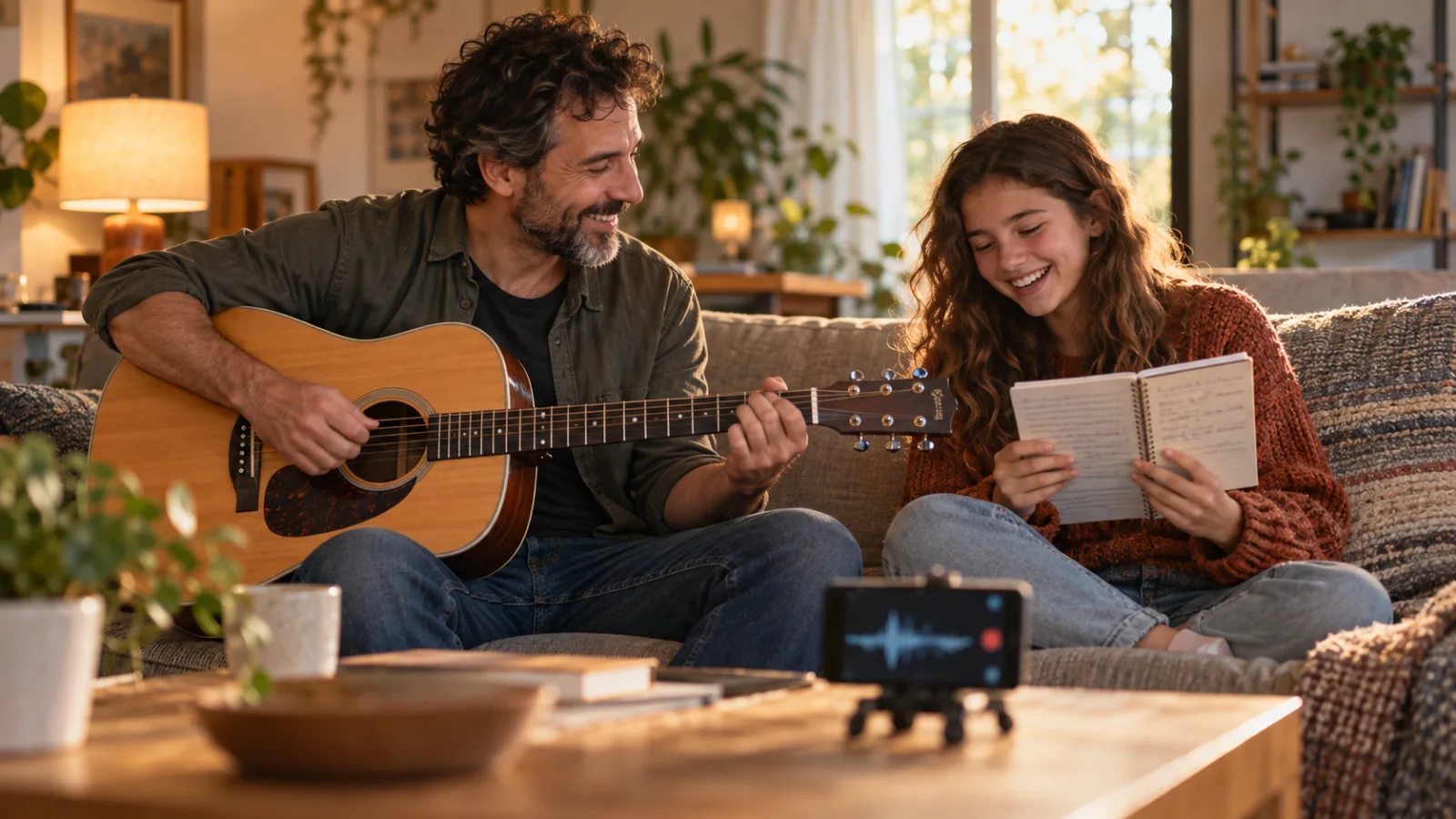
To write a song for your daughter or son, start with a letter, not with rhymes. Give yourself ten minutes of plain sentences: what you remember, what they always say, what you hope for them. Then underline the details only your family knows (the nickname, the stuffed rabbit with one ear, the street where they learned to ride a bike) and turn the phrase you say to them most often into the chorus. Two verses (then and now), a chorus that comes back three times and four easy chords are enough, and you can hum the melody and record it on your phone. The same method works whether you want to make a song for your daughter’s sixteenth birthday, a song for your son leaving for college or one for a baby who isn’t born yet.
Below: why your own song beats one you dedicate, the moments and what each one needs, the letter-to-song method step by step, a complete original example with chords and audio, a template to copy, melody options if you don’t play, and how to record it and give it. You don’t need to read music.
Why a song you write beats one you dedicate
Plenty of people search for a good song to dedicate to their daughter or son, and there are beautiful ones. But a dedicated song carries someone else’s memories. Yours can name the closet you checked for monsters, the purple bike, the eye-roll they give you at every goodbye. That’s what makes a kid (even a teenager pretending not to care) keep the recording for years. It doesn’t have to be good. It has to be theirs, and it has to sound like you.
There’s a second reason. Most parents say the important things in a rush, at the door or in a text. A song gives you three minutes where they have to listen to the whole sentence.
Pick the moment: from baby on the way to their wedding
The occasion decides the tone, the length and how much you can say before it gets heavy.
| Moment | What the song can say | Tone and length |
|---|---|---|
| A baby on the way or a newborn | The wait, the name you chose, the first night home | Soft and slow, 1–2 minutes |
| A birthday (1st, 5th, 10th) | One memory of the year, their name in the chorus | Playful, 1–2 minutes |
| Sixteen, a quinceañera or eighteen | Who they were and who they’re becoming | Warm with one joke, 2–3 minutes |
| Graduation | The effort you watched, not the grades | Proud and light, about 2 minutes |
| Leaving home | The empty room, your phrase at every goodbye | Tender, 2–3 minutes |
| Their wedding | Their story so far and one line to welcome their partner | Warm and short, 2–3 minutes |
| An adult child (30, 40, a grandchild on the way) | What you see in them now | Honest, 2–3 minutes |
For a baby, a lullaby is often the better shape: how to write a lullaby covers the slow rocking feel and the small range. If your family celebrates a quinceañera, the father and daughter traditionally share a waltz, and a song fits well right before it or at the toast; keep it under three minutes so the party keeps moving.
How to write a song for your daughter or son: the letter-to-song method
Most parents freeze when they try to rhyme on the first line. Write the letter first and let the song come out of it.
- Write the letter. Set a timer for ten minutes. No rhymes, no editing. Start four paragraphs with: “I remember when you…”, “You always say…”, “I never told you…” and “What I hope for you…”
- Underline what you can see or hear. Objects, places, sounds, exact phrases. Cross out adjectives like “amazing” or “special”: every parent uses them, so they don’t sound like you.
- Find the chorus line. It’s usually something you say to them, or they say to you: “Text me when you get there,” “Five more minutes,” “Go get ‘em, kid.” A phrase your child recognizes from the first word beats any line about love.
- Sort the details. Verse 1 is then (a memory from when they were small). Verse 2 is now (who they are today). A short bridge, if you want one, is the wish or the thing you never said out loud.
- Turn sentences into lines. Cut each sentence to six to nine syllables, put the strongest word at the end of the line and rhyme loosely: “night” and “light,” or “eyes” and “fine,” are close enough. The rhyming dictionary helps when you’re stuck, and the lyric syllable counter shows which line will rush.
- Read it aloud once. Mark every word you trip over and swap it.
Here’s how the letter becomes lyric:
| What you wrote in the letter | What you sing |
|---|---|
| ”I still remember you asleep on my chest the night we brought you home." | "You slept on my chest the whole first night" |
| "You made me check the closet for monsters, every night, and leave the hall light on." | "I checked the closet and left on the light" |
| "Every time you leave I say ‘text me when you get there,’ and you roll your eyes." | "Text me when you get there, go on, roll your eyes” |
Keep what doesn’t fit. It goes on the card.
A simple structure for a song for your kid
- Verse 1 (then): four lines, one memory detail per line.
- Chorus: four lines, with your phrase in the first one.
- Verse 2 (now): four lines about who they are today.
- Chorus.
- Bridge (optional): two to four lines with the wish.
- Last chorus: change one line so the ending lands.
That runs two to three minutes at 80–90 BPM. For a toddler, cut it to one verse and the chorus; for a wedding, stay under three minutes.
Here’s the kind of backing that carries a parent’s song: four chords, a gentle arpeggio and a soft ballad beat.
What to listen for: after the count-in (0:00–0:02), the four chords play once from 0:02 to about 0:13 and again until the end. Speak your verse over the first pass and sing the chorus over the second: the same loop carries both, so you only need one progression for the whole song. It’s a synthesized teaching example, not a finished recording.
Example: “Text Me When You Get There”
A dad writes for his daughter Maya, who’s leaving for college. The chords loop C–Am–F–G, one chord per bar at 84 BPM, so each line takes two chords. The verses sit low and close to speech; the chorus climbs a little on “get there.”
Verse 1 (then)
C                    Am
You slept on my chest the whole first night,
F                    G
I checked the closet and left on the light,
C                    Am
purple bike on Maple Street,
F                    G
"Don't let go!" I let go of the seat
Chorus
C                    Am
Text me when you get there,
F                    G
go on and roll your eyes,
C                    Am
one word is all I'm asking,
F                    G
just "here," and I'll be fine
Verse 2 (now)
C                    Am
Now you drive and you pick the songs,
F                    G
you finish all my stories wrong,
C                    Am
your life in boxes down the hall,
F                    G
eighteen years and you packed them all
Bridge (F–G twice)
F                    G
I won't say this at the station,
F                    G
I'd just cry and make it weird,
F                    G
you were ready long before me,
F                    G
it's the letting go I feared
Last chorus (the twist)
C                    Am
Text me when you get there,
F                    G
go on and roll your eyes,
C                    Am
I'll keep the porch light on, kid,
F                    G        C
just "here," and I'll be fine
Why it works: every verse line is something only this family can sing (the closet, Maple Street, the bike seat, the boxes in the hall). The chorus is the dad’s real phrase, and the eye-roll is in the song, so it never gets too sweet for an eighteen-year-old. Verse 1 is then, verse 2 is now, and the light from the first verse comes back in the last chorus as the porch light. For a son, keep the method and change the details; nothing else needs to move.
Try it now: the player below loops the example’s chords. Read your own verse over it, then sing your chorus line until a tune sticks.
Template to copy
SONG FOR MY DAUGHTER / SON: TEMPLATE
Name (and nickname):                 Age:
Moment: baby on the way / birthday / 16 or 18 / graduation /
        leaving home / wedding / adult child
Date I'll give it:                   Live or recorded:

THE LETTER (10 minutes, no rhymes)
I remember when you…
You always say…
I never told you…
What I hope for you…

UNDERLINED DETAILS (things I can see or hear)
1.            2.            3.
4.            5.            6.

CHORUS LINE (my phrase to them, or theirs to me):

VERSE 1, then (4 lines, one detail per line)
VERSE 2, now (4 lines)
CHORUS (4 lines, the phrase in line 1)
BRIDGE, the wish (optional, 2–4 lines)
LAST CHORUS: change one line

MUSIC
Melody: hummed / four chords (C–Am–F–G) / a tune I sang to them when small
Key:            Tempo (BPM):            Length:

BEFORE I GIVE IT
[ ] At least four details only our family knows
[ ] Nothing they'd hate to hear in front of friends (unless it's the joke)
[ ] The chorus comes back at least twice
[ ] Under 3 minutes
[ ] I read it aloud once without stumbling
[ ] The lyric is handwritten or printed for them
Melody options if you don’t play an instrument
- Hum and record. Read the chorus aloud three times, then hum it until a tune feels natural, and record every attempt. The free online voice recorder records in the browser with a count-in and a click, keeps several takes and lets you download them as WAV; nothing is uploaded.
- Four chords on a loop. Sing over the player above. If the chorus sits too high, enter your lowest and highest comfortable notes in what key should I sing in (the link opens with C3–G4 as an example) and move the key in the player.
- The tune you sang to them when they were small. This one makes people cry. The melody of “Twinkle, Twinkle, Little Star” is the French air “Ah! vous dirai-je, maman,” first published in 1761, so it’s in the public domain. Its lines have seven syllables with the stress on 1, 3, 5 and 7. For an eighteenth birthday:
Eighteen candles, make a wish,      (7)
once you named the goldfish Trish,  (7)
now you're taller than the door,    (7)
shoes like boats across the floor,  (7)
eighteen candles, make a wish,      (7)
blow them out, my little fish.      (7)
About rights, briefly. A traditional melody is free to use and your new words are yours. A specific modern arrangement or karaoke track can still be protected, so sing it yourself or play the chords. A current hit is different again: new words sung once at a family party is how most parodies live, but if you post the video, the song has owners and platforms can claim or mute it. How to write a parody song explains what’s allowed where; this isn’t legal advice. If you’re starting from words and have never made up a tune, how to write a song without an instrument walks you through it.
Versions for every age
- A song for a baby who isn’t born yet. You can start singing it during the pregnancy. The American Academy of Pediatrics explains that from about 18 weeks a baby starts hearing sounds inside the mother’s body, like her heartbeat, and around 27 to 29 weeks some sounds from outside, like voices. You can’t teach a baby anything before birth, it adds, but familiar songs and voices can bring comfort afterward. Keep the song slow and small, and put the name in once you’ve chosen it.
- A song for your son on his birthday, or your daughter on hers. One memory per year works for small kids; for older ones, pick the year’s best story. Fitting a name into a melody and milestone ideas are in how to write a birthday song.
- Sixteen, a quinceañera or eighteen. One joke, one serious line, under three minutes. Ask yourself whether your teen would rather hear it in front of everyone or alone; if you’re not sure, record it and give it privately.
- Graduation. Sing about the effort you saw (the late nights, the bus at 6:40), not the diploma.
- Leaving home. The empty room, the phrase at the door, the first call. The example above is this one.
- Their wedding. Many couples have a father-daughter or mother-son dance; a song from you can replace the music, open the toast or play as a video. Give one line to welcome their partner and keep it under three minutes. Timeline, length and performing live are in how to write a wedding song.
- An adult child. At 30 or 40, or when they’re about to have their own baby, the song can turn around: now they do for someone else what you did for them.
For songs to the other people in your life, start from how to write a song for someone.
If you’re writing for a son or daughter who has died
Some parents write a song for a child who is no longer here, for the funeral, an anniversary or the birthday that keeps coming. Write it the same way, as a letter to them: small details in the past tense, and in the present tense what still goes on (the name you still say, the room, the habit of theirs you’ve kept). You don’t have to finish it or sing it live. If it’s for a service, record it beforehand and choose the take, and some parents add a verse every year. How to write a tribute song for someone who died has a gentle structure for it.
Record it and give it
- Choose live or recorded. Live at the table or the party; recorded if you live apart, if your voice will break, or if your teen would rather not have an audience.
- Get clean audio. Pick a room with curtains, a rug or a sofa, and keep the phone about 15–20 cm (six to eight inches) from your mouth.
- For video, keep it simple. Phone at eye level in landscape, light in front of you, Do Not Disturb on.
- Open with one sentence. “Maya, this one’s yours” makes it personal before the first chord.
- Record three takes and keep the most alive one, not the most perfect.
- Give the lyric on paper. Handwritten if you can. The recording lives on a phone; the paper ends up in a drawer they’ll open in twenty years.
- Send it to them first. Let them decide whether it goes to the family group chat.
Where Zoundroom fits: one project for your child’s song
A song for your kid shows up in pieces: the letter in a notes app, the chorus hummed in the car, the chords on the back of an envelope, three takes scattered across your phone. In Zoundroom each song is a project that keeps its recordings, lyrics, notes and files together, so create one called “Text Me When You Get There” (or your own phrase), paste the letter and the lyric into a note, and record the chorus melody inside that note on your phone or in the browser at app.zoundroom.com: the audio lands at the cursor, right under the lines it belongs to. Keep every rehearsal take in the same project, and if the song is from both parents or a sibling wants to add a verse, share it: Free shares with up to two artists, and Pro shares with up to four and adds feedback at the exact second of a take. The limits, plainly: Zoundroom doesn’t generate audio, has no virtual instruments or beats, and isn’t where you mix and master a polished final track (a DAW such as GarageBand or BandLab is); it doesn’t edit video either. Your next step: create the project tonight and record your chorus phrase before you talk yourself out of it.
FAQ
How do I write a song for my daughter if I can’t sing?
Write the lyric first, hum over a four-chord loop and keep the melody close to how you’d say the words. She’s listening for her details and your voice, not for pitch. You can also say the verses and sing only the chorus, or ask a friend who plays to accompany you.
What should I write in a song for my son?
One true story told through specific details, plus one phrase he’ll recognize, ideally something you’ve said to him a hundred times. Show what happened (the first bike ride, the night drive home) instead of listing compliments.
How long should a song for your child be?
Between one and three minutes: two short verses and a chorus that comes back two or three times. For a toddler, one verse and a chorus are plenty; for a wedding or a party, under three minutes keeps everyone listening.
Can both parents write it together?
Yes. Each parent writes their own letter, then you pick the best details from both. A simple split: one verse each and a shared chorus you sing together. Siblings can add a bridge or a spoken line.
Should I just use an AI song service?
Services that turn a form into a personalized AI song exist and take minutes, and the result can sound polished. But the words are guessed from a questionnaire and the voice isn’t yours, and what your child keeps is the fact that you wrote it and sang it. If you use AI, use it for ideas, like rhymes for a name or a word for the bridge, and keep your details, your phrase and your voice.
Sources
Pages checked on October 2, 2026.
- HealthyChildren.org (American Academy of Pediatrics), Jennifer Shu, MD, “When can my unborn baby hear me?”: sounds inside the body from 18 weeks, some outside sounds such as a voice at 27–29 weeks, nothing can be taught before birth, familiar songs and voices can comfort after birth (last updated April 28, 2021). healthychildren.org
- Wikipedia, “Twinkle, Twinkle, Little Star”: the melody is the French air “Ah! vous dirai-je, maman,” first published in 1761. en.wikipedia.org
- Wikipedia (Spanish), “Fiesta de quince años”: celebrated across Latin America; in Mexico it often starts with a thanksgiving mass, and the father and daughter share a waltz. es.wikipedia.org