Songwriting Exercises: 14 Daily Drills and a 4-Week Routine
Published
14 timed songwriting exercises for beginners, from object writing to a rough demo. Each has steps, a result, a check and a free tool, plus a 4-week plan.
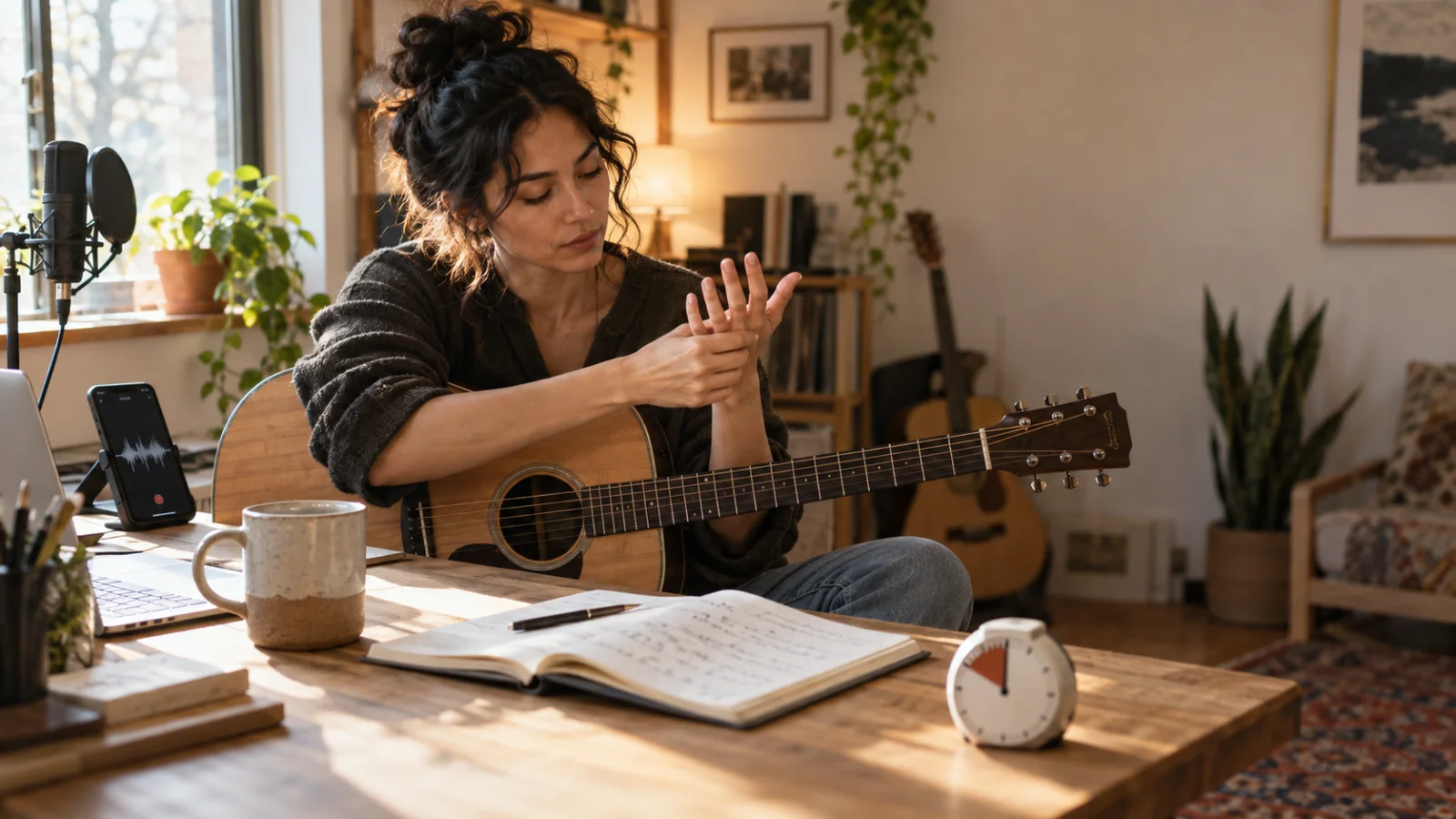
Use this list one exercise at a time: pick one exercise a day, give it 10 to 20 minutes and always finish with a recording, even a 30-second phone take of you reading or humming the result. The 14 exercises below are grouped by skill. Each has a time limit, steps, the output you should end up with and a “did it work?” check, and most use a free browser tool, so you can start now. Prefer a plan? Follow the four-week routine further down. Starting from zero? The free songwriting course takes one song through ten lessons; these exercises are the daily practice around it.
| Skill | Exercises | Time |
|---|---|---|
| Lyrics | 1 Object writing · 2 Show, don’t tell · 3 Title first · 4 Line-length mirror | 10–15 min |
| Melody | 5 Rhythm-first melody · 6 Three contours · 7 Steps vs leaps | 10–15 min |
| Harmony | 8 Change one chord · 9 Major and minor | 10–15 min |
| Structure | 10 Map a favorite song · 11 Pre-chorus only | 15–20 min |
| Finishing | 12 30-minute draft · 13 Second verse only · 14 Rough demo | 15–30 min |
Lyric exercises
1. Object writing (10 minutes)
This warm-up, popularized by Berklee professor Pat Pattison, trains you to write with your senses instead of explanations.
- Pick the nearest object, not an interesting one: a mug, a charger, a bus ticket.
- Write about it nonstop for 10 minutes: sight, sound, smell, taste, touch, how it feels in your body, how it moves. Follow any memory it drags in.
- Circle three phrases you would never have written on purpose and record yourself reading them.
Output: three circled phrases, such as “the cable is still warm where it bent all night.”
Did it work? At least three senses other than sight appear, and one phrase could open a verse.
2. Show, don’t tell (10 minutes)
- Write a line that names a feeling: “I miss you so much.”
- Rewrite it three times as something a camera could film, with no feeling words: “Your mug still hangs on the second hook.” “I set the table for two, then put one plate back.” “I still buy the cereal only you would eat.”
- Pick the strongest and record it spoken.
Output: one image line that replaces the explanation.
Did it work? A friend who reads only that line can tell what you feel. The song lyrics guide goes deeper into turning explanations into images.
3. Title first: three meanings, one chorus (15 minutes)
-
Choose a short title that works literally and figuratively: “Spare Key.” No title yet? Draw one in the songwriting prompts generator.
-
Write three meanings. Literal: the key under the stone by the door. Figurative: someone who still has access to your life. Twist: you changed the lock, but kept the spare.
-
Write a four-line chorus that starts and ends with the title, and sing it once on any notes:
Spare key under the stone, you never had to knock or phone. I changed the lock on Sunday night, but kept the spare key.
Output: a chorus with the title at both ends.
Did it work? The middle lines answer “why does this title matter?” If another title would fit without changing them, go back to step 2.
4. Line-length mirror with the syllable counter (15 minutes)
-
Paste four lines of yours, or this verse, into the syllable counter:
The kettle clicks, the kitchen’s grey, your jacket’s on the chair, I read through every note you wrote, and leave them lying there.
-
It reads 8, 6, 8, 6, counting every as two syllables (ev-ry). If you sing three, tell the counter: a hyphen marks the split (ev-er-y) and an equals sign fixes the count (every=3). The third line now reads 9, so cut through to bring it back to 8.
-
Write four lines on a different subject with the same counts, stresses and rhyme positions:
The platform hums, the train is late, the board is flashing red, a stranger holds the door for me and nods, and goes ahead.
-
Sing both verses to the same tune and record them.
Output: a new verse that mirrors the old one line by line.
Did it work? The counts match and the strong syllables land on the same beats. Right count but wrong feel? Check syllables and stress. Forced rhyme? Try a near rhyme from types of rhyme.
Melody exercises
5. Rhythm-first melody over the practice melody (15 minutes)
The practice melody in the lyrics guide offers four melodies (the original, a 3/4 ballad, upbeat pop and a minor-key one), optional chords and a “Record a take” button. This is the original:
After the count-in (0:00–0:02), four phrases start at 0:02, 0:07, 0:12 and 0:17. Each goes long–short–short–long, with a quick note just before the next phrase; the final C is held from 0:20 to about 0:22. The long notes (0:02 and 0:05 in the first phrase) are where your stressed syllables go.
- Tap the rhythm until you can tap it with the sound off.
- Write words to the rhythm: four syllables per phrase, stressed first and last, plus an optional pickup word. “KEYS on the HOOK, / (and) COAT on the CHAIR, / (the) RA-di-o ON, / NO-bo-dy THERE.”
- With headphones on, press “Record a take” and sing your words on the melody.
- Turn the audio off and sing the same words and rhythm on new pitches: where a phrase rose, make it fall. Record it on your phone.
Output: two takes of the same lines, one on the practice melody, one on your own notes.
Did it work? Your second take keeps the original rhythm, but at least three phrases move differently. Next time, use the ballad or pop melody.
6. Three contours over one progression (15 minutes)
After a one-bar count-in, the chords change every two and a half seconds (C at 0:02, G at 0:05, Am at 0:07, F at 0:10) and the loop restarts at 0:12.
- Open the chord player with this loop loaded, without drums.
- Take one line, yours or “I’m not calling you tonight,” and sing it three ways: rising to the last word, falling from your highest comfortable note, and flat, then jump on the key word.
- With headphones on, record a take of each over the loop and download the ones you keep.
Output: three takes of one line with three shapes.
Did it work? You can describe each take in one word (pleading, resigned, defiant), and one clearly suits the line. How to write a melody covers contour in depth.
7. Steps vs leaps: listen, then choose (10 minutes)
Almost every note moves to its neighbor, within five notes. The long D at 0:10 sounds unfinished and pulls you back to the start at 0:13.
Same chords and tempo, but the line jumps to a high C at 0:04, steps back down at 0:05, then leaps to a high D at 0:09.
- Listen to both; on the second pass, raise a hand at each leap.
- Take a chorus line (the one from exercise 3 works). Sing it all by steps, then with one leap on the most important word, “key.”
- Record both.
Output: two takes and one sentence on which you keep.
Did it work? The leap lands on the word that matters most and the melody then turns back by step, as at 0:05. If it lands on “the” or “and,” move it.
Harmony exercises
8. Change one chord: the borrowed iv (10 minutes)
The count-in runs to 0:03. F arrives at about 0:06 and Fm at about 0:09: one note drops (A becomes A♭) and the bright loop turns wistful. It happens again at about 0:22.
- Take a loop you already use, like C–G–Am–F, and change only the last chord to minor: C–G–Am–Fm.
- Sing the same line over both versions and note the word that sits over the Fm.
- Record a take over the changed loop.
Output: a loop with one borrowed chord, and a take.
Did it work? The word over the Fm deserves the shadow: “almost,” “still,” “used to.” Chord progressions for songwriting has more loops to try it on.
9. Same melody in major and minor (15 minutes)
Both count in until 0:03 and change chords at 0:03, 0:06, 0:09 and 0:12, with the same melodic shape. At 0:03 the minor version starts on E♭ instead of E; at 0:09 an A♭ chord replaces the Am.
- Sing a four-bar melody of yours over C–G–Am–F.
- Switch to Cm–B♭–A♭–B♭ and sing it again, lowering any clashing note a half step (E to E♭, A to A♭, B to B♭).
- Record both takes with the same words.
Output: one line in two moods.
Did it work? The words haven’t changed but their meaning has: write one adjective per take. Keep the version that fits the lyric, or use minor for the verse and major for the chorus.
Structure exercises
10. Map a favorite song in the structure planner (20 minutes)
- Play a song you know well with a timer running and note when each section starts.
- Find its tempo: count the beats in 15 seconds and multiply by four.
- Enter the sections in the structure planner at that tempo and adjust the bars until the durations match your notes.
- Note what changes at each section’s start (an instrument, a higher melody, a lyric turn), download the map and record a one-minute voice memo on what surprised you.
Output: a map, with bars and durations, of a song you love.
Did it work? The planner’s total is within about ten seconds of the track, and you can name what changes at every boundary.
11. Write only a pre-chorus (15 minutes)
-
Take an existing verse and chorus, and loop Dm–F–G–G: the two bars of G hold the tension.
-
Write two to four lines, shorter than your verse lines, that end on an unfinished thought. Before “Spare Key”:
Footsteps on the stairs, I know it isn’t you, and still I hold my breath…
-
Sing each line a little higher than the last, then record verse, pre-chorus and chorus in one take.
Output: a pre-chorus and a take that runs into the chorus.
Did it work? By the last line you want the chorus to arrive. If the chorus now feels smaller, bring the pre-chorus’s last line down.
Finishing exercises
If a draft has already stalled, use the method for finishing a song when you’re stuck instead.
12. A complete draft in 30 minutes
The one long exercise; save it for a weekend.
- 0–5 minutes: a title and a four-chord loop.
- 5–15: verse 1 and chorus. Placeholders allowed: write “[something about the car]” and move on.
- 15–22: verse 2, with one new fact.
- 22–30: sing it through twice, fixing only what stops you, then record the whole song.
Output: a recorded verse–chorus–verse–chorus draft with placeholders marked.
Did it work? The recording plays start to finish with no missing section. Completeness is the test, not quality.
13. Write only the second verse (15 minutes)
- Take a song with a finished verse 1 and chorus.
- Choose one move: later (what happened next), closer (a detail seen up close) or reversed (the other person’s side). For “Spare Key,” later might open: “The locksmith came at nine.”
- Write verse 2 on verse 1’s melody and check both in the syllable counter: each line within one syllable of its partner. Record the song through verse 2.
Output: a second verse that fits the first verse’s melody.
Did it work? Verse 2 tells the listener something verse 1 did not, and no line rushes.
14. Record a rough demo in 15 minutes
- Choose any draft from the last two weeks and say its title, key and tempo at the start of the recording.
- Record one full pass with voice and one instrument, or over the chord player loop with headphones.
- Two takes maximum. Keep the better one, unedited.
Output: a complete rough demo.
Did it work? Someone else could learn the melody and chords from it. Missing words? Sing “la la” and keep going.
A four-week songwriting routine (15 minutes a day)
Monday to Friday, 15 minutes, always ending with a recording. If an exercise normally takes longer, stop when the timer rings.
| Day | Week 1: lyrics | Week 2: melody | Week 3: harmony and form | Week 4: finish |
|---|---|---|---|---|
| Mon | 1 Object writing | 7 Steps vs leaps | 8 Change one chord | 3 Title first, for the song you will finish |
| Tue | 2 Show, don’t tell | 6 Three contours | 9 Major and minor | 13 Second verse only |
| Wed | 3 Title first | 5 Rhythm-first, ballad or pop melody | 10 Map a song, up to the second chorus | 4 Mirror verse 2 against verse 1 |
| Thu | 4 Line-length mirror | 1 Object writing, new object | 11 Pre-chorus only | 6 Three contours for the final chorus |
| Fri | 5 Rhythm-first melody | 14 Record your best chorus | 14 Record verse, pre-chorus, chorus | 14 Rough demo of the whole song |
Weekend option: the 30-minute draft (exercise 12) after weeks 2 and 4.
How to review your exercises
Once a week, after Friday’s recording or on the weekend, take ten minutes. Play the week’s recordings in a row without writing anything, then ask three questions:
| Question | If yes |
|---|---|
| Did something surprise me? | Mark it as a keeper and note why in one line |
| Can I still hum or quote it a day later? | Candidate hook or title: top of the list |
| Did I skip a recording? | Redo a five-minute version tomorrow |
Keep what surprises you, not what is correct: correct lines are easy to write again. Revisit last week’s keepers; anything that still surprises you becomes a song and goes through exercises 11 to 14.
Stuck on a term in these exercises? The songwriting glossary explains each one in plain language.
Where Zoundroom fits
If you use Zoundroom, create one project called “Exercises” and add one note per day, titled with the date and the exercise number. Write in the note and record inside it: the audio is inserted at your cursor, so each take sits under the lines it belongs to, and you can keep writing while it plays. Takes downloaded from the chord player or the practice melody can be imported into the project and inserted into that day’s note. On review day the whole week is in one place, and when a keeper becomes a song, it gets a project of its own.
Frequently asked questions
How often should I do songwriting exercises?
One a day, 10 to 20 minutes, five days a week. If that’s too much, three days a week works, as long as every session ends with a recording and you review once a week.
Which exercises help with writer’s block?
Match the exercise to the block. Nothing comes out: object writing. Too many options: the 30-minute draft. A fragment that won’t grow: pre-chorus only or second verse only. You can’t hear your song anymore: map someone else’s. The creative block guide helps you tell which block you have.
Do songwriting exercises produce real songs?
Some do: keepers become titles, hooks and verses, and exercises 12 to 14 exist to finish songs. Their main job is to make each skill faster, so a real idea gets shaped before it fades.
Can I use these exercises with a group or with kids?
Yes. A band can do object writing on the same object and compare. With kids, keep it to five minutes and make it a game: show, don’t tell as a guessing game, rhythm-first with clapping.