
How to Write a Wedding Song: Steps, Timeline and Template
Published
Write a wedding song for your partner or the bride and groom: their story, a 2–3 minute structure, easy chords, an 8-week timeline and a template to copy.
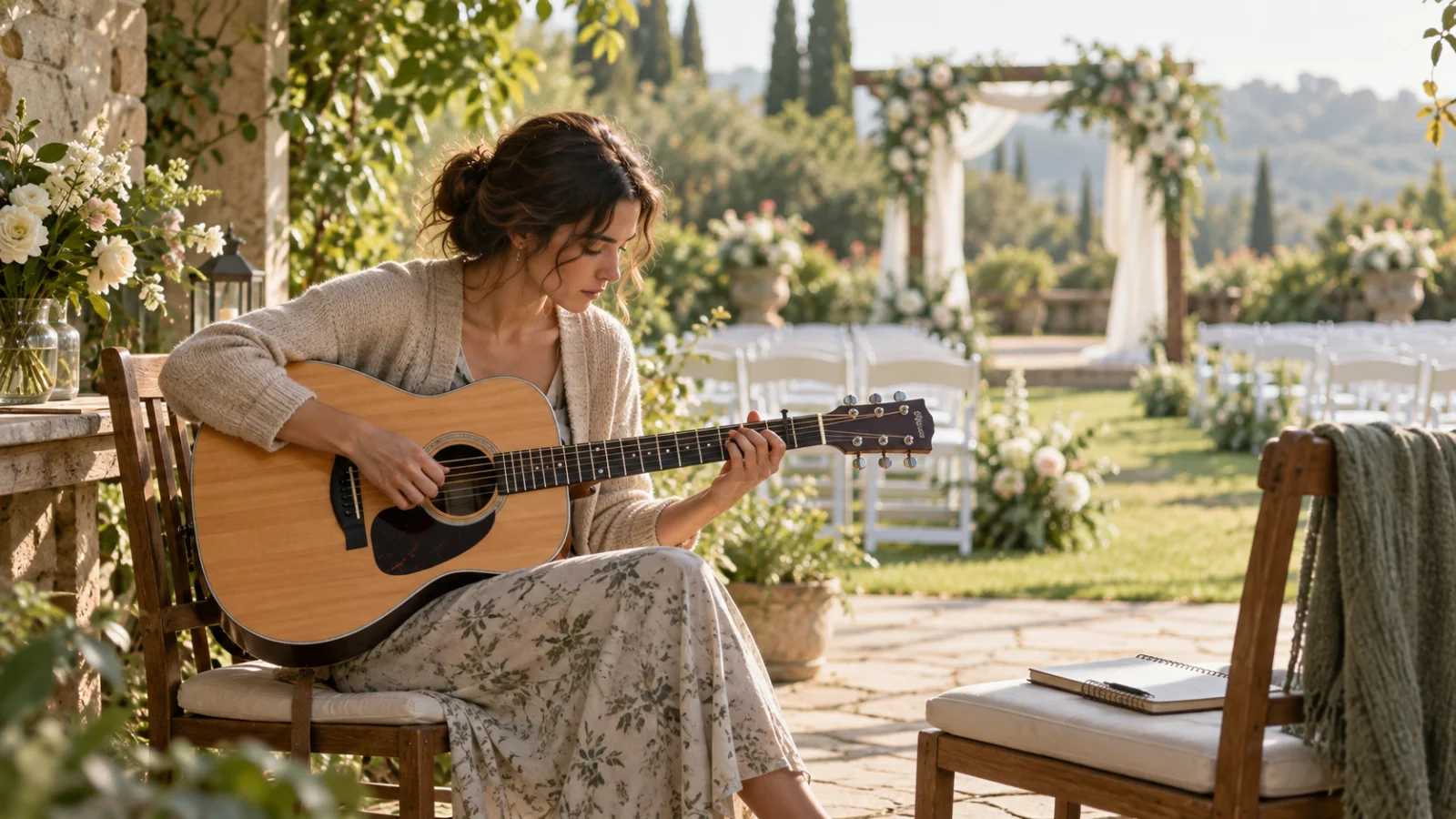
To write a wedding song, first decide which moment it is for: the ceremony, the first dance, a toast, or a gift from friends to the bride and groom. Then collect fifteen real details about the couple, pick one story, and write a chorus that sounds like a promise before you write the verses. Keep it to two or three minutes: two short verses, a chorus that comes back three times and a short bridge, over three or four chords you can play without looking. Start six to eight weeks before the wedding, rehearse it out loud every day for the last three weeks and record a backup version on your phone in case your voice breaks on the day.
Below: which wedding song you are actually writing, how to turn their story into a lyric, the clichés to swap out, how long it should be, simple accompaniment with chord loops you can hear, a complete original example, live versus recorded, an eight-week timeline and a worksheet to copy.
First, which wedding song are you writing?
“Write a song for your wedding” covers very different jobs. The moment decides the length, the tone and who sings.
| Moment | Who usually sings | Length | Tone | Watch out for |
|---|---|---|---|---|
| Ceremony (after the vows, during the signing) | You, or a musician friend | 2–3 min | Tender, quiet | Ask the officiant first: some ceremonies have rules about music |
| First dance | You write it; you, the band or a recording plays it | About 3 min | Intimate, slow enough to sway | A tempo the couple can actually dance to |
| Inside a toast or speech | You, solo; guests join on the chorus | 60–90 s | Funny verses, tender chorus | Inside jokes nobody else gets |
| Gift from friends or family | A group | 2–3 min | Celebratory | Ten people singing at once need an easy key |
| Recorded gift (you can’t attend) | You | 2–3 min | Personal, like a letter | Sound quality: record close to the phone |
If you are writing for your own partner, the love song guide covers the angles and clichés of romantic writing in depth. This article is about everything the wedding adds: an audience, a schedule, a sound system and a date you cannot move.
Step 1: Collect the couple’s story
Set a twenty-minute timer and write fast. Aim for fifteen details you could film. If the song is for your own partner, write from memory. If it is for friends, interview them separately (each one tells the story differently, and the gap between versions is often the best line), or ask a sibling or a best friend if it’s a surprise.
- How they met: the place, the weather, the first thing one of them said.
- The first date, and what went wrong.
- A ritual: the Sunday call, the shared playlist in the car, who makes the coffee.
- A phrase one of them always says, word for word.
- A hard moment they got through together, and what each one actually did.
- A running argument: the window open or closed at night, the thermostat, the last slice.
- Something only friends know, with a door: someone outside the joke has to understand what happens, even if they don’t know why it matters.
Then mark three details: the most concrete, the most surprising and the one that makes you smile or catch your breath. Those three carry the song. For the general method of turning memories into lines, the hub guide on how to write a song for someone goes step by step.
Step 2: Choose a wedding story arc
A wedding song is not a biography. It tells one story well, and the wedding gives you a natural ending: today. Four arcs that work:
- Then, now, from today. Verse 1 is a memory, verse 2 is their life now, the chorus is the promise and the bridge lands in the room, today.
- Two roads. Verse 1 follows one of them, verse 2 the other, and the chorus is where the roads meet.
- The witness. A friend or a parent tells what they saw from the outside: the first time they noticed something had changed.
- The running joke. Their eternal argument becomes the chorus, and the bridge reveals why it never really mattered.
Write your arc in three sentences before you write a single line. “Verse 1: the restaurant was closed on our first date. Verse 2: she leaves the porch light on when I’m late. Chorus: wherever we live, she keeps the light on.” If those three sentences move you a little, the song will too.
Step 3: Write a chorus that sounds like a promise
At a wedding, the chorus is what the room remembers and what guests will sing the second time around. Write it before the verses.
- One title line, repeated. Put it at the start or the end of the chorus and sing it twice. The chorus writing guide has eight ways to make it stick.
- Short lines, about six to nine syllables. Check them with the syllable counter so the lines of each verse match.
- Plain rhymes. Everyday words sound sincere. The rhyming dictionary gives perfect and near rhymes.
- A range guests can sing. Worship leader Bob Kauflin keeps congregational songs between a low A and a high D, A3 to D5 (men sing an octave lower without thinking about it). If the guests will join in, stay inside that window: the free tool what key should I sing in opens with that range and tells you which key fits your melody.
Wedding lyrics fall into the same five clichés again and again. Swap each one for something you could film:
| Cliché | Why it falls flat | Try instead |
|---|---|---|
| ”Two hearts become one” | Every wedding song says it | One thing they now do together: the shared alarm, the one mug they fight over |
| ”Forever and always” | A promise with no picture | A concrete promise: “I’ll warm the car on winter mornings" |
| "You complete me” | A movie line | What changed in you since you met |
| ”My soulmate, the one” | Abstract | The exact moment you knew |
| ”Walking down the aisle” | Describes what everyone is already watching | A detail of the day the guests can’t see |
How long should a wedding song be?
Two to three minutes, and shorter inside a speech. WeddingWire puts the sweet spot for a first dance at around three minutes, longer than one and less than four. Zola advises keeping a wedding toast under five minutes, ideally three to five, so a song inside a toast should run 60 to 90 seconds: one verse and the chorus twice.
The math is easy to check. Intro, verse, chorus, verse, chorus, bridge and last chorus at 4 + 8 + 8 + 8 + 8 + 4 + 8 bars make 48 bars in 4/4: about 2:00 at 96 BPM and 2:40 at 72 BPM. A verse and two choruses (24 bars) at 80 BPM last about 72 seconds. The song structure planner adds up your own form and tempo.
Simple accompaniment you can actually play
Nobody expects a session musician. Three or four chords on a loop are enough, as long as you can play them while looking at the couple instead of your hands.
| If you… | Use | Hear it |
|---|---|---|
| Play some guitar | C–G–Am–F strummed, capo to fit your voice | I–V–vi–IV at 72 BPM |
| Play piano | C–Am–F–G as broken chords | I–vi–IV–V at 76 BPM |
| Don’t play anything | The chord loop through a speaker behind you, or a musician friend | the same loop, held chords |
| Have a musician friend | Send them a voice memo of the melody and a chord sheet four weeks before |
This is the classic wedding-ballad loop, I–vi–IV–V in C:
After a two-second count-in, a broken-chord pattern and a soft ballad beat play C, Am, F and G, one bar each (about three seconds per chord), and the loop starts again around 0:13. Notice how the G at around 0:11 pulls you back to C: that pull is what makes a chorus feel like it is arriving home.
For the bridge, when the song turns to today or to someone who couldn’t be there, one borrowed chord does a lot:
After a three-second count-in, held chords play C, F, Fm and C. Listen for the Fm at around 0:09 and again at around 0:22: one note drops by a half step and the warmth turns bittersweet for a moment before C resolves it. Both are synthesized teaching examples, not finished productions. If you play guitar and sing at the same time, the guide to singing and playing guitar together helps you get the strumming on autopilot.
Worked example: “Leave the Light On”
A song written for this article, from someone to their partner, for the reception before the first dance. The three details: their first date was at a restaurant that had already closed, so they ate fries on the curb in the rain; she leaves the porch light on whenever he comes home late; and they argue about almost everything except that. The arc is “then, now, from today”. Key of C, 72 BPM, I–V–vi–IV: C–G–Am–F, and Am–F–C–G for the bridge (hear the verse loop).
Verse 1:
C                       G
The restaurant had closed at nine,
Am                         F
they'd stacked the chairs and dimmed the light,
C                         G
so we ate fries out on the curb
Am                        F
and talked until it rained all night.
Verse 2:
C                          G
I've missed the bus, I've missed the train,
Am                       F
I've walked home hours after ten,
C                         G
and every time I turned the corner
Am                          F
your porch light found me there again.
Chorus (guests join on the last line the second time):
C                          G
So leave the light on, I'll be home
Am                           F
from every road, from every year,
C                         G
whatever rooms we're living in,
Am           F          C
leave the light on, I'll be here.
Bridge, then the last chorus:
Am                       F
Today the light is in your eyes,
C                        G
there's no more corner left to turn,
Am                         F
no curb, no rain, no closing time,
C                            G
just the one thing I had to learn.
What each part does:
- Filmable details: stacked chairs, fries on a curb, a porch light. No line says “you’re my soulmate”; the details say it.
- A promise with a picture: “leave the light on” is something she already does. The chorus turns a habit into a vow.
- Callbacks in the bridge: the curb, the rain, the closing time and the corner all come back, now as things that are over. That is the “today” of the arc.
- Easy rhymes: light and night, ten and again, year and here. Nothing forced, so it sounds like speech.
- Length: with a 4-bar intro, the full form is 48 bars, about 2:40 at 72 BPM.
New lyrics to a famous song?
Rewriting the words of a hit everyone knows is a wedding tradition, especially for a group of friends: the melody is instantly singable and the laughs come for free. It works best for the funny gift; for the ceremony or the first dance, a melody of your own means more. Two practical points: keep the syllable count of each original line (the counter helps), and if you plan to post the video publicly, remember that the melody still belongs to its writers unless it is an old traditional tune. Your own melody avoids that question entirely.
Live or recorded?
| Live | Recorded | |
|---|---|---|
| Best when | You have performed before, the venue has a sound system | Nerves, an outdoor ceremony with no PA, guests watching remotely |
| You need | A vocal mic, an input for your guitar or keyboard, a sound check | A clean take, a speaker and someone to press play |
| The risk | Your voice breaks (that’s fine, everyone will be crying too) | It can feel less present |
| Plan B | A recorded backup on your phone | Sing the last chorus live over the recording |
If you sing live, ask the venue or the DJ three questions two weeks before: is there a mic on a stand for you, can your instrument plug in, and who cues your moment? Do a sound check before the guests arrive.
To record, find your key first: take the vocal range test, then enter your range in what key should I sing in. Set the tempo with the tap tempo metronome. On iPhone, Voice Memos is in the Utilities folder: tap the record button, and per Apple’s guide, adjust the level by moving the microphone closer or farther. Voice Isolation, in Control Center, filters background sound; if you sing with a guitar, test it against Wide Spectrum, because the guitar may count as background. For practice takes with a count-in and a click, the free online voice recorder records in your browser, keeps several takes and downloads them as WAV; nothing is uploaded. The guide to recording with your phone covers placement when you also play.
Your timeline: the eight weeks before the wedding
| When | What to do | Done when |
|---|---|---|
| 8 weeks before | Choose the moment; confirm the slot with the planner, the DJ or the officiant (not the couple, if it’s a surprise) | You know the minute it happens and what equipment is there |
| 7 weeks | Collect fifteen details, mark three, write the arc | Three sentences that move you |
| 6 weeks | Write the chorus, pick chords and key, record the melody on your phone | You can sing the chorus from memory |
| 5 weeks | Write the verses and the bridge, check syllables, time the whole song | A full draft of 2–3 minutes |
| 4 weeks | Play it to one honest person who isn’t in the couple; send the voice memo and chord sheet to your accompanist | One round of fixes done |
| 3 weeks | Rehearse every day; record a full run-through | You no longer need the paper |
| 2 weeks | Ask the venue the three sound questions; rehearse with your accompanist | You know where you stand and who cues you |
| 1 week | Record the backup version; print the lyrics as a gift; stop rewriting | The song is finished |
| The day | Sound check before the guests arrive, water nearby, sing it to them, not to the room |
Only one week left? Day 1: details and arc. Day 2: the chorus. Day 3: the verses. Day 4: key and timing. Days 5 and 6: rehearse and record the backup. Day 7: sound check. A short, honest song beats a long, unrehearsed one.
Wedding song template to copy
WEDDING SONG WORKSHEET
Couple: ____________   Date: ________
Moment: ceremony / first dance / toast / gift   Surprise? yes / no
Who sings: ____________   Live or recorded: ____________
Slot confirmed with: ____________ (planner, DJ, officiant)
Sound: mic [ ]  instrument input [ ]  someone to press play [ ]

THEIR STORY (15 details, mark 3)
How they met:                  The first date:
A ritual they share:           A phrase one of them always says:
A hard moment they got through:
Their running argument:
Something only friends know (with a door):

ARC (three sentences)
Verse 1 (then):
Verse 2 (now):
Chorus (the promise):
Bridge (today):

CHORUS LINE (6–9 syllables):
Key:      Chords:      BPM:      Length: 2–3 min (in a toast: 60–90 s)
Rehearsals: [ ][ ][ ][ ][ ][ ][ ]   Backup recorded [ ]   Lyrics printed [ ]
Where Zoundroom fits: the interview, the lyric and the rehearsal takes
A wedding song gets written in pieces over several weeks: interview answers in a message thread, a chorus hummed into Voice Memos on the train, the chord loop in a browser tab and the rehearsal takes on your accompanist’s phone. In Zoundroom each song is a project with its recordings, lyrics, notes and files, so create one named after the couple and paste the fifteen details at the top of a note. Write the verses and the chorus underneath, and when the melody shows up, record it inside that same note, on your phone or in the web app: the audio is inserted at your cursor, right under the lines it belongs to. Import your old voice memos and the week-three run-through into the project, and invite the friend who plays guitar (Free shares with up to two artists; Pro raises that to four and adds timestamped feedback, so, if they also have Pro, they can point to the exact second where the bridge rushes). If it’s a surprise, keep the couple out of the project until the day. When a line won’t come, Auralis, Zoundroom’s AI assistant, suggests other ways to say it, as text; the details stay yours. What it doesn’t do: Zoundroom doesn’t generate audio, has no virtual instruments or beats, and isn’t where you mix and master a final recording (a DAW such as GarageBand or BandLab is). It won’t run the sound at the venue either. Your next step: create the project tonight and write your three chosen details in its first note. See how notes and lyrics work with audio.
FAQ
How do I write a song for my own wedding?
Pick the moment (vows, first dance or reception), write down fifteen concrete memories of your partner and choose one story. Write the chorus first as a promise with a picture in it, then two short verses, then a bridge that lands on the wedding day. Keep it to two or three minutes and rehearse it daily for three weeks.
How do I write a song for the bride and groom as a friend?
Interview both of them separately, or ask family if it’s a surprise. Tell one story from the outside, as a witness: the first time you noticed something had changed. Keep the verses funny and the chorus tender, and give the guests a chorus line they can sing in an easy key.
Can I write a wedding song if I can’t sing or play?
Yes. Write the lyric, hum a melody over a free chord loop and record it on your phone. Then ask a musician friend to perform it, or play your recording at the reception. A simple song written for them matters more than a polished one that could be for anyone.
How long should a wedding song be?
Two to three minutes for the ceremony, the first dance or a gift; 60 to 90 seconds if it sits inside a toast. Two short verses, a chorus three times and a short bridge fit comfortably. If you have more memories than space, keep the best three and write the rest in a card.
Can I adapt this for an anniversary?
Yes. For a 25th (silver) or 50th (golden) anniversary, the “then, now, from today” arc works especially well: verse 1 on the wedding day, verse 2 on a moment from the years between, and a chorus about what never changed. Ask their children or friends for details you don’t know. If it’s for your own parents, the guide on how to write a song for your mom shows how to give each of them a verse with a shared chorus. If the occasion is a birthday instead, the birthday song guide shows how to fit a name into the melody.
Sources
All pages were checked on October 2, 2026.
- WeddingWire, “How to Pick a Non-Cliché, Totally Unique First Dance Song”: around three minutes is the sweet spot; longer than a minute and less than four. weddingwire.com
- Zola, “How to Write a Wedding Toast: The Ultimate Guide”: speeches under five minutes, in a 3–5 minute sweet spot. zola.com
- Bob Kauflin, “Finding the Right Key to Sing In”, Worship Matters: songs for a congregation from “a low A to a high D”. worshipmatters.com
- Apple Support, “Make a recording in Voice Memos on iPhone”: Voice Memos in the Utilities folder, tap to record, adjust the level by moving the microphone closer or farther, Voice Isolation and Wide Spectrum in Control Center. support.apple.com