
How to write a song for your dad, for Father's Day or his birthday
Published
Write a song for your dad: his phrases, a funny or emotional tone, three chords and a template, plus Father's Day dates and how to record it as a gift.
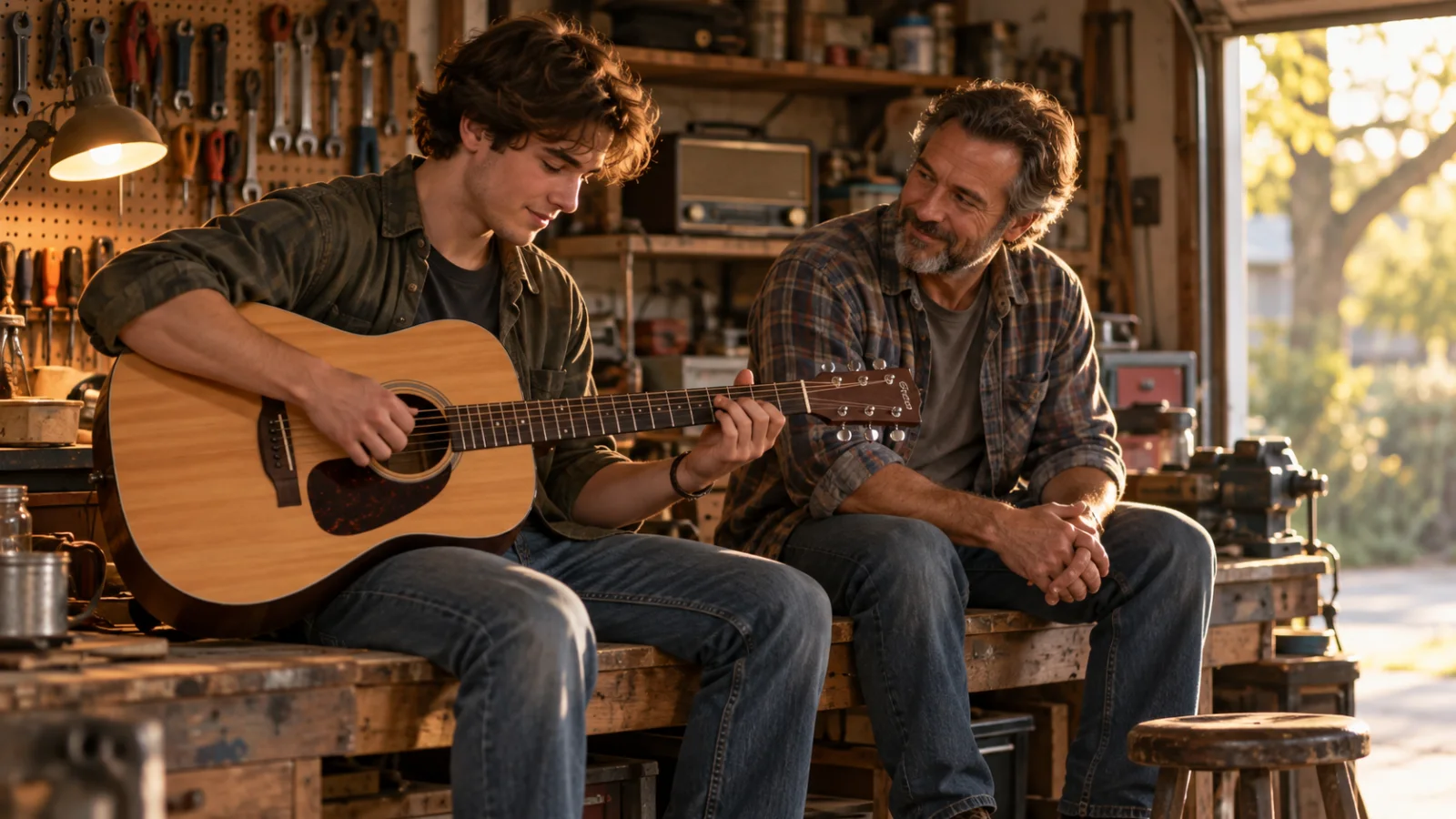
To write a song for your dad, start with what he does and what he says, not with “you’re my hero.” List ten details: a phrase he always repeats, a habit, a tool or a car, a joke he’s told for twenty years, one thing he did quietly that you only noticed later. Make verse 1 funny with his habits, let verse 2 turn serious, and build the chorus on his own phrase. Three chords (G, C and D) are enough, and you can record it on your phone. For a Father’s Day song, start ten days ahead: it falls on June 20, 2027 in the US, Canada, the UK and Ireland, and on September 5, 2027 in Australia.
Below: the dates, a memory list, how to mix humor and emotion, a three-chord melody you can listen to, a worked example with chords, a template to copy, versions for his birthday, a wedding or a song from the kids, how to record it as a gift and what changes if he has passed away. You don’t need to read music.
How to write a song for your dad in 7 steps
- List ten details only your family would recognize: a phrase, a habit, an object, a joke, a moment.
- Pick the shape: funny all the way, emotional all the way, or funny verse first and emotional turn later. The third works for most dads.
- Find the chorus line in something he says. “We’ll see” or “Ask your mother” beats “you’re the best dad in the world.”
- Write two short verses: verse 1 shows who he is (his habits, with a smile), verse 2 shows what he did for you.
- Use three chords, a melody close to speech in the verses and a little higher in the chorus.
- Rehearse it out loud five times over a few days.
- Sing it live or record it, and give him the lyric on paper.
When is Father’s Day? Dates by country
The date depends on where he lives, so check it before you plan.
| Where | Father’s Day | Next date |
|---|---|---|
| US, Canada, UK, Ireland | Third Sunday in June | June 20, 2027 |
| Australia | First Sunday in September | September 5, 2027 |
| Mexico | Third Sunday in June | June 20, 2027 |
| Spain, Italy, Portugal | March 19, St. Joseph’s Day | March 19, 2027 |
| Germany | Ascension Day (“Vatertag”) | May 6, 2027 |
| Brazil | Second Sunday in August | August 8, 2027 |
If your dad grew up in another country, you can sing it on his date, on yours, or on his birthday: a song with his details works any day.
A ten-day plan that fits around work or school:
| Day | What you do | Time |
|---|---|---|
| 1 | Memory list (step 1 below) | 20 minutes |
| 2–3 | His phrase and the chorus | 30 minutes a day |
| 4–5 | Two verses | 30 minutes a day |
| 6 | Chords and melody, recorded as a voice memo | 30 minutes |
| 7–9 | Sing it daily and fix any line you trip on | 10 minutes a day |
| 10 | Record three takes, or rehearse the live version once more | 30 minutes |
Short on time? A chorus and one verse written tonight is still a song he’ll keep.
Step 1: what he does, what he says
Plenty of dads say “I love you” by fixing a bike, driving you at 6 a.m. or checking your tire pressure. Those actions are your best lyric material, because nobody else’s dad did them exactly that way. Answer these in a note on your phone:
| Ask yourself | Example answer |
|---|---|
| What does he always say? | ”We’ll see.” (It usually meant yes, eventually.) |
| What does he fix, build or keep? | The neighbor’s lawn mower, never ours |
| What object is “his”? | A radio in the garage stuck on the ball game |
| What joke has he told for twenty years? | Calling every GPS “the lady who’s always wrong” |
| What did he do that you only noticed later? | Came straight from the early shift to every game, even the 10–0 losses |
| What did he teach you without saying it? | That you show up, even when you said “we’ll see” |
Ask a sibling or your mom for one more detail. They remember different things, and the song becomes a gift from the family.
Step 2: funny, emotional, or both
Most dads are easier to move with a laugh first. Humor lowers his guard, so the serious line lands harder.
| Shape | Works when | Watch out for |
|---|---|---|
| Funny all the way | A family barbecue, a 60th birthday, a dad who loves to roast and be roasted | Jokes about his weight, hair, age or job, unless he already makes them himself |
| Emotional all the way | A recorded gift, a hard year, living far apart | Big words like “hero” or “everything”; let the details carry it |
| Funny, then emotional | Almost any occasion | Don’t turn in the first line; the shift belongs in verse 2 or the last chorus |
The safest kind of teasing is about the things he’s proud of: his grill, his shortcuts, his playlists, his “I’ll fix it myself.” If you’re unsure about a joke, picture him hearing it with the whole family watching. If he’d laugh, keep it.
Step 3: a chorus on his phrase
The chorus is the part he’ll hum in the car next week, so give it one idea and few words.
- Start with his phrase. “We’ll see,” “Ask your mother,” “Lights off, we’re not heating the street.” It’s instantly his, and it’s a ready-made title.
- Then give the phrase a second meaning. “We’ll see” was his slow yes, and it also describes a dad who came to see every game. That double meaning turns a funny line into an emotional one.
- Put “Dad” on a strong beat, at the start or end of a line. It’s one syllable, so it lands easily; “Daddy” or “Pops” work if that’s what you call him. Check your line lengths in the lyric syllable counter.
- Don’t end every line on “Dad.” It rhymes too easily (had, glad, sad, bad), and the obvious rhymes sound like a greeting card. Rhyme the line next to it instead; the rhyming dictionary opens with “dad” filled in if you need options.
- Keep the chorus lines even, within one or two syllables of each other, so the family can sing along after one listen.
Step 4: three chords and a melody he can sing along
A lot of dads grew up on songs built from three chords, and a song for him doesn’t need more. In G major those chords are G, C and D, three of the first shapes most guitar players learn. Listen to how they sound together:
What to listen for: after the count-in (0:00–0:02), strummed guitar and rock drums play G–C–D–C twice, one chord per bar, about two seconds each. The D arrives around 0:06 and again around 0:15: that’s the chord that pulls back home to G. Put the end of a verse line, or the word “Dad,” on that pull.
For your song, loop the verse chords at 100 BPM and hum over them until a phrase repeats itself; then try the chorus chords, which start on C and resolve to G. For an emotional version, slow the same chords to 80 BPM with arpeggios and a ballad beat. Record every hum: the second or third attempt is usually the one.
If you’d like him to sing along on the last chorus, keep the melody in a comfortable middle range, and test the key with what key should I sing in (the link fills in C3–G4; replace it with your range). If he plays guitar, give him a chord chart made with the chord sheet maker so he can join in.
Worked example: “We’ll See”
This song uses the details from step 1. The verse loops G–C–D–C and the chorus C–G–D–G, one chord per bar at 100 BPM, so each lyric line covers two chords.
Verse 1 (who he is, with a smile)
G                              C
Saturday, the garage door wide open,
D                              C
that radio stuck on the ball game news,
G                              C
you fixed the neighbor's mower, never ours,
D                              C
in the same old pair of tennis shoes
Chorus
C                    G
"We'll see," you'd always say,
D                  G
the slowest yes on earth,
C                    G
but, Dad, you came to see
D                     G
my games, for what they're worth
Verse 2 (what he did)
G                              C
Up at five for the early shift, and then
D                              C
you'd still show up with sawdust on your sleeve,
G                              C
the bleachers soaked, the score was ten to nothing,
D                              C
and you were still the last one there to leave
Chorus again, then the last chorus with the turn:
Last chorus
C                    G
I tell my friends, "We'll see,"
D                  G
the slowest yes on earth,
C                    G
then, Dad, I show up first,
D                     G
like you, for what it's worth
Why it works: verse 1 is affectionate teasing he can laugh at (the neighbor’s mower, the shoes, the radio). The chorus is his own phrase, so he recognizes it from the first two words, and “see” gets a second meaning in line three. Verse 2 changes the tone without saying “thank you”: the early shift, the sawdust, the 10–0 game in the rain. The last chorus flips it: now you’re the one who says “we’ll see” and shows up anyway. The chorus lines stay at six syllables each and rhyme only lines two and four (earth, worth, with “first” as a near rhyme). In this form (verse, chorus, verse, chorus, last chorus) the song runs about a minute and a half at 100 BPM, closer to two with a short intro and ending.
Template to copy
Fill in the brackets and cut anything that doesn’t sound like you. If you’re stuck on a title, the song title generator can give you a starting point, but his phrase is usually better.
Title: [a phrase he always says]
Shape: funny / emotional / funny, then emotional
Chords: verse G–C–D–C, chorus C–G–D–G, 90–110 BPM (76–84 if emotional)

Verse 1 (who he is, with a smile)
[A place and a time that are his: the garage, the car, the grill]
[An object or a sound: the radio, the toolbox, his whistle]
[A habit he's proud of]
[A funny detail that leads into the chorus]

Chorus
[His phrase]
[What it really meant]
[A line with "Dad" that gives the phrase a second meaning]
[A short closing line]

Verse 2 (what he did for you)
[Something he did that cost him: early shifts, long drives]
[A detail you can see: sawdust, grease, a cold coffee]
[One specific moment]
[What you didn't notice then]

Last chorus (the turn)
[His phrase, now said by you, or answered in a new way]
Checklist before you rehearse:
- Every verse line holds a detail that only your dad fits.
- Every joke is one he’d laugh at in front of the family.
- His phrase is in the chorus, and the chorus comes back at least twice.
- The serious turn comes in verse 2 or the last chorus, not earlier.
- The chorus lines are within one or two syllables of each other.
- It lasts under three minutes.
Versions: his birthday, a wedding, or a song from the kids
- For his birthday. Swap the date for his age: a line about the year he was born, or “sixty years and still won’t use the GPS.” For fitting his name into a melody and milestone birthdays, see how to write a birthday song.
- From a daughter or from a son. The method is the same; what changes is the memories. Write about the things the two of you did, not about what a daughter or a son “should” feel.
- For a wedding. A song for the father-daughter dance or a toast needs a story arc and a clear length; how to write a wedding song covers the timeline and how to perform it.
- From young kids. Use a melody they already know, four short lines, one detail per line and a gesture for each. How to write a song for kids explains vocabulary and range by age.
- For both parents. Write one verse for each and a shared chorus; how to write a song for your mom has the version for her. For partners, friends or grandparents, start from how to write a song for someone.
How to record it and give it as a gift
- Choose live or recorded. Sing it at the table if you’ll be together; send a video if you live apart or think your voice might break. A recording takes the pressure off.
- Lock the tempo. Tap the speed you rehearsed in the tap tempo metronome and play along for a minute first.
- Get clean audio. Pick a room with curtains, a sofa or a rug, and keep the phone about 15–20 cm from your mouth. For audio only, the free online voice recorder records in the browser with a count-in and a click, keeps several takes and lets you download the one you like as a WAV file. Nothing is uploaded.
- For video, keep it simple. Phone at eye level, an arm’s length away, light in front of you, Do Not Disturb on.
- Open with one sentence. “Dad, this one’s yours” makes it personal before the first chord.
- Record three takes and keep the most alive one, not the most perfect.
- Make it something he can play. Send the file directly so he can play it in the car or the garage, and give him the lyric on paper. Let him decide whether it goes in the family group.
For phone settings, levels and common recording mistakes, see how to record a song on your phone.
Writing a song for a dad who has passed away
Many people look for a song for a dad who is no longer here: for a funeral, an anniversary or Father’s Day itself. The method is the same, with some care.
- Speak to him directly, as if he could hear it. Memories go in the past tense; what he still means to you can stay in the present.
- Keep the details small: his handwriting on a toolbox label, the way he whistled through his teeth, the station his radio was always on.
- Let the chorus be something you still do: a phrase of his you now say, a habit you picked up, a place you still go.
- Go slower and lower: 66–76 BPM and a key where your voice is comfortable, even if it shakes.
- For a service, record it beforehand. You choose the take, and you don’t have to get through it live.
Humor still has a place if he was a funny man: one of his jokes in verse 1 can be the most loving line in the song. And it doesn’t have to be finished. Some people add a verse every year.
Where Zoundroom fits: one project for your dad’s song
A song for your dad tends to arrive in pieces: his phrases in a notes app, the chorus hummed into a voice memo on the way home, the chords on a scrap of paper. In Zoundroom each song is a project with its recordings, lyrics, notes and files, so create one called “We’ll See” (or his phrase), write the memory list and the lyric in a note, and record the chorus melody inside that note: the audio is inserted at the cursor, right under the words it belongs to. Keep every rehearsal take and the final one in the same project, and share it with your siblings if the song is from all of you. Free shares with up to two artists; Pro shares with up to four and adds timestamped feedback, so your brother, if he also has Pro, can mark the exact second where the joke falls flat. The same account works on iPhone, Android and the web. What it doesn’t do: Zoundroom doesn’t generate audio, has no virtual instruments or beats, and isn’t where you mix and master a polished final track (a DAW such as GarageBand or BandLab is). It doesn’t edit video either. Your next step: create the project today and record his phrase as the first line before you forget how it sounded.
FAQ
How do I write a song for my dad if I can’t sing?
Write the lyric first, hum over a three-chord loop in a free chord player and keep the melody close to speech. He’s listening for his details, not for your voice. You can also ask a friend who plays to perform it, or say the verses and sing only the chorus.
What should a song for your dad say?
One true story told through specific details, plus one line he recognizes, ideally his own phrase. Show what he did, not a list of compliments: one early drive or one game in the rain says more than “you’re my hero.”
Should a Father’s Day song be funny or emotional?
Both usually works best: a funny first verse about his habits, then a serious turn in verse 2 or the last chorus. If the occasion is a party, keep it light; if it’s a recorded gift or a hard year, lean emotional.
How long should a song for your dad be?
Between one and three minutes. Two verses and a chorus that comes back three times, at about 100 BPM, lasts around a minute and a half to two minutes, short enough to watch twice in a video message.
Can AI write a Father’s Day song for me?
AI song generators can turn a prompt into a finished track in minutes; our comparison of AI apps that create songs explains how they work. The voice and the melody won’t be yours, though, and each service has its own terms. A simple song you write and sing yourself, with his phrase in the chorus, usually means more. If you use AI, use it for rhyme ideas and keep your details and your melody.
Sources
Pages checked on October 2, 2026.
- Legal Information Institute (Cornell Law School), 36 U.S. Code § 109: “The third Sunday in June is Father’s Day.” law.cornell.edu
- PublicHolidays.co.uk, “Father’s Day”: observed in the UK on the third Sunday of June; Sunday, June 20, 2027. publicholidays.co.uk
- Holidays-info.com, “Father’s Day in Australia”: first Sunday in September; September 5, 2027. holidays-info.com
- Wikipedia, “Father’s Day”: dates by country (third Sunday in June in Canada and Ireland; Ascension Day in Germany). en.wikipedia.org
- Wikipedia (Spanish), “Día del Padre”: March 19 in Spain; third Sunday in June in Mexico. es.wikipedia.org
- Wikipedia (Italian), “Festa del papà”: March 19, St. Joseph’s Day, in Italy. it.wikipedia.org
- Wikipedia (Portuguese), “Dia dos Pais”: second Sunday in August in Brazil; March 19 in Portugal. pt.wikipedia.org