
How to write a worship song: 7 steps your church can sing
Published
Write a Christian worship song step by step: who sings it, a key the room can reach, simple chords, scripture without copying, a rehearsal test and CCLI.
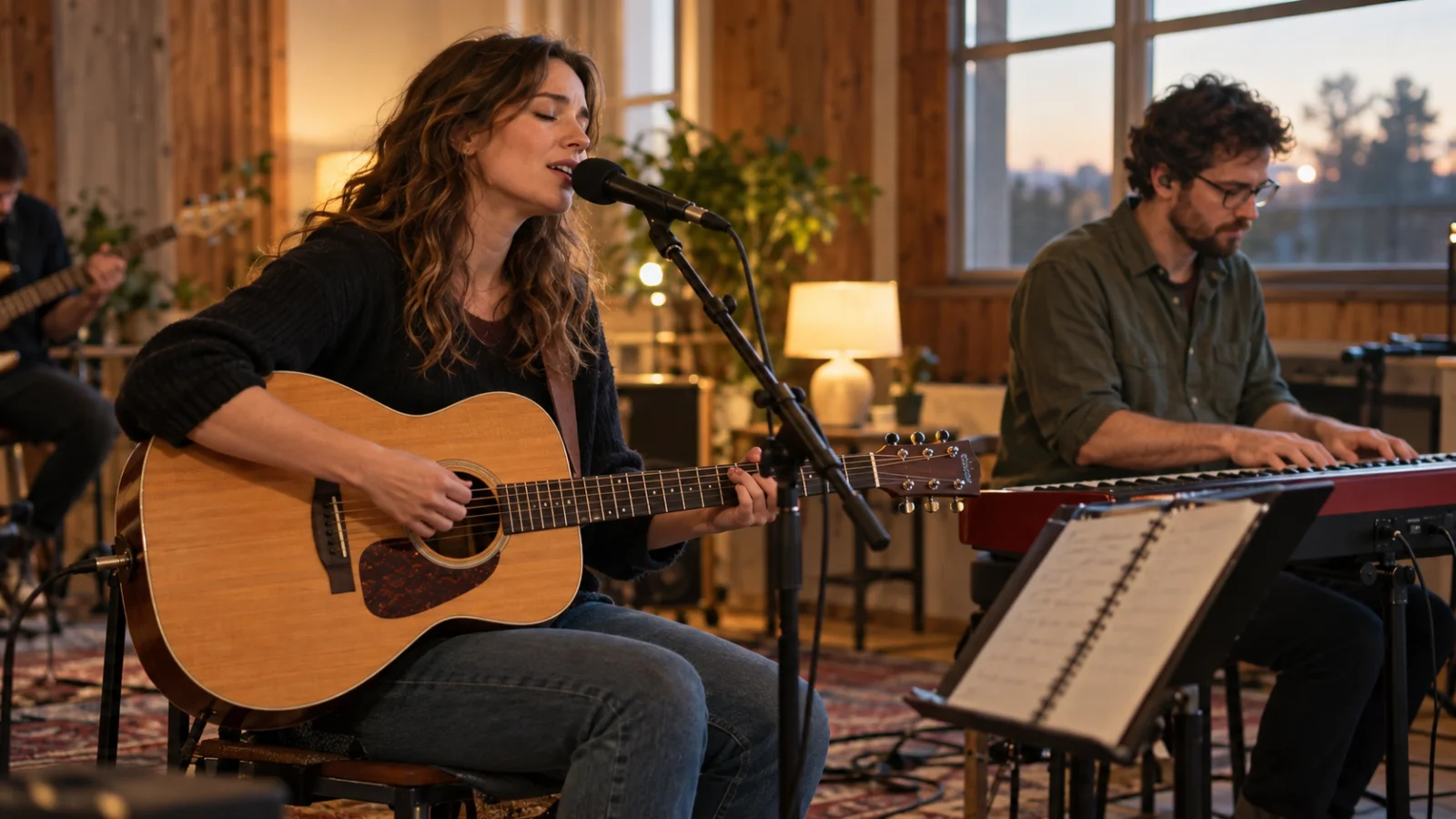
To write a worship song, first decide who will sing it: the whole congregation, or the team for others to listen to. For a congregational song, choose one truth from scripture or from your own walk with God and say it in your own words, in short lines. Build a chorus that repeats and is easy to learn, keep the melody roughly between A3 and D5 so most people can reach it, and use three or four chords such as G–D–Em–C (I–V–vi–IV). Shape it as verse–chorus–bridge, record a voice memo the same day and test it with your worship team before it reaches a Sunday.
Below: two audio examples, chord loops for the free chord progression player, an original song written for this article, a rehearsal test, a worksheet you can copy and what CCLI licensing covers today. The same steps work for a Christian song for a youth group or a gospel song for a small choir.
Congregational or performance song: decide who sings it
Most worship songs fail for one simple reason: they were written to be performed, then handed to a room full of people who are not singers. Both kinds of Christian song are valid, but they follow different rules.
| Congregational song | Performance song (special, solo, recording) | |
|---|---|---|
| Who sings | Everyone, including people who “can’t sing” | One singer or a trained group |
| Melody range | About an octave and a bit, roughly A3–D5 | Whatever the singer can do well |
| Rhythm | Predictable, few syncopations | Can be free, conversational, riffed |
| Lyrics | Words a whole church can say together | Personal story, testimony, detail |
| Repetition | A chorus heard three or four times | Less repetition is fine |
| Pronoun | Often “we”, or an “I” anyone can own | ”I” with a specific story |
Gospel songs sit in between: a leader sings a line and a choir or the congregation answers. That call-and-response is one of the best tools for beginners, because the room only has to learn the answer. If you want a song your church sings on a Sunday, write for the left column. Everything below assumes that, and notes where a performance song can bend the rule.
Step 1: start from one truth, in your own words
A worship song carries one idea well. “God is faithful when I can’t sleep” is a song. “Everything I believe about God” is a sermon. Write your idea in one sentence before you write any lyric.
Good places to find it:
| Source | How to use it | Watch out for |
|---|---|---|
| A psalm or another passage | Take its image and its movement (lament, then trust) | Quoting a modern translation word for word (see below) |
| A hymn in the public domain | Borrow its theme, or set its old words to a new tune | Checking that the text really is public domain |
| A sermon series | Write the response the congregation would sing | Lyrics that only make sense to people who heard the sermon |
| Your own story | Find the part anyone in the room could also sing | Details so private that the room can’t join |
Theological care is part of the craft, whatever your tradition. Ask yourself three questions: Is it clear who the song is addressed to? Would a love song to a person sound the same? Does every line say something your church can affirm out loud? Many teams ask a pastor or elder to read the lyric before it’s taught, and that habit saves awkward Sundays.
Scripture is the best source, but copying it word for word has two traps. First, many modern Bible translations are under copyright and set limits on quotation. Crossway, for example, lets you quote the ESV without written permission up to 500 verses, as long as the verses don’t make up 25% or more of the text of the new work. A song lyric is short, so one full verse can easily cross that line. Translations old enough to be in the public domain are free to quote, so check the copyright page of the one you use. Second, paraphrase sings better: you can fit the words to your melody instead of forcing the melody to fit a translator’s sentence.
The same goes for other worship songs. A familiar phrase might slip in by accident; a borrowed line on purpose is copying. If a line sounds like something you’ve sung many times, rewrite it.
Step 2: write a chorus a whole church can sing
The chorus is the part people take home. Write it before the verses.
- Put the main line at the start or end of the chorus, and repeat it. If it can be the title, even better.
- Use short lines, around six to nine syllables, with the same rhythm in matching lines. Paste them into the syllable counter when one feels crowded.
- Put open vowels on the high notes. “Name”, “high”, “you” and “God” are easy to hold. “Is”, “it” and “with” are not.
- Rhyme gently. Plain rhymes like came/name/same sound sincere. If you are stuck, the rhyming dictionary gives near rhymes as well as perfect ones.
- Leave room to breathe. A crowd needs a breath at the end of every line.
The chorus guide has eight techniques for the melody and the lyric. For worship, the test is simple: could a visitor sing the chorus by its second time through?
Step 3: keep the melody in range and choose a key
This is where many good worship songs get lost. Worship leader Bob Kauflin keeps congregational songs from a low A to a high D, which in note names means A3 (the A below middle C) to D5. Men sing the same melody an octave lower without thinking about it. Within that window, a melody that spends most of its time between C4 and C5 and touches D5 only on a few strong words is comfortable for almost everyone.
Three checks before you settle on a key:
- Find the highest and lowest notes of your melody. Sing it slowly and check each extreme with a piano app or the what note am I singing tool.
- Count how often the top note comes back. One D5 on the last chorus is fine. A chorus that sits on D5 four times will tire the room.
- Run it through the key finder. Open what key should I sing in with the congregation range already entered as the voice (A3–D5), then add your melody’s key and its lowest and highest notes. The tool lists the keys that fit.
A key that shows off a strong lead voice is often too high for the room. If you lead, take the free vocal range test to know your own range, then serve the congregation’s range first. The guide to voice types and vocal range explains the numbers.
Guitar-friendly keys like G, D, C, A and E cover most needs. If the best key for the room is awkward to play, keep the open shapes and use a capo.
Step 4: simple chords that carry the singing
Worship harmony is there to hold the melody up, not to impress. Three or four chords looped through a section let musicians play with confidence and keep the room’s attention on the words. The most common loop is I–V–vi–IV. Hear it first:
After the two-second count-in, keyboard, bass and a pop beat play C, G, Am and F, one bar each, and the loop starts again at about 0:12. Listen to the Am at around 0:07: it is the one minor chord, and it gives the loop its gentle ache before F opens it up again. This is a synthesized teaching example, not a finished production, but it’s the backbone of a huge number of worship choruses.
| Progression | In G | Feel | Try it |
|---|---|---|---|
| I–V–vi–IV | G–D–Em–C | Warm, open, the classic chorus | Loop it at 72 BPM |
| IV–I–V–vi | C–G–D–Em | Starts lifted, good for a chorus | Loop it at 72 BPM |
| vi–IV–I–V | Em–C–G–D | Reflective, good for verses and bridges | Loop it at 68 BPM |
| I–IV–I–V | G–C–G–D | Hymn-like, steady, easy for new players | Loop it at 80 BPM |
| I–IV–V–I | G–C–D–G | Joyful, ideal for an upbeat song | Loop it at 112 BPM |
Hum over a loop until a melody line sticks, then put the chorus words on it. The guide to chord progressions for songwriting has eleven more loops with audio. Find the tempo in your head with the tap tempo metronome: a slow, reflective song might sit around 65–80 BPM and an upbeat one above 100.
Step 5: verse, chorus, bridge (and an ending)
Most congregational songs use a form people learn by the second chorus:
- Verse: where we are. A situation, a memory, a line from scripture retold. Lower in pitch, more words.
- Chorus: the response. The main truth, sung higher and repeated.
- Bridge: a short declaration that builds, often two lines sung several times, rising in energy. The bridge guide shows seven ways to write one.
- Ending or tag: the last line of the chorus repeated, so the song lands instead of stopping.
A typical order is verse–chorus–verse–chorus–bridge–chorus–tag. Listen to how a verse and a chorus can differ in this example:
From 0:02 to 0:12 the verse melody stays low and close to speech, with no drums. At 0:12 the chorus jumps higher, the notes get longer and the drums enter. In a worship set that lift is what tells the room “now we all sing”. Plan the sections and their lengths in the free song structure planner.
Worked example: “Before the Dawn”
A draft written for this article. Its idea, in one sentence: God’s mercy arrives before we ask for it, every morning. It paraphrases the thought of Lamentations 3:22–23 without quoting any translation. Key of G, 72 BPM. The melody stays between D4 and D5 and touches D5 only on “dawn” and “morning” in the chorus. Loop the verse while you read.
Verse 1, I–V–vi–IV (G–D–Em–C):
G                       D
I lay awake and counted every fear
Em                         C
till the window turned from black to gray,
G                          D
and before I found a word to pray,
Em         C
You were already here.
Chorus, IV–I–V–vi, then IV–I–V–I:
C           G          D        Em
Before the dawn, Your mercy came,
C            G          D        Em
before we learned to call Your name;
C            G          D       G
and every morning, it's the same:
C       D     G
You are faithful.
Verse 2:
G                          D
We come in with the week still on our coats,
Em                           C
the things we said, the things we meant to do,
G                          D
and still You call us by our names
Em          C
and make the morning new.
Bridge, vi–IV–I–V, sung three times and building (loop it):
Em               C            G        D
When the night comes back, You'll still be true;
Em               C          G       D
when the morning comes, we'll sing to You.
Tag: “You are faithful”, three times, ending on G.
What each part does:
- One idea: every section serves “mercy arrives first”. Nothing about the song needs a sermon to make sense.
- I and we: verse 1 is one person’s night; verse 2 and the chorus turn to “we”, so the room joins in.
- Clear address: “Your mercy”, “call Your name”, “sing to You”. No one will hear it as a love song.
- Singable chorus: four lines of eight syllables, the same rhyme sound three times (came/name/same) and a short answer anyone can learn at once.
- Range: the high D lands on open vowels (“dawn”, “morn-”), twice per chorus.
How worship teams test a new song in rehearsal
A song isn’t ready because the writer likes it. It’s ready when the team can play it and a room can sing it. Here’s a rehearsal test that takes about twenty minutes:
- Send it a week ahead: a voice memo of the melody with guitar or piano, a chord sheet with key, tempo and form, and the lyric on its own.
- First pass, listening: the writer sings it once. The team listens without playing and notes where they got lost.
- Second pass, everyone sings: the band plays simply and every person in the room sings the melody, including the drummer and whoever runs sound. If the non-singers can’t follow by the second chorus, simplify the melody or the rhythm.
- Key check: try the chosen key and one step lower. Ask the people with the lowest and highest voices which felt better.
- Words check: read the lyric aloud without music. Fix any line that is unclear, too private or hard to say together.
- Record the run on a phone and write down the decisions: key, tempo, form, who starts.
- Plan the introduction: sing it a few Sundays close together so the congregation learns it, rather than once every few months.
For the general shape of a good rehearsal, see how to run a band rehearsal. A clean lyric and chord sheet makes step 1 much easier, and the free chord sheet maker builds one in the browser. To schedule the team and share charts and multitracks for the service, the best apps for worship teams compares Planning Center, WorshipTools, OnSong and others.
Copyright, CCLI and registering your worship song
This is general information, not legal advice. Two things are often mixed up.
Using other people’s songs in church. In many countries churches buy a CCLI Church Copyright License. According to CCLI, it covers projecting lyrics from a computer or digital device, printing lyrics in bulletins, programs and song sheets, recording services for archive or limited distribution, and making your own arrangements and translations where no published version exists. Streaming services online needs a separate CCLI Streaming License. Ask your church office what it already has.
Your own song. You hold the rights to what you write. Your own church doesn’t need a license to sing a song you wrote and own, but other churches projecting or printing it need your permission. CCLI says it is not a publisher; songwriters who self-publish can become registered copyright owners under certain conditions, and CCLI pays royalties to registered owners based on the reports churches send. Signing with a publisher is the other route.
Before you share the song widely, document it: date the drafts, keep the voice memos and, if you co-wrote it, agree on percentages with a free split sheet template. The guide on how to copyright and register a song covers the US Copyright Office, BMI, ASCAP and the MLC.
Copy this worksheet for your next worship song
WORSHIP SONG WORKSHEET
Title:
One-sentence idea:
Scripture behind it (reference, paraphrased):
Who sings it:   congregation / team / soloist
Pronoun:        I / we / both
Key:            Tempo (BPM):
Melody range:   lowest ____  highest ____  (aim: A3 to D5)
Times the top note appears per chorus:
Form:  V1 / C / V2 / C / Bridge x__ / C / Tag
Verse chords:            Chorus chords:            Bridge chords:
Lyric read by (pastor, elder, team):
Rehearsal test date:     Changes decided:
Co-writers and split:
Where Zoundroom fits: one song, one project for the whole worship team
A worship song usually lives in three places at once: the lyric in a notes app, the melody in a voice memo and the chord sheet in someone’s email. Zoundroom keeps them together, because each song is a project with its recordings, lyrics, notes and files. Create a project called “Before the Dawn”, write the lyric in a note with the chords above each line and “G, 72 BPM, range D4–D5” at the top, and record the melody inside that note: the audio lands at the cursor, right under the chorus it belongs to. Add the chord sheet PDF to the project’s files (PDF import needs Pro) and import older voice memos so nothing stays on one phone. Then share the project with your team; open it on iOS, Android or the web. Free shares with up to two artists, Pro with up to four and adds timestamped feedback (a bassist who also has Pro can point to the exact second the bridge drags), and the Band plan puts a whole team of up to seven people under one subscription. Be clear about what it doesn’t do: Zoundroom doesn’t generate audio, has no virtual instruments or beats, isn’t where you mix and master a final recording (a DAW like GarageBand or BandLab is), and it doesn’t project lyrics, schedule volunteers or license songs. Your next step: create the project today and record the chorus in that note before rehearsal.
Frequently asked questions
How do I write a Christian song as a beginner?
Write one sentence about what you want to say to or about God, then find a chorus line that says it in under ten syllables. Loop G–D–Em–C in a chord player, hum until a melody sticks, put the line on it and record it on your phone. Write two short verses that lead into that chorus and test it by singing it with friends.
Can I use Bible verses word for word in a song?
You can quote public-domain translations freely, but many modern translations are under copyright. Their permission notices usually allow short quotations up to a share of the new work, and a song is so short that one verse can exceed it. Paraphrasing in your own words avoids the problem and usually fits the melody better.
What is the best key for congregational singing?
There is no single best key; there is a best range. Aim for a melody between about A3 and D5, with few visits to the top note. Then pick the key that puts your melody inside that window, using a key finder, and try one step lower in rehearsal.
How do I write a gospel song for beginners?
Start with a short, strong refrain and use call-and-response: the leader sings a line, the choir or congregation answers with the same short phrase. Keep the chords simple, such as I–IV–V, let the rhythm swing and leave space for the leader to improvise between the answers.
Do I need a CCLI license to sing my own song at church?
If you wrote the song and own its rights, your church doesn’t need a license to sing it. Other churches would need your permission to project or print it, and CCLI can handle that permission if you become a registered copyright owner or sign with a publisher that works with CCLI.
Sources
All pages checked on October 2, 2026.
- CCLI, “Church Copyright License” (US): projecting lyrics, printing in bulletins and song sheets, recording services for archive or limited distribution, own arrangements and translations where no published version exists. ccli.com
- CCLI, “Streaming and Streaming Plus Licenses”: streaming services with music requires a separate license that extends the Church Copyright License. ccli.com
- CCLI, “Owners”: CCLI is not a publisher; self-published songwriters can become registered copyright owners under certain conditions; royalties are paid to registered owners based on church reports. ccli.com
- Bob Kauflin, “Finding the Right Key to Sing In”, Worship Matters: congregational songs kept from a low A to a high D. worshipmatters.com
- Crossway, “Permissions Requests”: the ESV may be quoted up to 500 verses without written permission if the verses are less than 25% of the total text of the new work, among other conditions. crossway.org