
How to write a song for a musical (and for a school musical)
Published
Write songs for a musical: what each song does, the main song types, a scene-to-song method with an original example, a template and a plan for a school show.
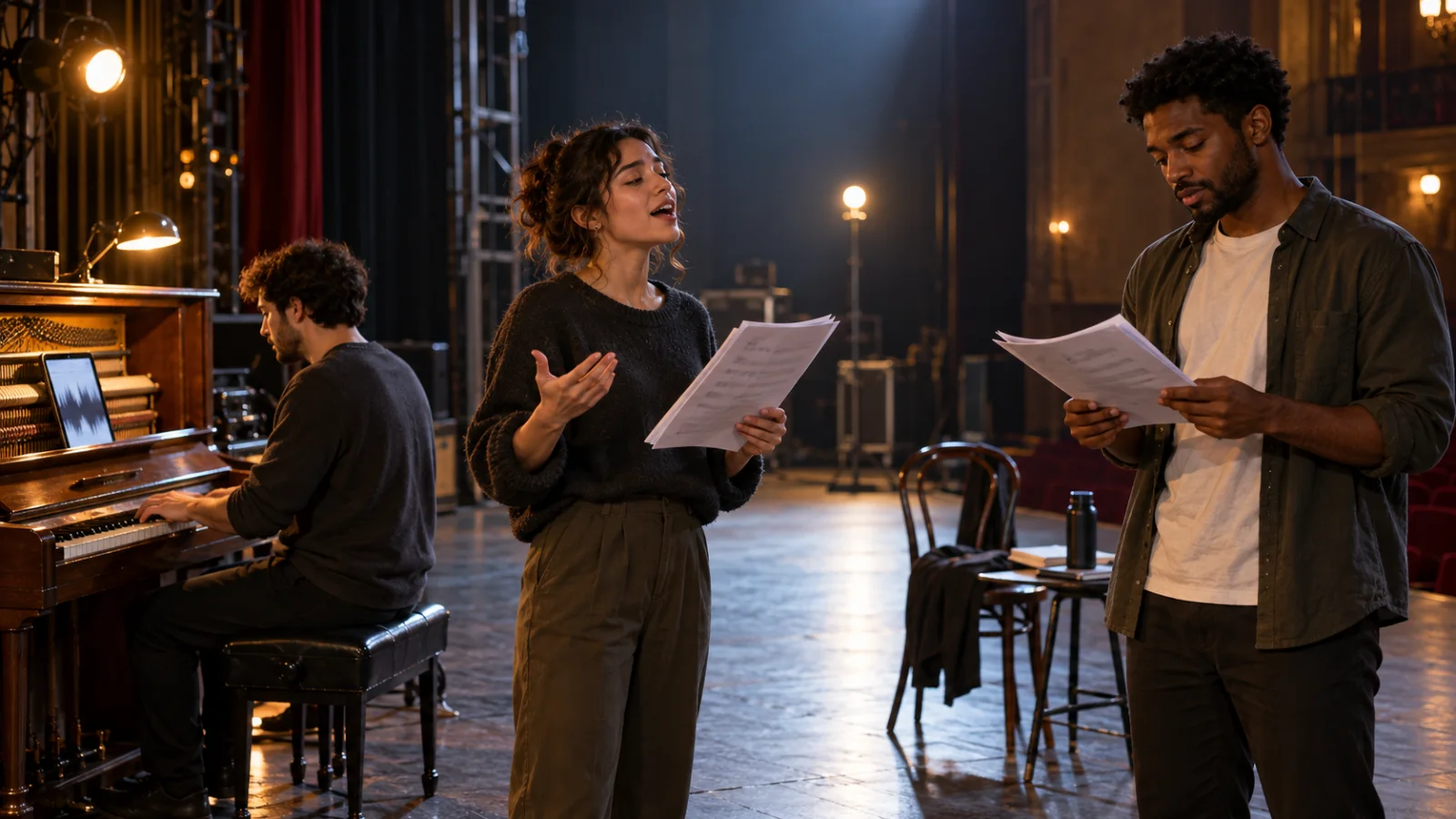
To write a song for a musical, start from the story, not from a tune. Pick a moment where the character’s feelings are too big for dialogue, decide what they want and what has changed by the last note, and write the song so the scene moves forward while it plays. Most musical theater songs belong to a few types: the opening number sets up the world, the “I want” song states the hero’s goal early in Act 1, comedy songs and ballads reveal character, a reprise brings a melody back with new meaning, and the finale resolves the story. Write lyrics the audience understands in a single hearing, in the character’s own voice, with clean rhymes, then record a simple piano-vocal demo so the cast can learn it.
Below: what each song type does (with shows you can study), a step-by-step method from scene to song, an original “I want” song built from a scene, a song brief you can copy, the rules for lyrics that land in a theater, how to share the work with a book writer and a composer, rehearsal demos, a 12-week plan for a school or community musical, and the rights you need when a school uses existing songs.
What a song does in a musical
In a pop song, the song is the whole event. In a musical, a song is part of a scene, and something has to happen during it. Every number does at least one of three jobs:
- It moves the story. A decision, a plan, a confession, a fight: the situation at the end of the song is different from the one at the start.
- It shows what a character wants or feels, in a way dialogue can’t. Characters sing when speaking is no longer enough.
- It sets the world and the tone. Where we are, what kind of show this is, what the rules are.
A quick test for any song in your show: cut it and read the scene without it. If nothing is lost, the song isn’t doing its job yet. The other test is the turn: the character should leave the song a little different from how they entered it, even if the change is only a decision.
People also search for how to write a “Broadway song”. What makes a song feel like Broadway is this function more than a sound. Shows use classic show tunes, pop, rock, folk or hip-hop, as Hamilton proved. Write in the style your story needs, but write a song that belongs to one character at one moment.
Musical theater song types: opening number, “I want” song and more
| Type | Where it usually comes | What it does | Shows to study |
|---|---|---|---|
| Opening number | The first minutes | Sets the world, the tone and the main characters; promises what the show is about | Into the Woods (“Prologue: Into the Woods”), Hamilton (“Alexander Hamilton”) |
| “I want” song | Early in Act 1 | The protagonist states the goal that drives the whole story | The Little Mermaid (“Part of Your World”), Hamilton (“My Shot”) |
| Comedy or charm song | Anywhere, often after a tense scene | Makes us laugh or like a character; the jokes land on the rhymes | West Side Story (“Gee, Officer Krupke”) |
| Ballad | Emotional peaks | A character alone with a feeling, or a love duet; slower, with room for the voice | Les Misérables (“On My Own”) |
| Reprise | Later in the show | A melody we already know comes back with new words or a new singer, so we hear what changed | Many shows reprise their “I want” song |
| Act 1 finale | End of Act 1 | Raises the stakes and leaves a question hanging over the intermission | Les Misérables (“One Day More”) |
| Eleven o’clock number | Late in Act 2 | A showstopper near the climax, often the answer to the “I want” song | Gypsy (“Rose’s Turn”) |
| Finale | The last number | Resolves the story, often bringing back earlier melodies | Listen to how your favorite show ends |
How to write an opening number. In a few minutes it has to answer three questions: where are we, whose story is this, and what kind of evening is it going to be (funny, dark, epic, intimate). Write those three promises down before you write a line, and make sure the opening keeps all three. Many writers draft the opening early and rewrite it last, once they know what the show actually became.
How to write an “I want” song. Make the want specific and active: not “I want to be happy” but “I want to audition in the city on Saturday”. It should come early, so the audience has a goal to follow, and it should name an obstacle, so they worry. Playbill describes the eleven o’clock number as often working like the resolution of the Act 1 “I want” song: plan the two together.
How to write a musical theater song, step by step
This is the scene-to-song method. It works whether you write words, music or both.
- Write the scene in prose first. Who is there, what just happened, what the character wants and what they are hiding. Half a page is enough.
- Find the song moment. Look for the point where talking stops working: a decision, a secret coming out, a plan forming. With your team, go through the outline and mark those points; that is called spotting the songs.
- Write the song in one sentence. “[Character] wants [goal], but [obstacle]; by the end, [what changes].” If you can’t fill in the last part, the song has no turn yet.
- Choose the type and the listener. Is it an “I want” song, a comedy song, a duet? Does the character sing to themselves, to another character or to the audience?
- Find the title in the character’s words. A short phrase they would actually say, which can come back several times and mean something different each time.
- Map the structure to the story. A reliable shape: verse 1 sets the situation, the chorus states the want, verse 2 adds the obstacle, the bridge is the turn, and the final chorus comes back changed. Theater also uses the AABA form and through-composed songs; the guide to song structure compares them, and the song structure planner lets you lay out the sections and their bars.
- Write the lead-in and the button. The lead-in is the last line of dialogue before the music; the button is the final line or chord that tells the audience the song is over (and lets them applaud).
- Draft, then sing it at tempo. If you also write the music, hum the lines until a melody fits their natural stresses; the guide to putting music to lyrics shows the method. If a composer sets it, send the lyric with the song sentence on top.
- Test it inside the scene. Read the scene aloud, sing or play the demo, and continue. Cut from the dialogue anything the song already says, and cut from the song anything the scene already showed.
Worked example: an “I want” song from a bakery scene
A show premise and song written for this article.
The show. Nora, 17, works before school at her father’s bakery in a small coastal town. She wants to audition for a music college in the city, two hours away by train. Her father can’t run the bakery on his own, and he would never ask her to stay.
The scene. Five in the morning. Her father leaves on his delivery route. The audition form has been in a drawer for weeks. Every morning at 5:40, the city train passes behind the bakery.
The song in one sentence. Nora wants to take the 5:40 to the audition, but she’s afraid of leaving her father alone; by the end, she decides to mail the form.
Type and title. An “I want” song, sung to herself. Title: “Five-Forty”, the train she hears every day, a concrete image that holds the whole want.
| In the scene | In the song |
|---|---|
| Her father’s routine and his last line | Verse 1: short, repetitive images of the daily routine |
| The train she hears every morning | The title and the chorus |
| Her father can’t manage alone | Verse 2: the obstacle, shown through his character |
| The form in the drawer | The bridge, then the action that turns the scene |
The lead-in, the lyric and the button:
DAD:  Rye first, then the rolls. Same as always.
      (He leaves. A train whistle in the distance.)
NORA: Same as always.

VERSE 1 (the situation)
Five a.m., the ovens hum,
rye goes first, the rolls will come.
Dad's van turns at Miller's store:
same street, same bell, same door.
And at five-forty, right on cue,
the city train comes rolling through.

CHORUS (the want)
Five-forty, take me with you,
one ticket and one song,
two hours down the line to show them
I've been singing all along.

VERSE 2 (the obstacle)
Who would knead if I weren't here?
Who'd save crusts for Mrs. Greer?
Dad would never tell me no,
he'd just bake a little slow.

BRIDGE (the turn)
The form's been in my drawer since March,
beneath the gas and water bills.
I've told myself "next week" so long
that next week's standing still.
      (She takes the form out of the drawer.)

FINAL CHORUS (what changed)
Five-forty, not this morning,
but I'll be on your line:
the form goes in the mail today,
next Saturday the seat is mine.

BUTTON: the van's horn outside. She hides the envelope
in her apron and picks up the tray. Last chord.
And a reprise for Act 2, when her father drives her to the station and sings her melody with his own words:
Five-forty, take her with you,
I'll manage on my own;
two hours down the line she'll show them
what I have always known.
What each choice does:
- The title is something on stage, a real train with a real time, not “my dream”. Every time it comes back, the audience remembers what she wants.
- Verse 1 is routine on purpose. Short lines and “same street, same bell, same door” make the daily loop audible, so the longer chorus lines feel like escape.
- The obstacle is a person, not a villain. “He’d just bake a little slow” shows her father’s character in six words and explains why leaving is hard.
- The bridge is the turn. She notices that “next week” never comes, and the stage direction turns that thought into an action.
- The final chorus keeps the melody and changes the words, so the audience hears the decision without being told.
- The rhymes are perfect and fall on stressed words (song/along, here/Greer, bills/still, line/mine), easy to catch on a first hearing.
- The reprise gives her melody to her father. The music itself tells the audience how far both characters have come.
Template: a song brief for each number in your show
Fill one in before you write each song, and give a copy to everyone who works on it.
SONG BRIEF
Show:                     Act / scene:          Song no.:
Title:
Type: opening / "I want" / comedy / ballad / duet / reprise / finale
Who sings:                To whom:

Before the song, the character...
The song in one sentence: ___ wants ___, but ___; by the end, ___
What the audience learns that the dialogue didn't say:

Lead-in (last line of dialogue):
Button (last line, last action, last chord):

Structure:  verse 1 = situation   chorus = want   verse 2 = obstacle
            bridge = turn         final chorus = what changed
Key words to land on long notes:
Rhymes (stressed syllables):

Performer's range:  lowest ___  highest ___     Key:        Tempo:
Demo: piano-vocal v__ (date)     Rehearsal tracks: accompaniment / parts
Reprise later? Where, and with which new words:
Lyrics an audience hears once: clarity, rhyme and character voice
A theater audience hears each lyric once, at speed, over a piano or a band, while watching actors move. Nobody can rewind. That changes how you write.
- Clarity beats cleverness. One idea per line, plain word order, and the important word on a long or high note. Avoid inversions for the sake of a rhyme: “to the station I must go” sounds like a lyric, not like a person.
- Perfect rhymes, on stressed syllables. Pop and rap use near rhymes freely, but on a stage, where every word is exposed, a near rhyme can sound like a mistake, so theater writers mostly prefer true rhymes. The guide on how to rhyme in songs explains the difference between them.
- Jokes land on the rhyme. In a comedy song, build the line so the rhyme word is the punchline, and leave a beat after it for the laugh.
- Let the character choose the words. Nora talks in work words: rye, ovens, crusts, bills. A fast-talking comic character might pack internal rhymes into every line; a child might use short words and repeat them. Exercise: write the line “I’m leaving” for three characters in your show and compare the vocabulary, the length and the rhythm.
- Fit the stresses to the beat. Read the line aloud and check that stressed syllables fall on strong beats; the syllable counter helps you match lines that share a melody.
Look for true rhymes for the word that ends your line:
Working with a book writer and a composer
A musical has several authors, and one person often covers two jobs:
| Role | Writes | Typical questions |
|---|---|---|
| Book writer (librettist) | The story, the scenes and the dialogue | Where do the songs go? What can the song say so the scene doesn’t have to? |
| Lyricist | The words of the songs | What does the character want here? What’s the title? |
| Composer | The music | What’s the tempo, the style, the key for this actor? |
| Music director | Teaches the songs and plays rehearsals | Which key suits the cast? Where do they need a breath? |
| Orchestrator or arranger | The instrumental parts, usually later | Which instruments, for which band size? |
A few habits keep the team moving:
- Spot the songs together from a shared outline, and write a song brief for each one.
- Decide song by song whether the lyric or the music comes first. Comedy songs often start from the lyric; big ballads sometimes start from a melody.
- Trade lines between the scene and the song. If the song says it, the book writer cuts it from the dialogue, and the other way around.
- Give feedback on the recording, with the exact minute and second (“at 1:12 the high note comes on a weak word”), and keep every version.
- Agree on credits and splits early, in writing: who wrote what and how income from the show is shared. The split sheet template is a simple starting point; this is not legal advice, and a full production will need a proper collaboration agreement.
Demo recordings for rehearsals
Actors learn songs from recordings long before they see sheet music, so the demo is part of the writing.
- A piano-vocal demo per song, at the final tempo and in the performer’s key. In musical theater, songs are usually set or transposed to suit the actor; enter their range in what key should I sing in (the link opens with A3 to E5) and set the tempo with the tap tempo metronome.
- An accompaniment-only track, so performers can practice singing over it at home.
- One track per vocal part for group numbers: the melody, then each harmony line played or sung on its own.
- A slower version of fast or wordy songs for the first rehearsals.
- Clear file names, the same for everyone: song number, title, character, version and date, for example
05 Five-Forty - Nora - piano-vocal - v3.
For quick takes, the free online voice recorder has a count-in and a click, keeps several named takes, downloads them as WAV and never uploads your audio.
How to write a school or community musical: a 12-week plan
A school or amateur musical follows the same rules, scaled to the group. Keep the show to 30 to 60 minutes with five to eight songs, write ensemble numbers so everyone sings, offer solos to those who want them, and keep melodies inside a small range for young voices (the guide to writing songs for kids gives ranges by age, and the vocal range test checks a soloist in a minute).
| Weeks | What happens | Who |
|---|---|---|
| 1–2 | Choose the story and the characters with the group; outline six to ten scenes; spot the songs | Everyone, led by the teacher or director |
| 3–5 | Write the lyrics in small groups, one group per song, chorus first; hum and record melodies | Groups, with a teacher or musician shaping the tunes |
| 6 | Record the rehearsal tracks: piano-vocal and accompaniment only | The music lead |
| 7–10 | Rehearse scenes and songs; the cast practices at home with the tracks | Cast and director |
| 11 | Full run-throughs; shorten anything that drags | Everyone |
| 12 | Dress rehearsal and the show | Everyone |
Split the writing so every student has a real job: lyricists, a melody group, a fact or story checker, and a group in charge of recordings. If nobody in the group writes music, two options work: put new words on a public-domain melody, or ask a musician to set the class’s lyrics.
If you’d rather stage an existing show, licensing houses offer school versions. Music Theatre International’s Broadway Junior collection, for example, has 30-minute KIDS versions for elementary school and 60-minute JR. versions for middle school, with the music written in keys for developing voices.
Rights when a school uses existing songs
This is general information, not legal advice; rules differ by country, so check yours before the show.
- Your original songs belong to the people who wrote them. Keep dated versions, and if you want formal protection, the guide to copyright and registering a song explains the options.
- An existing musical is licensed from the company that represents it. The license sets the number of performances, the script and the score you may use.
- Pop songs inside your own story are a different case. ASCAP explains that its licenses cover non-dramatic performances only, not the “dramatic” or “grand” rights you need to use songs in a staged musical; those are cleared with the composer, publisher or licensing agent. In other words, a venue’s or a school’s music license doesn’t cover a jukebox-style show.
- New words on a famous melody still use someone else’s music. A traditional, public-domain tune is free to use; a recent hit needs permission, and the guide to writing a parody song covers when.
- Filming and posting the show is a separate use of the music. Check the license or ask the rights holders before you upload it.
Common mistakes when writing songs for a musical
- The song repeats the scene. If the dialogue already said it, the song needs a new job, or the dialogue needs cutting.
- A vague want. “I want more” gives the audience nothing to follow; “I want that seat on the 5:40” does.
- No turn. The character ends the song exactly where they started.
- Clever lines nobody catches. Packed wordplay at high speed is lost in the room; slow it down or simplify it.
- Writing in your own key. Check the performer’s range and set the song for them.
- Songs that outlast the scene. Especially with kids: cut a verse before you cut a song.
- No lead-in or button. The audience doesn’t know when to start listening or when to clap.
Where Zoundroom fits: one project per song of the show
A musical piles up material fast: scene drafts, a song brief, three versions of a chorus, the composer’s piano-vocal demo, each actor’s key, the rehearsal tracks. In Zoundroom each song is a project that keeps its recordings, lyrics, notes and files together, so give every number of the show its own project. Paste the song brief into a note, write the lyric under it, and record the hummed melody or the first piano-vocal take inside that note, on your phone or in the browser at app.zoundroom.com: the audio lands at the cursor, next to the verse it belongs to. Add the scene as a PDF file (PDF import needs Pro) and import the composer’s demo and the rehearsal tracks into the same project. Invite the composer or the book writer (Free shares with up to two artists; Pro with up to four, and lets anyone on Pro leave feedback at the exact second of a take, such as “at 1:12 this sits too high for Nora”), and a creative team can share one Band subscription for up to seven members. Auralis, Zoundroom’s AI assistant, can suggest another way to phrase a line, as text only. Be clear about the limits: Zoundroom doesn’t produce sheet music or scripts, doesn’t generate audio, has no virtual instruments or beats, and isn’t where you mix and master a cast recording (a DAW such as GarageBand or BandLab is). Your next step: create a project for your “I want” song, paste the brief into a note and record your first sung chorus inside it. See how notes and lyrics work with audio.
Frequently asked questions
How do you write a song for a musical?
Start from a scene. Find the moment where dialogue isn’t enough, write what the character wants, what stops them and what changes by the end, and pick a title from their own words. Shape the song so the chorus states the want and the final chorus shows the change, use clear lyrics and true rhymes, and test it inside the scene.
What is an “I want” song?
The song, early in Act 1, where the protagonist tells the audience what they want most. It gives the story its question and makes the audience root for the character. Late in Act 2, the eleven o’clock number often answers it.
How do I write an opening number for a musical?
Decide what the opening must promise: where the story happens, whose story it is and what kind of show it is. Introduce the main characters and the tone in a few minutes, and end with a clear button. Expect to rewrite it once the rest of the show is written.
Should the lyrics or the music come first?
Either works, and teams often switch from song to song. Lyrics first is common for comedy songs, where the jokes drive the rhythm; music first can help ballads and dance numbers. What matters is that both writers share the song brief.
Can a school use pop songs in its musical?
Not freely. A general music license usually covers ordinary performances of songs, not their use inside a staged story, which needs permission from the publishers. An original score, licensed school versions of existing shows, or public-domain melodies are the simpler routes.
Sources
All pages checked on October 2, 2026.
- Playbill, “Celebrate the 11 O’Clock Number With These 25 Showstopping Songs” (July 8, 2020): the eleven o’clock number as a showstopper near the end of the show, often the resolution of the Act 1 “I want” song, with “Rose’s Turn” from Gypsy among its examples. playbill.com
- ASCAP, “Music licensing FAQs”: ASCAP does not license dramatic or grand rights, which are needed to stage a musical and are cleared with the composer, publisher or licensing agent; its license covers non-dramatic performances of songs from dramatic productions. ascap.com
- Music Theatre International, “Broadway Junior”: 30-minute KIDS shows for elementary school, 60-minute JR. shows for middle school, music written in keys for developing voices. mtishows.com