
How to write a song for your teacher (thank-you or goodbye)
Published
Write a thank-you or goodbye song for a teacher with the whole class: real classroom details, a chorus kids can sing, an easy tune, a template and recording tips.
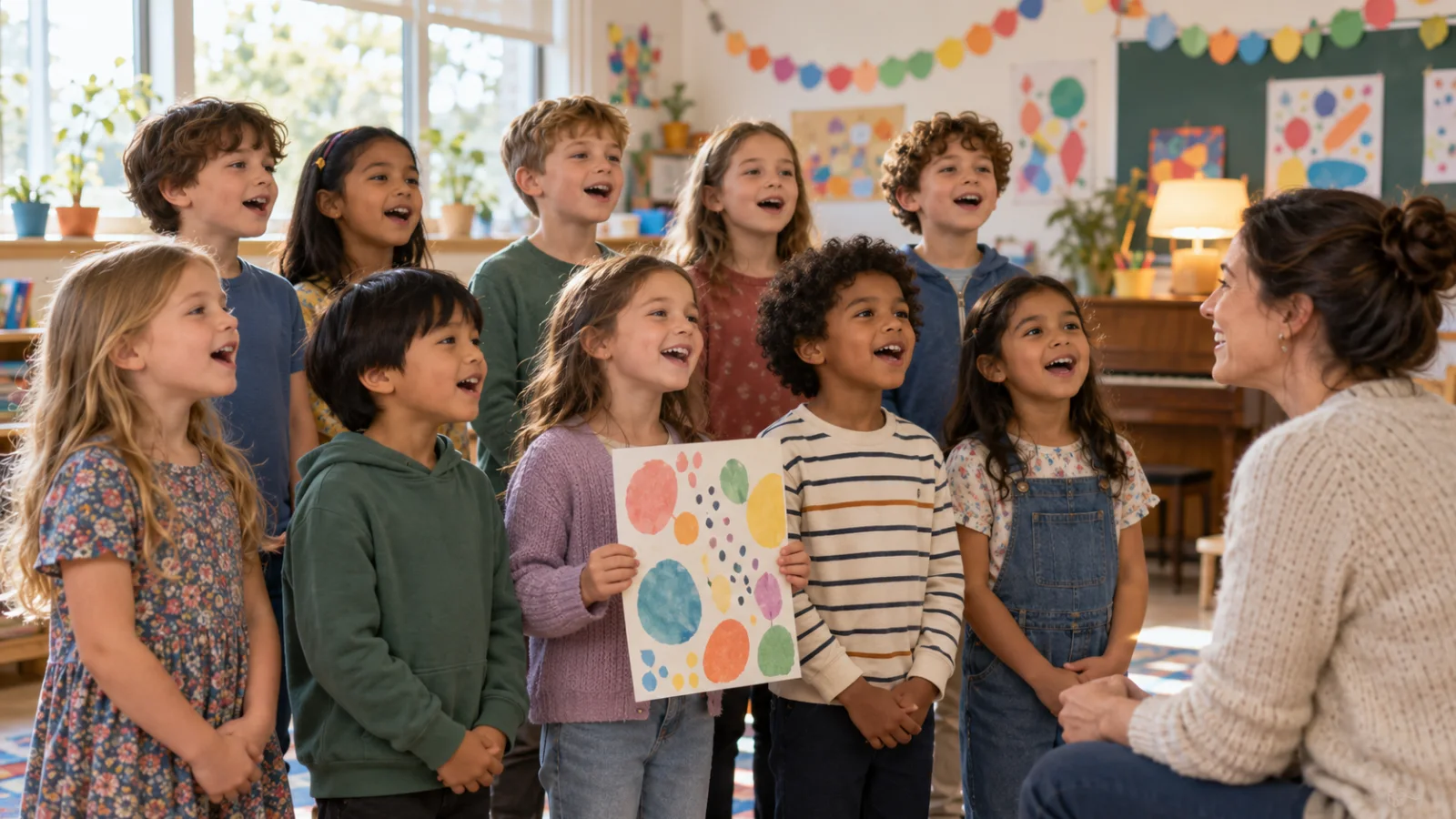
To write a song for your teacher, start with the classroom, not with “you’re the best teacher ever.” Collect eight to ten details only this class knows: the phrase the teacher always says, the signal for quiet, the class pet or plant, the best day of the year. Turn the teacher’s own phrase into a short chorus everyone can sing, and give each verse to a small group of kids, one detail per line. Keep the tune small (five or six notes) and simple: new words on a public-domain melody like “Twinkle, Twinkle”, or your own tune over four easy chords. Rehearse it a few minutes at a time for two weeks and record a video. It works for Teacher Appreciation Week, the last day of school or a goodbye song for a teacher who is retiring.
Below you’ll find when to sing it, a whole-class plan in steps (who writes what), a complete original example with chords and audio, a version on a tune everyone knows with an honest note on rights, a template to copy and how to record it. Nobody in the class needs to read music.
Why a song the class writes beats a ready-made one
There are plenty of thank-you songs for teachers online, and a dedicated one is a kind gesture. A song the class writes is a different gift: the teacher hears the name of the class plant, the joke from the field trip and the phrase they have said three hundred times this year, sung back by the kids who heard it. That’s why it lands, even when the singing wobbles. It also gives the children a small, real experience of writing something together, which most teachers will appreciate as much as the song.
Song for teacher appreciation, the last day or a goodbye: pick the moment
The moment decides the tone and how much time you have. In the US, the big one is Teacher Appreciation Week.
| Moment | When | Who usually sings | Tone that works |
|---|---|---|---|
| Teacher Appreciation Week | The first full week of May: May 3–7, 2027, with National Teacher Day on Tuesday, May 4 | The class, often organized by a room parent | Light and grateful |
| World Teachers’ Day | October 5 every year (a UNESCO day since 1994) | A class or a whole school assembly | Short and grateful |
| The last week of school | Late spring, depending on your district | The class, sometimes with parents | Thank-you plus a “have a great summer” |
| A teacher retiring | Usually the end of the school year | Current kids, former students, colleagues | Warm, with years of memories |
| A teacher leaving mid-year | Whenever it happens | The class | Short and tender |
If the teacher is retiring, colleagues often want their own version with staff-room humor; how to write a farewell song for a colleague covers that, with rules for jokes that don’t hurt. The class version stays simple: what this teacher did for kids, year after year.
Step 1: collect the classroom details (without spoiling the surprise)
A song for “a teacher” fits every teacher, so it moves none. A song for this teacher needs details the class can name. Ask these questions in small groups, or one per child on a slip of paper (an adult writes for the youngest):
| Ask the class | Example answer |
|---|---|
| What does our teacher always say? | ”Mistakes mean you’re learning.” |
| How do we get quiet? | Two claps, and we clap back |
| What’s ours, only in this room? | Gerald, the plant on the window sill |
| What was the best or funniest day? | The aquarium trip, when it rained and our shoes got soaked |
| What did they do that nobody asked them to? | Remembered every birthday |
| What will you keep doing because of them? | Reading one more page before bed |
If parents are organizing it, ask the question at dinner and collect one answer per family in the class group chat. Keep everything that doesn’t fit the song: it goes on the card.
How to write a song for your teacher as a whole class
The trick with 20 or 25 writers is to give everyone a job and one adult the final say. Plan two to three weeks.
| Role | Who | What they do |
|---|---|---|
| Editor | One adult: a room parent, the aide or the music teacher | Keeps the secret, glues the lines together, makes them fit the tune |
| Chorus voters | The whole class | Choose the chorus line from three of the teacher’s phrases |
| Verse groups | Three or four kids per verse | Each group owns one verse and one detail per line |
| Gesture team | Two or three kids | Invent one movement per chorus line |
| Leaders | Two or three confident voices | Start each verse and keep the tempo |
- Collect the details (step 1, ten minutes).
- Vote the chorus. The editor writes three of the teacher’s phrases on the board; the class picks one.
- Write the verses in groups. Each group gets one theme (our room, our best day, what we’ll keep) and writes four short lines. With five- and six-year-olds, the adult writes down what they say.
- Edit for singing. The editor makes the lines similar in length, checks them with the lyric syllable counter and swaps any word the kids stumble on.
- Choose the melody (three options below).
- Teach it by echo. Sing one line, the class sings it back, then the next. Start with the chorus. The open textbook Music and the Child describes this phrase-by-phrase echo for longer songs and teaching a short, repetitive song whole.
- Rehearse little and often: five to ten minutes, three or four times, ideally during music class or with another teacher so it stays a surprise.
- Add the gestures and a solo line for any child who wants one, and nobody else has to sing alone.
Keep the range small. The same textbook gives typical comfortable ranges: middle C to the A above it for ages 3–5 (C4–A4), middle C to the C above for ages 6–8 (C4–C5) and B♭3 to E5 for ages 9–11, with the strongest notes around F and G. It also warns that adults tend to pitch songs where they are comfortable, which is usually too low for children. Put the kids’ range into what key should I sing in (the link opens with C4–C5). For vocabulary, actions and length by age, see how to write a song for kids.
A structure that works for a class
- Chorus first, so the song opens with the part everyone knows.
- Verse 1 (our room), chorus, verse 2 (our best day), chorus.
- Last chorus with a twist: change one line so the kids now say the teacher’s phrase back.
- Length: one and a half to two and a half minutes. Short is a feature with kids.
Here’s what a melody that young voices can manage sounds like: every note moves to its neighbor, and the whole tune fits in five notes, from C to G.
What to listen for: after the count-in (0:00–0:02), the melody plays once over C–Am–F–G, from about 0:02 to 0:13, then again to the end. No leaps, no high notes: a class of six-year-olds can sing all of it. It’s a synthesized teaching example, not a finished recording.
Example: “Mistakes Mean We’re Learning”
A second-grade class writes for Ms. Rivera, using the answers from step 1. The chords loop C–Am–F–G, one chord per bar at 88 BPM, so each line takes two chords. Sing the verses on the five notes of the audio example and let the chorus reach up to A on “thank you.”
Chorus (the whole class)
C                Am
Mistakes mean we're learning,
F                G
that's what you would say,
C                Am
Ms. Rivera, thank you
F                G
for every single day
Verse 1 (group 1: our room)
C                    Am
Two claps and the room goes still,
F                    G
Gerald grows on the window sill,
C                    Am
stories on the purple chair,
F                    G
"One more page!" from everywhere
Verse 2 (group 2: our best day)
C                     Am
Wet shoes at the aquarium,
F                     G
sharks went gliding past the glass,
C                     Am
you remembered every birthday,
F                     G
every name in our whole class
Last chorus (the twist)
C                Am
Mistakes mean we're learning,
F                G
now we're the ones who say,
C                Am
Ms. Rivera, thank you
F                G      C
for every single day
Why it works: every verse line is something only this class can sing (the two claps, Gerald, the purple chair, the wet shoes). The chorus is the teacher’s own sentence, so it’s recognized from the first word. Chorus lines have five or six syllables and verse lines seven or eight, and the rhymes (still and sill, chair and everywhere, glass and class, say and day) are easy for kids to remember. The last chorus turns it around: the kids now say the teacher’s phrase. For gestures, try two claps on “learning,” a pointing hand on “you,” and arms wide on “every single day.”
Try it now: the player below loops the example’s chords. Sing the chorus over it, slow it down if the kids rush, and record a take for the class.
New words on a tune everyone knows (and the rights)
The fastest route for a class is a melody the kids already sing. The tune of “Twinkle, Twinkle, Little Star” is the French melody “Ah! vous dirai-je, maman,” first published in 1761; Jane Taylor’s words appeared in 1806. It has six lines of seven notes, the stress falls on the odd syllables (1, 3, 5, 7), and the third and fourth lines share the same tune. An end-of-year version:
Thank you, thank you, Mrs. Gray,     (7)
for the songs we sang each day.      (7)
Reading, writing, two plus two,      (7)
all the things we learned from you.  (7)
Thank you, thank you, Mrs. Gray,     (7)
happy summer, Mrs. Gray!             (7)
Count each line, sing it, and if two syllables crowd onto one note, cut a word. “Frère Jacques” is another traditional option (it appears in a French manuscript from around 1780) and can be sung as a round; the farewell guide above has a round for a teacher.
About rights, briefly. A traditional melody like these is in the public domain, and your new words are yours. A current hit is different: singing new words to it once in your classroom is how most school parodies live, but if you post the video, the song and any karaoke backing track have owners, and platforms can claim or mute it. In the US, parody may be fair use, decided case by case. How to write a parody song explains what’s allowed in class, at a party and on YouTube. This isn’t legal advice; for a video you’ll publish, a public-domain tune or your own melody saves the doubts.
Melody options if nobody in the class plays
- Hum and record. Read the chorus aloud three times, then hum it until a tune sticks, and record every attempt. The free online voice recorder records in the browser with a count-in, keeps several takes and lets you download the one you like; nothing is uploaded.
- Four chords on a loop. Use the player above (C–Am–F–G) or any preset, and sing over it. If the chorus feels high for the kids, move the key down in the player before teaching it.
- A public-domain tune with new words, as in the section above.
If you’re starting from the words and have never written a melody, how to put music to lyrics and how to write a song without an instrument walk you through it.
A goodbye song for a teacher who is retiring
A retirement song carries more years, so give it a wider view:
- One verse per era, if you can collect details from former students or colleagues: the classroom they had when they started, the things they never changed, what this year’s kids know.
- A chorus about what continues: the phrase generations of kids still repeat, or what the teacher will finally have time for.
- Invite former students to sing the last chorus, live or in a video.
- Keep the kids’ part light. Children sing “we’ll miss you” better than “thirty years of service.”
Sing it on the last day of school or at the goodbye party, and print the lyric for everyone with the free chord sheet maker if a parent will play along. For songs to other people in your life, see how to write a song for someone.
Template to copy
SONG FOR OUR TEACHER: TEMPLATE
Teacher's name (as the kids say it):        Grade:
Moment: Teacher Appreciation Week / last day / retirement / other:
Date we sing it:                 Rehearsals start (2–3 weeks before):

CHORUS LINE (the teacher's phrase, voted by the class):

DETAILS
Signal for quiet:                Class pet / plant / object:
Best or funniest day:            Something they did that nobody asked:
What we'll keep doing:

MELODY: own tune over C–Am–F–G / "Twinkle" tune / other public-domain tune:
Key:          Tempo (BPM):          Range (lowest–highest note):

CHORUS (4 short lines, the teacher's phrase in line 1)
1.
2.
3.
4.

VERSE 1, group:          (our room, one detail per line)
VERSE 2, group:          (our best day)
LAST CHORUS: change one line so the kids say the phrase back

WHO DOES WHAT
Editor:          Leaders:          Gestures:          Solo lines:          Video:

BEFORE THE BIG DAY
[ ] Every verse line has a detail only our class knows
[ ] The chorus comes back at least twice
[ ] Lines differ by two syllables at most
[ ] The highest note is comfortable for the kids
[ ] Under 2.5 minutes
[ ] Rehearsed at least three times
[ ] Lyric printed for the teacher, signed or drawn on by everyone
Rehearse, perform and record it
- Pick the moment. The end of the day works well, or right before the gift. Tell any adult present how long it lasts.
- Keep the tempo. Set the rehearsal speed in the tap tempo metronome, or play the chord loop on a speaker.
- Leaders start each part. Two or three confident kids count in and the rest follow.
- Film it simply. Phone in landscape, at the kids’ eye level, three or four steps back, light coming from behind the camera. One take with everyone smiling beats a perfect one.
- Respect the school’s rules. Before anyone posts a video of the class, check the school’s policy on filming students and ask the families. The safest default is to send the video to the teacher only.
- Hand over the lyric. Print it, let every child sign or draw on it, and give it with the song. The recording lives on a phone; the paper ends up on the fridge or in a memory box.
Where Zoundroom fits: one project for the class song
A class song gets made in pieces: the details on paper slips, the lyric on the whiteboard, the chorus hummed into a parent’s phone, the final video in a group chat. In Zoundroom each song is a project that keeps its recordings, lyrics, notes and files together, so create one called “Mistakes Mean We’re Learning,” put the list of details and the lyric in a note, and record the chorus melody inside that note on your phone or in the browser at app.zoundroom.com: the audio lands at the cursor, under the lines it belongs to. Keep the rehearsal takes in the same project and import the final recording when it’s done. If another parent or the music teacher helps, share the project with them: Free shares with up to two artists, and Pro shares with up to four and adds feedback at the exact second of a take, handy for “the class rushes the second line here.” Be clear about the limits: Zoundroom isn’t a classroom platform for pupils, doesn’t generate audio, has no virtual instruments or beats, and isn’t where you mix and master a finished track (a DAW such as GarageBand or BandLab is); it doesn’t edit video either. Your next step: create the project today and record the chorus before the first rehearsal.
FAQ
What do you write in a song for a teacher?
Concrete things the class shared: the teacher’s favorite phrase, the signal for quiet, the class pet, a field trip, something kind they did without being asked. Put the phrase in the chorus and one detail per verse line. Skip generic praise like “the best teacher in the world”: every teacher gets that.
How long should a song for a teacher be?
One and a half to two and a half minutes: a chorus, two short verses and a last chorus. With young kids, shorter is better; a one-minute song sung with energy beats a three-minute one where half the class gets lost.
Can young kids write the song themselves?
Yes, with an adult as editor. Five-year-olds can answer questions, pick the chorus and invent gestures while the adult writes their words down. From about age eight, small groups can write their own verse and count syllables.
Can we use a famous song for the teacher video?
Singing new words to a hit once in the classroom is common. Posting it is different: the song and any backing track have owners, and platforms may claim the video. For a video you’ll share, use a public-domain tune or your own melody.
Should we just use an AI song service?
Services that turn a form into a personalized song with AI exist and take minutes. But the teacher will be moved by the kids’ words and voices, not by a polished track. If you use AI, use it for ideas, like rhymes for “aquarium,” and keep the class’s details, voices and melody.
Sources
Pages checked on October 2, 2026.
- UNESCO, “World Teachers’ Day”: October 5, held since 1994, marking the 1966 ILO/UNESCO Recommendation concerning the Status of Teachers. unesco.org
- National PTA, “PTA Teacher Appreciation Week”: a week in May designated since 1984; 2027 calendar May 2–8. pta.org
- South Dakota Education Association (an NEA affiliate), “National Teacher Day”: Tuesday, May 4, 2027; National Teacher Appreciation Week May 3–7, 2027. sdea.org
- Natalie Sarrazin, Music and the Child, chapter “Children Singing and Children’s Songs” (LibreTexts edition): ranges by age (C to A at 3–5, C to C′ at 6–8, B♭ to E′ at 9–11), strongest notes around F and G, adults pitching songs too low, teaching whole song or phrase by phrase with echo. socialsci.libretexts.org
- Wikipedia, “Twinkle, Twinkle, Little Star”: the melody “Ah! vous dirai-je, maman” first published in 1761; Jane Taylor’s poem published in 1806. en.wikipedia.org
- Wikipedia, “Frère Jacques”: traditional; earliest known manuscript from around 1780; traditionally sung as a round. en.wikipedia.org