
How to write an indie song: lyrics, chords and a lo-fi demo
Published
Write an indie song step by step: a personal, specific lyric, maj7 and add9 chords, a free structure, a lo-fi home demo, indie rock vs indie pop, and how to release it.
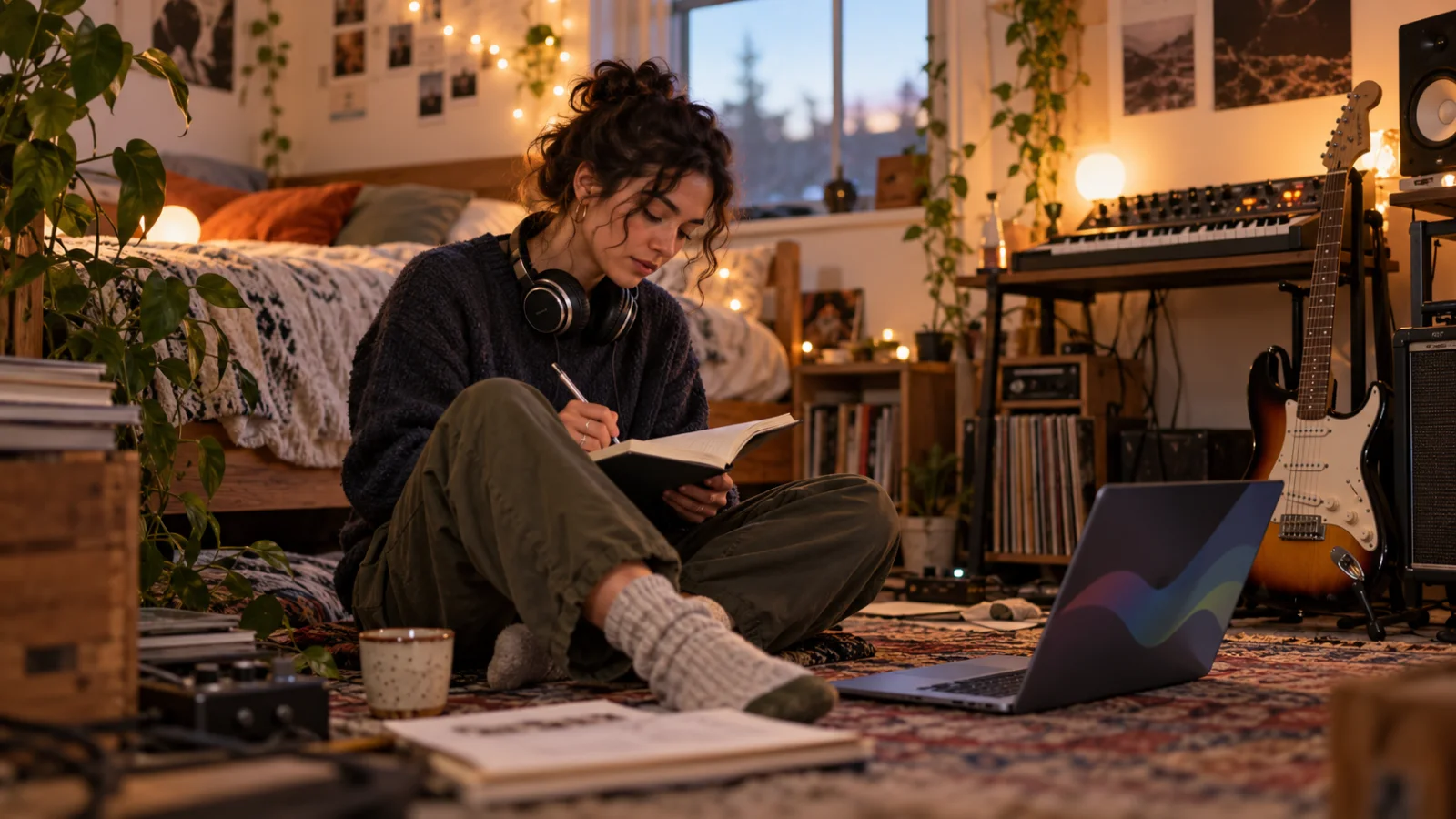
To write an indie song, start from something only you could say: one real place, one object and one moment, told in your own conversational voice instead of big words like “love” or “forever”. Put it over a few chords with a little color, such as a maj7 or an add9 in place of a plain major chord. Let the story decide the structure: a short refrain at the end of each verse works as well as a big chorus. Record it at home, even on your phone, and keep the imperfections that carry feeling while fixing the ones that hide the words. Then decide whether it leans toward indie rock or indie pop, finish it and release it yourself.
Below: what “indie” means today, a method in four steps, two chord colors you can hear, a full worked example, a lo-fi recording recipe, a checklist for finishing and releasing, and a template to copy.
What makes a song “indie” today
“Indie” started as a business fact, not a sound. It meant a record released on an independent label, with a do-it-yourself attitude, and the phrase “indie rock” shows up in a Billboard headline in January 1983. By the 1990s it had become the name of an aesthetic: you can now hear “indie” songs released by major labels and self-released songs that sound like pure pop. What the songs share is a set of choices.
| Trait | What it sounds like | What to do |
|---|---|---|
| A personal, specific lyric | Real places, objects and names; a voice that talks | Write what you saw, not what you felt in general |
| Chords with color | maj7, add9, m7, a borrowed chord | Swap one plain chord per progression |
| Home or “lo-fi” production | Room sound, breaths, a phone mic | Keep the honest flaws, fix the ones that block the lyric |
| A loose structure | Refrains, long outros, songs without a chorus | Let the story choose the form |
| DIY release | Self-released singles, small labels, Bandcamp | Finish, release, then write the next one |
None of these rules is fixed. Indie is closer to an attitude: you make the decisions yourself, and the song sounds like a person, not a formula.
Step 1: write in a personal, specific voice
The indie lyric voice is the biggest difference from mainstream pop. Pop often aims for lines that fit everyone’s life; indie bets that one person’s exact detail will feel more universal than a general statement.
- Pick one scene from the last two weeks. Not “a breakup”, but “the night I returned the spare key”.
- List ten concrete details from that scene: a street name, a brand-free object, the time, what was on the radio, what someone said word for word.
- Write in the first person, the way you’d talk to a friend. Short sentences, normal words, contractions.
- Ban three words for this song: “heart”, “forever” and “soul” (or whichever ones you overuse). The ban forces you back to objects.
- Let one line be odd, funny or contradictory. A small joke next to a sad moment is very indie.
If you need words that sound right at the end of a line, check the free rhyming dictionary, but don’t let the rhyme pull you away from the true detail: in indie, a slant rhyme is fine, and an unrhymed line is fine too.
Step 2: add color to your chords (maj7 and add9)
A lot of the indie sound comes from chords that are one note richer than a basic triad. Two are worth learning first:
- Major seventh (maj7): a major chord plus the note a half step below the root. Cmaj7 is C–E–G–B. It sounds open, warm and slightly wistful.
- Add9: a major chord plus the ninth, with no seventh. Cadd9 is C–E–G–D. It sounds bright and ringing. It isn’t the same as sus2, which drops the third (Csus2 is C–D–G), so it feels less resolved.
On guitar, both are easy shapes. Cmaj7 is x32000 (a C chord with the index finger lifted), Cadd9 is x32030, Fmaj7 is xx3210 and Am7 is x02010. For songs in G, A or E, Gmaj7 (320002), Amaj7 (x02120) and Emaj7 (021100) are just as easy. On piano, add the B or the D to a C chord with your right hand. The Cmaj7 chord page shows every note and voicing, and the guide to types of chords explains sevenths and sus chords in more detail.
The fastest way to use them: take a progression you already know and swap one chord. C–Am–F–G becomes Cmaj7–Am7–Fmaj7–G. Listen to the same idea in two short examples:
What to listen for: after the count-in (0:00–0:02), the loop starts on Fmaj7, not on the home chord, so it feels like the middle of a thought. The Em7 around 0:08 is soft rather than sad, and the Am at the end of each pass (around 0:11 and 0:22) leaves the question open. That unresolved feeling suits a lyric that observes more than it explains.
What to listen for: after the count-in (0:00–0:03), F becomes F minor around 0:09 and again around 0:22. One borrowed note (A♭ instead of A) darkens the whole bar before the C comes back. Use it under the line where the story turns.
Now try your own palette. The player below loops Cmaj7–Em7–Am7–Fmaj7; change any chord, slow it down, and hum a melody over it. The free chord progression player has maj7, m7, sus2 and sus4 chords but no add9, so use Isus2 or IVsus2 to hear that open color, then play the real add9 on your instrument.
Don’t color every chord. Two rich chords in a progression of four sound deliberate; four in a row can blur into lounge music.
Step 3: let the story choose the structure
Indie songs often skip the verse–pre-chorus–chorus machine. That freedom isn’t an excuse for a shapeless song: each form below still has something that comes back, so the listener knows where they are.
| Form | How it works | When to use it |
|---|---|---|
| Verses with a refrain | Each verse ends on the same one- or two-line refrain, no separate chorus | Story songs, quiet songs |
| Verse–chorus, short | Two verses, two choruses, out in under three minutes | Indie pop singles |
| Slow build | Same chords throughout; instruments and voices pile up | Songs with one big feeling |
| Long outro | The last line repeats while the arrangement grows or falls apart | Endings that should linger |
| Two halves | The song switches tempo or key halfway, like a second scene | Songs about a before and an after |
Sketch the order of sections in the free song structure planner before you write the second verse; it’s easier to cut a section on paper than in a recording.
Indie rock vs indie pop: what changes
Both come from the same independent roots, but they pull in different directions. Indie pop grew out of British post-punk and took shape in the 1980s; it is usually more melodic and sweeter, with jangly guitars; indie rock is rawer and louder. Decide which side your song leans to, because it changes the tempo, the drums and the way you sing.
| Indie rock | Indie pop | |
|---|---|---|
| Guitars | Distorted or overdriven, riffs, feedback | Clean, jangly, arpeggiated; often synths |
| Drums and tempo | Driving; try 120–150 BPM | Lighter; try 90–120 BPM |
| Vocals | Half-spoken, shouted in the chorus | Sung, often doubled or soft |
| Lyric tone | Restless, ironic, urgent | Tender, nostalgic, wry |
| Listen to | The Strokes, Pixies, Pavement | The Smiths, Belle and Sebastian, Alvvays |
For an indie rock version, loop G–F–C–G (I–♭VII–IV–I) with rock drums in this preset of the chord player. The F chord (borrowed ♭VII) gives the open, slightly unresolved sound of a lot of guitar indie. For the riff-and-power-chord side of it, read how to write a rock song; for hooks and a tighter chorus, read how to write a pop song.
Worked example: “Dryer Nine”
Here is a complete indie pop song written with the method: one scene (a laundromat at 11 p.m.), the chords from the player above (Cmaj7–Em7–Am7–Fmaj7), verses with a refrain instead of a chorus, and a bridge with the borrowed F minor. Tempo around 84 BPM.
Verse 1 (Cmaj7–Em7–Am7–Fmaj7, twice)
The change machine only takes quarters, I’ve got two and a bus transfer slip. The TV shows the weather in Denver on mute, for a city we skipped.
Refrain (Fmaj7–G–Cmaj7)
And your hoodie’s still in dryer nine, going round like it’s still mine.
Verse 2
I fold your shirts the way you showed me, sleeves first, then in thirds, then in half. The lady with the cart gives a nod, like she’s heard the joke and won’t laugh.
Refrain
And your hoodie’s still in dryer nine, going round like it’s still mine.
Bridge (Fmaj7–Fmaj7–Fm–Cmaj7)
Forty minutes, a dollar fifty, that’s the price of warm for a while.
Last refrain
So I leave your hoodie in dryer nine, let somebody else call it mine.
Why it works:
- Every image is a real object: quarters, a transfer slip, a muted TV, a numbered dryer. The word “breakup” never appears, and you still know what happened.
- The refrain does the job of a chorus. It comes back twice unchanged, and the last time one verb changes (“still in” becomes “I leave”), so the ending is a decision.
- The bridge gives two numbers and drops the rhyme. The F minor arrives with the second line and darkens the one moment that says the feeling out loud.
- The rhymes are loose on purpose (slip/skipped, half/laugh) and the lines sound like speech.
Record it lo-fi, on purpose
Lo-fi means keeping sounds that a polished studio would remove: tape hiss, room noise, a breath before the line. Home recording has a long history here. The Tascam Portastudio of 1979 put multitrack cassette recording in bedrooms, and in the 2010s “bedroom pop” became a name for intimate songs recorded at home. Bon Iver’s For Emma, Forever Ago was recorded in a Wisconsin cabin with a few guitars, microphones and a computer between late 2006 and early 2007, then self-released on 500 CDs before a label picked it up.
The trick is to choose your flaws. A simple recipe for a phone or a laptop:
- Record guitar and voice together in one take, phone about a foot (30 cm) away, in a room with a bed, curtains or a sofa to soften echoes.
- Do three full takes and keep the one with the best feeling, not the cleanest one.
- Add one extra layer at most: a soft harmony on the refrain, a cheap keyboard pad or a second guitar.
- Keep: room sound, breaths, a little string noise, a slightly rough note that sounds honest.
- Fix: clipping (the red level that crackles), a mains hum, a vocal so quiet that the words get lost, a guitar that’s out of tune.
For a first idea you can use the free online voice recorder in your browser; the audio stays on your device. When you’re ready to layer and mix, a DAW such as GarageBand or BandLab does the rest, and the guide to recording a demo at home without expensive gear covers levels and placement step by step.
Finish it and release it
Indie songwriters often lose songs not at the start but at the end: a third verse that never comes, a mix that’s never good enough. Set a date and use this checklist.
- The song has a title, and the title appears in the refrain or chorus.
- Every section is written; no “la la la” placeholders.
- You can play it from start to finish without stopping.
- One rough full recording exists, dated and saved.
- Someone you trust has heard it once and told you the line they remember.
- You decided: release this version, or record one more and stop.
If you’re stuck on the last section, how to finish a song when you are stuck has exercises for exactly that moment. To release it, a distributor puts the track on streaming services; the music distribution guide compares the main ones. Many indie artists also sell on Bandcamp, which takes 15% of digital sales (10% once you pass $5,000 in sales) and 10% of physical sales, plus payment processor fees of about 4–6%. Release one single first, learn from it, and keep writing.
A template to copy for your next indie song
Song title (working):
The scene (one place, one moment):
Ten concrete details:
1.  2.  3.  4.  5.  6.  7.  8.  9.  10.
Banned words for this song:
The odd or funny line:
Chord palette (two colored chords max):
Form (refrain / short verse-chorus / slow build / long outro / two halves):
Leaning: indie rock (BPM ___) or indie pop (BPM ___)
The line where the story turns (borrowed chord here):
Lo-fi rule: keep ___ / fix ___
Release date for the rough version:
Common mistakes and how to fix them
- Vague lyric (“I feel lost in this city”): replace each abstract line with something a camera could film.
- Too many colored chords: keep two rich chords per loop and let the others be plain.
- Lo-fi used to hide an unfinished song: finish the words first; the rough sound should be a choice, not a cover.
- Copying one reference band’s sound: take one trait from three different artists instead of everything from one.
- Never releasing: a song nobody hears can’t teach you anything. Put the rough version out to a few people by the date on your checklist.
Where Zoundroom fits: the lyric, the chord colors and every bedroom take
Zoundroom doesn’t generate audio, has no virtual instruments or beats, and isn’t where you mix and master the final track; a DAW such as GarageBand or BandLab is. What it keeps together is everything around the song while you write it: each song is a project with its recordings, lyrics, notes and files. Create a project called “Dryer Nine”, paste the lyric into a note with the chord palette (Cmaj7–Em7–Am7–Fmaj7) on top, and record the melody inside that note, so the voice memo lands right at your cursor next to the refrain. Import your phone takes and the loop you exported from the chord player into the same project, and pick the keeper later. It’s the same account on iOS, Android and the web, and the web app records in the browser too. Free lets you share a project with up to two artists; Pro adds timestamped feedback, so a friend who also has Pro can mark the exact second the bridge drags. Auralis, the app’s assistant, can suggest alternative lines as text, never audio. Your next step: create the project today and record one full take of verse one and the refrain.
Frequently asked questions
How do you write an indie song for beginners?
Pick one real scene from your week, list ten concrete details, and write a verse and a two-line refrain in your own speaking voice. Put it over three or four chords with one maj7 or add9, record a rough take on your phone, and finish the rest of the song before you worry about the sound.
What chords are used in indie songs?
Ordinary chords with color: major sevenths (Cmaj7, Fmaj7), add9 (Cadd9), minor sevenths (Am7, Em7), sus2, and borrowed chords such as F minor in the key of C or ♭VII (F in the key of G). Swap one or two chords of a familiar progression rather than inventing a hard one.
What’s the difference between indie rock and indie pop?
Indie rock is rawer and louder: distorted guitars, driving drums and half-spoken vocals. Indie pop is more melodic and gentler: clean or jangly guitars, synths, softer sung vocals and a sweeter tone. Both share the personal lyric voice and the do-it-yourself attitude.
Do indie songs need a chorus?
No. Many indie songs use a short refrain at the end of each verse, a slow build or a long outro instead. What they need is something that comes back, a line or a melody, so the listener has something to hold on to.
Can I make an indie song at home with just my phone?
Yes. Record guitar or keys and voice in one take with the phone about 30 cm away in a soft room, keep the best-feeling take and add at most one extra layer. For a fuller arrangement, move the takes into a free DAW later.
Sources
All pages checked on October 2, 2026.
- Wikipedia, “Indie rock”: “indie” first meant music on independent labels with a DIY ethos; first documented use of “indie rock” in a Billboard article of January 1983; by the 1990s the term described an aesthetic. wikipedia.org
- Wikipedia, “Indie pop”: UK origin in post-punk, the C86 compilation (NME, 1986), described as more melodic and less abrasive than indie rock; early acts include The Smiths and Belle and Sebastian. wikipedia.org
- Wikipedia, “Lo-fi music”: imperfections kept as a stylistic choice; the Tascam Portastudio (1979) as the first portable multitrack recorder; “bedroom pop” in the 2010s. wikipedia.org
- Wikipedia, “Added tone chord”: Cadd9 is C–D–E–G, with no seventh; sus2 replaces the third. wikipedia.org
- Wikipedia, “Major seventh chord”: root, major third, perfect fifth and major seventh; Cmaj7 is C–E–G–B. wikipedia.org
- Wikipedia, “For Emma, Forever Ago”: recorded in a hunting cabin in Wisconsin, November 2006 to January 2007, with guitars, microphones and Pro Tools LE; self-released on 500 CDs in July 2007; Jagjaguwar release in February 2008. wikipedia.org
- Bandcamp Help Center, “Pricing”: 15% on digital items, 10% after $5,000 in sales; 10% on physical items; payment processor fees typically 4–6%. get.bandcamp.help