
How to Write Songs for Other Artists: Voice, Pitch and Splits
Published
Write for another singer's voice and story, build a pitch with a guide vocal, lyric and chord sheet, reach the right people and agree splits before it goes out.
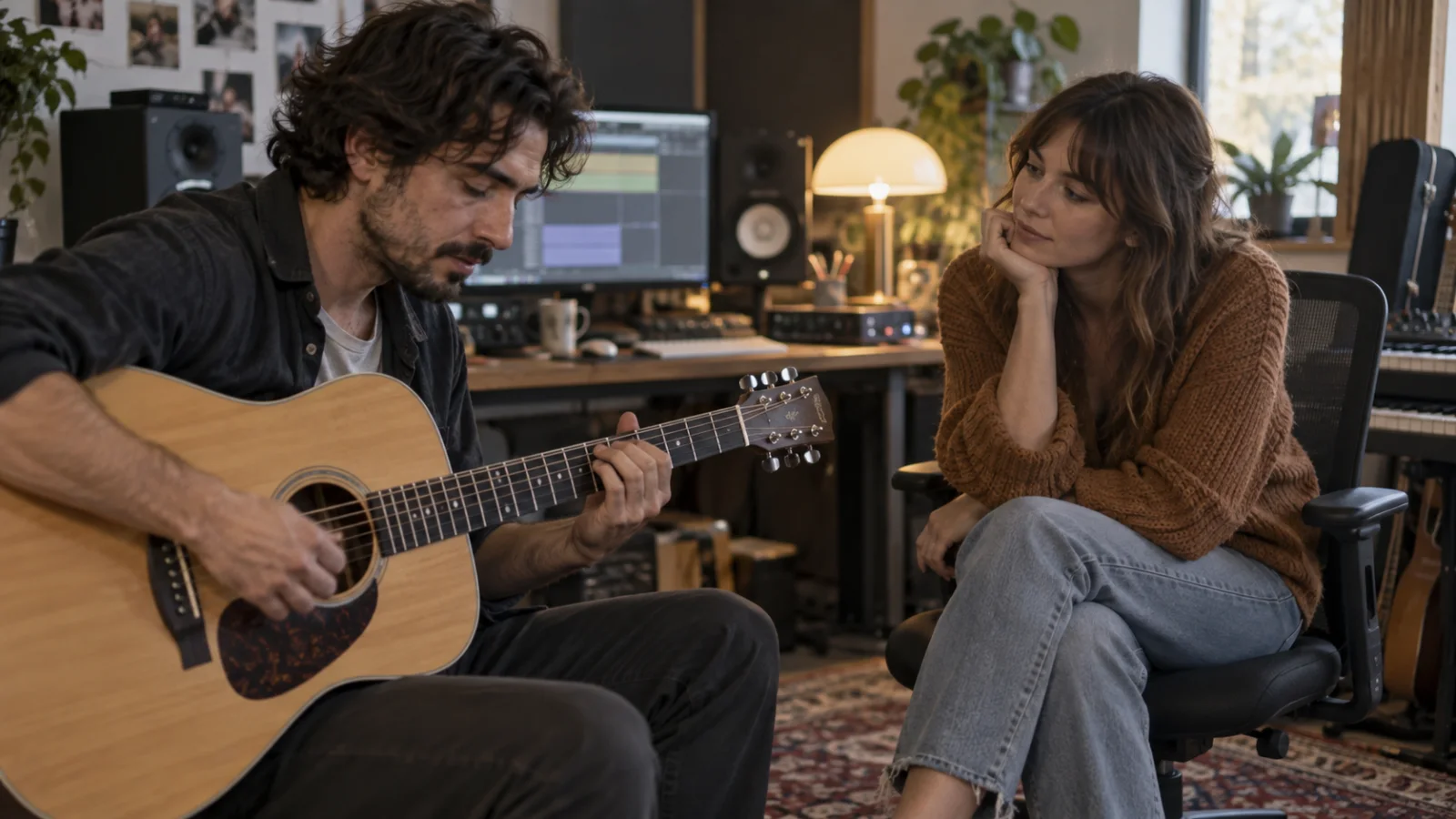
To write songs for other artists, you write for their voice, their story and their audience instead of your own. Study what they’ve released (range, tempo, topics, the words they’d actually say), write or rewrite the song in a key that suits them, and record a pitch demo with a clear guide vocal. Send it with a lyric sheet and a chord chart through someone the artist’s team already listens to: a producer, a publisher, an A&R person or a manager. Before the song leaves the room, write down who wrote what on a split sheet. You rarely “sell” a song outright: you usually keep your share of the composition and earn royalties when it’s recorded and used.
Below: how it differs from writing for yourself, a worked example that rewrites one chorus for a fictional artist, a pitch checklist, who to pitch to, how splits and royalties work in the US, UK and Canada, and a template for your pitch catalog. This is general information, not legal advice; for a contract, talk to a music lawyer.
Writing for yourself vs writing for another artist
| Writing for yourself | Writing for another artist | |
|---|---|---|
| Voice | Your range, your key | Their range: the chorus sits where their voice shines |
| Story | What happened to you | Something they could sing on stage for years and still believe |
| Words | Your vocabulary | Words that sound natural in their mouth, none they’d never say |
| Who decides | You | The artist, their producer and their team; you propose |
| What you deliver | A finished recording | A song that’s easy to imagine: guide vocal, lyric sheet, chords |
The last row is the big shift. When you write for yourself, the recording is the product. When you write for someone else, the demo is a proposal, and its job is to let the artist hear themselves in it within the first minute.
That doesn’t mean writing blank songs that “anyone could sing.” A song without a point of view is easy to pass on. The skill is to keep a specific story and move it into the artist’s world.
Study the artist before you write a line
Spend an hour with the artist’s recent releases, the last album or the last five singles, and fill in a one-page profile. Five things matter:
- Range. Find the lowest and highest notes they sing in choruses, not the one high note at the end of a bridge. Sing along and check the pitch with the free what note am I singing tool; it listens through your mic in the browser, and the audio stays on your device.
- Tempo and feel. Tap along with the tap tempo metronome on three or four songs. Most artists live in a narrower BPM band than you’d expect.
- Point of view. Do they sing to “you,” about someone else, or to a crowd? Are their songs confessions, stories or party instructions?
- Vocabulary. Write down ten words they use often and five they never use. A singer who never says “baby” won’t start because your chorus needs the rhyme.
- The gap. What haven’t they said yet? A song that fills a gap in their catalog gets a better hearing than a copy of their last single.
Interviews help with the gap: artists often talk about what the next record is about. Keep the profile short enough to reread before every writing session.
Worked example: one idea rewritten for another voice
Here’s a fictional profile, the kind you’d write after that hour of listening:
Jordan Vale, indie pop. Chorus range about G3–D5. Songs between 88 and 104 BPM. First person, always talking to “you.” Concrete small-town images: cars, gas stations, late shifts. Never says “baby,” “forever” or “soul.” The gap: every song is about leaving home; none is about coming back.
Now say you have a chorus you wrote for yourself:
I don’t know how to leave, I don’t know how to stay, so I sit in the quiet and I let the hours go gray.
It’s honest, but it’s abstract, and it lives in your register: the melody spans C4–A4 in C major. Here’s the same feeling rewritten for Jordan:
Took exit 14 at a quarter to two, same gas station light, same view, I’m not asking for the whole way back, just the steps where I used to wait for you.
Four decisions changed it:
- Point of view. An inward monologue became a singer talking to someone, the way all of Jordan’s songs work.
- Vocabulary. “Quiet” and “gray” became an exit number, a time and a gas station, the kind of words Jordan already sings.
- Story. The chorus fills the gap: this time the character comes back. The title writes itself: “Exit 14.”
- Key. Open what key should I sing in (the link fills in Jordan’s range, G3–D5) and enter your melody’s range, C4–A4. The song fits in every key from G, a fourth down, to F, a fourth up, and the tool lists the most centered keys first. For a chorus that should lift, pick D: the peak lands on B4, a minor third under the top of the range, so Jordan can push the last chorus without straining.
Write the chorus in D with the chords inline, the way the chord sheet maker reads it:
[D]Took exit 14 at a [A]quarter to two,
[Bm]same gas station light, same [G]view,
[D]I'm not asking for the [A]whole way back,
[Bm]just the steps where I [G]used to wait for [D]you.
Paste it into the free chord sheet maker to transpose it if the artist’s team asks for another key, and print a clean sheet for the pitch. To hear the progression under the melody while you sing it, open the chord player in D.
Build the pitch: guide vocal, lyric sheet and chord chart
The pitch has one goal: the artist should be able to picture themselves singing the song. Everything that doesn’t serve that goal can wait.
| Item | What it should do | Tip |
|---|---|---|
| Pitch demo | Show the song in the artist’s key and genre | A guide vocal close to their style; production that shows the genre, not a master |
| Lyric sheet | Let them read the story at a glance | Title, sections labeled, no chords, writers at the bottom |
| Chord chart | Let a band or producer learn it in minutes | Key, BPM and capo if needed; chords above the syllables |
| Song info | Answer the practical questions | Length, key, BPM, all writers with their shares and PRO |
| Private link | Play at once on a phone | Streamable, not a download-only zip; one song per link |
The guide vocal matters most. If your own voice is far from the artist’s, hire or ask a singer whose voice sits closer, and record in the artist’s key, not yours. Keep the vocal clear and in front of the track. What a demo is explains the difference between a working demo and a presentation demo; a pitch is always the second kind.
Send one to three songs at a time, strongest first, with a short message that names the song, why it fits this artist and who wrote it. Our guide on how to send a demo has an email template, and how to share unreleased music privately covers links, leaks and downloads.
One more reason to keep pitch songs unreleased: in the US, a compulsory license to record a song becomes available once recordings of it have been distributed to the public with the copyright owner’s permission (17 U.S.C. § 115). Before that, the first recording is yours to allow or refuse.
Who to pitch to: producers, publishers, A&R and managers
Artists rarely listen to cold messages from strangers. Songs reach them through people:
| Who | Their role for the artist | How writers usually reach them |
|---|---|---|
| Producer | Builds the record and often co-writes it | Co-writes and topline sessions; producers at your level first |
| Publisher | Pitches its writers’ catalog to artists and labels | Through a referral, or once you have cuts or a strong catalog |
| A&R | Finds songs and writers for the artist’s album | Usually through publishers, managers and producers they know |
| Manager | Filters what reaches the artist | A relationship, rarely a cold email |
| The artist | Writes with the people they trust | Co-writing sessions, often set up by one of the above |
For most writers, the way in is co-writing. Artists who write their own material still bring in co-writers and toplines, and a producer building an album needs songs fast. If you write over tracks, what a topline is shows how those sessions work; how to run a co-writing session helps you arrive with a seed and leave with decisions. To practice first, the guide on how to write a pop song shows how to sing a topline over a four-chord loop.
Before you send anything to a publisher or a label, look for its submission policy on its website. If it doesn’t take unsolicited material, go through a person who already works with it.
Splits, credits and royalties before the song leaves the room
A song has two copyrights: the composition (music and lyrics) and the recording (the master). As the writer, you own a share of the composition. When an artist records your song, the label or the artist usually owns their recording, and you earn from the composition through your performing rights organization (PRO) and, for mechanical royalties, through a publisher or a collecting body.
Agree the split in writing on the day you write, and again if the song changes. If the artist changes a line and asks to be credited as a writer, that’s a decision about the composition: talk it through with your co-writers and update the sheet. The guide to what a split sheet is has worked examples, and the free split sheet template checks that the shares add up to 100% and prints the sheet to sign.
What happens next depends on your market, as checked on September 28, 2026:
- United States. Joining BMI or ASCAP as a writer is free. Each work is registered with its writers and their shares; at BMI, a registration from any writer or publisher credits all participants. BMI counts performance royalties as 200%, with 100% for the writers and 100% for the publishers, and ASCAP pays 50% to writers and 50% to publishers. For streaming mechanicals in the US, The MLC lets self-administered songwriters join free and register their share.
- United Kingdom. PRS for Music asks writers without a publisher to register works as soon as they’re written; they don’t need to be recorded or released. If a co-writer has already registered the work, you authorize your share so it can be paid.
- Canada. SOCAN charges no fees to writer members, and you register each work with the share percentages the writers agreed.
Some jobs pay a flat fee or a “buyout” instead of royalties, or come with a publishing contract. Those are contracts about who owns and administers the song, so have a music lawyer read them before you sign. For the money side in detail, see songwriting royalties explained; for registration, how to copyright and register a song.
Organize your song catalog for pitching
After a year of writing for others, you’ll have more songs than you can remember, and the worst pitch is sending the same song to the same person twice. Keep a catalog with one row per song:
| Song | Status | Key / BPM | Melody range | Writers and splits | Pitched to (date) |
|---|---|---|---|---|---|
| Exit 14 | Pitch-ready | D / 96 | D4–B4 | You 50%, co-writer 50% | Producer A (Sep 28) |
| Salt and Sugar | On hold | A minor / 88 | E4–C5 | You 100% | Artist B’s manager (Sep 12) |
| Night Bus | Writing | C / 120 | — | You 60%, producer 40% | — |
| Second Floor | Released | G / 104 | G3–E4 | You 34%, two co-writers 33% each | Artist C’s producer (May 3) |
Five statuses are enough: writing, pitch-ready, on hold, recorded, released. “On hold” means an artist’s team has asked you not to offer the song elsewhere while they decide. It isn’t a promise, so write down the date and ask how long the hold lasts.
Add tags that match how people ask for songs: tempo, mood, voice type and the kind of artist it suits. When a producer says “we need an uptempo breakup song for a high voice,” you should find three candidates in a minute. The same tags, plus each song’s details, are what music supervisors ask for in sync licensing for TV, ads and games.
Common mistakes
- Pitching your own song unchanged. If the demo sounds like your record, the artist hears your song, not theirs. Rewrite the point of view, words and key first.
- A demo in the wrong key. Even a great chorus loses if it sits at the bottom of the artist’s range. Check it against their range before you record.
- Unclear splits. A song with an unsigned split is a risk for everyone who wants to record it. Sign before you pitch.
- Sending ten songs at once. Nobody listens past the third. Send your strongest one to three.
- No follow-up log. Without dates, you’ll either follow up too soon or pitch a song that’s already on hold.
Where Zoundroom fits: one project per song you pitch
A pitch song tends to scatter: the guide vocal in a drive folder, the lyric in a notes app, the chord chart in a PDF and the signed split sheet in an email. In Zoundroom each song is a project, so the pitch demo, the earlier versions, the lyric, the chord chart and the split sheet sit together. Write the artist profile and your pitch log (who heard which version, and when) in a note in the same project, and when a better bridge line arrives, record it inside that note in the app, right under the lyric. Before a pitch goes out, share the project with your co-writer or the producer so everyone hears the same version: the Free plan lets you share with up to 2 artists and Pro with up to 5, and on Pro and Band they can leave timestamped comments such as “the guide vocal drops too low at 1:05.” Zoundroom doesn’t register songs, collect royalties or send pitches; registration goes through your PRO, and the pitch through your own email or contact. Start with the song you’d pitch first: create its project and import the guide vocal.
Frequently asked questions
How do I sell my songs to other artists?
In most cases you don’t sell the song itself. You pitch it (through producers, publishers, A&R or managers, or by co-writing with the artist), and if it’s recorded, you keep your writer’s share and earn royalties when it’s played, streamed or sold. A flat-fee buyout is a different deal: read the contract with a lawyer.
Do songwriters get paid when another artist records their song?
Yes, from the composition. Performance royalties come through your PRO (ASCAP, BMI, PRS for Music or SOCAN, depending on where you are), and mechanical royalties come from reproductions such as streams and downloads, collected in the US for streaming by The MLC. You need to be a member and have the work registered with the right shares.
Do I need a publisher to write for other artists?
No. Many writers start by co-writing with producers and artists and register their own share. A publisher can pitch your catalog and handle administration, in exchange for part of the publishing income. Whether that’s worth it depends on the deal, so get advice before you sign.
What should I send when I pitch a song?
A private link to a demo in the artist’s key with a clear guide vocal, a lyric sheet, a chord chart with key and BPM, and the writers with their shares. One to three songs, strongest first, with a short note on why the song fits this artist.
What if the artist wants to change my lyrics?
Small changes to fit their voice are part of the job. If the artist or their team asks for a writing credit for those changes, that’s a split decision: discuss it with your co-writers and update the split sheet before the song is released.
Sources
All pages checked on September 28, 2026.
- Legal Information Institute (Cornell Law School), 17 U.S.C. § 115: the compulsory license applies once phonorecords of the work have been distributed to the public in the US under the authority of the copyright owner.
- BMI: fee to join as a songwriter or composer (free, no annual dues), Royalty Policy Manual (one registration credits all participants; the 200% unit) and how BMI splits royalties between writers and publishers.
- ASCAP: join ASCAP for free, registering your music and what co-writers need to know about splits.
- The MLC: membership (free; self-administered songwriters register their share).
- PRS for Music: register your music and authorise your shares.
- SOCAN: frequently asked questions (no fees for writer members; works registered with agreed share percentages).