How to prepare and run a co-writing session
Published · Updated
A practical 1:1 or small-group co-writing workflow: roles, timebox, seed, capture, decisions, and a clean close without turning the session into administration.
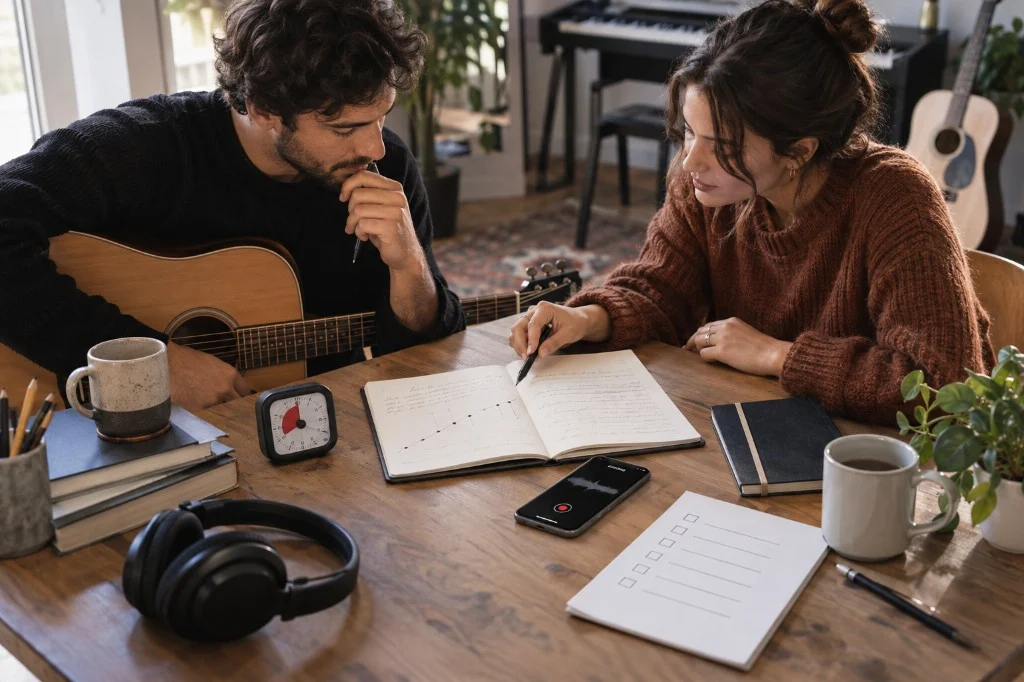
A co-writing session works best when everyone arrives with room to discover but not with a completely empty operating plan. Preparation is not about deciding the song in advance; it is about removing avoidable friction so the session can spend its energy on writing.
Quick answer
Before the session, agree on the timebox, a loose outcome, and one seed. At the start, assign working responsibilities—who captures audio, who keeps the lyric visible, who watches time—without turning them into hierarchy. Work in short cycles, save a reference at the end, and name open decisions before everyone leaves.
1. Bring a seed, not a finished song
The seed can be a title, progression, melody, beat, image, or line. Bring one or two options rather than a folder of twenty. BMI’s co-writing guidance emphasizes making room for a collaborator’s contribution; if every decision is already made, the session becomes review rather than co-writing.
2. Set the frame in five minutes
Agree on what you are trying today and how much time you have. Decide where the working lyric, reference recordings, and files will live. In a 1:1 session, one person can keep the shared text current while the other captures musical ideas; swap roles whenever that helps.
Example: a 45-minute co-writing session
Use this agenda for one verse and chorus: 5 minutes to choose a seed, 10 to generate melodies, 10 to draft the words, 10 to sing and revise, and 10 to record a full pass and agree on the next task. If the verse is still rough, keep a placeholder rather than losing the final recording time. Leave with one audio, one lyric draft and a named next action.
Map the sections of your own song with the song structure planner.
3. Separate generation from evaluation
Use one block to generate options without defending each one. Use the next to listen and choose. Mixing creation and critique line by line tends to stall momentum. Better prompts are: “What does this section need?”, “Which option sets up the hook?”, or “What should survive even if the rest changes?”
4. Capture context, not only the latest bounce
Keep the current lyric, one audio reference, and a short note on unresolved decisions. Do not make a message thread the only record. When someone reopens the song later, they should know which version the group was judging and what was still provisional.
For your next co-writing session, create a Zoundroom project and put the starting lyric in a note. Record a melody directly inside that note, then invite your co-writer to develop the words with you. Before you finish, write the chosen take and next task beside the lyric so the next session starts with a song you can hear and read.
5. Close with a full listen
Protect the final minutes for listening without editing. Name what is decided, what is open, who owns the next action, and which reference is current. That close prevents the next session from starting with detective work around filenames and chat history.
Turn a disagreement into a five-minute test
One writer wants the title on the first chorus line; the other wants to save it for the last. Record both options over the same chords and tempo, with the same ending to the verse. Listen to the verse and chorus together without looking at the lyric. Ask one question: which entrance makes the central idea clearer? Keep the stronger option for the working draft and write down why. If neither convinces you, keep both named takes and make the next task a new first line. The session can move on without pretending the choice is final.
Reusable session agenda
- Context and outcome.
- Pick a seed.
- First generation cycle.
- Listen and select.
- Second cycle on the weakest section.
- Full listen and a clear close: what stays, what is open, and who picks it up next.
For lyric craft, use the step-by-step lyric guide as a shared reference rather than a mandatory script.
Sources
- BMI — How co-writing improves collaboration
- BMI — The dos and don’ts of co-writing
- BMI — Avoiding and resolving conflicts between songwriting collaborators
Documentation reviewed: 2026-09-13.
Plan a co-writing session
Agree on one song and one outcome before you start. Use this brief to give everyone something concrete to bring.
A chorus melody, a title or a verse: choose the idea you will develop.
Finish the chorus lyric, choose a structure or record a rough take. Pick one.
Alex: two chorus melodies. Sam: a verse built around the train-station scene.
Name a specific feature to discuss: sparse verse, rising melody or a short intro.
10 minutes listening, 25 writing, 15 singing the options, 10 recording a choice.
Write the chosen take, the next task, its owner and the next check-in.
Save a draft on this device to return later, or copy or download it. Your answers are not sent to Zoundroom.
Copy the brief into a Zoundroom project note and invite your co-writer. Keep the starting recording and the new takes in that project.