
How to write a folk song: story, fingerpicking and open tunings
Published
Write a folk song step by step: a story told in verses, a melody anyone can sing back, fingerpicking patterns, open tunings like DADGAD and a first demo.
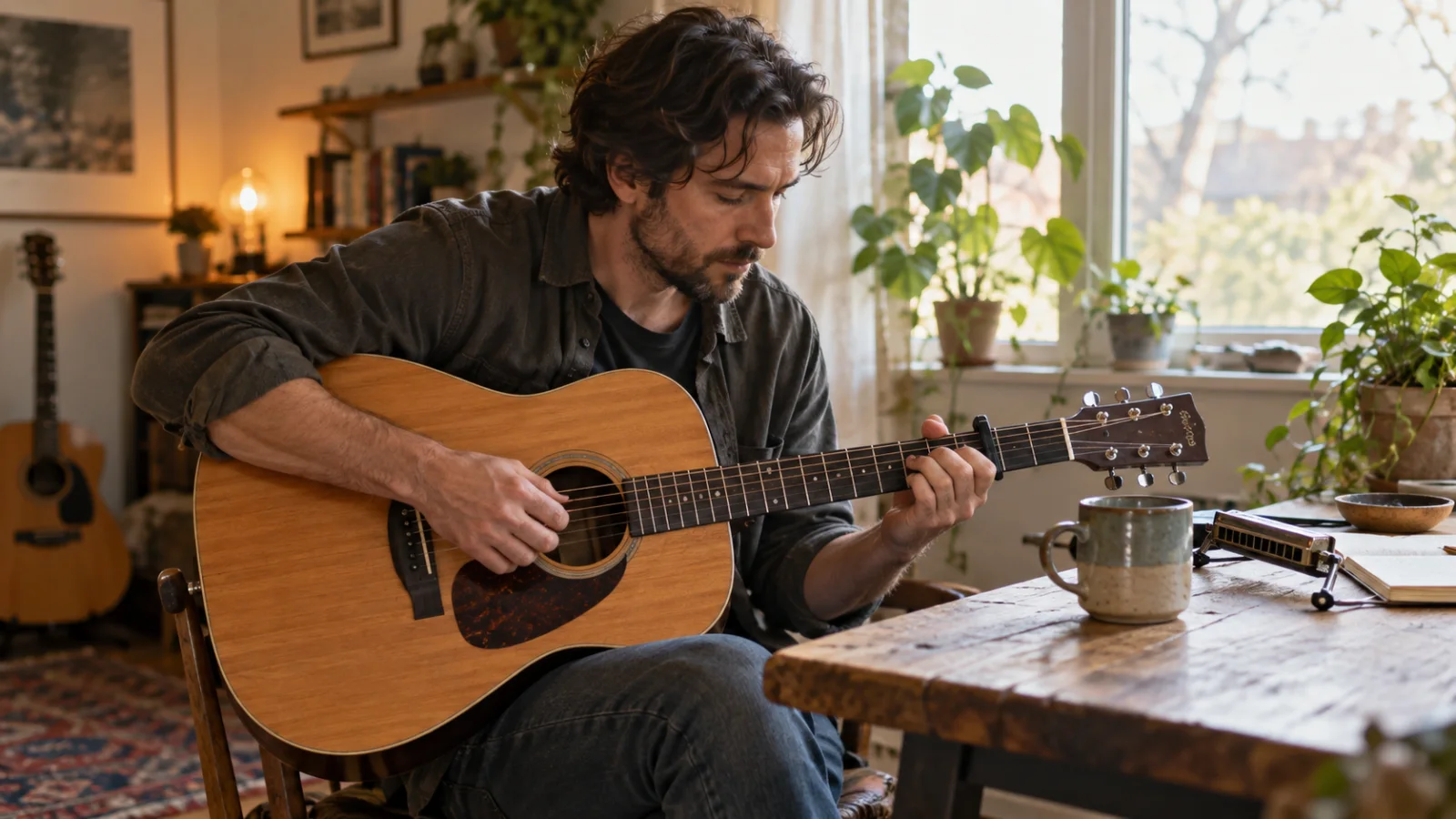
To write a folk song, tell one story in plain words across several verses that share the same melody, and add a short refrain line the listener can join the second time round. Keep the melody simple: mostly stepwise, within about an octave, easy to sing back after one hearing. Play two to four chords (G–C–D, or D–G–A) with a fingerpicked alternating bass, or try an open tuning such as DADGAD or open D so the open strings drone under your voice. Then do what folk songs have always done: sing it out loud, change what trips you up and record it on your phone the same day.
What makes a song folk: the traits at a glance
Traditional folk is music passed on by ear, from singer to singer, usually with no known composer. Because nobody learns a song word for word that way, every song grows variants: collectors have found countless versions of the ballad “Barbara Allen”. In the late 19th century, Harvard professor Francis James Child gathered 305 English and Scottish ballads, still a storehouse of plots. After World War II, a revival in the United States and Britain created contemporary folk, which peaked in the 1960s with writers like Bob Dylan and Donovan.
| Element | Typical folk choice | Why it works |
|---|---|---|
| Lyrics | A story or a portrait, told plainly | The listener follows people, not slogans |
| Form | Many verses on one melody, plus a refrain line | The words carry the song |
| Melody | Stepwise, narrow range, repeated | Anyone can sing it back, which is how songs travel |
| Chords | I, IV, V; sometimes vi or a modal bVII | Harmony supports the story |
| Guitar | Fingerpicking or a light strum, often in an open tuning | Open strings ring and leave room for the voice |
Style references range from Woody Guthrie, Joan Baez and Joni Mitchell to Gillian Welch or Iron & Wine: say something specific, sing it simply and trust the story.
Step 1: tell a story in verses (the ballad stanza)
Before touching the guitar, write one sentence: who, where and what changes. “A night bus driver does his last run after thirty years” is a song. “A song about change” isn’t, because nobody is in it.
Many old English-language ballads use the ballad stanza: four lines alternating about eight and six syllables, with only lines 2 and 4 rhyming (ABCB). It’s short enough to remember and long enough to hold one moment of the story, which is why a folk song can have six or eight verses without tiring anyone.
Three rules keep a long song moving:
- One verse, one step. Every verse changes something: time, place or what a character knows. If two verses can swap places, one of them is extra.
- Show, don’t sum up. Ballads rely on images. “The bread was on the table still” beats “she was very sad”. If one of those images keeps coming back until it carries the whole song, it has become a metaphor; the guide to metaphors in songs shows how to sustain it.
- A refrain line instead of a big chorus. Repeat one or two lines after each verse, and let a word change in the last refrain so it lands differently.
Stuck for a situation? Try the songwriting prompts generator or the 60 song ideas. The verse guide shows how to make verse 2 move, and the syllable counter checks matching line lengths.
Step 2: fingerpicking patterns that leave room for the words
Folk guitar often picks rather than strums, so every word can be heard. The base is the alternating bass named after Merle Travis: the thumb keeps a steady bass on the low strings while the fingers pluck the higher ones. The guitar songwriting guide covers the basic pattern; here are two folk variations. T is the thumb, i the index, m the middle and a the ring finger; numbers are strings (6 is the thickest).
Pattern 1, alternating bass with a pinch (4/4). On beat 1, thumb and middle finger pluck together.
Count:   1    &   2   &   3   &   4   &
Finger:  T+m  i   T   m   T   i   T   m
G:       6+2  3   4   2   6   3   4   2
C:       5+2  3   4   2   5   3   4   2
D:       4+1  2   3   1   4   2   3   1
Pattern 2, the folk waltz (3/4). One bass note, then up and back down the top strings.
Count:   1   &   2   &   3   &
Finger:  T   i   m   a   m   i
G:       6   3   2   1   2   3
C:       5   3   2   1   2   3
D:       4   3   2   1   2   3
Start at 60 BPM on the tap tempo metronome, which also clicks in 3/4, and speed up only when your thumb runs on its own. If singing on top feels impossible, the guide to singing and playing at the same time has a seven-day plan. Hear what broken chords do to a progression:
After the count-in (0:00–0:03), each chord gets one bar of broken notes, with no drums: D at 0:03, A at about 0:07, Bm at 0:10, and so on until the A at about 0:27 leaves the phrase open. Each chord’s notes keep sounding under the next ones; that halo is what makes picked guitar feel intimate. It’s a synthesized teaching example, not a guitar recording.
Step 3: open tunings and drones
An open tuning retunes some strings so the open guitar sounds a chord, or a chord with no third. Open strings ring longer than fretted ones, drones appear on their own and one finger can play a whole chord. Joni Mitchell built much of her writing this way: her official site catalogs more than 60 tunings across her songs. One new tuning is often enough to shake loose a song.
| Tuning | Strings, low to high | What it gives you | A first move |
|---|---|---|---|
| DADGAD | D A D G A D | A Dsus4 sound, neither major nor minor | 3rd string at the 2nd fret: a D5 that rings |
| Open D | D A D F♯ A D | A D major chord on the open strings | One-finger bar: G at the 5th fret, A at the 7th |
| Open G | D G D G B D | A G major chord on the open strings | The same bar: C at the 5th fret, D at the 7th |
British guitarist Davey Graham devised DADGAD in the late 1950s, and it’s still a folk and Celtic favorite. The free online guitar tuner has DADGAD, open G and open D presets, and how to tune a guitar explains how to get there and back safely.
To hear that suspended color before retuning, loop D–Dsus4–D–Dsus2 as an arpeggio and hum over it: the sus chords refuse to settle, which suits songs about waiting or distance. Write the tuning and capo fret at the top of the lyric, or you won’t be able to replay the song a month later.
Step 4: a melody anyone can sing back
In folk, the melody carries the words through verse after verse, so it must be easy to remember and hard to tire of. Listen to a melody that moves mostly by steps:
After the count-in (0:00–0:02), the tune moves between neighboring notes and stays within five of them, from C up to G. It settles on C at about 0:07, climbs again and hangs on a D around 0:11, which asks for another verse; the shape repeats from about 0:14. That’s the folk recipe: a short range, one small climb and a phrase ending that leaves the door open.
- Keep the range narrow. An octave or less, so anyone can join and verse eight doesn’t strain. Find your key with what key should I sing in (replace the example range, C3 to G4, with yours).
- Follow the speech. Say each line aloud and let the melody rise where your voice rises.
- Repeat, then answer. Lines 1 and 3 can share a melody; line 4 answers and lands home.
- Borrow with care. Woody Guthrie wrote “This Land Is Your Land” in 1940 to a melody very close to a hymn the Carter Family had recorded. If you adapt an old tune, make sure it really is traditional, not a recent arrangement.
Folk chord progressions to loop
Two chords can carry a ballad; four is plenty. Every link opens the chord player with no drums, as a guitar and voice would sound.
| Progression | Chords | Feel | Try it |
|---|---|---|---|
| I–IV–I–V | G–C–G–D | Plain and open, the classic verse | Loop at 100 BPM |
| I–IV–V–I | D–G–A–D | Resolved, like the end of a tale | Loop at 84 BPM |
| I–bVII–IV–I | D–C–G–D | Modal and Celtic-sounding | Loop at 96 BPM |
| i–bVII–i–v | Em–D–Em–Bm | Dark, old-ballad minor | Loop at 72 BPM |
| I–IVsus2–I–Vsus4–V–I | D–Gsus2–D–Asus4–A–D | Airy and ringing, close to DADGAD | Loop at 80 BPM |
The bVII (C in the key of D) comes from the Mixolydian mode; the guide to musical modes explains why it sounds older than a plain major key. If a key sits wrong for your voice, keep the shapes and move a capo with the capo chart. The player loops in 4/4; for a waltz, let your picking hand play in three.
Worked example: “The Last Run of the 42”
A draft written for this article in D at 84 BPM. Each line takes two bars: the verse uses D–G–D–A, D–G–A–D, and the refrain G–D–Asus4–A. Loop the verse while you read, and play it with pattern 1 in standard tuning or with one-finger bars in open D.
Verse 1
For thirty years Ray drove the night,
the forty-two to town,
past shuttered mills and all-night lights,
the window rolled half down.
Refrain (after verses 1 to 3)
Ring the bell and I’ll slow down,
the forty-two goes round.
Verse 2
He knew the nurse who rode at ten,
the baker up at three,
the kid who played his cello case
like drums against his knee.
Verse 3
A letter came in early spring:
the route would close in May,
the new road ran a mile away
and faster, so they say.
Verse 4
The final night the seats were full,
the nurse, the baker too,
the kid, now grown, the cello case,
they rode the whole way through.
Last refrain
Nobody rang, nobody stepped down,
the forty-two went round.
What each part does:
- One step per verse: the routine, the people, the news, the last night.
- Images, not feelings: shuttered mills, a window half down, a cello case played like a drum. The song never says “he loved his job”.
- Ballad stanza: lines of about eight and six syllables, rhymes only on lines 2 and 4 (town/down, three/knee, May/say, too/through).
- The refrain turns: “ring the bell” is routine for three verses; at the end nobody rings, because everyone stays for the whole ride.
With a short intro, four verses, a refrain after each and a tag, it runs about two and a half minutes. Map it in the song structure planner if you add verses.
Common mistakes when writing folk (and the fix)
| Symptom | Likely cause | Fix |
|---|---|---|
| It sounds like a costume | Borrowed props: “thee”, old trains, faraway hills | Tell a story from your own street, in today’s words |
| The listener drifts by verse 4 | Verses repeat the situation | One verse, one step: move time, place or knowledge |
| Nobody can sing along | Range too wide, lines of uneven length | Stay within an octave; match line lengths |
| The song preaches | Opinions instead of scenes | Put the message in what a character does |
When a rhyme feels forced, look for near rhymes in the rhyming dictionary; folk happily rhymes “town” with “round”.
Record your first folk demo today
A folk demo is one voice and one guitar in one pass. Its job is to prove the story is clear and the melody survives every verse.
- Tune first, in the tuning you wrote with, using the online guitar tuner.
- Write tuning, capo and tempo at the top of the lyric: “open D, capo 2, 84 BPM”.
- Record the whole song once, mistakes included, with the phone a little away from the guitar.
- Record the last refrain twice more: once slower, once with a pause before the changed line.
- Play it to one person the next day and ask them to tell the story back. The verse they skip is the one to rewrite: the folk process on a small scale.
For a cleaner version, the home demo guide covers the room and levels. If your folk leans toward story songs with a twist, read the country songwriting guide next; if it leans toward a lo-fi bedroom sound, how to write an indie song.
Where Zoundroom fits: every verse, the tuning and the takes together
A folk song scatters easily: verses on paper, the tuning in your head and three voice memos with different last refrains. Zoundroom keeps those pieces together. Each song is a project with its recordings, lyrics, notes and files, so create a project called “The Last Run of the 42”, write the verses in a note with “open D, capo 2, 84 BPM” on the first line and record the first full pass inside that note on your phone: the audio lands at the cursor, right under the verse it belongs to. Import older voice memos into the same project, and open everything later on iOS, Android or the web. With Free you can share a project with up to two artists; Pro adds timestamped feedback, so a co-writer who also has Pro can point at the second a verse drags. Auralis, the app’s assistant, can suggest alternative lines or a verse order as text, never audio. Zoundroom isn’t a full DAW: its audio editor can slow a take down without changing its pitch or record a second voice over it, but there’s no pitch correction or reverb, and there’s no tuner inside the app: to tune to open D or DADGAD, use the free online tuner. Your next step: create the project, type the tuning on the first line and record the whole song once today.
Frequently asked questions
How do you write a folk song for beginners?
Write one sentence about a small story and split it into four scenes, one per verse. Use the ballad stanza (lines of about eight and six syllables, rhyming on lines 2 and 4), pick G–C–G–D or D–G–A–D and hum until a melody fits verse 1. Sing every other verse to that tune and add a one-line refrain.
What chords are used in folk music?
Mostly the I, IV and V of a major key: G, C and D in G, or D, G and A in D. Many songs add the vi (Em in G); modal folk uses the bVII (C in D) or minor keys like Em–D–Em–Bm. Sus2 and sus4 chords add the ringing color of open tunings.
What is the structure of a folk song?
Many folk songs are strophic: several verses on the same melody, often with a refrain line after each. Contemporary folk also uses verse–chorus form. Either way, the verses move the story and the melody stays put so the words come first.
What tuning is best for folk guitar?
Standard tuning with a capo works for most folk songs. For a droning, modal sound, try DADGAD (D A D G A D); for one-finger major chords, open D (D A D F♯ A D) or open G (D G D G B D). The free online tuner has all three as presets.
Sources
All pages checked on September 28, 2026.
- Wikipedia, “Folk music”: traditional folk as music transmitted orally, with no known composers; variants from oral transmission, including the many versions of “Barbara Allen”; the post–World War II revival in America and Britain and its 1960s peak with Bob Dylan and Donovan. wikipedia.org
- Wikipedia, “Ballad”: ballad meter as quatrains alternating lines of about eight and six syllables, usually rhyming ABCB; ballads are narrative and rely on imagery; Francis James Child’s 305 ballads in The English and Scottish Popular Ballads. wikipedia.org
- Wikipedia, “This Land Is Your Land”: lyrics written by Woody Guthrie in February 1940; melody very similar to a hymn recorded by the Carter Family as “When the World’s On Fire”. wikipedia.org
- Wikipedia, “Travis picking”: alternating-bass fingerpicking named after Merle Travis; the thumb plays the bass strings while the index and middle fingers play the treble strings. wikipedia.org
- Wikipedia, “List of guitar tunings”: notes of DADGAD, open D and open G; DADGAD devised by Davey Graham in the late 1950s. wikipedia.org
- Joni Mitchell official site, “Tuning Patterns”: more than 60 apparently different tunings across her songs, about 45 distinct patterns. jonimitchell.com