
How to write a country song: story, twist and three chords
Published
Write a country song step by step: a story told in concrete details, a chorus that turns at the end, I–IV–V on guitar, the right tempo and a first demo.
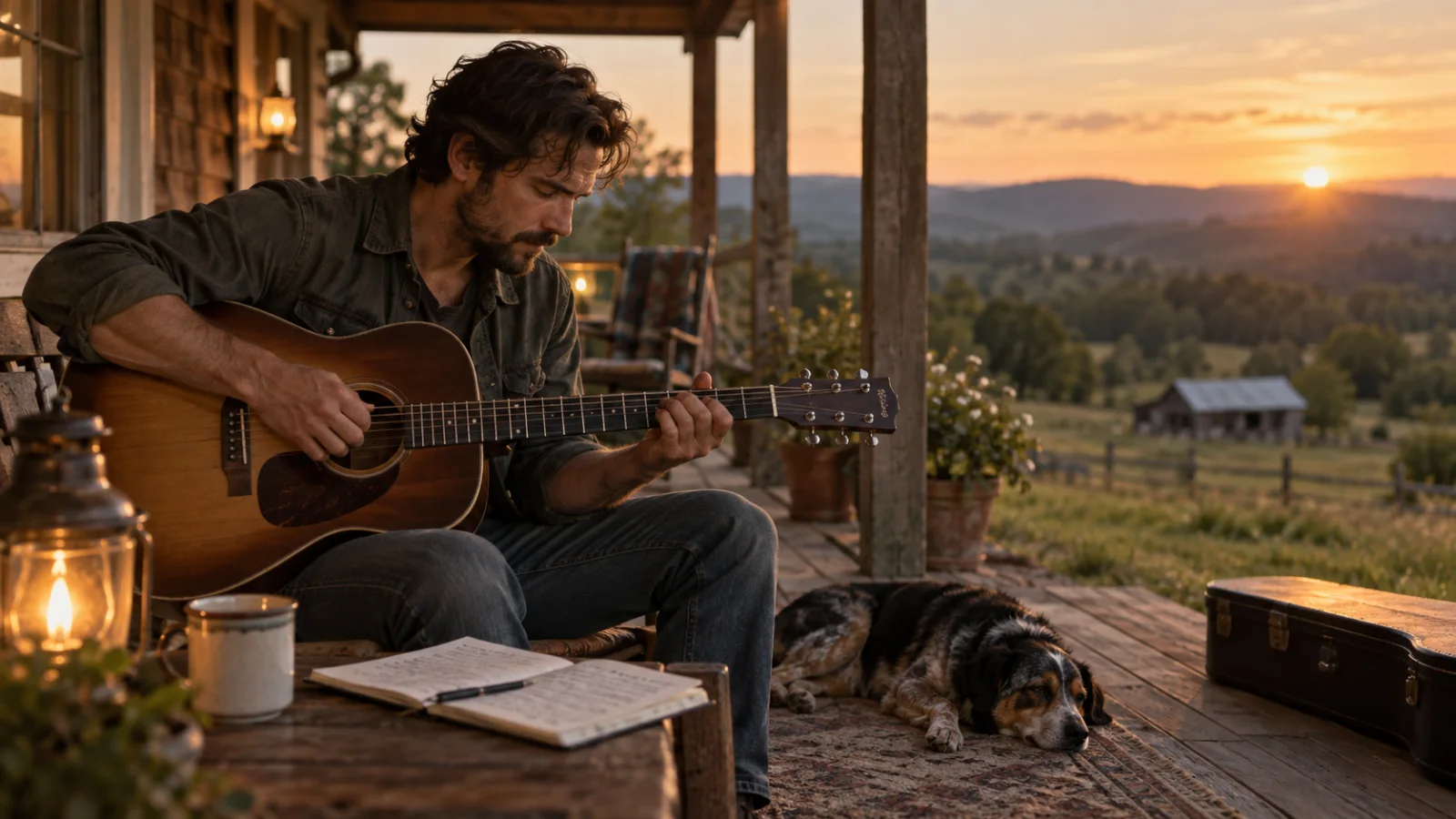
To write a country song, pick one small story that feels true and tell it through concrete details: a name, a road, an object, a time of night. Build the chorus around a short title that means one thing the first time and something deeper by the last chorus. That turn is the twist. Play it with three chords (I–IV–V, which is G–C–D on guitar) or with I–V–vi–IV for a modern sound, at a tempo that suits the story. Use verse–chorus–verse–chorus–bridge–chorus, move the story forward in every verse and record a guitar-and-voice demo on your phone the same day.
Below: an audio example, loops for the free chord player, an original song written for this article with its twist explained, and the mistakes that make country sound like a costume.
What makes a country song: the traits at a glance
Country grew out of the American South in the 1920s, from British folk ballads, cowboy songs, gospel and African American spirituals, among other roots. A century later the sound has changed many times, but the writing habits have stayed remarkably stable. Songwriter Harlan Howard summed them up in the 1950s as “three chords and the truth”: simple harmony and lyrics that sound lived. Country shares those roots with folk, so much of how to write a folk song applies here too.
| Element | Typical country choice | Why it works |
|---|---|---|
| Lyrics | One story, told in scenes with specific details | Listeners see it and believe it |
| Chorus | A short title that shifts meaning by the end | The last chorus pays off the whole song |
| Chords | I, IV and V, sometimes vi; I–V–vi–IV in modern country | Words and melody stay in front |
| Form | Verse–chorus–verse–chorus–bridge–chorus | Each verse moves the story on |
| Voice | Close to speech in the verse, open in the chorus | Sounds like someone telling you something |
| Instruments | Acoustic guitar first; fiddle, steel guitar, banjo or piano in the arrangement | It all starts with guitar and voice |
The style references vary a lot, from Johnny Cash and Dolly Parton to Chris Stapleton, Kacey Musgraves or Zach Bryan. What they share is a writer’s attitude: say something specific, say it plainly and make the chorus land.
Step 1: find a story you can tell in three scenes
A country song is a short film. Before any chord, write down one situation in a sentence: who, where and what changes. “A kid sneaks home late and the porch light is on” is enough. “A song about family” is not, because it has no scene.
Then split the story into three moments, usually spread across time:
- Scene one (verse 1): the setup, in one place, at one hour.
- Scene two (verse 2): later: hours, years or a whole life later. Something has changed.
- Scene three (bridge or verse 3): the moment that changes how we hear the title.
The “truth” doesn’t mean autobiography. It means specific details that could only belong to this story. Compare:
| Summary (tells) | Scene (shows) |
|---|---|
| I missed my hometown | The county road still had the same pothole by the church |
| We were poor but happy | Dad fixed the radio with a paper clip and we danced anyway |
| She left me | Her coffee cup is still upside down in the dish rack |
If you need a starting situation, the songwriting prompts generator combines an image, a situation and a title, and the list of 60 song ideas has a section by genre. For songs to one person, the love song guide covers details over clichés.
Step 2: write a chorus title that can turn (the twist)
The twist is the country writer’s signature: the chorus keeps the same title, but the story around it makes the title mean something new by the end. The listener hears the last chorus and understands the whole song again.
The best-known case is “He Stopped Loving Her Today”, written by Bobby Braddock and Curly Putman and recorded by George Jones in 1980: only at the end does the listener learn why the man stopped loving her. It was the Country Music Association’s Song of the Year in 1980 and again in 1981. You don’t need a tragedy, though. Four kinds of twist cover most songs:
- Meaning shift: the same words, a new sense. A title that sounds like trouble in chorus 1 sounds like love in the last one.
- Reveal: the song holds back one fact until the end.
- Point-of-view flip: the singer ends up in the other person’s place.
- Double meaning: a title that works literally and figuratively at once, like “Check Engine Light” for a car and a relationship. That’s a metaphor hidden in the title, and the guide to metaphors in songs shows how to carry one through the whole lyric.
A quick test: write your title and list three things it could mean. If you only find one, the chorus can still work, but the song will need another kind of turn. Put the title on the first or last line of the chorus, where it’s easy to hear, and repeat it. The chorus guide has eight techniques for the melody and the lyric.
Step 3: three chords (and a fourth) that sound country
Country harmony leans on the I, IV and V chords of a major key: G, C and D in G. Nashville session players write them as numbers (1, 4, 5) in the Nashville Number System, created there in the late 1950s, so the same chart works in any key. Hear the three chords first:
After the count-in (0:00–0:02), a strummed guitar and a rock beat play G, C, D and C, one bar each, and the loop starts again on G at about 0:11. Listen to the D at 0:06: it pulls toward home, but the progression steps back to C first, so the return to G at 0:11 feels earned. It’s a synthesized teaching example, not a finished production, but that pull is the engine of countless country verses.
| Progression | In G (guitar) | Feel | Try it |
|---|---|---|---|
| I–IV–V–I | G–C–D–G | Classic, direct, resolved | Loop it at 112 BPM |
| I–I7–IV–I–V7–I | G–G7–C–G–D7–G | Old-school, bluesy walk to the IV | Loop it at 100 BPM |
| I–V–vi–IV | G–D–Em–C | Modern country, radio-friendly | Loop it at 96 BPM |
| IV–I–V–vi | C–G–D–Em | A chorus that starts high and lifts | Loop it at 96 BPM |
| I–Isus4–I–IV, Vsus4–V | D–Dsus4–D–G, Asus4–A | The acoustic hammer-on sound | Loop it in D |
On guitar, country loves open keys: G, D, A, E and C. If none suits your voice, keep the shapes and move a capo: the capo chart shows which fret gives each key, and the guitar songwriting guide covers strumming and fingerpicking patterns. For endings, the V7–I and the IV–I “amen” close are the two sounds you’ll use most; the cadences guide lets you hear both.
Step 4: pick a tempo and a feel for the story
Tempo follows the story: a slow one needs room for words, a party song needs legs. These windows are starting points, not rules. Tap the tempo you hear in your head into the tap tempo metronome and adjust from there.
| Kind of song | Starting window | Player settings to sketch it |
|---|---|---|
| Ballad, memory, loss | 65–80 BPM | Arpeggio or strum, ballad drums |
| Mid-tempo story | 85–110 BPM | Strum, ballad or pop drums |
| Up-tempo, road, Saturday night | 115–140 BPM | Strum, rock drums |
The chord player has no shuffle or train beat, the two classic country grooves. For a sketch, the rock beat gives the drive and “no drums” with a strummed guitar gives the front-porch feel. Your right hand on a real guitar will always swing more than any preset.
Step 5: structure and lyrics: move the story, keep the chorus
The most common country form is verse–chorus–verse–chorus–bridge–chorus, often without a pre-chorus. Some story songs use three verses and a short chorus instead. What matters is that each section has a job:
- Verse: the scene. Close to speech, lower melody, more words. Rhyme in couplets (AABB) or on lines 2 and 4 (ABCB). The verse guide shows how to make verse 2 move instead of repeat.
- Chorus: the title and what it means right now. Keep three lines fixed and let one line change if that helps the twist.
- Bridge: the jump in time or the reveal, two to four lines, often over vi–IV–I–V.
- Last chorus: the same title, now heard differently. Don’t explain it. Let it land and stop.
Country lyrics sound spoken, so check that each stressed syllable lands on a strong beat. Matching lines should have similar lengths: paste them into the syllable counter if one line keeps tripping you. For rhymes that don’t sound forced, the rhyming dictionary gives you perfect and near rhymes to choose from; country happily uses near rhymes like “means” and “me”.
Worked example: “Porch Light”
A draft written for this article in G, at 88 BPM. The verse uses G–C–G–D twice, the chorus C–G–D–G twice, the bridge Em–C–G–D. Loop the verse and chorus while you read.
Verse 1 (G–C–G–D)
I was seventeen, it was a quarter after two,
I cut the lights down by the mailbox like the older kids would do,
gravel popping under the tires, the dog too old to bark,
and one yellow bulb still burning in the dark.
Chorus 1 (C–G–D–G)
There’s a porch light on,
and I know what that means:
somebody’s up in the kitchen
with a list of questions for me.
Verse 2
Twenty-six and living in a city with no stars,
I drove nine hours Christmas Eve, the presents in the car,
took the county road past midnight, turned in at the old oak tree,
and that same yellow bulb had waited up for me.
Chorus 2
There’s a porch light on,
and I know what that means:
somebody’s up in the kitchen
keeping a plate warm for me.
Bridge (Em–C–G–D)
Now it’s my kid with the car keys and a curfew they ignore,
and I’m the one who hears the gravel, standing at the door.
Last chorus
There’s a porch light on,
and now I know what it means:
somebody’s up in the kitchen,
and that somebody is me.
What each part does:
- Details, not feelings: the mailbox, the gravel, the old dog, the yellow bulb, the oak tree, the warm plate. The song never says “I love my family”.
- Time moves: 17, then 26, then years later with a kid of their own. Each verse is a new scene.
- The twist: the light means trouble in chorus 1, welcome in chorus 2 and, after the bridge, the singer is the one waiting up. Only two words change in line 2 (“that” becomes “now I know what it”), and line 4 carries the turn.
- Rhyme: couplets in the verses (two/do, bark/dark), and every chorus ends on the same sound (means/me), so the final “me” rings.
At 88 BPM, with a two-bar intro, 8-bar sections, an 8-bar instrumental break after chorus 2, the 4-bar bridge and a 2-bar tag, the song runs about 2:30. Map it in the song structure planner before you record.
Common mistakes when writing country (and the fix)
| Symptom | Likely cause | Fix |
|---|---|---|
| It sounds like a parody | Borrowed props: trucks, boots, beer with no story | Use objects from your own life and place |
| The verse feels flat | It summarizes instead of showing | One place, one hour, three concrete details |
| Verse 2 repeats verse 1 | The clock didn’t move | Jump hours or years; change who is in the scene |
| The last chorus doesn’t hit | The title means the same thing every time | Plan the meaning in chorus 1 and in the last chorus first |
| The twist feels forced | It’s explained in the lyric | Cut the explanation; trust the listener |
| It’s hard to sing and play | Too many chords or a melody that fights the strum | Strip it to I–IV–V and keep the verse close to speech |
Record your first country demo today
A country demo only needs a guitar, a voice and a phone. Its job is to prove that the story is clear and the twist lands.
- Tune first. Use the free online guitar tuner or the steps in how to tune a guitar; an out-of-tune demo hides a good song.
- Choose the key. Enter your lowest and highest comfortable notes in what key should I sing in (the example range is C3–G4, replace it with yours) and move the capo until the chorus sits well.
- Record the whole song once, start to finish, mistakes included. Keep the phone steady on a table, a little away from the guitar, so the voice isn’t buried.
- Record the last chorus three more times with different endings: slower, quieter, with a pause before the title.
- Listen the next day with the lyric in front of you. Mark any line where you lose the story.
When the song is ready for a cleaner version, the home demo guide covers the room, levels and free apps.
Where Zoundroom fits: the story, the chords and every take in one song
Zoundroom won’t write the song for you or produce it. It isn’t a full DAW: its multitrack editor can add a harmony or a second guitar over a take, but there’s no pitch correction, reverb or mastering; GarageBand or another DAW is for the finished production, and the app has no tuner, so tune with the free web tuner before you record. What it keeps together is the part of a country song that tends to scatter: the three scenes, the chords with the capo fret, the tempo and the takes of that last chorus. Each song is a project with its recordings, lyrics, notes and files, so create a project called “Porch Light”, write the lyric in a note with the chords above each line and “G, no capo, 88 BPM” at the top, and record the first guitar-and-voice pass inside that note on your phone: the audio lands at the cursor, right under the verse it belongs to. Import older voice memos into the same project and open everything later on iOS, Android or the web. With Free you can share a project with up to two artists; Pro adds timestamped feedback, so a co-writer who also has Pro can point at the exact second the twist lands. Auralis, the app’s assistant, can suggest alternative lines or a structure as text, never audio. Your next step: create the project with your title today and record the three versions of the last chorus in that note.
Frequently asked questions
How do you write a country song for beginners?
Write one sentence about a small story, split it into three scenes and choose a short title that can mean two things. Play G, C and D on guitar at a comfortable tempo and hum over the loop until a chorus melody sticks. Put the title on it, write verse 1 as a scene with concrete details and record the draft on your phone.
What chords are used in country music?
Mostly I, IV and V of a major key: G, C and D in G, or D, G and A in D. Many songs add the vi (Em in G), and modern country often uses I–V–vi–IV. Seventh chords like G7 and D7 add an older, bluesy color (the guide on how to write a blues song shows where it comes from), and sus4 chords give the typical acoustic hammer-on sound.
What is the structure of a country song?
Most country songs use verse, chorus, verse, chorus, bridge and a final chorus, often without a pre-chorus. Story songs sometimes use three verses with a short chorus between them. In both forms the verses move the story forward in time and the last chorus carries the twist.
What are country songs usually about?
Home, family, love and heartbreak, work, faith, small towns, roads and the passing of time are common subjects. The topic matters less than the angle: one specific story with details the listener can see, and a title that turns by the end.
Can I write a country song without playing guitar?
Yes. Loop G–C–D or G–D–Em–C in the free chord player with a strummed guitar sound, sing over it and write the lyric. Later, anyone who plays guitar can read the chords from your chart, or you can learn the three open shapes in an afternoon.
Sources
All pages checked on September 28, 2026.
- Wikipedia, “Country music”: origins in the southern United States in the 1920s; roots in British folk music, cowboy songs, gospel and African American spirituals among others; typical instruments (acoustic and electric guitar, steel guitar, banjo, mandolin, fiddle, harmonica, piano); known for ballads and dance tunes. wikipedia.org
- Wikipedia, “Three Chords and the Truth”: the phrase coined by Harlan Howard in the 1950s to describe country music. wikipedia.org
- Wikipedia, “Nashville Number System”: numbers for scale degrees and chords, developed in Nashville in the late 1950s by Neal Matthews Jr. and later adapted by Charlie McCoy; C–F–G–C written as 1–4–5–1. wikipedia.org
- Wikipedia, “He Stopped Loving Her Today”: written by Bobby Braddock and Curly Putman, recorded by George Jones in 1980; the title’s meaning revealed at the end; CMA Song of the Year in 1980 and 1981. wikipedia.org