How to Make a Setlist for a Gig: Song Order, Timing, Examples
Published
How many songs fit in 30 to 90 minutes, how to order them by energy, key and tempo, two sample sets, transitions and a setlist you can read on stage.
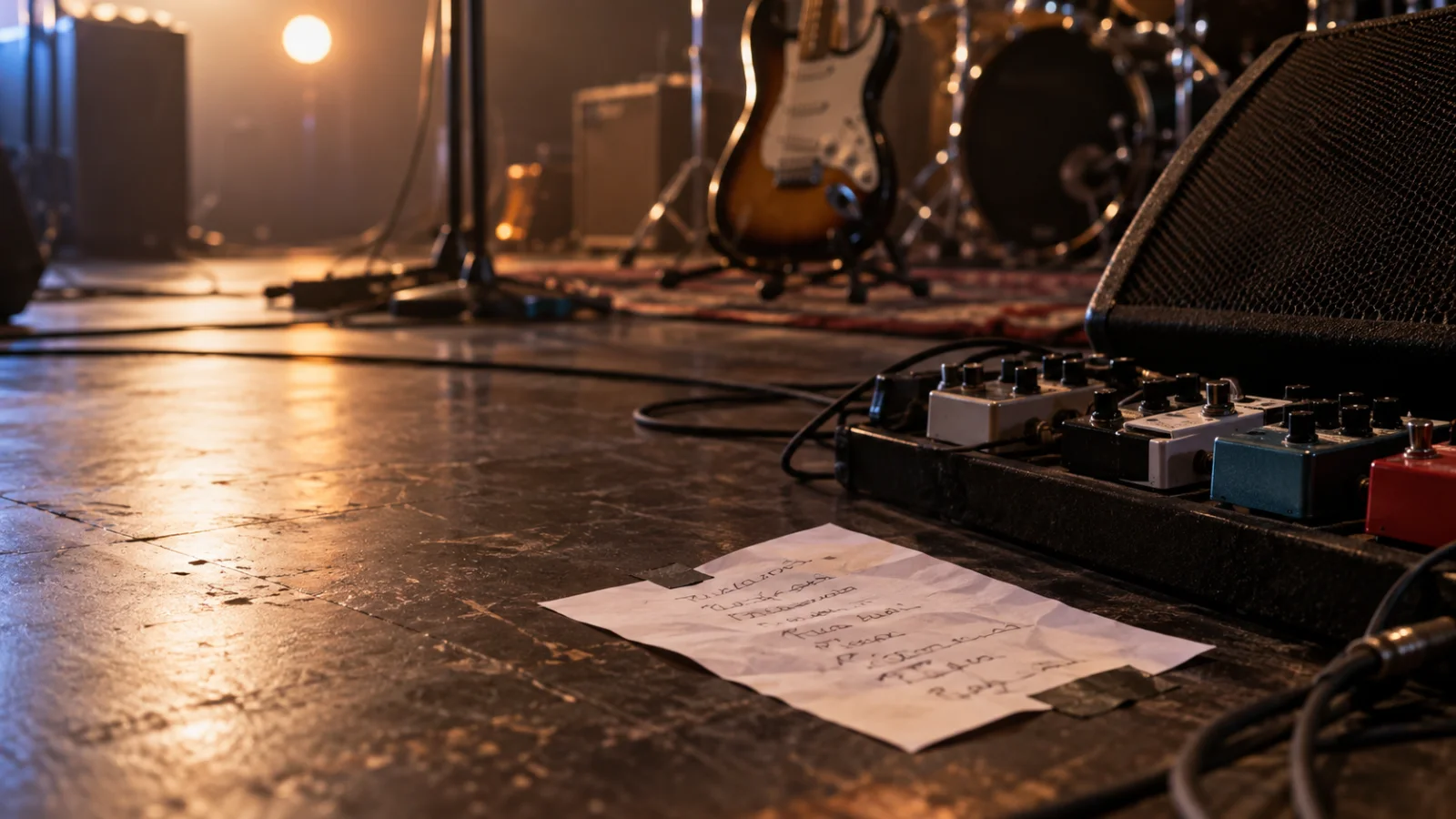
To make a good setlist, start from the time you have, not from the songs you like. Ask whether your slot includes setup, then count how many songs fit once you add the gaps between them. Open with a strong song the band plays with total confidence. Group songs by energy, key and tuning so the set flows and nobody retunes twice. Place a breather a little past the middle, then build. Save the best-known song for last, or second to last if you expect an encore. Plan every transition and what you will say, and print the list in large type, one copy per player.
How many songs fit in your slot
First ask the promoter whether the time you were given is stage time or includes changeover and line check, and whether there is a curfew. Running over usually costs the next band time or gets your sound cut, so treat the length as a hard limit.
Then use one formula: songs = stage time ÷ (average song length + gap). The gap is everything between the last note of one song and the count-in of the next: applause, a sentence, a sip of water, a capo move. For a band that has rehearsed its transitions, 20 to 30 seconds is realistic. With retunes, stories and instrument swaps it gets closer to a minute.
Here is the arithmetic with songs that average 3:45 and 30 seconds between them. The last song has no gap after it.
| Slot | Maximum songs | Running time | Plan this many |
|---|---|---|---|
| 30 minutes | 7 | 29:15 | 6 or 7 |
| 45 minutes | 10 | 42:00 | 10 |
| 60 minutes | 14 | 59:00 | 13 (54:45) |
| 90 minutes | 21 | 88:45 | 20 (84:30), encore included |
Two things change these numbers quickly. If your songs average 4:30 instead of 3:45, a 45-minute slot holds 8 songs comfortably (39:30) and 9 at a push (44:30). And if your gaps stretch to one minute, the same ten songs that ran 42:00 now run 46:30 and no longer fit.
Use live lengths, not the length of the recording: endings stretch and nervous bands play faster. Time a run-through in rehearsal, or tap along to a rehearsal recording with the tap tempo metronome and write the BPM next to each title.
The free setlist maker does this arithmetic for you. Enter each song with its key, tempo and length, set the seconds between songs and the length of your slot, and it shows the running time, the time left or over, and the minute each song starts. It runs in your browser and saves nothing, so copy, download or print the result.
Finally, put one or two cuttable songs in brackets and keep a short spare song at the bottom. If the stage starts ten minutes late, nobody negotiates on stage.
Map the energy before you choose the order
A setlist is a shape, not a ranking. Build it in four steps.
- List every song you could play, with its key, tempo, tuning or capo, length and who sings lead.
- Give each song an energy score from 1 (quiet, slow, sparse) to 5 (loud, fast, the room moves). Score how it lands live, not how it sounds on the record.
- Mark the songs people know: released singles, the song local radio played, the cover everybody sings.
- Draw the curve: a strong first two or three songs, a varied middle, one clear breather, a build, and the peak in the last two.
Then check the order against a few rules.
- Open with confidence. The first song is also the soundcheck for the room. Pick one that is tight, immediate and forgiving if the monitors are wrong.
- Vary key and tempo. Three songs in a row in the same key at a similar tempo sound like one long song. Moving up a fourth or a fifth (E to A, D to A) or to the relative minor sounds natural; a big tempo drop needs a spoken line or a moment of silence.
- Hide new songs between strong ones. An unknown song in slot four, between two songs the band plays best, gets a fair hearing.
- Group tunings and capos. Each change should happen once, ideally while someone talks.
- Place the breather after the middle. Around 55 to 65% of the way through, never in the first quarter. After it, raise the tempo in steps.
- Protect the voice. Put the highest songs after the voice has warmed up and before it tires. If a song sits uncomfortably high, check the key with the vocal key finder before you rehearse it in the set.
- End with the song people came for. If an encore is likely, play it second to last, and keep a strong song or a surprise for the encore.
Example: a 45-minute set for a band
A four-piece indie rock band (vocals, guitar, bass, drums) has a 45-minute support slot. The song titles are invented.
| # | Song | Key · BPM | Length | Energy | Transition and notes |
|---|---|---|---|---|---|
| 1 | Static on the Line | E · 132 | 3:20 | 5 | Drums count in, no talking |
| 2 | Borrowed Car | A · 124 | 3:45 | 4 | Guitar holds an A drone into the intro |
| 3 | Northbound | A · 118 | 4:00 | 4 | Talk 1: band name, city, thank the headliner |
| 4 | Paper Sun (new) | D · 104 | 3:40 | 3 | Say the title before it |
| 5 | Glasshouse | G · 96 | 4:10 | 3 | Bass riff starts alone |
| 6 | Salt and Wire | D, drop D · 78 | 4:20 | 2 | Retune while the singer tells the story |
| 7 | Low Tide Radio | D, drop D · 112 | 3:50 | 3 | Straight in, same tuning |
| 8 | Night Bus Home | B minor · 120 | 3:35 | 4 | Retune to standard during Talk 2: merch, one handle |
| 9 | Fireworks for Nobody | E · 138 | 3:30 | 5 | Fastest song, no pause after it |
| 10 | Hold the Porch Light | E · 128 | 4:30 | 5 | Best-known song: “this is our last one” |
The music adds up to 38:40. With nine gaps of 30 seconds the set runs 43:10, which leaves 1:50 of slack in a 45-minute slot. The drone between songs 1 and 2 saves a few seconds; the two retunes cost some. That balance is about right.
What makes the order work:
- The opening pair moves up a fourth, from E to A, and the held A lets “Borrowed Car” start before the applause dies.
- Energy steps down and climbs back: 5, 4, 4, 3, 3, 2, then 3, 4, 5, 5. The tempo follows, from 132 down to 78 and up to 138, and the breather lands at song 6 of 10.
- Both drop D songs sit together: one retune down, one back up, each covered by talking.
- Songs 9 and 10 share a key, so there is no retune and no dead air before the end.
Example: a 30-minute acoustic set
A duo (lead vocal and guitar, second voice) plays a café. They talk more than a band, so they plan 40-second gaps.
| # | Song | Key (capo) · BPM | Length | Energy | Notes |
|---|---|---|---|---|---|
| 1 | Coffee at Six | A (capo 2, G shapes) · 116 | 3:10 | 3 | Bright opener, not the loudest |
| 2 | Streetlight Letters | E (capo 2, D shapes) · 100 | 3:30 | 3 | Same capo; hello and names after it |
| 3 | The Kitchen Radio | D (no capo) · 92 | 3:20 | 3 | Capo off while the second voice talks |
| 4 | Half a Mile of Rain | E minor · 72 | 4:00 | 1 | The breather, after a one-line story |
| 5 | Tin Roof Dancing | G · 124 | 3:00 | 4 | The lift: ask for claps on 2 and 4 |
| 6 | Borrowed Sweater | C (capo 5, G shapes) · 104 | 3:40 | 3 | Capo on during the applause |
| 7 | Sunday Porch | C (capo 5, G shapes) · 108 | 3:50 | 4 | Best-known song, singalong chorus |
The music runs 24:30; with six gaps of 40 seconds the set lasts 28:30 and leaves 1:30 spare.
- The capo moves only twice, off before song 3 and on before song 6, each time covered by talking or applause.
- E minor to G is a move to the relative major, so the lift after the quietest song feels natural.
- Contrast comes from feel, not volume: the slowest song follows three mid-tempo ones, then the fastest arrives.
- The opener is bright, not quiet, because in a café people are still ordering.
Transitions: segues, count-ins, retunes and what to say
Most sets lose their energy between songs, not during them. Rehearse the transitions as if they were part of the songs.
Segues
Three reliable ways to join two songs:
- Hold a chord or a drone and start the next song over it. It works when the keys are the same or a fourth or fifth apart.
- Let the drums carry the groove into the new tempo, and bring the band in on a cue.
- Use a short ambient bridge: a pedal swell, a keyboard pad, eight to sixteen seconds at most.
Write ”→” on the setlist between two songs that go straight into each other.
Count-ins
One person counts every song, usually the drummer, with the BPM written next to each title; if there is a click, load the tempos in set order. When a song starts with one instrument alone, that player counts in their head and the band follows the cue.
Tuning changes and capos
Group songs by tuning, retune while someone else talks, and keep a pedal tuner in mute mode. A second guitar already in the other tuning saves 30 to 60 seconds. Put the capo on during applause and write the fret on the setlist.
Instrument swaps
Decide who moves where, leave stands and cables ready and save keyboard sounds in set order. Allow 45 to 60 seconds, and tell the sound engineer where the swap happens.
What to say between songs
Plan two or three talking moments, not ten.
- After song 2 or 3: band name, where you are from, thanks to the venue and the other bands. Say the name again before the last song.
- Before a new song or the quiet one: one sentence about what it is about. Nobody needs the whole story.
- Before one of the last two songs: where to find you, once: merch, one handle or a QR code.
- Keep each moment to 20 to 40 seconds and write the key words on the setlist (“TALK: name + thanks”).
- Agree on a plan for problems. If a string breaks, bass and drums keep a groove going and the singer says what is happening.
Setlists for different gigs
| Gig | Goal | What changes in the setlist |
|---|---|---|
| Opening slot | Win people who came for another band | Short intros, strongest songs early, band name twice, finish on time |
| Headline show | Give your audience a full night | Wider dynamics, older songs mid-set, a planned encore |
| Covers bar gig | Keep the floor full | Several sets with their own curve, blocks by tempo or decade, a reserve list |
| Acoustic café | Win attention in a room that talks | Bright opener, more talking, capos and tunings grouped |
| Festival | Catch passers-by within a strict changeover | Immediate songs early and late, no slow intro, a cut list ready |
Opening slot. Look up the headliner’s recent sets on setlist.fm, a public setlist wiki, to see what their audience expects. Do not cover their songs, and treat your finishing time as part of the deal.
Headline show. You can take one risk in the middle: an older song, a stripped-down version, a new one. Plan the encore: walk off, wait about a minute, come back. If you are not sure there will be one, keep the best-known song last.
Covers bar gig. Each set gets its own curve: lower while people eat, dancing at the end. Keep a reserve list of five to ten songs grouped by tempo to react to the room or a request.
Festival. The stage manager may cut you off when time is up. Open with your most immediate song, play something recognizable in the last ten minutes, and agree beforehand which songs go if you start late.
A rehearsal setlist is not a show setlist
The show setlist has a fixed order. The rehearsal setlist is a work plan: problem songs first, while everyone is fresh, then transitions, then a full run in show order with a timer. Run the whole set, talking and retunes included, at least twice before the gig, and record the run-through on a phone to check the real time.
Decide who owns the setlist, too: one person proposes it, the band agrees, and the final version sits where everyone can see it. The guide to removing the organizer bottleneck explains how to share that kind of decision, and the guide to apps for bands compares tools for rehearsals and shows.
Print it for the stage
- One page, one copy per player, plus one for the sound engineer. Tape it to the floor or the top of an amp with gaffer tape, and bring a spare.
- Large type: bold capitals of at least 28 pt, and 36 pt or more if the list sits on the floor. With more than 12 songs, use two columns or short names (“PORCH”, “RADIO”).
- One line per song: number, short title, key, capo or tuning, BPM and a cue: ”→” for straight in, “TALK”, “RETUNE”, “SWAP”. Put cuttable songs in brackets and the encore below a line.
- A version for each role: the drummer needs BPM and count-ins, the keyboard player sound numbers, and the singer can add the first word of songs that start with vocals.
- Stage-plot notes for the engineer: the setlist is not a stage plot, but the engineer’s copy should say which songs use acoustic guitar, who sings lead, where instrument swaps happen, where backing tracks run and which songs start with one instrument alone.
- Phones and tablets work with auto-lock off and brightness up, but paper does not run out of battery or reflect the lights.
The setlist maker has a “Print for the stage” button. For the chords of each song, the lyric and chord sheet guide and the chord sheet maker cover the page each player keeps on the stand.
After the show: keep the setlist for royalties
If you play songs you wrote, the setlist is also how your collecting society knows what was performed. In the US, ASCAP writer members submit setlists through ASCAP OnStage by a deadline for each quarter: shows from January 1 to March 31, for example, must be claimed by June 30. BMI Live generally accepts performances up to nine months after the show, entered by the performing songwriter. In the UK, PRS for Music asks for the venue, the date, the performer and every work performed, within 12 months for pubs, clubs and small venues and within three years for concert venues. The songwriting royalties guide explains the rest. Keep the final setlist, the date and the venue of every gig.
Where Zoundroom fits: one set of versions behind the setlist
A setlist is only as reliable as the versions behind it. In Zoundroom each song is a project that holds its latest recording, its lyric and its chords, and the band works on the same projects. When the setlist says “Glasshouse, G, 96”, everyone opens the same current demo and lyric instead of a version from three chats ago. Create a project for the gig, paste the setlist from the setlist maker into a note, and record the rehearsal run-through into that project. Invite band members with an invitation code; each one signs in with their own account on iOS, Android or the web. On Pro and Band, timestamped audio comments on the run-through point to the exact second (“the ending of song 7 runs 20 seconds long”). The Band plan brings up to seven members under one subscription, with owner, editor and viewer roles.
Zoundroom does not order or time setlists, and it is not a stage display: order and time the set with the setlist maker and print it on paper. See how collaboration in Zoundroom works, or the Band plan.
Frequently asked questions
How many songs are in a set?
Divide your stage time by the average song length plus the gap between songs. With 3:45 songs and 30-second gaps, that is about 7 songs in 30 minutes, 10 in 45, 13 or 14 in 60 and around 20 in 90, leaving a few minutes of slack.
Should you open with your best song?
Open with a strong, confident song, not necessarily your best-known one: it doubles as a soundcheck for the room. Keep the song people came for for the end, or second to last if there will be an encore.
How long should you wait between songs?
Twenty to thirty seconds is a good average for a rehearsed band. Plan two or three longer moments for talking or retuning, and join some songs directly.
Do setlists include covers?
Yes, if they suit the gig. In an original set, one well-chosen cover in the second half helps a room that does not know you; a covers bar gig is built from them. Place covers on the energy map like any other song, and if you report the set to a collecting society, list every work performed.
Sources
All pages checked on September 27, 2026.
- ASCAP: ASCAP OnStage and OnStage, Plus Awards and live performances (quarterly deadlines, direct deposit).
- BMI: BMI Live and BMI Live FAQ (up to nine months after the performance, entered by the performing songwriter).
- PRS for Music: Reporting live performances and How long do I have to report a live performance? (12 months for small venues, three years for concert venues).
- setlist.fm: home page (the setlist wiki).