
How to write a jingle for your business, podcast or school
Published
Write a jingle step by step: 5-, 15-, 30- and 60-second versions, a name hook people remember, a simple melody, a phone demo, and the rules for AI and existing songs.
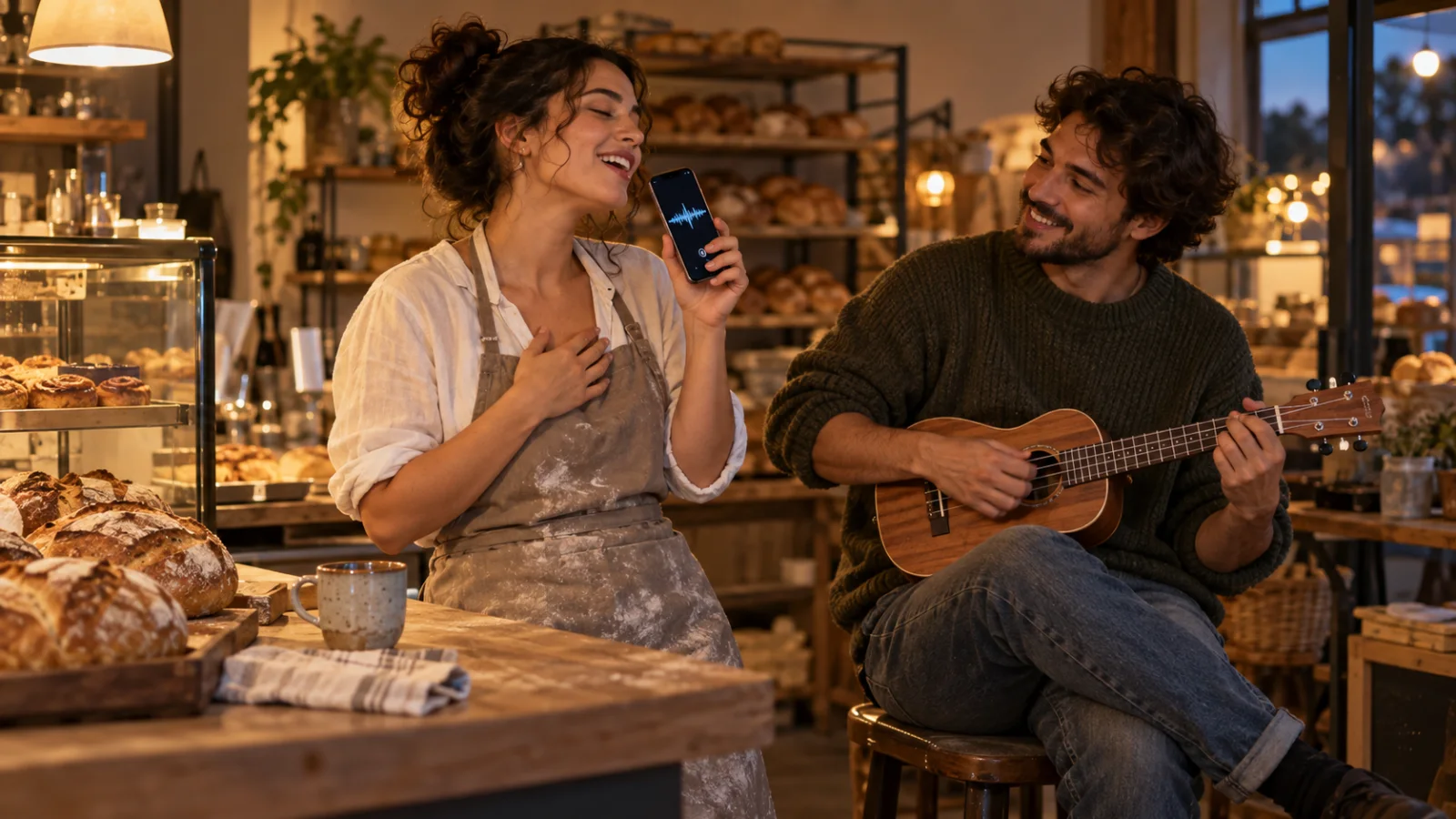
To write a jingle, start with the name and one promise, not with the music. Turn them into a short line of about eight syllables that puts the brand name on a strong beat, sing it over a two-bar phrase that stays within five notes, and repeat it until it sticks. Then decide where it will play: a 5-second tag, a 15-, 30- or 60-second spot (the slot lengths radio stations sell), or a 5- to 15-second podcast intro. Record a demo on your phone with a metronome, play it to people who don’t know the business, and only then decide whether a composer should produce the final version. If you borrow an existing song or use an AI generator, check the rights before it goes on air.
Below: a length table with the timing in bars, a seven-step method, two audio examples, a complete jingle for a small bakery (a tag, plus 15- and 30-second versions with a voice-over script), a template to copy, versions for school assignments and podcasts, how to record the demo, when to hire a composer, and what you can and can’t use from existing music and AI tools.
How to write a jingle in 7 steps
- Write a one-card brief: the name, what you sell, who it’s for, one promise and where the jingle will play.
- Pick the length before you write a note: 5, 15, 30 or 60 seconds.
- Write ten tagline candidates of six to ten syllables, each with the name in it.
- Set the best three to a two-bar melody and sing them out loud.
- Match the sound to the brand: tempo, instrument and voice.
- Record a phone demo of each length and play it to five people who don’t know the business.
- Keep the winner, or brief a composer with your demo, and agree the rights in writing.
Each step is expanded below, with a worked example you can adapt.
How long should a jingle be? 5, 15, 30 and 60 seconds
A jingle isn’t a song. It’s a short sung or played phrase that carries a name, usually inside an ad, an intro or a video. Write it for the slot it will fill.
| Length | Where it plays | What fits |
|---|---|---|
| 2–5 seconds | Tag at the end of an ad, a podcast sting, the first seconds of a video | The name hook only, sung once |
| 5–15 seconds | Podcast intro or outro, a 6-second video bumper, a 15-second spot | The hook plus one spoken line of about 10 words |
| 30 seconds | Radio or video ad, a podcast sponsor break | Sung hook, about 35–40 spoken words over the music, the hook again |
| 60 seconds | Longer radio spots, a school assignment, a song-like jingle | A short verse, the hook as a chorus, a call to action |
Three facts shape those choices. Radio stations sell 60-, 30-, 15- and 10-second units. Podcast sponsor messages usually run 15 or 30 seconds, sometimes 60, and American Public Media’s script guide counts about 75 spoken words in a 30-second spot (roughly 2.5 words per second). On YouTube, viewers can skip a skippable ad after 5 seconds, and bumper ads last 5 to 6 seconds. So the name has to land in the first five seconds, and the 5-second tag is the most valuable thing you’ll write.
To fit the music to the slot, count bars. At 100 BPM, one bar of 4/4 lasts 2.4 seconds:
| Version | Bars at 100 BPM | Music length | Spare time |
|---|---|---|---|
| 5-second tag | 2 | 4.8 s | 0.2 s |
| 15 seconds | 6 | 14.4 s | 0.6 s |
| 30 seconds | 12 | 28.8 s | 1.2 s for the last chord to ring |
| 60 seconds | 24 | 57.6 s | 2.4 s |
The formula for any tempo: seconds = bars × 240 ÷ BPM. At 120 BPM a bar lasts exactly 2 seconds, which is handy but leaves no air at the end, so plan one bar less. To feel a tempo before you write, tap it in the tap tempo metronome.
Step 1: put the brief on one card
Everything a jingle needs fits on a card. If it doesn’t, the jingle will try to say too much. Here’s the card for the example in this article, an invented neighborhood bakery:
Name:            Mabel's Bakery
What:            sourdough and pastries, baked on site
Who:             neighbors on their way to work
One promise:     the bread is still warm when you walk in
Tone:            warm, homemade, a little playful
Where it plays:  local radio (30 s), Instagram (15 s), 5-second tag
Call to action:  "Corner of Pine and Fourth, open at seven"
Pick one promise. The voice-over can carry the address, the opening hours and the offer of the week; the sung part carries the name and the one idea you want people to hum.
Step 2: write the name hook
The hook is the line people will remember, so write ten before you choose. Aim for six to ten syllables with the name inside, and try different shapes:
- Name plus promise: “Mabel’s oven, warm by seven.”
- A question the name answers: “Who’s got the warm bread? Mabel’s!”
- An action: “Follow your nose to Mabel’s.”
- A rhyme or echo on the name: sounds that come back make a line easier to recall.
Then test each candidate:
- Say it in rhythm and clap on the strong syllables. The stressed syllable of the name must fall on a clap: it’s MA-bel’s, so “Mabel’s” goes at the start of a beat, not squeezed in between.
- Count the syllables in the lyric syllable counter. Two lines of four syllables each fit the melody in the next step exactly.
- Say it in one breath. If you can’t, it’s too long to sing.
- Check that no other business could use it. “Quality you can trust” fits a bank, a plumber and a bakery, so it fits nobody.
- Look for an echo. In “Mabel’s oven, warm by seven”, oven and seven share their ending; the rhyming dictionary opens with “seven” filled in.
For more ways to build a hook and test it, see how to write a hook for a song; for stress and syllables in detail, song syllables and stress.
Step 3: a melody anyone can sing back
Most jingles use one short phrase, repeated. Here’s that shape:
What to listen for: after the count-in (0:00–0:02), a two-bar phrase of eight notes starts at 0:02 and comes back at about 0:07, 0:12 and 0:17. Every bar has the same rhythm: a long note, a quick one, a note held across the middle of the bar, and one that leads on. The whole tune stays between G and the D above it, five notes. Each pass lasts 4.8 seconds, exactly the length of a 5-second tag.
Now sing the tagline on it: “MA” on the first note, “bel’s” on the quick one, “O” held, “ven” leading on; then “WARM”, “by”, “SEV” held, “en”. Eight syllables, eight notes, and the name opens the phrase. The rules behind it:
- Small range: five or six notes, so anyone can sing it back in the shower.
- Repetition: the same rhythm in both bars, the same phrase in every version.
- The name in the spotlight: on the first beat, the longest note or the highest one.
- A finished ending for the tag: the last time, land on the home note (C here) over the home chord.
Loop the same chords at 100 BPM in the chord player and hum taglines over them; record every attempt. C, G, Am and F are beginner-friendly shapes on ukulele and guitar, so a friend who plays a little can accompany you. If you don’t play at all, how to write a song without an instrument walks through humming first and finding chords later, and how to write a melody goes deeper into shape and range.
Match the sound to the brand
The same words can sound like a bakery or a hardware store. Tempo, instruments and voice decide which. These are practical starting points, not rules:
| Brand feel | Tempo | Sound | Voice |
|---|---|---|---|
| Bakery, café, florist: warm, homemade | 90–105 BPM | Ukulele, acoustic guitar, hand claps | One friendly voice, close to the mic |
| Gym, garage, hardware store: energetic | 115–130 BPM | Strummed guitar, driving drums | A group shouting the name |
| Clinic, lawyer, accountant: calm, trustworthy | 70–90 BPM | Piano, soft pad | Clear and unhurried |
| Toy shop, kids’ event: playful | 110–125 BPM | Xylophone, whistling, bouncy bass | Children or a bright voice |
| Podcast: the show’s mood | Match the opening segment | One instrument and the show name | The host, or no voice |
For contrast, here’s the energetic end of the table:
What to listen for: after the count-in (0:00–0:02), G–C–D–C plays twice with a strummed guitar and rock drums, to about 0:20. Hum your tagline over it and notice how the same words now sound like a garage, not a bakery. Both clips are synthesized teaching examples, not finished productions.
Worked example: a jingle for Mabel’s Bakery
Mabel’s Bakery is invented for this example. The promise is that the bread is still warm when the shop opens at seven, so the hook says exactly that, and every version is built from it. Tempo: 100 BPM, so one bar is 2.4 seconds.
The 5-second tag (2 bars)
F              G       C
Mabel's oven,  warm by seven
The G to C at the end is the “finished” sound: it tells the ear the phrase is over. This tag closes every longer version and works on its own at the end of a video.
The 15-second version (6 bars)
0:00–0:05  sung      C                G
                     Mabel's oven,    warm by seven
0:05–0:10  music     Am | F
           voice:    "Sourdough and cinnamon buns, baked right here every morning."
0:10–0:14  sung tag  F                G       C
                     Mabel's oven,    warm by seven
The 30-second version (12 bars)
0:00–0:05  sung      C                G
                     Mabel's oven,    warm by seven
0:05–0:10  sung      Am               F
                     Crusty loaves,   hot and golden
0:10–0:24  music     C | G | Am | F | C | G
           voice:    "Mabel bakes everything on site from five a.m.,
                      so the sourdough is still warm when you walk in.
                      Grab a cinnamon bun on your way to work:
                      corner of Pine and Fourth."
0:24–0:29  sung tag  F                G       C
                     Mabel's oven,    warm by seven
0:29–0:30  last chord rings
The voice-over has 32 words, about 13 seconds at 2.5 words per second, which fits inside the six bars of music. For a 60-second version, add a sung verse about the morning (the first tray, the smell on the street) and bring the hook back twice more. Don’t add new taglines: every version should repeat the same one.
Why it works: the name opens the hook on the strongest beat. “Oven” and “seven” echo each other, and the promise is a fact customers can use: it’s warm, and it’s open at seven. The answer line “Crusty loaves, hot and golden” has the same rhythm, so it sings itself. The details that would be clumsy to sing, like the address, go in the voice-over. And because the tag ends every version, a listener who hears the 15-second cut on Instagram already knows the end of the radio ad.
Template to copy
Fill in the brackets, then sing it before you show it to anyone.
JINGLE CARD
Name (as people say it):  [                ]
One promise:              [                ]
Where it plays:           5 s tag / 15 s / 30 s / 60 s / podcast
Tempo:                    [   ] BPM   (at 100 BPM, 1 bar = 2.4 s)
Chords:                   C–G–Am–F, or your own

HOOK (2 bars, 6–10 syllables, the name on a strong beat)
[                                        ]

ANSWER LINE (2 bars, same rhythm; 30 and 60 s only)
[                                        ]

VOICE-OVER (about 2.5 words per second)
15 s: about 10 words  [                  ]
30 s: about 35 words  [                  ]

TAG (last 2 bars, ending on the home chord)
[the hook again]

CALL TO ACTION (spoken, not sung): address, website, hours
Checklist before you record the final demo:
- The name is in the hook and sung clearly enough to spell.
- In 15 seconds and longer, the hook appears at least twice.
- Every version ends with the same tag.
- Each version fits its slot with at least half a second to spare.
- Five people who don’t know the business can say the name the next day.
How to write a jingle for school
Teachers often ask students to write a jingle for a real or invented product, in a business, English or music class. Check what the assignment asks for (length, whether it must be sung, how many times the name appears), then use this 45-minute plan:
| Minutes | What to do |
|---|---|
| 0–5 | Choose the product and fill in the card: name, one benefit, who buys it |
| 5–15 | Write ten taglines; vote on the best one in your group |
| 15–25 | Set it to a melody: your own over C–G–Am–F, or a public-domain tune |
| 25–35 | Add the answer line and a spoken call to action |
| 35–45 | Rehearse three times and record it on a phone |
If the jingle will be posted online, use your own melody or one in the public domain: new words on a current hit don’t make the melody yours. For a class of young children, keep it to the hook and one action per line; how to write a song for kids has vocabulary, range and actions by age. If the school wants a song for assemblies rather than an ad, read how to write an anthem instead.
Podcast jingles: intro, outro and sponsor breaks
A podcast needs one musical idea used three ways, so it becomes the show’s sound:
- Intro (5–15 seconds): the motif plus the show’s name, sung or spoken. Keep it short; listeners came for the episode.
- Outro (10–20 seconds): the same motif, longer, under the host saying where to follow the show.
- Break sting (2–3 seconds): the first notes of the motif, to mark a sponsor break or a change of segment.
Leave space for the voice: a busy melody under talk fights the host. One instrument and a clear rhythm are enough.
Record the demo on your phone
- Set the tempo in the metronome and count bars, so each version fits its slot.
- Play the chord bed from the chord player on a laptop, or have a friend strum the ukulele next to you.
- Pick a quiet room with curtains or a sofa, and hold the phone about 6 to 8 inches (15–20 cm) from your mouth.
- Record in the free online voice recorder: it records in the browser with a count-in, keeps several takes and lets you download the one you like; nothing is uploaded.
- Record each length separately and time it. A 30-second demo that runs 31 seconds doesn’t fit the slot.
- Name the files with brand, length, version and date, for example
mabels-jingle-30s-v3-2026-10-02; the song file name generator builds names like that. - Test it: play it to five people, and the next day ask them what the bakery was called.
For phone settings and common recording mistakes, see how to record demos with your phone.
When to hire a composer, and what to agree in writing
A phone demo is enough for a podcast intro, a school project, local social media posts or testing ideas. Hire a composer or a jingle studio when the jingle will run on paid radio or TV, when you need a polished vocal and several versions, or when it will stay part of the brand for years. Your demo is the best brief you can give them, together with the card, the lengths you need, a description of the sound (not a song to copy), the deadline and the budget.
Before any money changes hands, agree in writing:
- Uses: radio, online video, social media, in-store, TV, on-hold music.
- Territory and duration: where and for how long you can use it.
- Exclusivity: whether the composer can reuse the melody for another client.
- What you receive: the 5-, 15-, 30- and 60-second versions, an instrumental bed for voice-overs, the a cappella tag, and the stems.
- Who owns the recording, credit, number of revisions and the fee (a one-off buyout or a license).
Under US law, a commissioned work counts as a “work made for hire” only if it falls into one of nine categories, such as part of an audiovisual work, and both sides sign a written agreement saying so. A jingle written only for radio or a podcast may not fit those categories, so ask for a signed written assignment or license instead. This isn’t legal advice: for a large campaign, have a lawyer read the contract. To document who wrote what, see how to copyright and register a song.
Can you use an existing song, public-domain music or AI?
- A hit with new words: you still need permission from whoever controls the composition (usually the publisher) and, if you use the original recording, from the label. Changing the lyrics doesn’t make the melody yours. Music sync licensing explains the two licenses behind every ad.
- Public-domain melodies: on January 1, 2026, works published in 1930 or earlier were in the US public domain, along with sound recordings from 1925 or earlier. An arrangement or recording made later can still be protected even when the tune is old, so record your own version.
- Stock music: read the license for advertising and broadcast use before you build a jingle on it.
- AI music generators: Suno’s terms, updated August 10, 2026, say free and Basic users may use outputs only for personal, non-commercial purposes. Paid Pro and Premier users may use them commercially if they follow the conditions and obtain a permitted download. The same terms say Suno makes no promise that copyright will vest in an output, and that your output may not be unique: the service can generate the same or similar output for someone else. The US Copyright Office concluded in January 2025 that prompts alone don’t make you the author. For a brand sound, that matters: you may not be able to stop a competitor from using something similar. Other generators have changed their download and licensing rules over the past year, so read the current terms of any tool you use.
A safer way to use AI: ask a chat assistant for twenty tagline options as text, keep the ones that sound like the business, and write the melody yourself. How to write a song with ChatGPT has prompts for that, and can you copyright AI music covers the rights in more depth.
Where Zoundroom fits: one project per jingle, with every demo and version
A jingle produces more versions than most songs: ten taglines, three melodies, a 5-second tag, 15- and 30-second cuts, the client’s notes and, later, the composer’s mix. In Zoundroom each song is a project with its recordings, lyrics, notes and files, so make one project per jingle (“Mabel’s Bakery jingle”), write the card and the tagline candidates in a note, and record each hummed melody inside that note, where the audio is inserted at the cursor, right under the line it belongs to. Import the phone demos and the composer’s files into the same project, and keep a short version list in a note (5 s, 15 s, 30 s, each with its date) so nobody plays last week’s cut on air. Free lets you share a project with up to two artists; Pro shares with up to four and adds timestamped feedback, so the business owner or your co-writer, if they also have Pro, can mark the exact second where the name gets lost. The same account works on iPhone, Android and the web. Its AI assistant, Auralis, can suggest tagline options as text, never audio. What it doesn’t do: Zoundroom doesn’t generate audio, has no virtual instruments or beats, and isn’t where you mix and master the final track (a DAW such as GarageBand or BandLab is). Your next step: create the project and write your ten taglines in it today.
FAQ
What’s the difference between a jingle and a sonic logo?
A sonic logo (or audio logo) is a few notes, often without words, that identifies a brand in two or three seconds. A jingle is sung and usually contains the name. Many jingles end with a tag short enough to work as the sonic logo, like the 5-second tag in the example above.
How long does it take to write a jingle?
A first demo takes an afternoon: an hour for the card and the taglines, another for the melody and the phone recording. Leave a few days to test it on people and fix what they don’t remember. A produced version with a composer depends on their schedule and the number of versions.
Can I make a jingle for free?
Yes. A phone, a friend who plays a little, and free browser tools (a chord player, a metronome and a voice recorder) are enough for a demo that works on social media or a podcast. Pay for production when the jingle will run on paid airtime.
Can I use Suno or another AI to make a jingle for my business?
Only on terms that allow commercial use. On Suno, that means a paid plan and a permitted download; free-plan outputs are for personal, non-commercial use. Even then, its terms don’t guarantee copyright or uniqueness, which is a weak base for a brand sound. Many businesses use AI for words and keep a human-made melody.
What makes a jingle catchy?
The name on a strong beat, a melody of five or six notes, a rhythm that repeats, and the same hook in every version. Catchy comes from repetition more than cleverness: people remember what they hear many times.
Sources
Pages checked on October 2, 2026.
- Google Ads Help, “About video ad formats”: skippable in-stream ads can be skipped after 5 seconds; bumper ads last 5 to 6 seconds and are non-skippable. support.google.com
- American Public Media, “Writing Spots”: podcast sponsorship messages usually run 15 or 30 seconds and sometimes 60; a 30-second spot is about 75 words, timed at 2.5 words per second. americanpublicmedia.org
- Wikipedia, “Radio advertisement”: stations sell 60-, 30-, 15- and 10-second units. en.wikipedia.org
- US Copyright Office, Circular 30, “Works Made for Hire”: the nine categories of commissioned works and the signed written agreement they require. copyright.gov
- US Copyright Office, “Copyright and Artificial Intelligence, Part 2: Copyrightability” (January 29, 2025): prompts alone do not provide sufficient human control to make users the authors of the output. copyright.gov
- Duke Center for the Study of the Public Domain, “Public Domain Day 2026”: works from 1930 and sound recordings from 1925 entered the US public domain on January 1, 2026. cspd.law.duke.edu
- Suno, Terms of Service (last updated August 10, 2026): non-commercial use for free and Basic tiers, commercial use for paid tiers with a permitted download, no representation that copyright will vest, and outputs that may not be unique. suno.com