
How to write an anthem for a school, club or company
Published
Write an anthem a crowd can sing: a chorus with the name, a narrow range, a steady beat and call-and-response. With a template, a full example and rights tips.
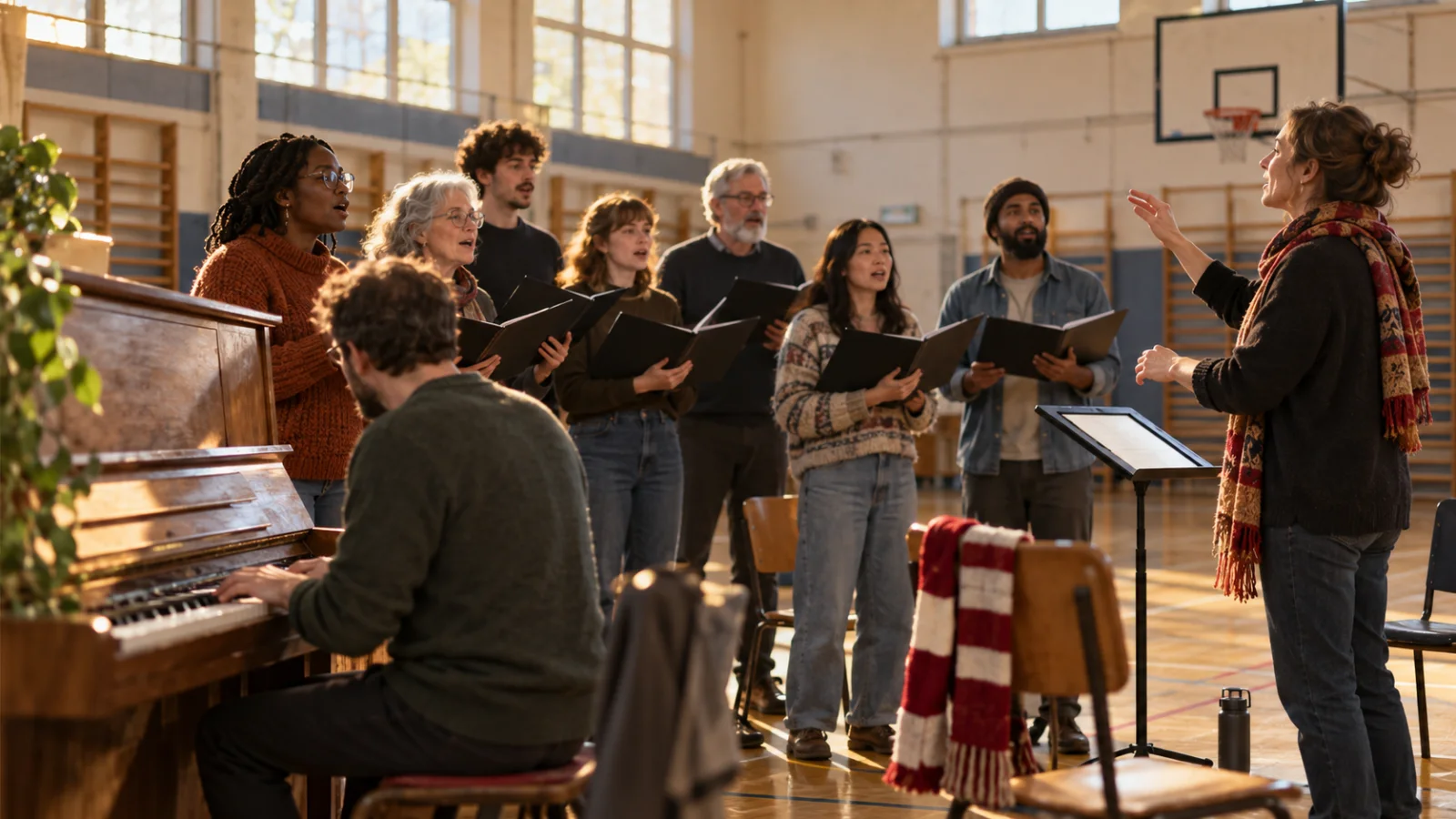
To write an anthem for a school, a club or team, a company or an event, write for the crowd, not for a soloist. Start with the name and three things the group is proud of, and turn each into a concrete image. Write a four-line chorus with the name in its last line, leave a gap where everyone can shout back, and keep the melody inside about one octave, with the highest note on the name. Use a steady beat, one syllable per note and three or four chords. Aim for two to three minutes: two or three verses (past, present, future) and a chorus that comes back at least three times. Teach the chorus first. If you borrow an existing melody, check that it’s in the public domain or get permission.
Below: what makes an anthem singable, how the job changes for a school, a club, a company or an event, the method step by step, a full worked example for a school, a template to copy, how to teach it to a group, and what to know about rights. National anthems are a different job and aren’t covered here.
What makes an anthem easy for a crowd to sing
A good anthem song is less about clever writing and more about removing every obstacle between a crowd and the tune. A crowd hasn’t rehearsed, half of it is shy, and it sings in unison, so men and women naturally end up an octave apart. These are the ingredients that make the difference.
| Ingredient | What to do | Why it works |
|---|---|---|
| A narrow range | About one octave; touch the top note rarely | Untrained voices drop out on very high or very low notes |
| A steady beat | 4/4, a walking or marching pulse, one syllable per note | People can clap, stamp and sing at once |
| The name in the chorus | First or last line, on the strongest beat | It’s the line everybody already knows |
| Call-and-response | A leader sings, the crowd answers with one or two words | Nobody needs to know every word |
| Repetition | The chorus three or four times, repeated lines inside it | Newcomers join in by the second chorus |
| Open vowels on long notes | ”go”, “day”, “high”, not “fit” or “this” | They carry in a gym or a stand |
| Short lines | One breath per line, 6–9 syllables | A crowd breathes together |
The range matters most. The US national anthem is the classic warning: Wayne Messmer, who has sung it at thousands of Chicago sports events, describes its octave-and-a-half range as far beyond the average untrained voice. For congregations, worship leader Bob Kauflin keeps songs between a low A and a high D (A3 to D5), and finds the strongest zone between G and D. An anthem should live in the middle of that window. To find the key that fits, open what key should I sing in, which loads that A3–D5 range, and add your melody’s lowest and highest notes.
Hear what a short, repeated phrase does:
After the count-in, the same two-bar phrase plays four times (about 0:02, 0:07, 0:12 and 0:17). It stays inside five notes, from G up to D, and by the third time you can sing along without trying. That’s the behavior you want from the name line of your anthem.
Now listen to the lift from a verse to a chorus:
The verse (0:02–0:12) is low and talky, with many short notes and no drums. At 0:12 the chorus jumps up, the drums come in and each note lasts two beats: that’s the moment a crowd raises its voice. One caution: this teaching example spans more than an octave and a half, from the A below middle C to the E above the next C. Keep the contrast, but squeeze it into one octave for an anthem. Both examples are synthesized for teaching, not finished recordings.
School, club, company or event: who sings it changes everything
Before writing a line, decide who will sing, where and how often. The same recipe sounds very different in an assembly hall and in a stand.
| Anthem for | Who sings | When | Themes that work | Watch out for |
|---|---|---|---|---|
| A school | Students, staff, families | Assemblies, graduation, anniversaries | The building, the founding story, what students actually do | A range too low for children; words only adults use |
| A club or team | Supporters, players | Kick-off, after a goal, the end of the season | Colors, the ground, the neighborhood, loyalty in bad years | Insulting rivals; verses nobody learns |
| A company | Employees | Anniversaries, annual meetings, parties | The people, the first office, shared moments | Slogans and mission-statement words |
| An event | Participants of a festival, camp, run or congress | Opening and closing | The place, the year, a ritual of the event | Dates that age the song; make the year easy to swap |
If children will sing it, write for their range first: the guide to writing a song for kids has comfortable ranges by age, and a school anthem for younger students often works better in C major, from middle C up to the C above.
A company anthem has a special risk: it can feel like an order to be enthusiastic. Keep it optional, write it with employees rather than for them, and allow humor. A line about the coffee machine that broke in the first week will get more voices than “excellence and innovation”. If the company needs a 15-second tag for an ad or a podcast rather than a song everyone sings, that’s a different brief: how to write a jingle.
Lyric themes: values, place and history, without sounding like a brochure
Most anthem lyrics fail the same way: they list virtues. “Pride, respect and unity” is true of every club on Earth, so it means nothing to yours. Turn each value into something people have seen.
| Abstract value | Concrete image |
|---|---|
| Teamwork | Six kids carrying the goalposts back to the shed |
| Perseverance | Losing 5–0 in the rain and turning up the next Saturday |
| Curiosity | A hand in the air before the question is finished |
| Inclusion | Somebody always saves a seat for the new kid |
| Roots | The creek, the old oak, the bus stop, the factory chimney |
Three kinds of material give an anthem its identity:
- Place. Street names, a river, a landmark, the view from the stand. A place name is free rhyme material that no other anthem can use.
- History. The founding year, the first coach, the borrowed ball, the shed that served as a changing room. Check every fact with someone who knows: an anthem lasts decades.
- Ritual. What the group already does together: the walk to the field, the bell, the colors on a scarf. If the crowd already does it, the song only has to name it.
Write in “we”, keep the words the group really says, and count syllables so lines sung to the same melody match: the syllable counter does it as you type. For rhymes on place names, the rhyming dictionary gives you options in seconds; near rhymes (creek / leaked) sound natural in a crowd song.
How to write an anthem step by step
- Write the brief in one sentence. “A chorus that 300 students and parents can sing at graduation, about the school’s first sixty years.” Note who sings, where, how often and who will lead.
- Collect raw material. Talk to five people: a founder or veteran, a newcomer, a parent or fan, a staff member, a student or player. Ask what they would miss if the place closed. Write down names, places, colors, dates, nicknames and inside jokes.
- Write the chorus first, with the name. Four short lines; the name in the first or last line, ideally both. The guide to writing a chorus goes deeper on making it stick.
- Hum the chorus melody and record it right away. Sing it in your normal voice, inside one octave, with long notes on the name and on the line ends. Record each idea on your phone or in the free online voice recorder before it fades. Put the highest note on the stressed syllable of the name, and only once or twice.
- Put three or four chords under it. I, IV and V carry most anthems: D, G and A in D major. Loop them in the chord progression player, which opens on D–G–A–D at 100 BPM, and sing over it. If the tune isn’t coming, the guide to writing a melody has six steps.
- Give each verse one job. Verse 1: where we come from. Verse 2: who we are now, in concrete images. Verse 3 (optional): where we’re going. Keep verses lower and lighter than the chorus, so the chorus feels like a lift.
- Add a call-and-response section. Four questions a leader can shout and four one-word answers. It’s the part a stand learns first.
- Test it with ten people who never heard it. Sing the chorus twice, then ask them to join. Where voices drop out, a note is too high, a line too long or a word too hard. Fix that and test again.
Check your tempo with the tap tempo metronome: a steady 92–112 BPM suits most anthems, walking pace for a hall, a bit faster for a stand.
Worked example: an anthem for Hollow Oak Middle School
An original anthem written for this article, for a made-up school, following the steps above.
The brief. A school anthem for students aged 11 to 14, staff and families, sung at assemblies and graduation. Founded in 1964 by Miller’s Creek, school colors blue and gold, named after the old hollow oak by the gate. Values the staff wanted: curiosity, kindness, not giving up. Key: D major. Range: D4 to D5, one octave. Chords: D–G–A–D in the chorus, Bm–G–D–A in the verses. Tempo: 100 BPM.
VERSE 1 (where we come from)
In sixty-four, by Miller's Creek,
six rooms, one bus, a roof that leaked,
a hollow oak beside the gate
that's seen a thousand kids run late.

CHORUS
Blue and gold above the door,
we came to learn and something more;
from the first bell to the last,
Hollow Oak! (Hollow Oak!) Holding fast!

VERSE 2 (who we are now)
We ask out loud what we don't know,
we hold the door in rain and snow,
we miss the shot, we try again,
and someone new becomes a friend.

CHORUS

CALL-AND-RESPONSE
Leader: Who are we?          All: HOLLOW OAK!
Leader: What are our colors? All: BLUE AND GOLD!
Leader: When do we give up?  All: NOT TODAY!
Leader: Who's got your back?  All: HOLLOW OAK!

VERSE 3 (where we're going)
Some day we'll drive past Miller's Creek
and slow down at the oak to peek;
we'll hear the bell, we'll hum along,
the oldest kids who know this song.

CHORUS ×2
The chorus melody, line by line:
| Line | Chord | Notes | What it does |
|---|---|---|---|
| Blue and gold above the door | D | F♯–A–B | Starts mid-range; long note on “gold” |
| we came to learn and something more | G | B down to D | Falls to a long low D on “more” |
| from the first bell to the last | A | E up to C♯ | Climbs and builds tension |
| Hollow Oak! (Hollow Oak!) Holding fast! | D | D5–A4, echoed, then F♯–E–D | The only D5 of the song, on “Hol-”, the name |
What each choice does:
- The verses carry the facts; the chorus carries the feeling. Nobody needs to remember the verses to join in.
- Values become pictures. “Curiosity” is a question asked out loud; “kindness” is a held door; “not giving up” is a missed shot and another try.
- The name sits on the top note and gets echoed. “Hollow Oak!” sung by the leader and shouted back is the line a whole gym learns in one go.
- Verse 3 looks forward. It turns the anthem into something graduates will still sing at a reunion.
- Every line is one breath, eight syllables in the verses, seven to nine in the chorus.
- Length: at 100 BPM, with two bars per line, three verses, four choruses and the call-and-response come to about two and a half minutes.
To hear the verse chords, open the player on Bm–G–D–A and sing the first verse over it.
Copy this anthem template
ANTHEM BRIEF
For:                        Who sings (ages, how many):
Where and when:             Who leads it:
Name as sung (syllables, stress):
Target length: ___ min      Short version for kick-off/assembly: yes / no

RAW MATERIAL
Place words:
History facts (checked with):
Rituals the group already has:
Value 1 → image:
Value 2 → image:
Value 3 → image:

MUSIC
Key:          Range: lowest ____ highest ____ (aim: one octave)
Tempo (BPM):  Chords chorus:          Chords verse:
Melody: original / borrowed (title, writer, writer's death year, status):

LYRIC
Chorus (4 lines, name in line 1 or 4):
Verse 1, where we come from:
Verse 2, who we are now:
Verse 3, where we're going (optional):
Call-and-response (4 questions, 4 one-word answers):

RIGHTS AND OWNERSHIP
Written by:            Commissioned by:
Who may use it, where:              Agreement signed: yes / no

TEST
[ ] Ten people sang the chorus after two listens
[ ] Highest note only on the name    [ ] Every line in one breath
[ ] Guide recording ready            [ ] Lyric sheet printed
To keep the structure and timings in one place, the song structure planner lays out sections and bars.
How to teach an anthem to a group
Teach it the way choirs and teachers teach any new song: in short pieces, by ear, with the chorus first.
- Record a guide track. One clear voice, with the chords if you play them, at the final tempo. Share it a week before the first rehearsal so people can listen at home.
- Teach the chorus by echo. Sing one line, the group repeats it. Then two lines, then the whole chorus. Don’t hand out the full lyric yet.
- Add the call-and-response next. It’s quick to learn and instantly fun, which gets the shy ones singing.
- Introduce the verses later, sung by a small choir, the players or a soloist. The crowd joins on every chorus.
- Make a lyric sheet with chords for the musicians, and a large-type lyric for screens or programs. The chord sheet maker prints the chords above the words.
- Rehearse it at the start of three sessions in a row, two minutes each time, rather than once for half an hour.
- Plan the premiere. A choir, a class or the team sings it first, with a leader facing the crowd. Show the words, keep the band below the voices, and sing the last chorus twice.
Rights: an original melody or an existing one?
This isn’t legal advice, just how the rules stand today. Many clubs sing borrowed songs, and many schools write new words to an old tune. The safe question is whether the melody is still protected.
- An original melody belongs to whoever wrote it. It’s the simplest option and the one that gives the group a song nobody else has.
- A public domain melody can be used freely. In the US, musical compositions published in 1930 or earlier are now in the public domain (works from 1930 entered it on January 1, 2026). In the European Union, protection generally lasts for the writer’s life plus 70 years. A modern arrangement of an old tune can be protected, so play your own.
- A melody that is still protected needs permission from whoever holds the rights, usually its music publisher, before you publish or use your new lyric publicly. Singing new words over a famous song is an adaptation of someone else’s work. The guide to writing a parody song explains where parody fits, and why an anthem usually isn’t one.
Then settle who owns the new anthem. Under US law, a song commissioned from an outside writer usually stays the writer’s: a commissioned work counts as “made for hire” only in a short list of categories and with a signed agreement, and ownership otherwise moves only through a signed written transfer. Put it in writing before the premiere: who wrote words and music, who may use the song and where, whether the writer can register it, and how credits appear. The guide to registering a song covers registration in the US and with ASCAP, BMI and the MLC.
Common mistakes when writing an anthem
- Writing for a soloist. If it needs a good singer, a crowd won’t sing it. Narrow the range and slow the melody.
- A list of values. Replace every abstract noun with something people have seen.
- Too many words per line. If you can’t sing it in one breath, a crowd can’t either.
- Hiding the name in a verse. Put it in the chorus, on the strongest beat and the top note.
- Long verses for the crowd. Give the verses to a choir or the players; give the crowd the chorus and the shouts.
- Insults and in-jokes nobody outside gets. An anthem lasts decades and gets sung in front of guests.
- Pitching it for the person who wrote it. Check the group’s range and lower the key if needed.
Where Zoundroom fits: the lyric, the guide melody and every version in one project
An anthem goes through many hands: the committee wants a line changed, the music teacher lowers the key, someone records the choir on a phone. In Zoundroom each song is a project that keeps its recordings, lyrics, notes and files together, so create one for the anthem, write the lyric in a note with the key, range and chords at the top, and record the guide melody inside that note, on your phone or in the browser at app.zoundroom.com: the audio lands at the cursor, under the chorus it belongs to. Import the rehearsal recordings into the same project, add the lyric sheet as a PDF (a Pro feature), and invite the music teacher or the club’s coordinator (Free shares with up to two artists; Pro, with up to four, adds feedback at the exact second of a take, handy for “the crowd rushes here”). Auralis, Zoundroom’s AI assistant, can suggest a simpler line, as text only. Be clear about the limits: Zoundroom doesn’t generate audio, has no virtual instruments or beats, and isn’t where you mix and master the final recording (a DAW such as GarageBand or BandLab is). Your next step: create the anthem’s project and record the chorus inside its note before the first test with ten people. See how notes and lyrics work with audio.
Frequently asked questions
How do you write an anthem for a school?
Start from what the school’s students and staff really share: the building, the founding story, the daily rituals. Write a four-line chorus with the school’s name in it, keep the melody inside one octave (from middle C for younger students), add a call-and-response part, and test it with a class before the premiere.
How long should an anthem be?
Two to three minutes for the full version: two or three verses and a chorus that returns three or four times. Many clubs and schools also use a short version, just the chorus or the call-and-response, for kick-offs and assemblies.
What makes a song an anthem?
A crowd can sing it without rehearsing: a narrow range, a steady beat, short lines, a repeated chorus with the group’s name, and a moment where everyone answers together. The lyric speaks as “we” and names things the group shares.
Can I put new words to a famous song for our club anthem?
Only if the melody is in the public domain or you have permission from its rights holder, usually the publisher. Songs by living writers, or writers who died less than 70 years ago in the EU, are almost always protected. An original melody avoids the problem.
Can AI write an anthem?
A chat assistant can suggest rhymes for a place name or alternative lines, but it doesn’t know your club’s history. Use it for options, check that the result doesn’t echo existing songs, and keep your own melody. The guide to writing lyrics with AI explains how to keep your voice.
Sources
All pages checked on October 2, 2026.
- Northwestern Now, article on the challenges of singing the national anthem (February 2017): Wayne Messmer, who has sung it nearly 5,000 times at Chicago sports events, on the anthem’s octave-and-a-half range, “far beyond the average person’s non-trained singing voice”, and the risk of starting in the wrong key. news.northwestern.edu
- Bob Kauflin, “Finding the Right Key to Sing In”, Worship Matters: congregational songs kept from a low A to a high D; the strongest range between G and D. worshipmatters.com
- Duke Law, Center for the Study of the Public Domain, “Public Domain Day 2026”: works published in 1930, including musical compositions, entered the US public domain on January 1, 2026; in the EU, works by authors who died in 1955 enter the public domain in 2026 (life plus 70 years). cspd.law.duke.edu
- US Copyright Office, Circular 30, “Works Made for Hire”: a specially commissioned work is made for hire only in listed categories and with a signed written agreement; otherwise the creator owns the copyright, and ownership is transferred by a signed written instrument. copyright.gov