
Minimalist home studio for songwriting: what you need
Published · Updated
Build a low-friction songwriting space with tools you own. Separate writing needs from production purchases and upgrade only for real limits.
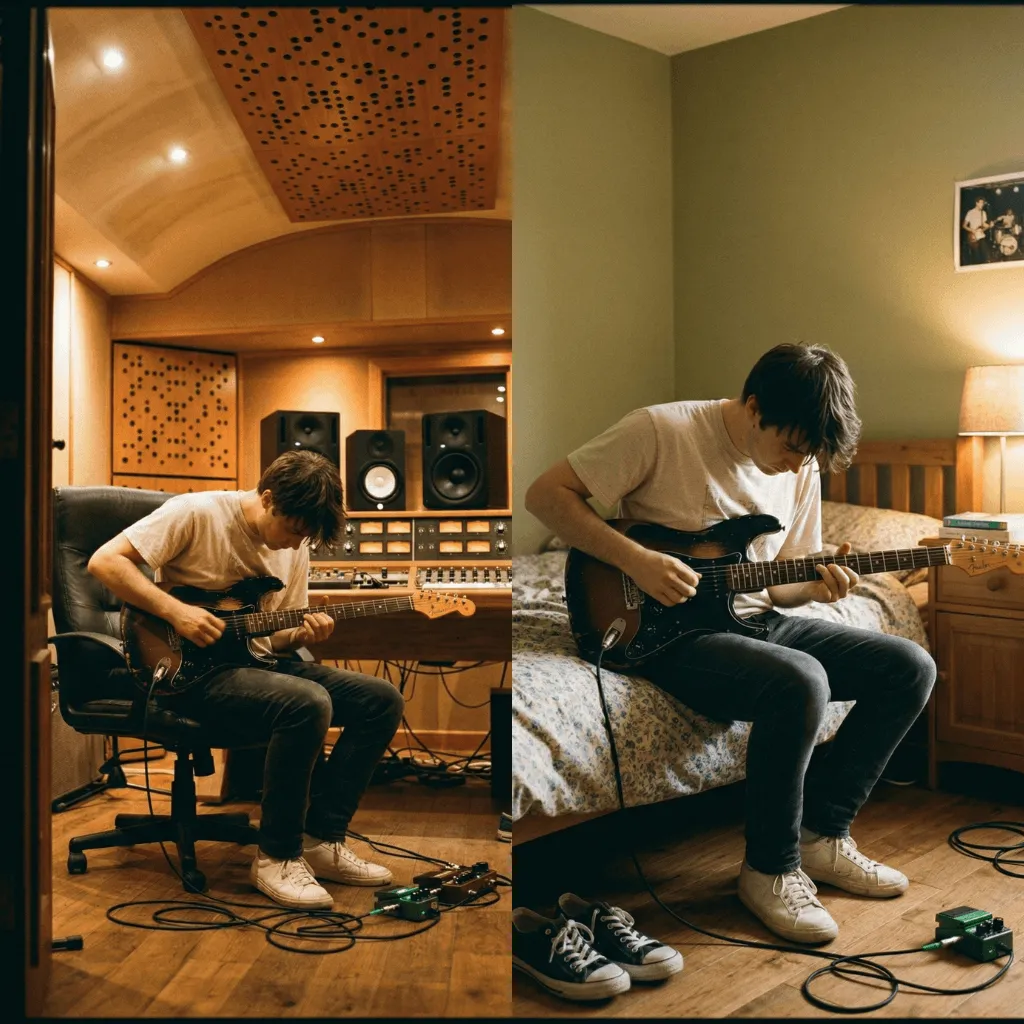
A home studio for songwriting and a home studio for recording finished productions are not the same project. Songwriting needs a place to play, hear, capture, and continue an idea. Production may later require monitoring, acoustics, inputs, microphones, computing power, and specialised software.
Buying for the second job before the first is clear can create more setup and less writing.
The minimum viable songwriting space
Your main instrument or input method
Use the instrument, controller, or voice that lets you reach an idea without preparation. Keep it accessible and ready. A better instrument that remains in its case may be less useful than a modest one within reach.
A capture device
Your phone or computer can preserve melody, rhythm, and lyric fragments. Learn one recording action well enough that you do not need to configure it during the idea. If the built-in recorder isn’t enough, the free music recording apps guide compares the options by task.
Headphones or a practical listening system
You need to hear references and rough recordings clearly enough to make writing decisions. Accurate mix translation is a different requirement. Start with what you already have and replace it when you can name a listening problem it creates. Closed headphones matter most when you sing over a track: recording vocals at home explains why.
A place for lyrics and notes
Paper, a notes app, or a specialist writing tool can all work. The important part is continuity: the active lyric and current audio reference must come back together inside the song project.
A project system
The space is incomplete when recordings remain in one list, lyrics in another app, and decisions in chat. Give each active song a container with current materials and next action.
Arrange the room for low friction
Reduce the setup sequence
Count the actions between arriving and making sound. Remove avoidable steps: leave a stand in place, keep the cable connected safely, create a recording template, and charge the device.
Control obvious noise
Choose the quietest practical area, close sources of noise, and test the loudest passage. Soft furnishings can reduce distracting reflections for demos, but they are not a substitute for measured acoustic treatment when accurate production monitoring becomes the goal.
Separate creation and administration
Keep a small writing surface free. Store receipts, adapters, and unrelated work elsewhere. The purpose is not an aesthetic studio photograph; it is a path from intention to sound.
Test your room in ten minutes before buying anything
Use the same four lyric lines and accompaniment for three short recordings. First, record where you normally sit. Second, move the phone closer to your voice while keeping it on a stable surface. Third, keep that position and move away from the noisiest part of the room. Play all three through the same headphones at a similar listening level.
If the words become clearer in take two, placement is the first fix. If a fan or traffic still dominates all three, try another time or room. If all three communicate the melody and lyric, begin writing. Your next useful test is a second verse, not another equipment search.
What can wait
Studio monitors
They become valuable when you need to judge balances and translation in a suitable room. They are not mandatory for capturing melodies, writing harmony, or testing structure.
Acoustic treatment
Treatment should respond to a measured recording or monitoring problem. Random foam is not a complete acoustic plan. For early songwriting demos, placement and a quieter furnished room may be enough.
A professional DAW
A DAW is essential for many production workflows. It is optional for a songwriter who currently needs quick capture and simple references. Use the least complex tool that supports the decision.
Multiple microphones and preamps
Buy or borrow them when the arrangement or recording method demands separate sources. They do not make an unfinished chorus clearer by themselves.
A powerful new computer
Upgrade when the current machine cannot run the sessions and tools you actually use with acceptable reliability. Do not buy against an imagined future workflow.
A sensible upgrade order
- Fix access and organisation first.
- Address the limitation that ruins the most takes: noise, latency, insufficient inputs, or unreliable storage.
- Borrow or rent to test the solution.
- Buy only when the need is recurring.
- Keep the old lightweight capture path available.
A full production setup can be slower than a phone for catching the first idea. The two paths should coexist.
The equipment level depends on the result you need. If that is still unclear, start with what a music demo is and what it is for before turning a home studio into a shopping list.
Three practical configurations
Writer with voice and acoustic instrument
Instrument, phone, stable stand or surface, notebook or lyric app, headphones, and a song project. Free browser tools cover the small gear: an online guitar tuner, a tap tempo metronome and a check of what key you should sing in. Add a microphone or interface when separate tracks or presentation quality becomes necessary.
Electronic songwriter
Computer or tablet, compact controller if useful, headphones, a familiar DAW or instrument app, and fast audio export into the project. Keep a phone capture route for ideas away from the desk.
Remote band writer
A way to record a clear reference, a shared current lyric or chart, a common song workspace, and an explicit review protocol. Each member can use a different production tool as long as the reference and decisions remain shared.
Where Zoundroom fits
Keep the clearest test take in a Zoundroom project and add the four lines in a note. Write where you placed the phone so you can repeat the setup at the next session. Record a full verse and chorus from that position, then keep your next lyric or arrangement idea beside the audio.
For the recording workflow, see how to make a home demo. For the broader environment, read how to build a physical and digital creative space.
The minimalist studio is not the cheapest possible shopping list. It is the smallest reliable system that lets you begin, capture, and continue a song.