
How to write a trap song: 808s, triplet flow, hook and ad-libs
Published
Write a trap song step by step: a 140 BPM half-time beat, 808s and hi-hats in plain words, triplet flow, a hook with ad-libs, an original example and a template.
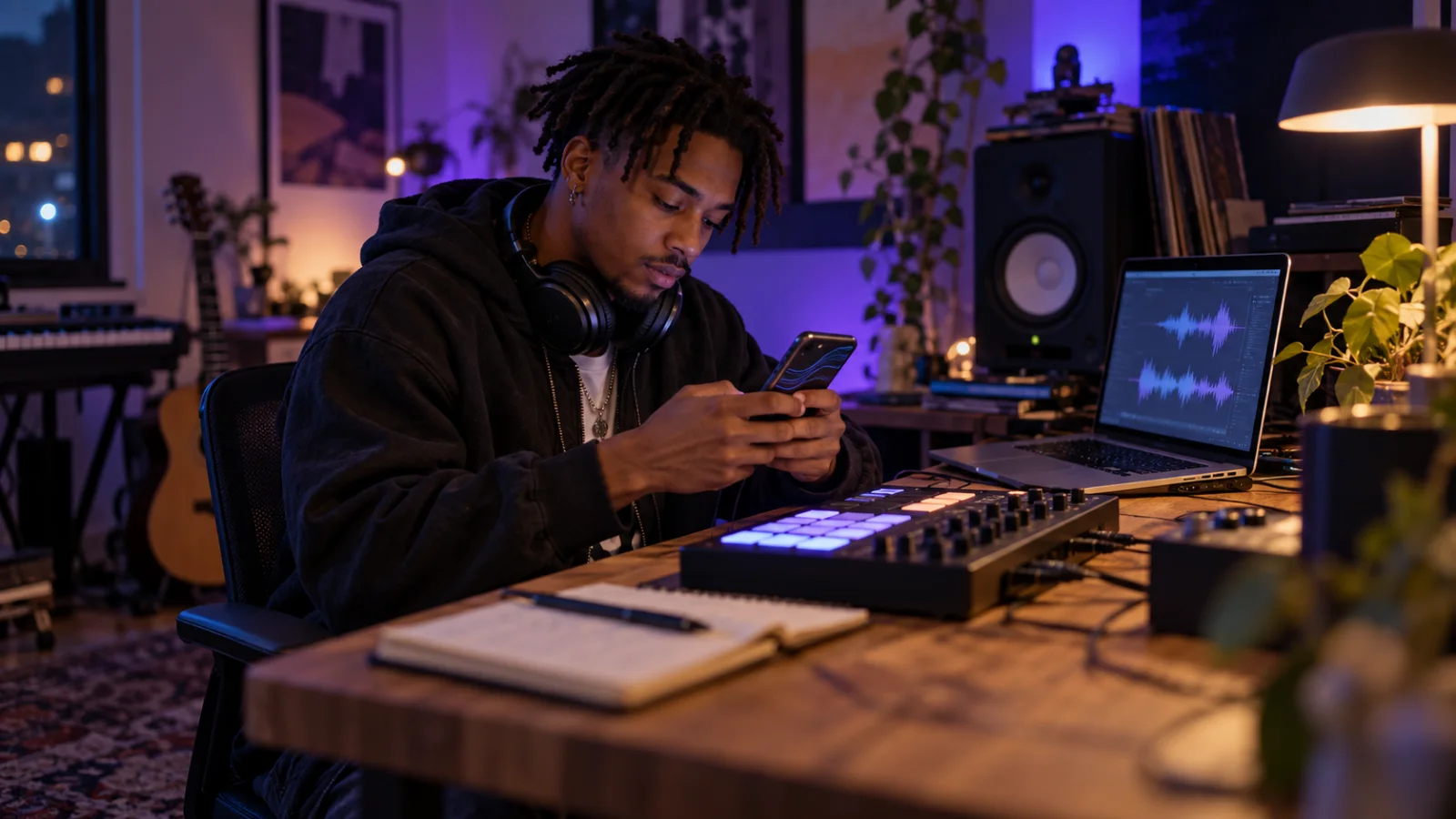
To write a trap song, start from a beat at about 140 BPM with the snare on beat 3 only, so it feels like 70: that half-time feel leaves room either for a few heavy words or for fast triplets. Write the hook first, a title of two to five words chanted or sung over two bars and repeated four times, and plan the ad-libs that answer it. Then write 16-bar verses in blocks of four, land each rhyme on the snare, leave beat 4 for a breath or an ad-lib, and switch between straight and triplet flow on purpose. A common form is intro, hook, verse, hook, verse, hook, and it fits in under three minutes.
Below: the trap beat as an audio example with a drum grid, 808s and hi-hats explained without a production tutorial, loops you can open in the free chord player, an original hook and verse with the flow marked, a template to copy and how trap sounds outside Atlanta. You don’t need to make beats to write trap lyrics.
Trap at a glance: what makes a song sound like trap
Trap comes from Atlanta. The name is slang for a trap house, a place where drugs are sold, and the first lyrics described that life. The modern sound took shape around 1999 with producers such as Shawty Redd, Zaytoven and DJ Toomp and rappers such as T.I., Jeezy and Gucci Mane. Lex Luger’s beats for Waka Flocka Flame’s Flockaveli (2010) spread it, and Migos’ “Versace” (2013), produced by Zaytoven, put the triplet flow at the center of hip hop. Today plenty of trap songs are about love, money, family or a bad week: the beat and the way the words sit on it make the genre as much as the subject.
| Element | Typical trap choice | What it means for your lyric |
|---|---|---|
| Tempo | About 140 BPM, felt in half-time (70) | Fewer words per beat, or triplets |
| Drums | 808 kick and bass, snare or clap on beat 3, fast hi-hats with rolls | Rhymes land on the snare; rolls invite fast syllables |
| Harmony | One or two minor chords on a loop, dark synths, bells or strings | The loop barely changes, so your flow creates the movement |
| Voice | Rapped verses, chanted or sung hooks, often with Auto-Tune on the record | Write a hook that works both sung and rapped |
| Ad-libs | Short shouts and echoes between lines | Leave gaps for them; beat 4 is the usual spot |
| Form | Intro, hook, verse, hook, verse, hook | The hook comes early and often |
Hear it: 140 BPM that feels like 70
Press play and follow the times. It’s a short synthesized teaching example, not a finished production.
After four fast clicks (0:00–0:01), Am starts at about 0:02 and F at about 0:05; the four-bar loop comes round again at 0:09 and ends at about 0:16. The snare hits once per bar, on beat 3, the first one just before 0:03. The kick plays on beat 1 and then twice around the snare. The hi-hats run in sixteenths, and at the end of every second bar (around 0:05, 0:08, 0:12 and 0:15) they roll into a burst of faster hits. The low bass note on beats 1 and 3 stands in for the 808.
Here is one bar on a grid of sixteenth notes (X is a hit):
count   1 e & a 2 e & a 3 e & a 4 e & a
kick    X . . . . . . X . . X . . . . .
snare   . . . . . . . . X . . . . . . .
hi-hat  X x x x X x x x X x x x X x x x
roll    every second bar, the last half of beat 4 splits into six fast hits
In most pop and rock the snare hits on 2 and 4. In half-time it moves to 3, once per bar. At 140 BPM a bar lasts 1.71 seconds, the same gap as between snares in a 70 BPM song, so heads nod at 70 while the hats run at 140. Wikipedia’s trap article puts the typical trap beat at around 140 (70) BPM, with a range from about 100 to 176. What BPM means explains half-time and double-time with more audio. Got a beat from a producer? Tap along with the snare in the tap tempo metronome and write the result at the top of your page.
For the lyric, that 1.71-second bar is the unit. In a straight flow, 6 to 9 syllables per bar sit comfortably; in triplets you fit 9 on beats 1 to 3 and breathe on 4.
808s and hi-hats in plain words
You don’t have to produce the beat, but knowing what each part does tells you where your words go.
- The 808. The Roland TR-808 is a drum machine launched in 1980. Its bass drum can ring for a long time, and producers lengthened and tuned it to play basslines; in trap, “the 808” means that deep, long, pitched kick-bass. It follows the root of the chords, so a sung hook has to be in the beat’s key. Ask the producer for the key, or upload the beat to the key and BPM finder. When the 808 cuts out for a beat or two, often right before the hook, that silence is a spot for one line alone.
- The hi-hats. They run in sixteenths, sometimes in triplets, and roll into 32nd notes at the end of a phrase. Where the hats roll, a quick run of syllables feels natural; where they tick evenly, fewer words breathe better.
- The snare or clap on 3. It’s your anchor: the stressed syllable of the rhyme goes there, and beat 4 stays free.
No beat yet? Loop one of these in the chord player with its trap drums, all in minor keys:
| Loop | Chords | Feel | Open it |
|---|---|---|---|
| i–i–♭VI–♭VI | Am–Am–F–F | The example above: dark and still, lots of room for words | Loop at 140 BPM |
| i–♭VI–iv–V | Cm–A♭–Fm–G | Menacing bell-like arpeggio; the G pulls back to Cm | Loop at 136 BPM |
| i7–iv7–i7–iv7 | Em7–Am7–Em7–Am7 | Softer, for a sung, melodic hook | Loop at 130 BPM |
To build your own beat with an 808 and hi-hat rolls, BandLab is a free studio in the browser and on iOS and Android with beat-making tools, and GarageBand on iPhone and iPad has a Beat Sequencer and Live Loops. That’s production, and it’s a separate job from writing.
How to write a trap song in 7 steps
- Loop the beat and write the tempo and key at the top of the page: “140 BPM, half-time, A minor”.
- Mumble the flow for five minutes on “da” and “ta” with the loop playing, and record it with your phone or the online voice recorder. Keep the two rhythms you like best.
- Write the hook first: a title of two to five words over a two-bar phrase, said four times to fill eight bars.
- Choose three or four ad-libs: an echo, an answer and one sound that’s yours.
- Write the verse in four blocks of four bars. Each rhyme lands on the snare on 3, and beat 4 is for a breath or an ad-lib.
- Switch flow on purpose, for example straight in the first eight bars and triplets in the next four.
- Record a rough demo the same day, listen back and cut one word from every crowded bar.
Flow: straight, double-time and triplets
Flow is where your syllables sit against the beat. Over a trap beat there are three grids worth knowing:
- Straight: syllables on eighth notes, 4 to 8 per bar. Laid-back, good for the opening bars and for hooks.
- Double-time: sixteenth notes, up to 16 syllables per bar. At 140 BPM that’s more than nine syllables per second, so use it for a bar or two, not a whole verse.
- Triplets: three syllables per beat. On beats 1, 2 and 3 that’s 9 syllables, with beat 4 free.
After the clicks (0:00–0:01), four bars run from 0:02 to 0:09. Beats 1, 2 and 3 each carry three even notes, the third group starts right on the snare, and beat 4 stays silent; in bars 2 and 4 the hi-hat roll fills that gap, around 0:05 and 0:08. Say this along with it: “MEL-o-dy | MEM-o-ry | BAT-ter-y”.
The triplet flow wasn’t new in 2013, but “Versace” made it the sound of the decade. In English, words with one stressed syllable followed by two light ones (melody, memory, battery, Saturday, everything) drop straight into a triplet; one-syllable words hit hardest on the snare in a straight flow. The syllable counter tells you at a glance when a bar has grown longer than its neighbors. For counting bars and finding the pocket, see how to write lyrics to a beat; for multis, punchlines and the craft of a 16-bar verse, how to write a rap song.
The hook and the ad-libs
The hook is the part people repeat, so it carries the title.
- Two to five words. Open vowels you can hold (“low”, “on”, “gone”, “night”) work better than consonant clusters.
- A two-bar phrase said four times. Same words each time; if anything changes, it’s the last line.
- Sung or chanted. Many trap hooks are sung on a simple melody, and records often add Auto-Tune. Write it so it works plain. Over the Am–F loop, the white keys of a piano stay in key, and what key should I sing in helps if the hook sits too high.
- Space. The hook has fewer syllables than the verse: if the verse runs 9 per bar, the hook sits at 4 to 6.
Ad-libs are the short shouts, echoes and sounds between the lines. They fall into three kinds: an echo (you repeat the last word), an answer (a short comment on the line) and a signature (a sound that becomes yours). Put them in the gaps, usually beat 4, never on top of a word that matters. Write them in parentheses in the lyric and record them as a separate pass. How to write a hook has a memory test for choosing between two titles, and the rhyming dictionary gives you a chain of rhymes for the hook word.
Trap song structure: a 2:31 map at 140 BPM
At 140 BPM a bar lasts 1.71 seconds, so eight bars take under 14 seconds. That’s why trap songs feel short and the hook comes back so often.
| Section | Bars | At 140 BPM | What it does |
|---|---|---|---|
| Intro | 4 | 0:00–0:07 | The beat, a producer tag or a hint of the hook |
| Hook | 8 | 0:07–0:21 | The title four times, with ad-libs |
| Verse 1 | 16 | 0:21–0:48 | The situation, in details |
| Hook | 8 | 0:48–1:02 | Same words |
| Verse 2 | 16 | 1:02–1:29 | What changed, another flow |
| Hook | 8 | 1:29–1:43 | Same words, more ad-libs |
| Verse 3 or guest | 16 | 1:43–2:10 | Optional: a feature or a short final verse |
| Hook | 8 | 2:10–2:24 | The last time |
| Outro | 4 | 2:24–2:31 | The beat alone, or the 808 fading |
That’s 88 bars, about 2:31. Without the third verse and its hook you get 64 bars, about 1:50. In the song structure planner, pick the rap form, set the tempo to 140 and move the hook to the front.
How to write trap lyrics: a worked example
“Low Battery” is a first draft written for this article over Am–Am–F–F at 140 BPM. Ad-libs are in parentheses.
Hook (one line every two bars, eight bars in all)
Low battery, still on (still on)
one percent, but I’m still going strong (strong)
Low battery, still on (still on)
gotta finish this before it’s gone (gone)
Verse 1, bars 1–8 (one line per bar)
Charger’s in the kitchen, not moving (nah)
notes app open, beat still looping
cracked screen, thumb on the red dot
one take, that’s the only shot I got (got)
melody, memory, battery (yeah)
pick it up, sing it low, finish it
thumb on the glass and I’m writing it (yeah)
screen going black, but the song is on (on)
What each part does:
- Bars 1–4, straight flow. Seven to nine syllables each, and the stressed rhyme syllable (MOV-, LOOP-, DOT, GOT) lands on the snare on 3. Beat 4 is empty or holds an ad-lib.
- Bars 5–8, triplets. Each group of three starts on a stressed syllable, and the third group lands on the snare. Bar 5 rhymes inside itself (melody, memory, battery), bars 6 and 7 rhyme with each other (finish it, writing it), and bar 8 ends on “on”, the hook’s word, so the verse hands over to the hook.
- Hook. “Low battery” is the title: four syllables (low-BAT-ter-y) with an open “o” you can hold. “On”, “strong” and “gone” share that vowel, and each ad-lib echoes the last word.
- Details, not feelings. The charger, the notes app, the cracked screen and the red record button say “I’m obsessed with this song” without saying it.
- Next. Verse 2 is the morning after: the phone charged, the take played back on the bus. The hook stays word for word.
Copy this template
TITLE / HOOK PHRASE: ____________ (2–5 words)
BEAT: ___ BPM, half-time · key ___ · loop ___

HOOK (8 bars = a 2-bar phrase × 4)
  Line A (bars 1–2): ____________ (ad-lib: ___)
  Line B (bars 3–4): ____________ (ad-lib: ___)
  Line A again (bars 5–6)
  Line C (bars 7–8): ____________ (ad-lib: ___)

VERSE (16 bars = 4 blocks of 4)
  Block 1, straight flow: the scene in 3 details
  Block 2: what happens + one internal rhyme per bar
  Block 3, switch flow (triplets): the turn
  Block 4: your best line in bar 16, ending on the hook's sound

AD-LIBS: echo ___ · answer ___ · signature ___
FORM: intro 4 · hook 8 · verse 16 · hook 8 · verse 16 · hook 8 · outro 4
Common mistakes and how to fix them
| Symptom | Likely cause | Fix |
|---|---|---|
| The verse sounds rushed | Sixteenths everywhere at 140 | Think in 70: fewer words, or triplets for four bars |
| Rhymes feel off the beat | The stressed syllable misses the snare on 3 | Reorder the words so the rhyme lands on 3; leave 4 free |
| The hook won’t stick | Too many words, or new words every time | Two to five words, repeated exactly |
| Ad-libs make it messy | They sit on top of important words | Move them to beat 4 and the gaps after the hook lines |
| The sung hook clashes with the beat | The melody is out of the 808’s key | Find the beat’s key and keep the hook inside it |
| Every bar sounds the same | One flow for 16 bars | Change grid or entry point every four bars |
| It sounds like a famous song | Borrowed flow, words and melody together | Borrow a rhythm idea, never the words or the tune |
Trap beyond Atlanta: Latin trap and other scenes
Trap travels well because the beat leaves so much space. Latin trap took shape in Puerto Rico and went worldwide in the second half of the 2010s, with Bad Bunny as its best-known voice; its vocals blend rapping and singing, with Auto-Tune, in Spanish or Spanglish. France, Germany, Italy, Brazil, Spain and Argentina all have their own trap scenes, each with its own slang and flows. The lesson for your writing: take the beat and the space, and write in the language you think in, with the words you actually use. If your song wants a dembow instead of half-time, how to write a reggaeton song is the next guide.
Where Zoundroom fits: the beat, the bars and every take of the hook
Zoundroom doesn’t make beats: it has no virtual instruments or drum machines, it doesn’t generate audio, and it isn’t where you mix and master the final track; that happens in a DAW such as GarageBand or BandLab. What it does is keep a trap song together while you write it, because each song is a project with its recordings, lyrics, notes and files. Create a project called “Low Battery”, import the beat, and write “140 BPM, half-time, A minor” at the top of a note with the hook and the verse below. Insert the beat into that note and play it while you write, then record your mumble flows and takes inside the same note: each recording lands at the cursor, right under the bars it belongs to. It’s the same account on iOS, Android and the web, and the web app records in the browser too. Free lets you share the project with up to two artists, such as the producer; Pro raises that to four and adds timestamped feedback, so, if they also have Pro, they can point to the exact second where the flow drags. Auralis, the app’s assistant, can suggest alternative lines as text, never audio. Your next step: create the project with your hook as its title and record three versions of the hook in that note today.
Frequently asked questions
What BPM is trap music?
Most trap is programmed at around 140 BPM and felt in half-time, like 70, because the snare hits only on beat 3. Wikipedia gives a range of about 100 to 176 BPM (50 to 88 in half-time). If a beat feels slow but the hi-hats fly, it’s half-time.
What is triplet flow in rap?
Three syllables per beat instead of two or four. Over a trap beat you fit nine syllables on beats 1 to 3 and breathe on 4. It existed before, but Migos’ “Versace” (2013) brought it to the center of hip hop in the 2010s.
Can I write a trap song without making the beat?
Yes. Write over a loop in the chord player, a producer’s beat or one you build in BandLab or GarageBand. If someone else made the beat, agree on the credits with a split sheet before you release anything.
Do I need Auto-Tune to write trap?
No. Auto-Tune is a production choice made when the vocal is recorded and mixed. Many trap vocals use it, but a hook should work sung plainly: write and demo it without effects, and decide on the sound later in a DAW.
Sources
All pages checked on October 2, 2026.
- Wikipedia, “Trap music”: origin in Atlanta in the 1990s and the meaning of “trap house”; modern sound from 1999; producers Shawty Redd, Zaytoven and DJ Toomp and rappers T.I., Jeezy and Gucci Mane; Lex Luger and Flockaveli (2010); typical beat around 70 (140) BPM, range 50 (100) to 88 (176); 808 kick drums, double- and triple-time hi-hats, synthesized strings, brass and keys; triplet flow, Auto-Tune and ad-libs; scenes in France, Germany, Italy, Brazil, Spain and Argentina. wikipedia.org
- Wikipedia, “Roland TR-808”: launched in 1980; bass drum decay control; lengthening and tuning the bass drum to create basslines; The New Yorker (2015) on the 808 as the bedrock of trap. wikipedia.org
- Wikipedia, “Versace (song)”: released by Migos in 2013, produced by Zaytoven; brought mainstream attention to the triplet flow, though not the first song to use it. wikipedia.org
- Wikipedia, “Latin trap”: origin in Puerto Rico; vocals blending rapping and singing with Auto-Tune, in Spanish or Spanglish; Bad Bunny as its most influential artist. wikipedia.org
- BandLab, official site and help center: free studio in the browser and on iOS and Android, with tools for making beats. bandlab.com
- Apple, GarageBand for iOS: Beat Sequencer inspired by classic drum machines, Live Loops and sounds for hip hop. apple.com