
How to freestyle rap for beginners: flow, rhymes and drills
Published
How to freestyle rap step by step: find the pocket on a beat, build a rhyme bank with multis, use fillers, tell a story and record drills to keep your best lines.
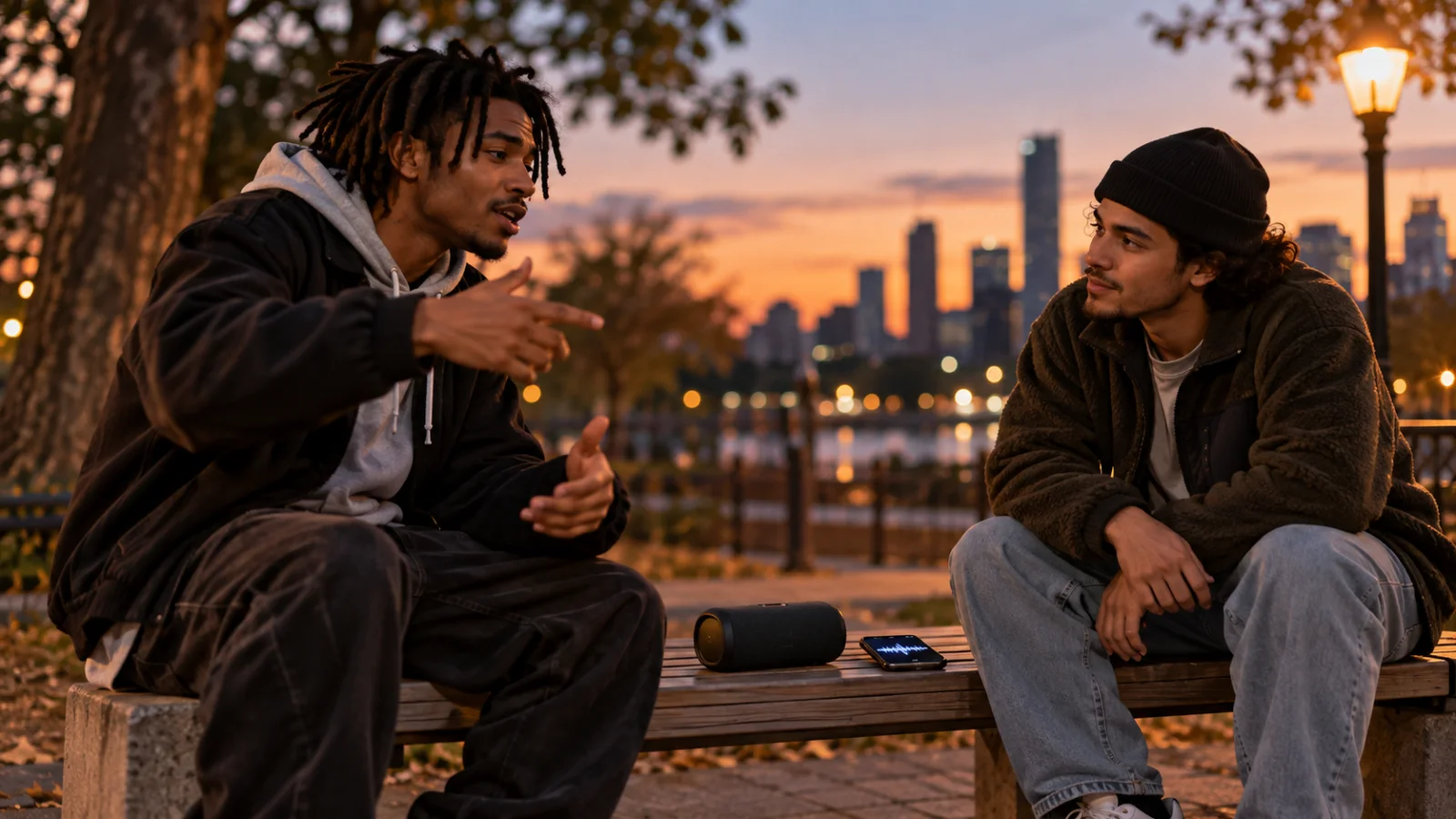
To freestyle rap, start with rhythm before words. Loop a beat at about 90 BPM, nod on the snare (beats 2 and 4) and fill each bar with a steady run of syllables, even nonsense ones, until you can hold the pocket for 16 bars without stopping. Then add real words: say what you see, aim each bar at a rhyme from a rhyme bank you built beforehand, and use short fillers (“look”, “you know”) to buy half a second while your brain picks the next line. Practice 15 minutes a day with drills such as word association and the object challenge, record every session, and keep the two or three lines that came out great. Cyphers and battles come after that.
Below: two audio examples to find the pocket, a rhyme bank with multisyllabic rhymes, the filler rule, a storytelling frame, an original 8-bar example with what to keep from it, a daily drill table, a four-week plan, cypher and battle etiquette, and where the freestyle scenes are. You need a beat, a phone and some nerve. No studio.
What freestyle rap is (and what it isn’t)
Today “freestyle” means rap lyrics you make up on the spot, over a beat or a cappella. It wasn’t always so. In the 1980s a freestyle was a written rhyme “free of style”, one not about any particular topic, as Big Daddy Kane described it, and improvising was called coming “off the top of the head” or “off the dome”. Kool Moe Dee said that until 1986 all freestyles were written. In the early 1990s groups such as Freestyle Fellowship pushed the new meaning, improvisation like a jazz solo, and that’s the one everybody uses now.
Freestyle is a trained skill, not a gift you either have or don’t. In 2012 a team at the US National Institutes of Health scanned 12 freestyle artists with at least five years of experience, once while they improvised over a beat and once while they performed a verse they had memorized. Improvising raised activity in the medial prefrontal cortex and lowered it in dorsolateral prefrontal regions linked to monitoring and self-control. In plain words: good freestylers stop editing themselves while they rap. That’s what the drills below train. Keep going now, judge later, when you listen back.
Freestyle and writing feed each other: freestyle finds flows and lines fast, writing keeps and polishes them. When you want a finished song, how to write a rap song picks up where this guide stops.
Step 1: find the flow before the words
Most beginners fail at freestyle because they think about words first. The beat comes first. In boom bap and most rap between 85 and 95 BPM, the kick sits on 1 and the snare cracks on beats 2 and 4. A bar is four beats; at 90 BPM it lasts 2.67 seconds, so 16 bars take about 43 seconds. Nod your head on the snare and count “1, 2, 3, 4” until you feel where each bar starts.
These are short teaching loops synthesized in your browser, not produced beats. Each starts with a count-in of clicks.
After the count-in (0:00–0:02), the loop starts at about 0:03 on Dm7, and the first snare lands a moment later, on beat 2. Dm7 lasts two bars (0:03–0:08) and Gm7 two more (0:08–0:13), then the four-bar loop repeats until about 0:24. That four-bar cycle is your unit: most freestylers think in blocks of four bars, with a punchline at the end of each block.
Now hear what a steady flow sounds like. Short beeps stand in for syllables.
After the count-in (0:00–0:02), four bars run from about 0:03 to 0:13. Each bar has six syllables on eighth notes: the first just after the kick, the last on beat 4 with the snare. The gap after beat 4 is your breath, and it’s also the half second in which you choose the next line.
The first drill is the syllable flow. Loop a beat and rap only “da-da-da” in that pattern for 16 bars. Then vary it: start a bar later, squeeze more syllables into bar 4, leave one bar empty. If you lose the beat, stop talking, nod and come back in on the next beat 1. When you can keep it up for two minutes, swap the syllables for words. Start at 85–90 BPM; a trap beat at 140 BPM feels like 70 and suits triplets, so leave it for week four. If a beat comes from a producer, tap along with the snare in the tap tempo metronome to get its BPM, and what BPM means explains half-time.
Step 2: build a rhyme bank, then go multisyllabic
Nobody finds rhymes from nothing at full speed. Freestylers carry families of rhymes in their heads, so the search is short when the bar ends. Build yours on paper first: pick five common end sounds, write eight to ten words for each and say them out loud over the beat until they come without thinking.
Then go one level up with multisyllabic rhymes (multis): two or more syllables whose vowels match, even if the consonants don’t. They sound skilled and, oddly, they’re easier to improvise, because you’re matching a vowel pattern rather than hunting a perfect rhyme.
| Vowel pattern | Words and phrases that fit | Bar ending to try |
|---|---|---|
| ay + eye | late night, great time, same side, safe ride, main line, make mine | ”…and I call it a safe ride” |
| oh + uh | open, chosen, frozen, broken, spoken, golden | ”…every door I find is open” |
| ee + uh | freedom, need ‘em, read ‘em, beat ‘em, Eden | ”…I write my own freedom” |
| ah + ee | body, copy, hobby, sloppy, stop me, got me | ”…nobody here can stop me” |
Two rules make a bank work. Rhyme on the vowel, not the spelling: “great time” rhymes with “late night” because of its vowels. And land the multi at the end of the bar, on the snare of beat 4, where the ear expects it. To fill the bank, type “night” or “time” into the free rhyming dictionary, which also lists near rhymes that share the vowels, then do the same with the words you use most. Types of rhyme in songs explains slant and internal rhyme, and how to rhyme in songs shows how to keep rhymes from sounding forced.
Step 3: fillers buy you time (then cut them down)
A filler is a word or short phrase that carries the rhythm while your brain catches up: “look”, “yeah”, “you know”, “check it”, “I’m saying”, or simply repeating the last few words you said. Every freestyler uses them. The difference is where.
- Fillers go at the start of the bar, never on the rhyme. Beat 4 belongs to the rhyme; a “you know” there sounds like a stall.
- Think one bar ahead. While you rap bar 1, pick the end word of bar 2, then build the line toward it. Choosing the target first is the core freestyle trick.
- Repeat and twist. If your mind goes blank, repeat the line you just said and change its last word. It buys a whole bar and sounds deliberate.
- Count them when you listen back. In week one, a filler every bar is fine. By week four, aim for one every four bars.
Step 4: stay on a story, not on random words
Random rhymes impress for 20 seconds; a freestyle that goes somewhere holds a circle. The simplest frame is a camera moving through four bars: where am I, who’s there, what happens, and the twist. Describing what you can see (the room, the street, the person in front of you) is how most freestylers start, because the material is right there. For a topic, ask a friend or open the songwriting prompts generator, and give yourself 16 bars to get from the beginning to an ending.
Worked example: 8 bars off the top, and what to keep
Here is an original 8-bar freestyle, transcribed after recording it over the boom bap loop, with fillers in brackets. The prompt was “the last bus home”, and the bank was the “ay + eye” row above. It’s rough on purpose: this is what a good beginner session sounds like.
1  (look) I'm at the bus stop and it's a late night
2  phone on four percent but I'm feeling great, right?
3  (yeah) the driver waves me on like we're on the same side
4  one seat in the back and I call it a safe ride
5  (you know) the city's asleep but this bus is my main line
6  every window's a movie and I just make it mine
7  (uh) a lady with flowers, a kid with a bike
8  a kid with a bike and a dream, that's alright
What to take from it:
- Keep bars 5–6. “Every window’s a movie and I just make it mine” is an image, not just a rhyme. It goes into your bars notebook as the possible start of a written verse.
- Bars 3–4 work because the multi (same side / safe ride) lands on beat 4 and the story moves: the driver, then the seat.
- Bar 2 is a stall: “great, right?” only rhymes. Next time, the camera frame would push you to a detail (the cold, the lights).
- Bar 8 is a rescue: repeat and twist (“a kid with a bike” repeated, then a new ending). That’s a skill, not a failure.
- Four fillers in 8 bars. Fine for now; the target for week four is two.
Freestyle drills: a 15-minute daily routine
Fifteen minutes every day beats two hours on Sunday. Wear headphones if you record over the beat, so the loop doesn’t swallow your voice.
| Minutes | Drill | How it works | Tool |
|---|---|---|---|
| 0–3 | Syllable flow | ”Da-da-da” for 16 bars, then vary where each bar starts | Boom bap loop at 90 BPM |
| 3–6 | Rhyme chain | One word, rhyme with it for 8 bars without repeating a rhyme | Rhyming dictionary |
| 6–9 | Word association | A friend says a word every four bars and you use it in the next bar | A friend, or the song title generator for random words |
| 9–12 | Object challenge | Put five random objects on the table and rap about one every four bars | Whatever is on your desk |
| 12–15 | Story run | One prompt, 16 bars, beginning to end, recorded | Online voice recorder |
A four-week plan that works for most beginners:
- Week 1, the pocket: syllables only at 90 BPM, until two minutes without stopping feel easy.
- Week 2, the bank: five rhyme families written and drilled; think one bar ahead; fillers allowed.
- Week 3, the inputs: word association and object challenge every day; fillers down to one every four bars.
- Week 4, new tempos: try a trap loop at 140 BPM with triplet flow, and do your first cypher with friends.
Record every session and keep the good lines
The best line of your week will leave your mouth once and then it’s gone, unless you were recording. Record every drill, even the bad ones. The free online voice recorder runs in your browser with a count-in and a click at your tempo, lets you name each take (“Freestyle, last bus, 90 BPM”) and downloads it as WAV; nothing is uploaded, and takes disappear when you close the tab, so download the ones you want. To rap over the beat, play the loop on a speaker and record the room, or record a take inside the chord player itself with headphones on.
Listen back the same day, with a pen. Write down the two or three lines that worked and the second where they happen. Those lines are raw material: the next time you sit down to write, a written verse can start from one of them, and how to write lyrics to a beat shows how to fit them into bars.
Cyphers and battles: the etiquette
A cypher is a circle of rappers taking turns over one beat, to share and practice, not to win. The unwritten rules:
- Wait for your turn and come in on beat 1 of a new bar, after the previous rapper finishes.
- Keep it to 8 or 16 bars, then pass. A cypher isn’t your solo show.
- Listen to the others: picking up the last rapper’s final word is a classic way in, and it proves you’re improvising.
- Don’t recite a written verse and call it freestyle. People notice, and in battles pre-written material is considered dishonorable.
- Hype the good lines of others, don’t talk over them, and don’t turn a cypher into a battle unless everyone wants one.
A battle is a competition: two MCs, rounds over beats chosen by a DJ or host, and a crowd or judges deciding. Follow the event’s rules on time, contact and language. What wins is usually reaction: answering the line your opponent just said beats any punchline you planned (for written ones, see how to write rap punchlines). Lose with a handshake; most good freestylers lost plenty of battles first. Note that many big battle leagues use written, a cappella verses, which is a different discipline from freestyle.
Where the freestyle scenes are
In English-language rap, freestyle battles had a landmark in Scribble Jam, the Cincinnati festival that ran from 1996 to 2008. End of the Weak, started in New York in 2000, gathers MCs from more than 20 countries in contests that include an improvised round where you rap about mystery objects pulled from a bag. Today some of the biggest freestyle battle circuits are in Spanish: Red Bull Batalla tours Spanish-speaking countries, with a US qualifier, and has set its 2026–27 international final for Lima, Peru, on March 20, 2027; FMS (Freestyle Master Series) has run leagues since 2017 and now has them in Spain, Mexico, Argentina, Colombia, Chile and the Caribbean. Brazil has its own huge batalhas de rima, such as the Duelo de MCs Nacional in Belo Horizonte, held since 2007. You don’t need any of them to start: an open mic, a school cypher or two friends on a park bench is where everyone begins.
Common mistakes and how to fix them
| Mistake | What it sounds like | Fix |
|---|---|---|
| Stopping when you stumble | Silence, a laugh, “wait, wait” | Keep the pocket with syllables or a filler and come back on the next beat 1 |
| Rushing the beat | Words pile up and bars end early | Slow the loop to 80 BPM, nod harder, use fewer syllables |
| Only one-syllable rhymes | Day, way, say, every single bar | Use multis from your bank |
| Fillers on the rhyme | ”…you know” on beat 4 | Fillers at the start of the bar only |
| Random topic jumps | A new subject every bar | The camera frame: where, who, what happens, twist |
| Reciting written bars | Too smooth, nothing about the room | Practice them, but say they’re written; freestyle what’s in front of you |
Where Zoundroom fits: your sessions and your best bars in one project
Zoundroom doesn’t make beats: it has no virtual instruments, it doesn’t generate audio, and it isn’t where you mix and master a final track; that happens in a DAW such as GarageBand or BandLab. What it does is keep your practice from disappearing, because each song is a project with its recordings, lyrics, notes and files. Create a project called “Freestyle sessions”, import the beats you practice on, and keep one note per week with the beat and its BPM at the top. Record each session inside that note, where the audio lands at your cursor, and write the lines worth keeping right under the take, with the second they happen. When one of those lines grows into a song, give it its own project. It’s the same account on iOS, Android and the web, and the web app records in the browser too. Free lets you share a project with up to two artists, such as your cypher partner; Pro raises that to four and adds timestamped feedback, so your partner, if they also have Pro, can mark the exact second you fell off the beat. Auralis, the app’s assistant, doesn’t suggest rhymes (grow your bank with the free rhyming dictionary), but it can suggest other ways to say a line as text, never audio. Your next step: create the project today, record two minutes over the boom bap loop and write your best line under the take.
Frequently asked questions
How do I start freestyling as a complete beginner?
Start with rhythm only: loop a beat at 85–90 BPM and rap syllables in a steady pattern until you can hold 16 bars. Then say what you see, ending each bar on a rhyme from a small bank you wrote beforehand. Fifteen minutes a day for four weeks gets most people to a short, confident cypher verse.
How can I freestyle rap better and faster?
Think one bar ahead: choose the end word of the next bar while you rap the current one. Drill multisyllabic rhymes from a bank, practice word association and the object challenge daily, and record every session to count your fillers and stalls. Speed comes from a bigger bank, not from rapping faster.
Do freestylers prepare anything in advance?
Most keep a mental bank of rhyme families, flows and topics they like, and that’s fair practice. What’s frowned upon is reciting a fully written verse and presenting it as freestyle, especially in a battle. The improvised part is how you connect your bank to the beat, the room and the other rapper in real time.
What BPM is best for freestyle?
Between 85 and 95 BPM, the classic boom bap range, because the space between snares leaves time to think. Faster beats around 140 BPM usually feel half-time, like 70, and suit triplets once your pocket is solid. Find a beat’s tempo by tapping along with the snare in a tap tempo metronome.
Sources
All pages checked on October 2, 2026.
- Wikipedia, “Freestyle rap”: the 1980s meaning as written rhymes “free of style” (Big Daddy Kane), “off the top of the head” (Kool Moe Dee, all freestyles written until 1986), the improvised meaning from the early 1990s and Freestyle Fellowship; battles and cyphers; pre-written material in battles considered dishonorable. wikipedia.org
- Liu, S. et al., “Neural correlates of lyrical improvisation: an fMRI study of freestyle rap”, Scientific Reports 2, 834 (2012): 12 freestyle artists with at least five years of experience; improvisation versus a memorized verse; medial prefrontal activity up, dorsolateral prefrontal activity down. nature.com
- Wikipedia, “Scribble Jam”: hip hop festival and MC battle in Cincinnati, 1996–2008. wikipedia.org
- Hip Hop Corner, “End Of the Weak : la compétition qui a révélé Nekfeu et Alpha Wann est de retour !” (October 2024): created in New York in 2000, MCs from more than 20 countries, the freestyle bag of mystery objects. hiphopcorner.fr
- Red Bull, “Red Bull Batalla” (official event series page): freestyle rap competition in Spanish, 2026 tour across Spanish-speaking countries and the United States, international final in Lima, Peru, on March 20, 2027. redbull.com
- FMS, official site: leagues in Mexico, Spain, Argentina, Colombia, Chile and the Caribbean in the 2026/27 season. fms.tv
- Wikipedia (Spanish), “Freestyle Master Series”: founded in Spain in 2017 by The Urban Roosters. wikipedia.org
- Itatiaia, “Duelo de MCs Nacional reúne 32 artistas de todo o Brasil em Belo Horizonte”: held since 2007 by Família de Rua at the Viaduto Santa Tereza. itatiaia.com.br