
5 famous songs that survived unlikely beginnings
Published · Updated
Five documented song origin stories—from Satisfaction to Hallelujah—and practical lessons about capturing, revising, sharing, and protecting unfinished music.
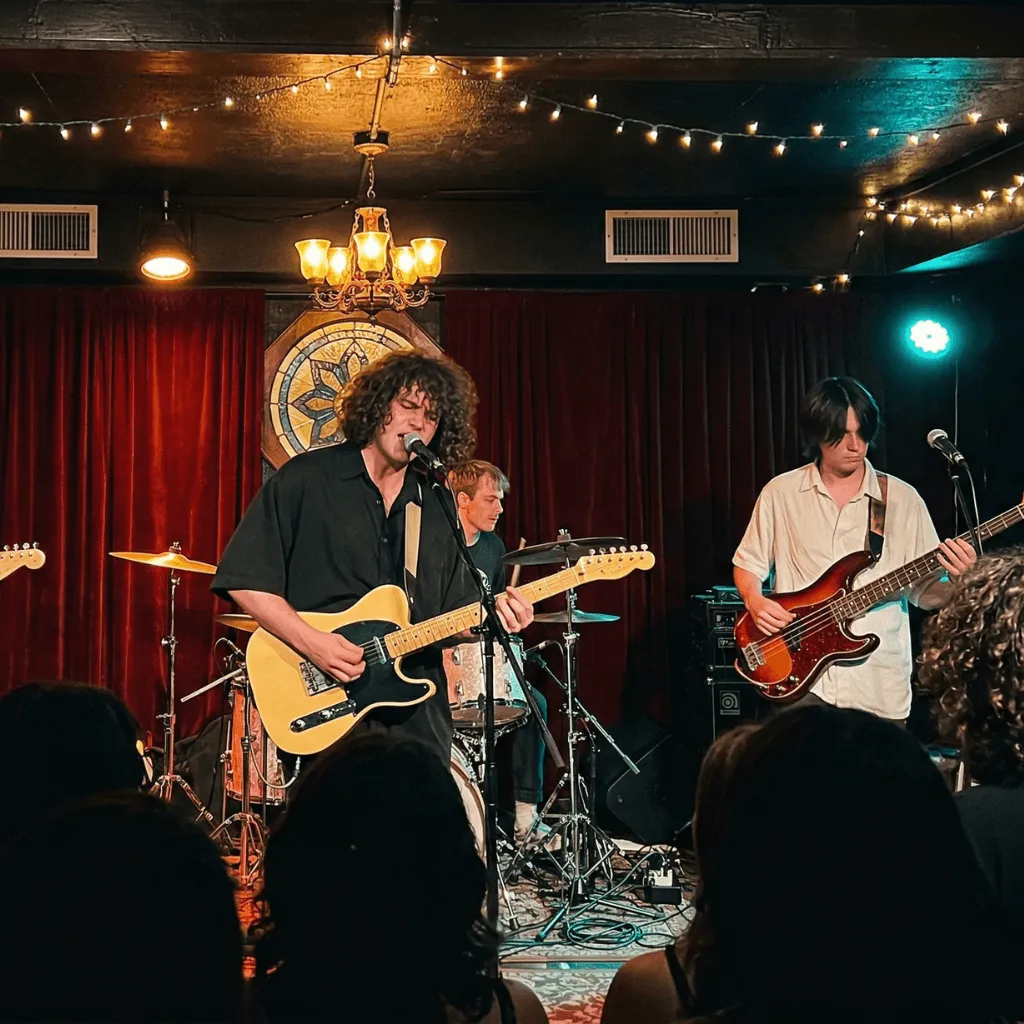
A riff recorded half asleep, an unexpected title, a private ballad and a song rewritten over years: famous recordings can begin as unfinished material. These five stories connect those beginnings with decisions you can use in your own writing—capture, share, reshape and return.
1. “(I Can’t Get No) Satisfaction”: capture the fragment before judging it
Keith Richards has repeatedly described waking to find that he had recorded the song’s central riff on a portable cassette machine while half asleep. On the tape, the musical idea was followed by a long stretch of sleeping sounds. Keith Richards — Guitar World.
The valuable part of the story is not that every late-night recording contains a hit. It is that memory was not asked to preserve the idea. The fragment existed outside Richards’s head, which meant it could be heard again and developed with the band.
Working lesson: make capture easier than postponement. A phone recording with a useful name is enough. Add the song or project it may belong to, then decide later whether it deserves more work.
2. “Smells Like Teen Spirit”: keep phrases whose meaning is not obvious yet
The title came from a phrase Kathleen Hanna wrote on a wall after a night out with Kurt Cobain and friends: “Kurt smells like Teen Spirit.” Hanna was referring to Teen Spirit deodorant, a context Cobain did not know at the time. He interpreted the phrase differently and used it as a title. Kathleen Hanna — Double J.
The story is a reminder that a line can be productive before its meaning is fixed. Strange phrases, overheard language, and private jokes can open a song because they contain sound and ambiguity as well as information.
Working lesson: store promising language with its original context. When you return to it, record both what it first meant and what it could mean inside a song. That prevents a compelling phrase from becoming an orphaned note.
3. “Nothing Else Matters”: do not reject an idea only because it falls outside your usual style
James Hetfield has described “Nothing Else Matters” as unusually personal for Metallica and as music he initially did not expect to present in the way the band eventually did. The group developed it, and the song became part of Metallica’s 1991 self-titled album. James Hetfield — Guitar World.
Its history does not prove that every stylistic detour belongs on the next release. It shows why “this does not sound like us” should be a question, not an automatic deletion rule. An idea can be valuable even before you know which project, arrangement, or audience it belongs to.
Working lesson: keep an “unassigned” area for strong material that does not yet fit the current brief. Revisit it with trusted collaborators before deciding that it has no place.
4. “Bohemian Rhapsody”: protect the section that makes the song itself
“Bohemian Rhapsody” was an unconventional single: long by contemporary radio standards, structurally episodic, and built around an operatic middle section. Brian May has recalled resistance to its length and suggestions that the track should be edited. The band did not remove the part that gave the recording its identity. Radio play—famously helped by DJ Kenny Everett—then created demand before the single’s release. Brian May.
The practical lesson is not “never edit.” Editing is essential. The question is whether a proposed cut removes repetition or removes the song’s reason to exist.
Working lesson: before shortening a piece, label each section by function. Cut material that repeats a function without adding pressure, contrast, or meaning. Defend the section that carries the central idea, even when it is the least conventional one.
5. “Hallelujah”: preserve branches, not just the latest draft
Leonard Cohen worked on “Hallelujah” for years and produced far more verses than appeared on the original recording. Columbia declined to release the album Various Positions in the United States. The song later travelled through other interpretations: John Cale selected and reshaped material for his version, which became an important reference for Jeff Buckley’s recording. Dayna Goldfine & Daniel Geller — Rock Cellar.
This is a history of revision and reinterpretation, not a simple straight line from rejected song to inevitable classic. It also shows why discarded material can remain useful. A verse omitted from one recording may reveal another route through the song.
Working lesson: keep milestones and branches. Mark the active draft, but do not overwrite every previous state. Add one sentence explaining what changed and why, so that revision creates a usable history rather than a pile of numbered files.
What the five stories have in common
The songs differ radically, but their histories point to five practical habits:
- Capture before evaluation. A fragment that has been recorded can be judged later; a remembered fragment cannot.
- Keep context with the idea. Record where a phrase came from, what a draft was trying to do, and which song it may belong to.
- Separate mismatch from failure. An idea that does not fit today’s project may fit another arrangement or release.
- Edit by function. Protect what makes a song distinct; remove what does not earn its place.
- Preserve meaningful versions. Keep the current draft obvious without destroying useful branches.
None of these habits guarantees a famous song. They solve a more ordinary and controllable problem: giving unfinished music enough continuity to become finishable.
Try one of the five lessons with your own material
Pick the situation closest to your current song and do only that exercise today.
| Your situation | A short writing test | What to keep afterward |
|---|---|---|
| A melody disappears when you reach for an instrument | Sing it twice into a recorder and say what made it catch your attention | The phrase, its pulse and one descriptive name |
| You have a striking title but no story | Write three different speakers who could say it; draft two lines for one of them | The title and the most promising point of view |
| A song feels unlike your usual work | Play the bare idea to one trusted collaborator and ask which moment they remember | The original take and their specific response |
| You are considering cutting a section | Record the transition with and without it at the same tempo | The version whose return makes more sense to you |
| An old verse no longer fits the draft | Save it separately and try it as another song’s opening | The cut verse, a working title and one possible next line |
These exercises turn the stories into something you can hear or read at your next session. You can keep a quiet, unfinished idea without deciding today how large a place it will have in your work.
A simple system for your own unfinished songs
For each song, keep one project containing:
- the latest playable audio;
- the active lyric or notes;
- a short next action;
- named milestones rather than every trivial save;
- references or feedback that still affect a decision.
When a new idea arrives, capture it quickly. During a separate review, either attach it to an existing song, create a project for it, archive it with context, or discard it deliberately. That is more reliable than asking your inbox, recorder, and memory to act as one system.
For a practical capture workflow, read how to capture song ideas and turn them into songs. To structure active work, see how to organize music in progress by projects.
When an old idea starts making sense again, rebuild its context first with the method for returning to an abandoned song.