Creative space for musicians: how to build yours (physical and digital)
Your creative space isn't just where you write songs. It's the physical and digital ecosystem that turns your ideas into music. Here's how to build yours.
Eliseu Bellés · Founder of Zoundroom. Musician and entrepreneur from Valencia. I am building Zoundroom so musicians stop losing their best ideas.
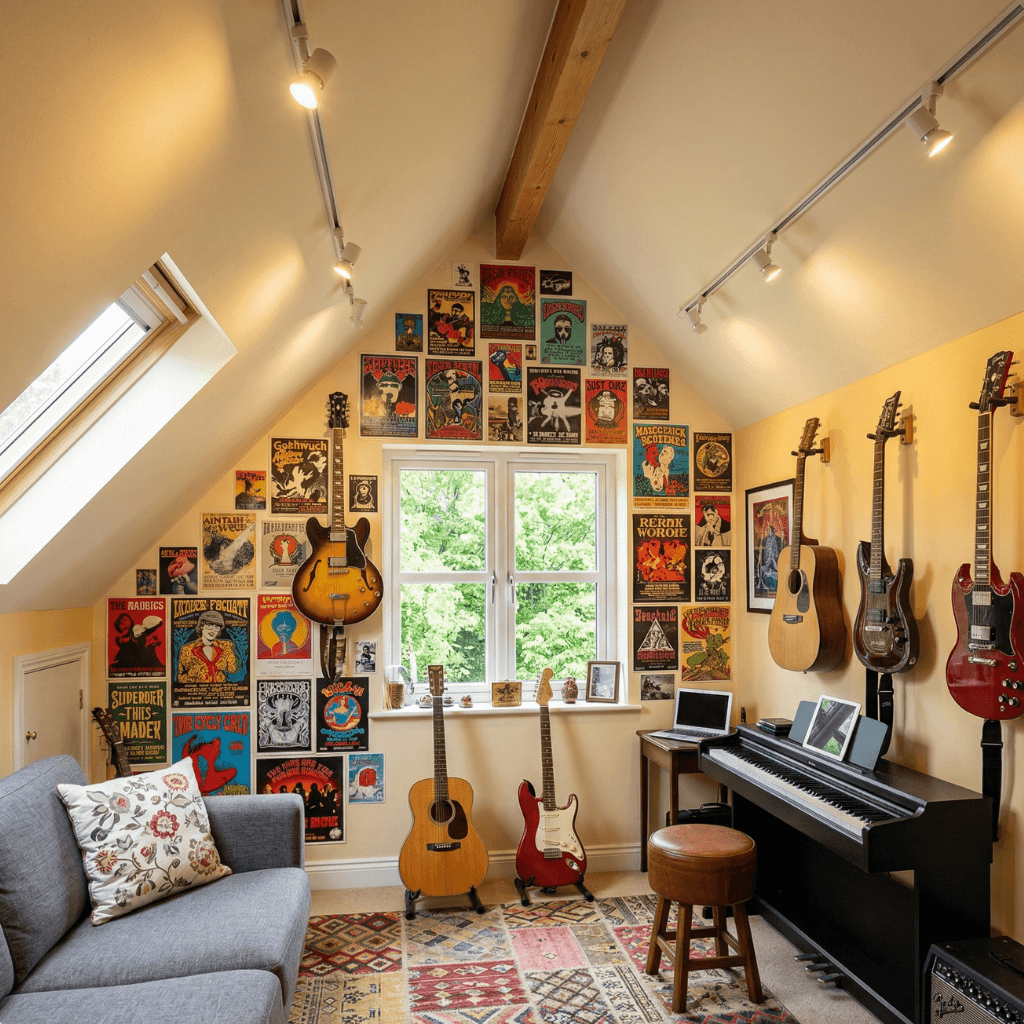
Creative Space for Musicians: How to Build Yours (Physical and Digital)
Every musician needs a creative space. A place where ideas flow, where you can experiment without judgment, and where your work-in-progress gets a home. But when most musicians think of a "creative space," they picture a physical spot: a home studio, a living room corner with a guitar and a notebook, or an acoustically treated room with a microphone.
That physical space is important. But it’s only one part of the equation.
Because you can have the most beautiful studio in the world and still lose ideas in nameless voice notes. You can have a perfect writing corner and still fail to find the lyric you wrote last week because it\'s buried in a WhatsApp chat. You can have all the gear you need and still feel like something is missing every time you sit down to create.
What’s missing isn’t a piece of furniture or a microphone. What\'s missing is a complete creative space: the sum of your physical environment, your tools, your digital system, and your mindset. If one of those pieces fails, the rest suffer. And the piece most musicians neglect—by far—is the digital one.
This guide will help you build your creative space from scratch, covering the four dimensions you need to make songwriting easier, smoother, and more productive.
What a Creative Space Actually Is
A creative space isn\'t a place. It\'s a system.
It\'s everything that surrounds your songwriting process and makes it possible. You can write on a bus if you have the right tools and a system to capture and organize what you create. And you can have a professional recording studio and write nothing at all if you lack mental clarity or a method to manage your ideas.
A real creative space has four dimensions. They all matter. None work well without the others.
1. Physical space: where you write. Your corner, your room, your studio. The environment that tells your brain "it\'s time to create."
2. Tools: what you write with. Your instrument, your recorder, your way of writing lyrics. The bare minimum you need to turn an idea into something audible.
3. Digital space: how you organize what you create. Where your recordings, lyrics, and projects live. The system that connects all the pieces of a song and lets you return to them with context.
4. Mental space: the state of mind you write in. Your routine, your mindset, your relationship with imperfection and the process.
Let’s dive into each one.
Physical Space: Your Songwriting Corner
You don\'t need a professional studio to write songs. You need a place where your brain knows it\'s time to create. It can be an entire room or just the corner of a desk. What matters isn\'t scope or gear. It\'s the mental association: when you are there, you write.
The Essentials
Keep your instrument accessible. If every time you want to write you have to pull your guitar out of its case, find a cable, plug in the amp, and hunt down a pick, you\'ve lost half your inspiration before playing the first note. Your main instrument should always be within arm\'s reach. If it\'s a guitar, keep it on a stand. If it\'s a keyboard, keep it turned on or ready to light up in seconds. Friction kills creativity.
Cut out distractions. You don\'t need to soundproof the room. But keeping the space free from obvious interruptions helps. If you write with your phone next to you buzzing with notifications, your focus will be constantly fragmented. Many musicians use "Do Not Disturb" as part of their writing ritual—a small habit with a massive impact.
Basic comfort. A chair you can sit in for an hour without pain. A reasonable temperature. Lighting that won\'t give you a headache. It sounds obvious, but many musicians write in uncomfortable setups and wonder why their ideas aren\'t flowing. Your body matters just as much as your mind during the creative process.
What You Do Not Need
You don\'t need acoustic treatment to write (save that for recording and mixing). You don\'t need studio monitors (a decent pair of headphones is plenty for the writing stage). You don\'t need a dedicated room if you don\'t have one. Steve Lacy wrote much of a Grammy-nominated album on his iPhone. Physical space helps, but it\'s rarely the bottleneck. Your ideas won\'t wait for the perfect studio.
Tools: The Minimum Needed to Write
An entire industry is built on convincing you that you need more gear to make better music. One more plugin. A better mic. A new MIDI controller. A more powerful DAW. While some tools make a real difference, most musicians have more gear than they actually use and fewer finished songs than they’d like.
Creative minimalism works. Fewer tools mean less friction. Less time setting up, more time creating. Fewer technical decisions, more musical choices.
The Essential Songwriting Kit
An instrument (or your voice). An acoustic guitar, a piano, a ukulele, your voice, or even beatboxing. You just need something that makes sound so you can explore melodies, chords, and rhythms.
A way to record. A phone voice recorder works fine for quick ideas. If you want better quality, a basic USB mic hooked up to your phone or computer is enough for the writing phase. Remember: you are capturing ideas, not final masters.
A way to write. A physical notebook or a notes app—whatever lets you jot down lyrics, chords, and song structure. The format matters less than the habit.
A way to organize. This is where most musicians fall short. They have the instrument, the recorder, and the notebook. But they lack a system to tie these pieces together. Recordings go one place, lyrics to another, chords to another. Within a week, nobody knows what belongs to what.
"Making the simple complicated is commonplace; making the complicated simple, awesomely simple, that\'s creativity." — Charles Mingus
The tool that impacts your creative process the most isn\'t the most expensive or powerful one. It\'s the one that creates the least friction between your brain and the draft.
The Digital Space: Where Most Musicians Fail
Here is the blind spot—the creative space dimension almost nobody talks about, and almost everyone gets wrong.
Your digital space is where your musical ideas live once captured. It\'s where they are stored, organized, connected, and developed into complete songs. For the vast majority of musicians, this space is pure chaos.
The Diagnostic
Ask yourself these questions:
Could you find the recording of that melody idea you had two weeks ago right now?
Do you know which lyric goes with which melody?
Can you see at a glance how many songs you have in progress and where each one stands?
If a bandmate asks "what are we working on?", can you answer without digging through folders for 10 minutes?
If the answer to any of these is no, your digital space needs work.
The Real Problem
The issue isn\'t capturing ideas. Most musicians record voice memos, jot down lyrics, and scribble chords constantly. The problem is that everything is scattered: audio goes to Voice Memos, lyrics to Apple Notes, chords to Google Docs, and band-shared files to WhatsApp.
Each of these apps works well for its specific purpose, but none were built to manage a musical project. A song in progress is exactly that: a project with multiple moving parts (audio, lyrics, chords, notes, references) that need to live together to make sense.
When those elements are split across five different apps, you lose three crucial things:
Context. A 30-second recording in Voice Memos has no context on its own. What song was it for? What lyric goes over it? Was it the verse or the chorus? Without context, that recording is noise. With context, it\'s the start of a song.
Continuity. If you have to spend the first 15 minutes of every writing session locating your previous drafts, you start with drained energy. That time goes to searching instead of creating. Those first 15 minutes are critical for getting into a flow state.
Visibility. Without a clear overview of your creative work, you can\'t prioritize. Which songs are almost done? Which ones have been stalled for weeks? Which ones deserve your focus? Without visibility, you\'re working in the dark.
The Difference Between Storage and a Workspace
Google Drive is storage. You upload files there. Same with Dropbox and Voice Memos. They are containers. You throw things in and hope to find them later.
A creative workspace is different. It’s a place where you work, not just store. Where a song\'s elements live together with context. Where you can see the progress of each project. Where you can open a track and find its audio, lyrics, and notes in the exact same place without switching apps.
The difference is subtle but has a massive impact on your creative output. It\'s like having raw ingredients in the fridge versus having them chopped and prepped on the counter. You have the same assets, but one setup gets you cooking in 5 minutes while the other takes 30.
Many musicians think they suffer from lack of inspiration. In reality, they just can\'t access the inspiration they already had. The ideas are there. They just need a place to meet.
Mental Space: Guarding Your Creativity
The fourth dimension of creative space isn\'t about gear or organization. It\'s about you.
Your mental state when you sit down to write determines your output. While you can\'t command inspiration, you can set up the conditions for it to show up more often.
Routines and Rituals
Many pro songwriters have starting rituals—not out of superstition, but because rituals signal the brain that "it\'s time to create." It can be as simple as making a coffee before sitting down, playing a specific playlist for the first 5 minutes, or taking your time tuning your instrument to transition from "daily life" mode to "writing" mode.
The ritual itself doesn\'t matter. Repetition does. Your brain links the ritual to the creative act and gets you in the zone faster.
Separate Creating from Editing
This is a powerful creative rule and one of the hardest to practice. When creating, just create. Don\'t judge, edit, or delete. Record everything, write down everything, let it out. When editing, edit. Listen critically, trim, improve, and reorganize.
Most musicians try to do both at the same time. They record a vocal line, listen back, think "that\'s not good enough," delete it, and start over. This loop drains energy and kills momentum. By separating the two phases (creating first without filters, editing later with standards), you produce more and better material.
Embrace Imperfection
Your first draft doesn\'t need to be good. It just needs to exist. Songs don\'t start out perfect. They start raw, messy, and half-baked. Your job is to shape them, not to wait for them to arrive fully formed.
Leonard Cohen spent years writing "Hallelujah," going through dozens of drafts. If he had judged the first version against the final cut, he would have abandoned it. Embracing imperfection isn\'t about lowering your standards; it\'s about knowing that quality comes through iteration, not on the first try.
How Zoundroom Becomes Your Digital Creative Space
We\'ve mapped out the four dimensions of creative space. The physical (first) and mental (fourth) rely on you. The tools (second) involve your instrument and method. But the third—the digital space—needs a solution built specifically for musicians. That\'s where Zoundroom comes in.
Zoundroom isn\'t raw storage, a DAW, or a generic notes app. It\'s a creative workspace where each song is a project housing all its parts together: audio recordings, lyrics, chords, structural notes, and band feedback. Everything in one place, connected and accessible.
What Changes with a Real Digital Space
Every idea has context from its birth. Record directly into a project and that audio stays tied to it. No more losing drafts in generic lists. You know exactly what song it belongs to, what lyrics match it, and what stage it’s in.
See the status of all your music in progress. Each project has a status: idea, in development, or ready to produce. At a glance, you know what you are holding, what needs work, and what is ready. It\'s a dashboard for your creativity.
Audio and lyrics live together. Not in separate apps. Not in scattered files. Side-by-side in the same project, allowing you to listen to your melody while tweaking lyrics to see if they fit. The way it always should have been.
Pickup where you left off in seconds. Open Zoundroom, load your project, and everything is right there. No searching for files or guessing which lyric draft was the latest. Jump straight into creating.
Seamless band collaboration. The Band plan creates a shared space where team members access the same projects. Ideas are shared with context, not as loose audio links in a chat. When you arrive at practice, everyone is already on the same page.
Get unblocked with built-in AI. Zoundroom\'s AI assistant sits right inside your projects to suggest chords, assist with lyrics, or pitch structural changes. It doesn\'t write for you; it gives you options so you can call the shots. It\'s a tool for your creative workflow, not a replacement for your voice.
FAQ: The Musician\'s Creative Space
Do I need a home studio to write songs?
No. A home studio is great for tracking and production, but for songwriting all you need is an instrument, a way to capture ideas, and a digital/physical space to organize them. Plenty of hits were written on a couch with an acoustic guitar and a phone.
How much should I invest in my creative space?
As little as possible at first. An instrument you already own, your phone recorder, and Zoundroom\'s free plan are enough to start writing with an organized workflow. Upgrade your gear as your process demands it, not before.
Is it better to write in the same place every time?
Writing in the same spot helps train your brain to get into the zone faster. However, don\'t limit yourself. Great ideas strike anywhere—on the train, in a park, or in the kitchen. Just make sure you can capture them on the go, which is why having your digital space on your phone is essential.
How do I organize my scattered ideas?
Set aside 30 minutes to take inventory. Scan Voice Memos, Notes, WhatsApp, Google Drive, and anywhere else you\'ve saved drafts. Group pieces belonging to the same song and move them into a single organized workspace. This one-time cleanup will save you months of future headache.
Does a digital space replace physical notebooks?
Not necessarily. Many writers use both. Physical notebooks are great for screen-free writing and sketching ideas. But paper can\'t play audio, sync across devices, or let you collaborate with your band. A digital space complements your physical tools; it doesn\'t replace them.
Your Music Needs a Home
A complete creative space is a necessity, not a luxury. It\'s what turns a shower hum into your next chorus. It\'s what connects Tuesday\'s lyric line with Thursday\'s guitar riff. It\'s what lets you sit down and immediately start creating, instead of searching.
The physical side is up to you. The mental side comes with practice. The digital side comes down to the tools you choose.
Choose wisely.
Get Zoundroom for free and build the creative space your music deserves.