Minimalist home studio for songwriting: what you need (and what to skip)
A minimalist home studio for songwriting doesn't require a €2,000 gear budget. Here is exactly what you need to write and record songs at home—and what you can safely ignore.
Eliseu Bellés · Founder of Zoundroom. Musician and entrepreneur from Valencia. I am building Zoundroom so musicians stop losing their best ideas.
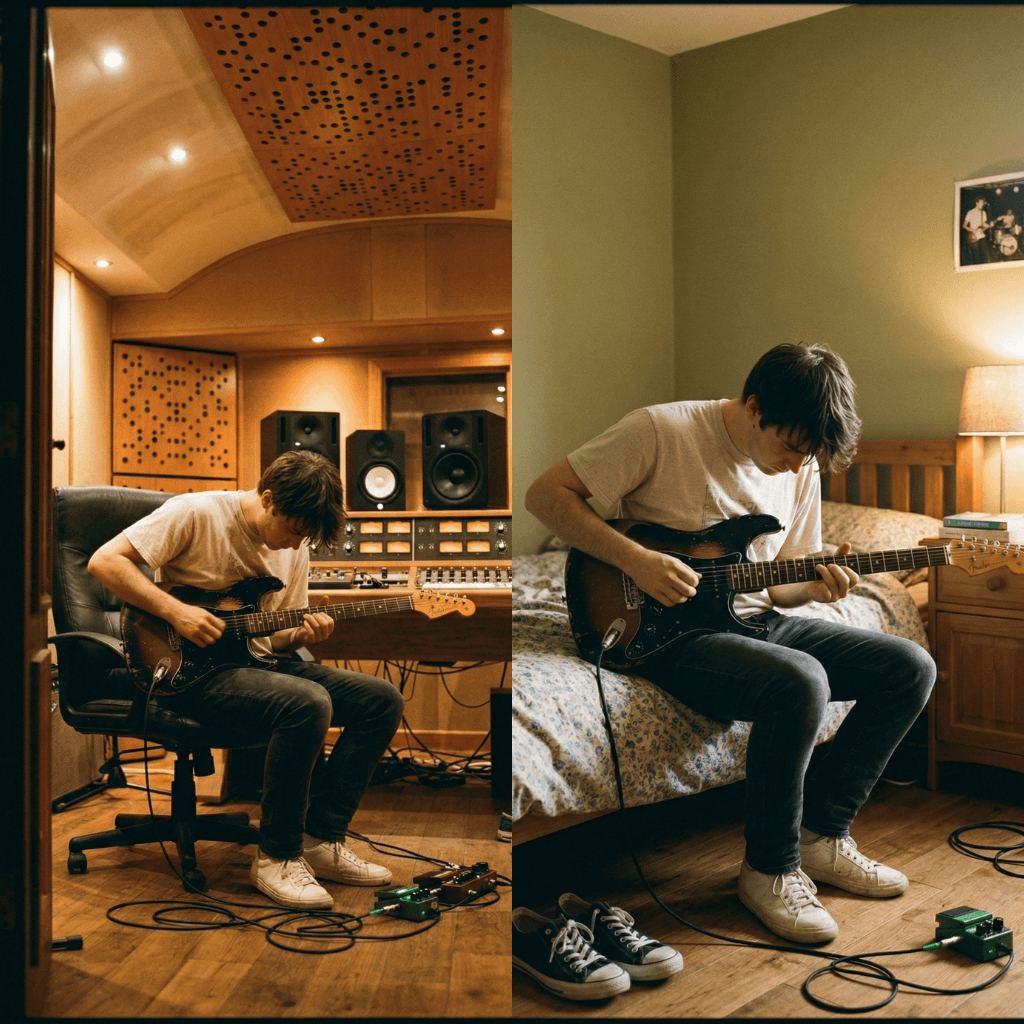
Minimalist Home Studio for Songwriting: What You Actually Need (and What You Don't)
If you search "how to build a home studio" online, you will find endless lists of gear: audio interfaces, studio monitors, acoustic treatment, large-diaphragm condenser mics, XLR cables, boom arms, pop filters, mixing boards... And before you even reach the end of the article, you are already thinking you need €2,000 and a spare room just to make music at home.
But there is a problem with all those guides: they are written for producing and recording. Not for songwriting.
And songwriting is not production. They are different phases of the musical process with completely different needs. Producing a song requires audio quality, an acoustically controlled environment, and mixing/editing tools. Writing a song requires an instrument, a way to capture ideas, and a physical and mental space to think clearly.
If you want to write songs — generate ideas, explore melodies, write lyrics, structure your music — you need much less than the internet tells you. This guide is for you. A minimalist home studio for songwriting, designed to get you creating without excuses, without debt, and without spending more time gear shopping than writing songs.
Writing Is Not Producing (and They Don't Need the Same Gear)
This distinction is the most important part of this article. If you get this, you will save hundreds of euros and months of procrastination disguised as "preparation."
Songwriting is the act of creating the song: finding the melody, writing the lyrics, defining the chord progression, deciding on the structure, exploring ideas. It is a creative process you can do with an out-of-tune guitar on a couch. The idea is what matters, not the audio quality.
Production is the act of turning that song into a finished recording: tracking every instrument with quality, mixing levels, adding effects, mastering so it sounds good on any speaker. It is a technical process that does require specific gear.
90% of home studio guides mix both phases and sell you production gear as if it were necessary from day one. It isn't. If you don't even have finished songs yet, a €300 microphone won't help you. What will help you is sitting down to write with the bare essentials.
Many of the most successful songwriters in history wrote their songs with a piano and a notebook. Or with a guitar and a tape recorder. Or, more recently, with an iPhone and headphones. Steve Lacy produced much of his album "Steve Lacy's Demo" on an iPhone using GarageBand. Billie Eilish and Finneas wrote "When We All Fall Asleep, Where Do We Go?" in a small bedroom with modest gear. The gear doesn't make the song. You make the song.
"I started making music with an iPod Touch and GarageBand. I realized I didn't need what I thought I needed." — Steve Lacy
The Essential Kit: What You Actually Need to Write
This is all you need to sit down and write songs today. No purchases. No excuses.
Your Main Instrument
The instrument you play. Acoustic guitar, electric guitar (unplugged is fine if needed, it is quiet but audible), piano, keyboard, ukulele, your voice, a makeshift drum pattern tapped on the desk. Whatever you use to explore music. If you already have an instrument at home, you already have the most important part.
If you don't play an instrument, your voice is an instrument. Humming melodies, improvising rhythmic phrases, singing chorus ideas. Many professional songwriters compose by humming before playing a single note on an instrument.
A Decent Pair of Headphones
You do not need studio monitors. For songwriting, normal headphones of decent quality are enough. The ones that came with your phone can work to capture quick ideas. If you want something better, closed-back mid-range headphones (between €30 and €60) are more than enough for this phase.
Why not monitors? Because studio monitors are designed for analytical listening: spotting mix issues, evaluating frequency balance, checking stereo panning. That is production, not writing. When you are writing a song, you do not need analytical precision. You need to hear your idea well enough to decide if it works.
Your Phone as a Voice Recorder
This is the hardest point to accept, but it is the truth: your phone is enough for the songwriting phase. The built-in voice recorder captures ideas with more than acceptable quality to evaluate a melody, a riff, or a vocal line. You are not tracking the master. You are capturing the spark.
The advantage of the phone is that you always have it on you. Ideas do not hit when you are sitting in a studio. They hit on the bus, in the shower, at 3 AM. If your capture tool is a condenser mic connected to an audio interface connected to a computer, you will lose 80% of your ideas. If your capture tool is your phone, you do not miss any.
An App to Keep Your Projects Organized
This is where most home studio guides fall short: they tell you what to buy but not how to organize what you create. Without organization, ideas pile up, get lost, and never become songs.
You need a place where each song is a project with its recordings, lyrics, chords, and notes kept together. Not scattered between Voice Memos, Google Keep, WhatsApp, and a Drive folder you haven't opened in weeks.
Zoundroom is designed exactly for this. It is a creative workspace where everything belonging to a song lives together. Capture an idea with the built-in recorder and it is linked to the project. Write lyrics right next to the audio. Track the status of each song. When you sit down to write, everything is there, with context, ready for you to keep working.
The Free plan has all the essentials. You don't need to pay anything to start.
An Instrument Stand
This seems like a minor detail but it has a huge impact. If your guitar is in its case in the closet, the friction between "I want to write" and "I am writing" is several minutes. If it is on a stand right next to your chair, the friction is 2 seconds: you grab it and play.
A basic stand costs between €10 and €20. It is probably the setup upgrade with the best return on investment on this list.
Essential Kit Summary
Item | Do you have it? | Cost if you don't |
|---|---|---|
Your Instrument | Probably yes | Variable |
Decent Headphones | Probably yes | €0-60 |
Your Phone | Yes | €0 |
Zoundroom (Free plan) | Download | €0 |
Instrument Stand | Maybe not | €10-20 |
Minimum Total | €10-20 |
That is your home studio for writing. Everything else is optional.
What You Can Add Later (When Your Workflow Demands It)
If you have been writing with the essential kit for a while and feel like you need more, here is the next level. Do not buy everything at once. Add each piece only when your workflow demands it, not before.
A Basic USB Microphone (€50-80)
If you want your voice memo quality to sound better than a phone microphone. A USB mic plugs directly into your computer or phone without needing an audio interface. For the writing and demo phase, it is more than enough.
Popular options at this price: Samson Q2U (dynamic, very versatile), Fifine K669 (condenser, cheap and functional), or the Rode NT-USB Mini if you can stretch your budget slightly. Any of these will give you a noticeable quality boost over your phone mic.
A Compact MIDI Keyboard (€60-100)
If you don't play piano but want to explore harmonies, a small MIDI keyboard (25-32 keys) connected to your computer or tablet lets you try out chords and melodies without needing to master the instrument. It is not for live performance. It is for exploration.
It is also useful if you compose with software: you can use the keyboard to trigger sounds, program drums, or write basslines and synth parts.
Good options: Akai LPK25, Arturia MiniLab, or the Korg nanoKEY.
An Entry-Level Audio Interface (€100-130)
If you want to plug an electric guitar or an XLR condenser mic into your computer with clean quality. The interface converts the analog signal of your instrument into a digital signal your computer can record. It is the bridge between the physical and digital world.
The Focusrite Scarlett Solo is the industry standard for entry-level home studios. But remember: for pure songwriting, it is not essential. It only makes sense if you want to record demos at a higher quality than a USB microphone offers.
Studio Headphones (€80-120)
If you want to hear your ideas in greater detail and start making decisions about dynamics and tone. The Audio-Technica ATH-M50x are a classic for a reason. The Beyerdynamic DT 770 Pro are another solid option. But again: for songwriting, your regular headphones work fine.
Second Tier Total Budget
Item | Estimated Cost |
|---|---|
USB Mic | €50-80 |
Compact MIDI Keyboard | €60-100 |
Audio Interface | €100-130 |
Studio Headphones | €80-120 |
Total (if buying everything) | €290-430 |
Do not buy everything at once. Add as you go. If you are a singer-songwriter with an acoustic guitar, the USB mic is your first upgrade. If you are an electronic songwriter, the MIDI keyboard. Adapt to your process.
What You Do NOT Need for Songwriting (Despite What Guides Tell You)
This is the section that will save you the most money. These are things that show up in every home studio guide but are absolutely not needed for the songwriting phase.
Studio Monitors
Studio monitors (reference speakers) are designed to reproduce audio flatly and accurately. They are tools for mixing and mastering. For writing, you do not need them. Listening to a song idea on €40 headphones gives you all the information you need to decide if the melody works, if the lyrics fit, and if the structure makes sense. Monitors will matter when you move to production. Not before.
Acoustic Treatment
Acoustic panels, bass traps, diffusers. All of this is used so your room doesn't add false room resonances to what you hear, which is key for a flat mix. For writing, your room exactly as it is now is perfectly fine. If you hear your chord progression and it sounds good on headphones, it sounds good.
A Professional DAW
Logic Pro, Ableton, Pro Tools, FL Studio. These are incredibly powerful production tools. But for the songwriting phase, they are like using a moving truck to buy groceries. Too much power, too many options, too much complexity for what you need: capturing an idea, writing lyrics, and deciding if the song works.
If you already have a DAW and feel comfortable in it, use it. But if not, you do not need one to start writing. Your phone recorder and an organized project workspace are plenty.
High-End Condenser Microphones
High-end condenser mics (Neumann, AKG, high-end Rode) are professional recording tools. They capture nuances training ears appreciate in a final mix. For recording an idea at 2 AM because you just came up with a chorus, they are completely unnecessary. Your phone mic captures the idea. That is what matters in this phase.
A High-Powered Computer
For production with heavy plugins, virtual instruments, and multi-track sessions, yes, you need processing power. For songwriting, no. Your phone or a tablet is more than enough. In fact, writing on your phone has an advantage: it is always on you. The most powerful computer in the world won't help if an idea hits you while you are on a train.
The best songwriting tool is the one you have with you when inspiration strikes. Not the one sitting in your studio waiting for you to get home.
How to Organize Your Physical Space for Free
Gear matters, but how you locate it does too. Here are rules that cost nothing but immediately improve your writing experience.
The 5-Second Rule
If starting to record an idea takes more than 5 seconds, your setup has too much friction. Measure the actual time from when you think "I want to record this" to when you are recording. If you have to power something on, open a program, create a project, select an input... every second of friction is an opportunity for the idea to slip away.
With your phone and Zoundroom, capture time is 2-3 seconds. Open the app, hit record, done. That immediacy is your best ally.
Keep Your Instrument Visual and Accessible
Put the case away. Place your guitar on a stand where you can see it and grab it with ease. If you play keys, keep them on or ready to power up instantly. The visibility of the instrument is a constant invitation to play. A zippered case in a closet is a barrier.
A Dedicated Writing Corner
You do not need a dedicated room. A corner of your bedroom, one side of the dining table, even a stool by the window. What matters is that it is always the same spot. Your brain associates space with activity. After a few weeks of writing in the same corner, sitting down there will trigger the signal: "it is time to create."
Kill Obvious Distractions
Set your phone to 'do not disturb' (except for your recorder app). Keep your computer screen off if you don't need it. If you share your space, let others know you need uninterrupted time. It sounds obvious, but most musicians write with WhatsApp open, emails coming in, and a YouTube tab open. Creativity requires mental space.
3 Minimalist Home Studio Setups That Actually Work
To see how this applies in practice, here are three real-world setups based on musician profiles.
The Acoustic Singer-Songwriter
What they have: Acoustic guitar on a stand. Phone with Zoundroom. Normal headphones. A cozy chair in a quiet corner.
How it works: They sit down, grab the guitar, open Zoundroom. They record an idea using the built-in recorder. They write lyrics inside the same project. They set the status ("idea" or "in progress"). When they have several ideas saved, they dedicate a session to review and develop them.
Extra cost over what they already owned: €0 (Zoundroom Free plan + guitar stand they already had).
What they get: An organized system where every song has its place. No lost ideas in Voice Memos. No scattered lyrics in random phone notes. Everything together, in context.
The Bedroom Songwriter
What they have: Arturia MiniLab MIDI keyboard (€80). Samson Q2U USB Mic (€60). Audio-Technica ATH-M40x headphones (€90). Laptop. Phone with Zoundroom.
How it works: They play chord progressions on the MIDI keyboard with a basic piano plugin. When they find something promising, they track a quick placeholder vocal using the USB mic. Initial ideas are captured on the phone with Zoundroom. More structured demos are worked on inside the laptop. Their entire project catalog (which songs exist, status, lyrics, notes) lives in Zoundroom.
Total gear investment: ~€230 (not counting the laptop and phone they already owned).
What they get: A setup that allows them to explore deeper harmonic ideas with keys and better placeholder vocal quality, without the bloat of a full production suite.
The Remote Collaborating Band
What each member has: Their instrument. Their phone with Zoundroom Band. Headphones.
How it works: Each member records ideas as inspiration hits and uploads them to the band's shared space in Zoundroom. The guitarist tracks a riff on Tuesday. The singer listens on Wednesday and tracks a vocal line over it. The bassist adds a groove on Thursday. By the time they reach rehearsal on Saturday, the song already has shape. Rehearsal is spent playing it, not trying to figure it out from scratch.
Extra cost per member: Zoundroom Band plan.
What they get: Steady progress on songs between sessions. No more relying on a messy WhatsApp chat to manage files. Every idea has home, context, and is accessible to the whole band.
Minimalist Home Studio FAQ
Can I write professional songs with such a basic setup?
Yes. The quality of a song does not depend on the gear used to write it. It depends on the melody, the lyrics, the harmony, structure, and the emotion it conveys. All of that comes from your mind and your instrument, not an audio interface. When the song is ready and you want to produce it, then you can invest in recording gear or go to a professional studio.
When should I upgrade from the essentials to the next tier?
When your current workflow demands it, and not before. If you've spent weeks writing with your phone recorder and feel the audio quality is actively holding you back from enjoying or evaluating your ideas, it is time for a USB mic. If you want to explore chord structures that your main instrument doesn't allow, grab a MIDI keyboard. Buy what you need, not when the internet tells you that you "should have" it.
Do I really not need a DAW to write?
For writing, no. For producing, yes. If your process is writing songs with voice and instrument, a recorder and an organized space are all you need. If you want to start building multi-instrument tracks, then exploring a DAW like GarageBand (free on iOS/Mac), Audacity (free), or Reaper (budget-friendly) makes sense.
Can I start today without buying anything?
Yes. If you have an instrument (or your voice) and a phone, you have everything. Download Zoundroom, record your first idea, add some lyrics, and organize it in a project. Your minimalist studio already exists. It's in your pocket.
Gear Doesn't Write Songs. You Do.
There is a very common syndrome among musicians called GAS: Gear Acquisition Syndrome. It is the belief that the next piece of gear, the next plugin, or the next microphone is what will finally unlock your creativity. It is a myth. What unlocks creativity is sitting down to write.
The best home studio for songwriting isn't the one with the most gear. It is the one with the least friction. The one that lets you go from "I have an idea" to "I'm recording" in 5 seconds. The one that keeps your songs organized and accessible. The one that invites you to create every time you look at it.
Start with the bare minimum. Write. Add tools only when your workflow demands it. And above all: don't let preparation become the perfect excuse to not start.
Download Zoundroom for free and build your creative space today. No excuses. No overspending.