Songwriting: Go paper or digital?
Paper or digital for writing lyrics? We analyze both methods, their real advantages, and how to make sure you never lose a lyric, whichever format you choose.
Eliseu Bellés · Founder of Zoundroom. Musician and entrepreneur from Valencia. I am building Zoundroom so musicians stop losing their best ideas.
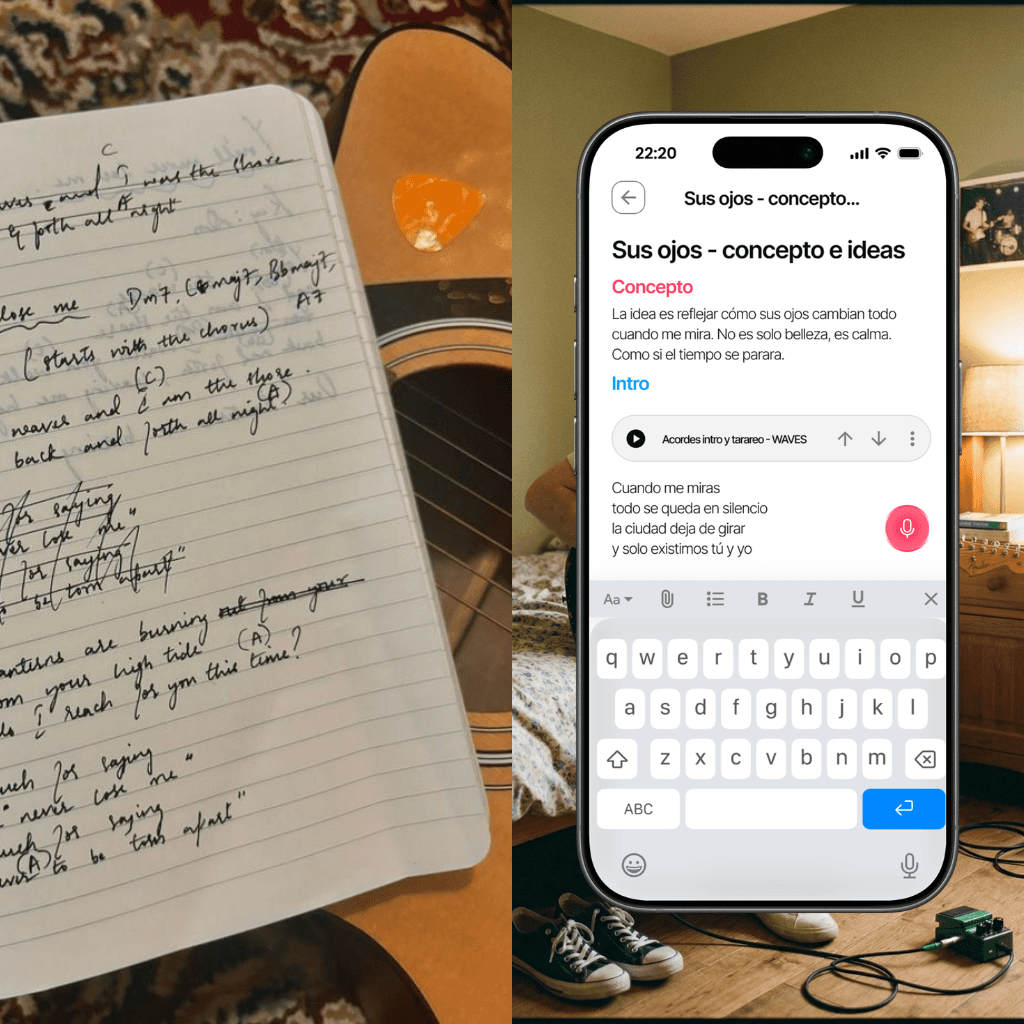
Writing Lyrics on Paper vs. Digital: The Endless Debate (and How to Never Lose Anything in Either)
Some musicians wouldn't trade their notebook for anything in the world. They have notebooks full of scratch-outs, arrows, alternate versions in the margins, and coffee stains that are already part of the song's story. For them, writing lyrics is a physical act. The weight of the pen, the sound of paper, the freedom to cross out without pressing "undo". Those notebooks are sacred objects.
And then there are musicians who write in their phone's notes app on the subway. Or in a computer document because typing is faster than writing. Or in whatever app is handy the moment a line pops into their head. For them, digital means convenience, speed, and access from anywhere.
In our conversations with bands, we find both profiles. And we find a third profile that is probably the most common: the one who uses both with no system, ending up with lyrics scattered across notebooks, phone notes, computer docs, and WhatsApp messages sent to themselves at 2 AM.
The debate isn't about which is better. Both work. The real problem is that, whatever your method, lyrics get lost with alarming frequency. And they get lost for different reasons depending on the medium.
Why Lyricists Prefer Paper
The preference for paper isn't just nostalgia or resistance to change. It has concrete reasons that consistently came up in our interviews.
Visual Freedom
Paper has no formatting. You can write diagonally, circle a word, draw an arrow connecting the second verse to the chorus, or scribble a chord next to a line. It’s a two-dimensional space where ideas are organized spatially, not linearly. A notes app is just a list of lines. A notebook is a canvas.
For songwriters who think visually (and many do without knowing it), paper allows them to map out the song's structure in a way digital text can't. You see the whole song at a glance. You see the connections between parts. You see the scratches that tell the story of how the lyrics evolved.
The Creative Ritual
Several musicians told us that the act of opening a notebook and grabbing a pen is a ritual that gets them into creative mode. It’s a physical cue that tells the brain: time to write. A phone or computer screen doesn't offer that same association because we use it for everything else: social media, email, work, entertainment. Paper is exclusively for creating.
Sentimental Value
One musician told us something that resonated deeply: "We hold onto those notebooks because all the lyrics are in there, with the edits and the terrible ideas. I don’t think they get digitized until it's time to upload them to streaming platforms."
A songwriter’s notebooks are an emotional archive. They don't just hold the final lyrics. They hold the process: the discarded versions, the ideas that failed, the moments of frustration, and the breakthroughs. That value can't be exported to a PDF.
Why Lyricists Prefer Digital
Those who write digitally also have solid reasons. And they’re not incompatible with paper.
Speed
Typing is simply faster than writing by hand. When an idea flows and you need to get the words down at the speed of thought, the keyboard wins. One musician told us they switch to the computer "because typing is just more comfortable." Physical comfort matters when you're in the zone.
Accessibility
Your phone is always with you. If a line hits you on the bus, in line at the grocery store, or while waiting for a friend, you can open a notes app and write it down before it slips away. Your notebook might be at home. Your phone isn't.
Searchability
What was that line you wrote two months ago? Digitally, you just search. On paper, you flip pages until you find it (or don't). When you accumulate dozens of lyrics and fragments, searchability becomes critical.
Easy Sharing
If you want to send lyrics to your band, from your phone it's just copy and paste. From a notebook, you have to retype it or take a photo that isn't always easy to read. Digital lyrics are born ready to share.
The Real Problem: Lyrics Get Lost in Both Formats
The paper vs. digital debate is interesting, but it hides a more urgent issue. Lyrics get lost. In both formats. For different reasons.
How Paper Lyrics Get Lost
The notebook stays at the rehearsal space. Or at a friend's house. Or in the backpack you used last month. Paper lyrics are tied to a physical object. If the object isn't with you, neither are the lyrics.
The lyrics aren't digitized until the last minute. Several musicians confirmed they don’t type up their lyrics until they need to upload them to distribution platforms. That means the lyrics live for months (sometimes years) exclusively on a medium that can get lost, wet, torn, or simply forgotten in a drawer.
There is no backup. If you lose your notebook, you lose every song inside. There’s no iCloud for notebooks. No automatic syncing. A single accident can wipe out months of creative work.
How Digital Lyrics Get Lost
Fragmentation across apps. The first verse is in your phone's Notes app. The rewritten chorus is in a Google Doc. An alternative version is in a WhatsApp message you sent to yourself. And the "final" version is in an email to your producer. Five different places for one song.
No connection to the audio. The lyrics live in a text app. The voice memo of the melody lives in recording software. The chords are somewhere else. To work on the song, you have to open three apps and mentally piece together what goes with what. If weeks pass between sessions, that connection is lost.
Version control chaos. Which is the right version of the lyrics? The one on your phone or your backup computer? The one you sent on WhatsApp, or the edit you made afterward? Without a version system, the "correct" lyrics are just whatever you happen to remember. And memory fails.
The Solution Isn't and Either/Or. It's Integration.
The paper vs. digital debate is a false dilemma. You don’t have to choose. You can (and probably should) use both. Paper for the raw creative process: writing, scratching out, drawing arrows, playing with words. Digital to make sure the lyrics survive, connect with the rest of the song, and remain accessible to anyone who needs them.
The key is the bridge between both worlds. And that's where most songwriters fail. They write on paper and never take it to digital. Or they write digitally across four unconnected apps. This bridge is either broken or completely manual and tedious.
The Workflow That Works
1. Write wherever you want. Paper, phone, computer, napkin. The moment of creation shouldn't have formatting restrictions. Use whatever works for you in that instant.
2. Digitize early. If you wrote on paper, type it up before the idea cools down. It doesn’t have to be instant, but don't let weeks pass. Digital lyrics are the ones that survive, get shared, and stay searchable.
3. Connect lyrics to the project. Your lyrics shouldn't live alone in a generic notes app. They belong inside the project of the song they belong to—right next to the demo audio, chords, and structural notes. Lyrics without audio is just text. Lyrics with audio is a song.
4. Keep the notebook as an archive. Paper has emotional and historical value worth preserving. But not as your primary working copy. Paper is the sacred draft. Digital is the working version. Both coexist.
How Zoundroom Integrates Lyrics into Your Creative Process
Zoundroom isn't an app just for writing lyrics. It's a workspace where lyrics live alongside everything else that makes a song.
Lyrics and audio in the same project. Every song in Zoundroom has a dedicated lyrics space right next to your audio recordings. No separate apps. No scattered files. Together. You can listen to the melody while reading the lyrics to see if they fit. That is how songs are written.
Accessible from any device. The lyrics you write on your phone at 2 AM are ready when you open Zoundroom from anywhere else. No dependency on a physical notebook or texting yourself on WhatsApp.
Connected to the context. Your lyrics don’t float in isolation. They are inside a project containing audio, chords, arrangement notes, and band feedback. When you open the song, everything is there. The entire creative context in one place.
Compatible with paper. If you prefer to write on paper and digitize later, Zoundroom is the natural destination. Open the project, type (or paste) your lyrics, and they are instantly linked to the rest of the song's elements.
If you're in a band, the Band plan lets all members see the active lyrics in real-time. No more "can you text me the latest lyrics?" on WhatsApp. The lyrics are in the project. Everyone sees them. Everyone can contribute.
Frequently Asked Questions
Does Zoundroom have an advanced text editor for lyrics?
Zoundroom doesn't aim to replace your favorite text editor or notebook. It's the hub where the finished (or in-progress) lyrics live alongside the song's audio and chords. If you need advanced writing tools (rhymes, thesaurus, syllable counters), use them separately and bring the results into Zoundroom.
Should I stop writing on paper?
No. If paper works for your creative flow, keep using it. Many great songwriters write by hand, and it's a perfectly valid method. Just make sure to digitize your lyrics before too much time passes, so you don't rely solely on a physical object that could get lost.
How do I manage different versions of a lyric?
The current version of your lyrics should always be active inside your Zoundroom project. If you want to keep older versions for reference, you can add them as notes within the same project. That way, you have your working draft and your history in one organized spot.
What if I write lyrics and music separately?
That's incredibly common. Many writers create lyrics without music and melodies without lyrics, then bring them together. Zoundroom allows you to start projects with only lyrics (no audio) or only audio (no lyrics) and add the missing pieces when you have them. You don't need everything finished to start a project.
Your Lyrics Deserve Better Than a Voice Memo and a Lost Notebook
It doesn't matter if you write with a Parker pen in a leather Moleskine or with your thumb in a notes app at 3 AM. What matters is that the lyrics don't get stuck there. Let them find their melody. Let them live inside the song they belong to. Make them accessible to you and your band when you need them.
Paper and digital aren't enemies. They are allies when connected. But that connection doesn't happen on its own. It needs a place where lyrics, audio, and chords live together.
Download Zoundroom for free and give your lyrics the home they deserve: right inside the song.