Band Music Feedback: How to Give Critiques That Actually Improve Your Songs
Giving musical feedback in a band is harder than it looks. Here is your practical guide to giving and receiving feedback that actually improves your songs—without ruining your band's chemistry.
Eliseu Bellés · Founder of Zoundroom. Musician and entrepreneur from Valencia. I am building Zoundroom so musicians stop losing their best ideas.
Giving musical feedback in a band: why it doesn't work on WhatsApp and how to do it right
You send a demo to the WhatsApp group. You are proud of what you have done. You have dedicated hours to it. You hit send and wait.
Silence.
A little heart. A thumb up. "Cool." And nothing else.
Three days go by. You still don't know if the song works, if the chorus is catchy, if the lyrics of the second verse are too literal, if the bridge needs another chord. Nobody says anything concrete. And you don't know if it's because the demo is perfect, because it's horrible, or because nobody has listened to it yet.
Two weeks later, a band member suddenly drops 15 observations about the song. All piled up. All together. "The verse is fine but the pre-chorus melody doesn't convince me, the bass at minute 1:20 should be slower, the bridge lyrics sound forced, what if we try in a minor key?" Fifteen ideas that would have been useful two weeks ago, when you still had the song fresh in your head and the energy to work on it.
If this sounds familiar, you are not the only one. In our conversations with bands, feedback emerged as one of the biggest friction points in the creative process. Not because musicians don't have opinions. But because they don't have a system to express them in a useful way.
The 4 problems of musical feedback via WhatsApp
Feedback is what turns an idea into a song and a demo into a production. Without feedback, each member works in their own bubble. With bad feedback, the band wastes time, energy, and motivation. This is what happens when feedback is managed via WhatsApp.
1. The initial silence that kills momentum
This is the most common pattern we found in our interviews. Someone sends a demo and the band doesn't react. It's not that they don't care. It's that listening to a demo closely takes time and focus, and the moment the audio arrives, most are doing something else. "I'll listen to it later." Later becomes tomorrow. Tomorrow becomes next week. And next week, the message has 150 other messages piled on top of it.
Silence is not indifference. It is friction. But for the musician who sent the demo, it feels exactly like indifference. And that erodes the motivation to keep sharing.
One musician described it to us with frustration: he sends the demos and receives little hearts. Nothing else. And when real feedback finally arrives, it's a late bombardment that generates more overwhelm than clarity.
2. The impossibility of referencing a specific moment
Imagine you want to tell the guitarist that the riff in the second verse should have a different note in the third bar. On WhatsApp, you have to write something like: "In the second verse, around minute 1:20, the riff you do there, the third note I think should be a B instead of an A."
The guitarist reads the message, opens the audio, tries to find minute 1:20, doesn't know exactly which note you mean, asks you to clarify, you send another text message trying to explain something that should just be pointed at, and the conversation drags on for 10 messages for something that would be solved in 5 seconds in person.
WhatsApp doesn't have timestamps on audio. You can't point to a specific spot on the recording and say "here, this." You have to describe with words something that is fundamentally sound. It's like trying to give directions to a place without being able to point at the map.
3. Feedback that gets lost among messages
Even when someone gives valuable feedback, that feedback gets trapped in the timeline of the chat. "I think the bridge should repeat the verse melody but higher pitch" is a brilliant observation. But if it appears between "what time are we meeting on Thursday?" and a photo of someone's dog, it has the same chance of being read, processed, and applied as it does of being ignored and buried.
There is no way to associate a comment with the song being discussed. There is no way to see, a month later, all the feedback that was given on a specific demo. There is no history of decisions. If the band decided to change the bridge three weeks ago, where is that decision? Somewhere in the chat. Go find it.
4. The delayed avalanche that overwhelms instead of helping
The opposite pattern of silence: a member who accumulates observations for weeks and drops them all at once. Fifteen points in a single message. Or worse: fifteen consecutive WhatsApp voice notes explaining each observation.
This kind of feedback isn't bad in its content. But the way it arrives makes it almost useless. The musician who receives 15 observations at once doesn't know where to start. They don't know which ones are priorities. And they have probably already moved the song in another direction, making half of the observations no longer relevant.
Feedback is most useful when it is immediate, specific, and structured. WhatsApp, by its asynchronous and unstructured nature, generates exactly the opposite: late, vague, and piled up.
What successful feedback looks like
Before we talk about tools, it's worth defining what makes musical feedback useful. Because the problem isn't just where it is given. It's how it is given.
It is specific
"I'm not feeling it" is not useful feedback. "The chorus melody goes up on the third phrase and I think it should stay flat to build more tension" is. Specific feedback gives the songwriter something to work with. Vague feedback just brings frustration.
It is timely
The most valuable feedback is the kind that arrives when the writer still has the song fresh in their head. If you send a demo on Monday and the feedback arrives on Friday, you've already lost 4 days of context. Immediate impressions (even imperfect ones) are more useful than detailed thoughts that arrive late.
It is referenceable
Ideal feedback points out exactly what part of the song is being discussed. Not "the verse," but "the verse, second phrase, the note you play after the pause." The more precise the reference point, the less room for error in communication.
It is actionable
Every observation should be able to turn into an action. "Try the bridge in a minor key" is actionable. "I don't know, something sounds off" is not. Good feedback tells the writer what to do (or at least what to try), not just how you feel.
It is kept on record
If feedback gets lost in a chat, it might as well not exist. The band's decisions on a song should be accessible weeks or months later. "Did we decide to change the bridge or leave it?" shouldn't require someone to scroll for 5 minutes to find the answer.
What we found in our conversations with bands
In the interviews we conducted, feedback was one of the topics that generated the most frustration. Some patterns we found:
Bands where feedback is almost non-existent. One band told us their main songwriter would send demos and the rest of the group barely reacted. Not out of disinterest, but because they trusted his judgment so much they didn't feel the need to comment. The result: the songwriter worked in isolation, never knowing if the band was aligned with his direction.
Bands where feedback causes conflict. In another band, comments arrived late and accumulated, causing tension. The musician receiving 25 revisions at once felt their work wasn't valued. The ones sending the revisions felt ignored when they sent them one by one. A vicious cycle of mutual frustration.
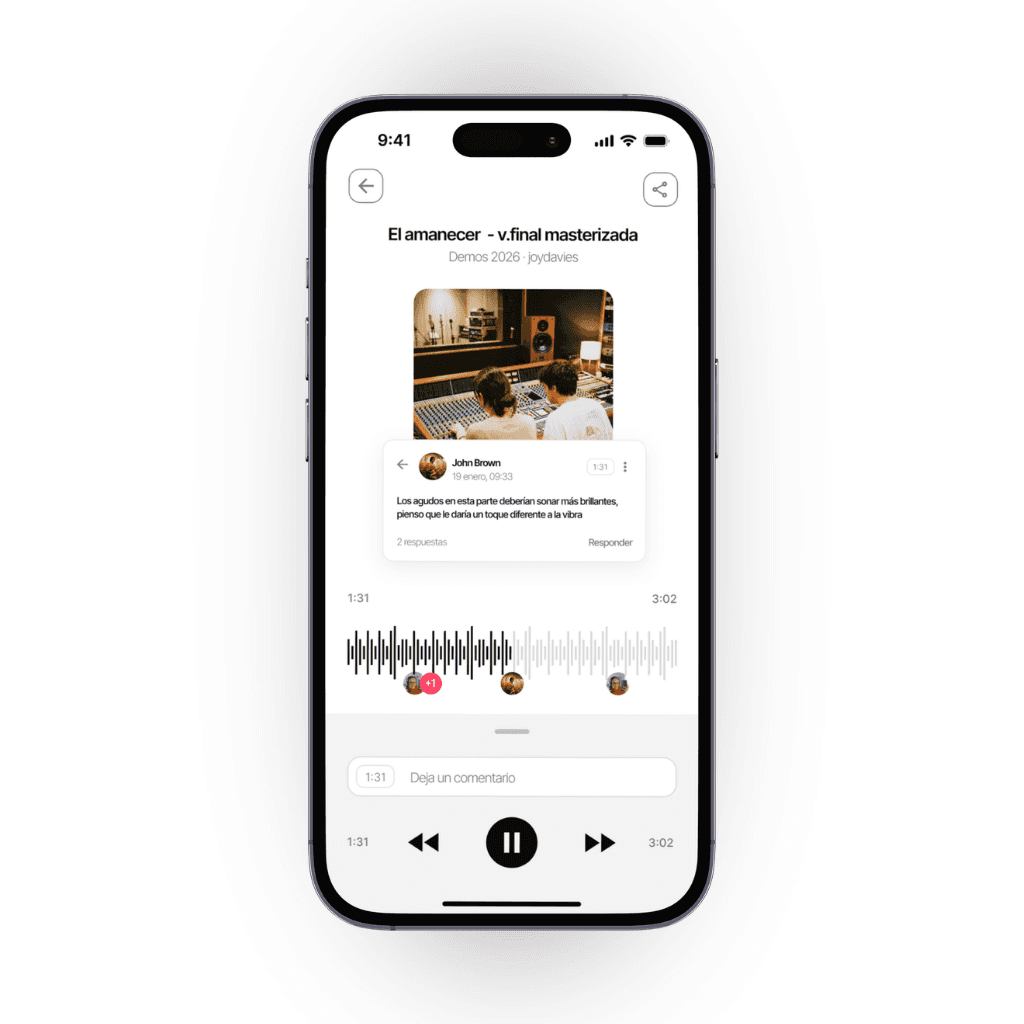
The universal desire to point to a specific part of the audio. In almost every interview, when we described the ability to leave comments pinned to a specific timestamp in the recording, the reaction was immediate and positive. "That would solve 80% of our communication problems," one musician told us. Another compared it to being able to point with your finger instead of having to describe it with words.
A preference for face-to-face feedback when possible. Several bands told us they prefer to solve feedback in person during rehearsals because it's faster and clearer. The problem is that rehearsals are once or twice a week, and things happen between rehearsals that need feedback before the next meeting.
How Zoundroom transforms your band's feedback
The feedback system in Zoundroom is designed to solve every issue we identified in our conversations with bands.
Contextual feedback inside the project. Comments in Zoundroom don't float in a chat. They live inside the project they belong to. When you open a song, you see the audio and the comments made on it. You don't have to search any WhatsApp group. Everything is together.
No mixing with logistics. Song commentary only contains song commentary. No messages about rehearsal times, memes, or photos from the last gig. The noise disappears, and the feedback becomes clear.
Accessible to all members. Any band member can see the feedback given on any project. It doesn't depend on someone forwarding it or being in the right group. The whole band sees the same thing.
History of decisions. Months after the band decided to change the bridge of a song, that decision is still there, inside the project, accessible. Not buried in a chat from 3 months ago.
5 rules for giving better band feedback (with any tool)
Regardless of the tool you use, these rules will improve the quality of feedback in any band.
1. Listen to the entire demo before commenting. Don't comment one minute after receiving it. Listen to it in full at least once. First impressions are valuable, but they need the context of the whole song.
2. Separate what you feel from what you suggest. "The bridge feels long" is an impression. "Try cutting the bridge to 4 bars instead of 8" is a suggestion. Both are useful, but the second one is actionable.
3. Prioritize. If you have 10 observations, pick the 3 most important ones. A 3-point feedback gets processed. A 10-point feedback gets ignored.
4. Be timely. A "looks good but the verse needs work" on the same day is better than a detailed analysis a week later. Speed matters more than perfect feedback.
5. Close the loop. If you suggested a change and the songwriter applied it, confirm it. "Yes, sounds much better like this" closes the loop. Without confirmation, the writer doesn't know if the change worked or if they need to keep iterating.
FAQ about musical feedback in bands
What if a member is afraid to give negative feedback?
Feedback is not personal. It is about the song, not the writer. If the band builds that culture from the start ("we critique the song, not the person"), that fear disappears. Always starting with something that works well before pointing out what doesn't helps build a safe environment.
How much feedback is too much?
If a member sends more than 5 observations on a single demo, they probably need to prioritize them. Useful feedback is feedback that can be processed in a songwriting session. If there are so many observations that the writer doesn't know where to start, it's too much.
Is it better to give feedback via audio or text?
It depends on the type of comment. For specific things ("the note in bar 3 should be a B"), text is clearer. For general impressions ("it feels dark but the chorus breaks that up"), audio works well because it captures the emotional tone. Ideally, combine both depending on the need.
What do I do if nobody gives feedback in my band?
Ask directly. Don't send the demo with a "let me know what you think." Send the demo with a specific question: "Does the chorus work?" "Is the bridge too long?" Specific questions bring specific answers. Open questions yield silence.
Feedback is the difference between an idea and a song
An idea without feedback is an idea that lives in one person's head. An idea with feedback from the group is a song that belongs to the whole band. The difference between the two is not talent. It is communication.
Give your band a system where feedback is specific, timely, referenceable, and accessible. Where comments don't get lost among memes. Where decisions are kept on record. Where creative communication has the same quality as the music you make together.
Download Zoundroom for free and transform how your band talks about its music.