Band Collaboration on Zoundroom: Organize Ideas and Finish Songs Together
The band collaboration guide: organize ideas, assign roles, and finish songs without losing anything along the way. Say goodbye to messy WhatsApp groups.
Eliseu Bellés · Founder of Zoundroom. Musician and entrepreneur from Valencia. I am building Zoundroom so musicians stop losing their best ideas.
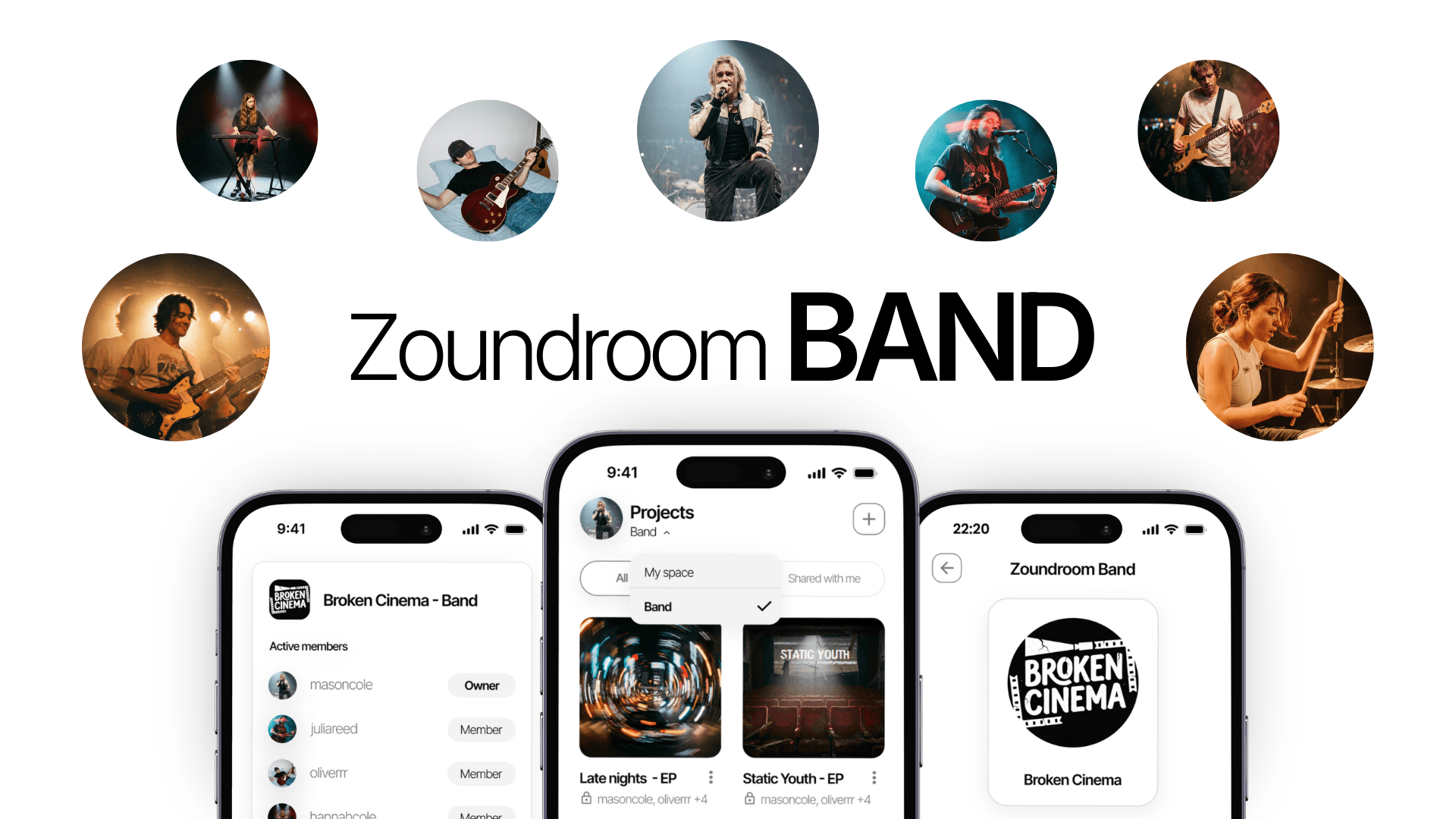
Music collaboration for bands: stop losing ideas and start finishing songs together
Playing in a band is one of the best experiences a musician can have. But managing a band is often an absolute mess.
Think about the last time someone in your group had a song idea. What did they do? They probably recorded a quick voice memo on their phone and sent it to the WhatsApp group. Someone replied with a "cool." Someone else sent a voice memo over it with a bass idea. Someone else typed out a snippet of lyrics in a separate message. And in between, three memes, a debate about rehearsal times, and a picture of the drummer's dog.
Two weeks later, nobody knows where that audio is. The bass idea got lost among 400 messages. The lyrics are somewhere in the chat, but nobody can find them. And the song that could have been never happens.
If this sounds familiar, it's not because your band is disorganized. It's because the tools you're using aren't built for creating music together. WhatsApp is for chatting. Google Drive is for file storage. Email is for... well, nobody really knows what email is for anymore. None of these tools understand what a music project is or how music collaboration in a band actually works.
This guide breaks down the root problem, explores the solutions most bands use (and why they fail), and offers a system to help your band stop losing ideas and start actually finishing songs.
The problem has a name: fragmentation
When a musician works alone, the chaos is theirs and theirs alone. They can have ideas scattered across five apps and still get by (poorly, but they manage). When there are three, four, or five people involved, that chaos multiplies exponentially.
The core issue with band collaboration isn't a lack of talent or ideas. It's fragmentation. Ideas live in different places, on different people's devices, with zero connection between them.
The guitarist has a riff recorded in Voice Memos. The singer has a lyric snippet in Google Keep. The bassist sent an idea on WhatsApp three weeks ago. The drummer has a beat reference saved in a Spotify playlist. And the keyboardist has a chord progression written down in a physical notebook left at the rehearsal space.
All of that belongs to the same song. But there's no single place where those pieces come together. There is no shared project. There's no status indicating "this is in progress" or "this needs someone to add a vocal melody." There is zero visibility.
In a band, an idea that isn't shared at the right time and in the right place is an idea that dies. Not because it's bad. But because nobody knew it existed.
What most bands do (and why it doesn't work)
Almost every band goes through the same phases of "creative management." It starts out chaotic, then someone tries to bring order, and eventually, they slip back into chaos because the chosen system is too much of a hassle.
Phase 1: The WhatsApp group as a recording studio
This is the most common phase. Someone sends an audio file, someone replies, and ideas flow for a bit. The problem is that WhatsApp has no structure. You can't link an audio file with a lyric sheet. You can't track the status of an idea. You can't search for "that riff the guitarist sent last month" without scrolling for half an hour. And if someone joins the group later, they lose the entire history of ideas.
WhatsApp is great for coordinating band logistics (rehearsals, gigs, schedules). It's terrible for managing the creative process.
Phase 2: The shared Google Drive folder
Someone in the band (usually the organized one) sets up a shared folder. Inside, they create subfolders by song. Inside each subfolder, there are audio files, lyric documents, maybe a PDF with chords. In theory, it's perfect. In practice, it's a file graveyard.
The issue is that Google Drive doesn't play audio seamlessly. To listen to an idea, you have to download the file or open it in another app. Lyrics are kept in a separate document from the audio they belong to. There is no way to leave feedback on a specific moment of a recording. And only one person maintains the folder structure; the rest ignore it.
Phase 3: Resigned dispersion
After failing with both WhatsApp and Drive, the band gives up. Everyone works with their own tools, and ideas are shared during in-person rehearsals. Which is fine, except rehearsals only happen once or twice a week, and a lot happens in between: new ideas, half-written lyrics, structure changes. All of that gets lost or arrives too late.
The 5 real collaboration needs of a band
If we had to design the perfect music collaboration system for a band, what would it need? After talking to many band musicians, these are the five needs that always come up.
1. A shared space where everything stays together
The most basic need, and the most ignored. Every song in development should be a project accessible to all members. Inside that project: recordings, lyrics, chords, structural notes, and any relevant references. One single place. Not five apps.
2. Individual capture, collective access
Every band member has ideas at different times. The guitarist records a riff at 2 AM. The singer writes a verse on the train. Everyone needs to capture ideas quickly and individually, but those ideas must flow into the shared space frictionlessly. If capturing and sharing an idea takes more than two steps, nobody will do it.
3. Context and status for every song
What stage is "that new song we started on Tuesday" in? Is it just a riff without lyrics? Does it have a structure yet? Is it ready to rehearse? When a band has 10 or 15 ideas in different stages of development, they need visibility. Simply being able to label each project as "idea," "in progress," or "ready to rehearse" completely changes the workflow dynamic.
4. Asynchronous feedback
You can't always wait until rehearsal to share your thoughts on an idea. And you don't always want to send a 3-minute WhatsApp voice memo explaining your perspective. Bands need a way to leave comments directly on projects: "I love this riff, but I think the bridge needs a different chord," "the second verse lyrics feel too literal," "what if we try this slower?".
5. History and evolution
Songs evolve. The original riff mutates. Lyrics get rewritten three times. The structure changes. Without a history of how each song evolved, the band loses context. Which version did we actually like? What changed since last rehearsal? A good system preserves the evolution, not just the current state.
What tools bands use today (and where they fail)
Let's be honest about the options currently on the market.
WhatsApp / Telegram
We've already covered this. It works for coordinating. It doesn't work for creating. Ideas get buried under messages, there is no project structure, and searching for specific content is nearly impossible.
Google Drive / Dropbox
Generic storage. No integrated playback, no linking between audio and lyrics, no project statuses, and no contextual feedback. It's a file system, not a creative space.
BandLab
A music app with recording and collaboration features. But its focus is on production (it's a simplified DAW), not on organizing ideas. If your band wants to multi-track record from a phone, it can work. If you need to organize 20 ideas in different stages and collaborate on them asynchronously, it falls short.
Trello / Notion
Some bands have tried using generic project management tools to organize songs. The problem is obvious: Trello doesn't play audio. Notion doesn't understand music projects. You can build a system, but you have to set it up from scratch and maintain it manually. Eventually, everyone stops using it because there's too much friction.
Highnote
A good tool for leaving feedback on audio with timestamped comments. However, it's designed for reviewing mixes and productions, not for songwriting and idea development. If your band already has produced songs and needs to review mixes, it works. If you're in the "we have 15 loose ideas and don't know which ones to develop" phase, it's not the right fit.
Tool | Shared space per song | Quick idea capture | Project statuses | In-context feedback | Audio + lyrics together |
|---|---|---|---|---|---|
❌ | ✅ | ❌ | ❌ | ❌ | |
Google Drive | Partial | ❌ | ❌ | ❌ | ❌ |
BandLab | Partial | ✅ | ❌ | Partial | ❌ |
Trello / Notion | Manual | ❌ | ✅ | ❌ | ❌ |
Highnote | ✅ | ❌ | ❌ | ✅ | ❌ |
Zoundroom Band | ✅ | ✅ | ✅ | ✅ | ✅ |
How productive bands organize their creative process
Bands that finish songs aren't necessarily more talented than those that don't. They are simply more organized. And that organization doesn't have to be rigid or bureaucratic. It only takes three things.
A shared capture system
Every member can record ideas whenever they want, from wherever they are. But those ideas don't stay locked on personal devices. They go straight to a space where the whole band can access them. That way, when the guitarist records a riff on Tuesday at midnight, the bassist can listen to it on Wednesday morning and add their part.
Regular material reviews
Productive bands take a few minutes (before or after rehearsal, or on a weekly call) to review the status of their projects. What new ideas came in? Which ones are moving forward? Which ones should be shelved? Think of it as a team sync, but for songs. Just 15 minutes a week makes a massive difference.
Clear decisions on what to develop
Not every idea is meant to become a song. And that's fine. The benefit of having an organized system is that you can see everything on the table and make smart decisions on where to focus your energy. Instead of "let's see what happens at rehearsal," the conversation becomes "we have these 5 ideas in progress, which ones are we prioritizing next month?"
Zoundroom Band: the workspace for bands that want to finish songs
Zoundroom was born out of frustration from musicians playing in bands who were tired of losing ideas between WhatsApp, Drive, and phone notes. The Band plan is built specifically to solve the exact problem detailed in this guide: giving your band a shared space where songs can be born, grow, and be finished.
How it works
Every band gets its own space in Zoundroom. Inside that space, every song is a project. And inside every project, audio recordings, lyrics, chords, structural notes, and team comments live together. Everything in one place, accessible to everyone.
Any member can open the app, record an idea, and link it to an existing project or spark a new one. The rest of the band gets that idea with context: they know which song it belongs to, what stage it's in, and what needs to be done next.
The difference for your band
No more searching for audio files on WhatsApp. Every recording lives within the project it belongs to. If you want to listen to "that riff the guitarist recorded," you just open the project and there it is. Right next to the lyrics and the band's comments.
Track the status of every song. Mark each project as an idea, in progress, or ready to rehearse. At a glance, the whole band knows what is on the table and what needs work.
Contextual, asynchronous collaboration. You don't all need to be in the same room at the same time. Everyone contributes when they can, and their input is saved in the song's project space. When you show up to rehearsal, everyone is already on the same page.
AI assistant support when you get stuck. Singer blocked on a melody? Missing a bridge? Lyrics need a rewrite? Zoundroom's AI assistant can suggest creative angles to break through blocks. It doesn't write for you; it just gives you the push you need.
Who it's for
The Band plan is built for any group creating original music that wants a better system to organize. Whether you're an acoustic duo or a six-piece act, composing rock, pop, hip-hop, folk, or electronic, if your musical ideas need a home to grow together, Zoundroom Band is that home.
It works incredibly well for bands that can't rehearse together constantly (due to schedules, distance, or busy calendars) and need a way to keep making progress between sessions.
FAQ: Band music collaboration
Does Zoundroom Band replace in-person rehearsals?
No. Nothing replaces playing together in a room. Zoundroom simply makes the time between rehearsals highly productive. By the time you get to the studio, ideas are already shared, discussed, and organized. You can actually play instead of spending the first half-hour asking, "do you remember that riff I sent you on WhatsApp?".
Does every band member need the app?
Yes. Collaboration works best when everyone has access to the shared space. The Band plan is designed for the whole group to work together. Check out the details at zoundroom.com.
Does it work if part of the band is in another city?
Perfect challenge. In fact, this is where it delivers the most value. Asynchronous collaboration lets every member contribute from where they are, when they can. Ideas don't have to wait until you're all in the same room.
Can I use Zoundroom as a solo musician and also with my band?
Yes. Your personal space (Free or Pro plan) is completely separate from your band's workspace. You can keep your personal projects in your account and your group projects in the Band space. When you're ready to share a solo idea with the band, simply move it to the shared space.
What about the songs we currently have scattered on WhatsApp and Drive?
Migrating them is your first step. Set aside one session (even just 30 minutes) to gather your scattered ideas and upload them to Zoundroom, organized by project. It's a one-time effort that will save you months of chaos. From then on, everything new starts directly in the shared space.
Your band has more songs than you think
Most bands don't have an idea database problem. They have an execution problem. The ideas are already there: in loose voice memos, lost notes, and in each member's head waiting to be shared. What's missing is a system to connect those pieces and turn them into completed tracks.
Stop running your band's creative process through WhatsApp. Give your ideas a dedicated space to meet, grow, and turn into the music you want to make.
Download Zoundroom for free and see what happens when your band finally has a real place to work together.