Song Ideas: How to generate, capture, and turn them into finished tracks
How to generate musical ideas when you are stuck, capture them before they vanish, and develop them into real songs.
Eliseu Bellés · Founder of Zoundroom. Musician and entrepreneur from Valencia. I am building Zoundroom so musicians stop losing their best ideas.
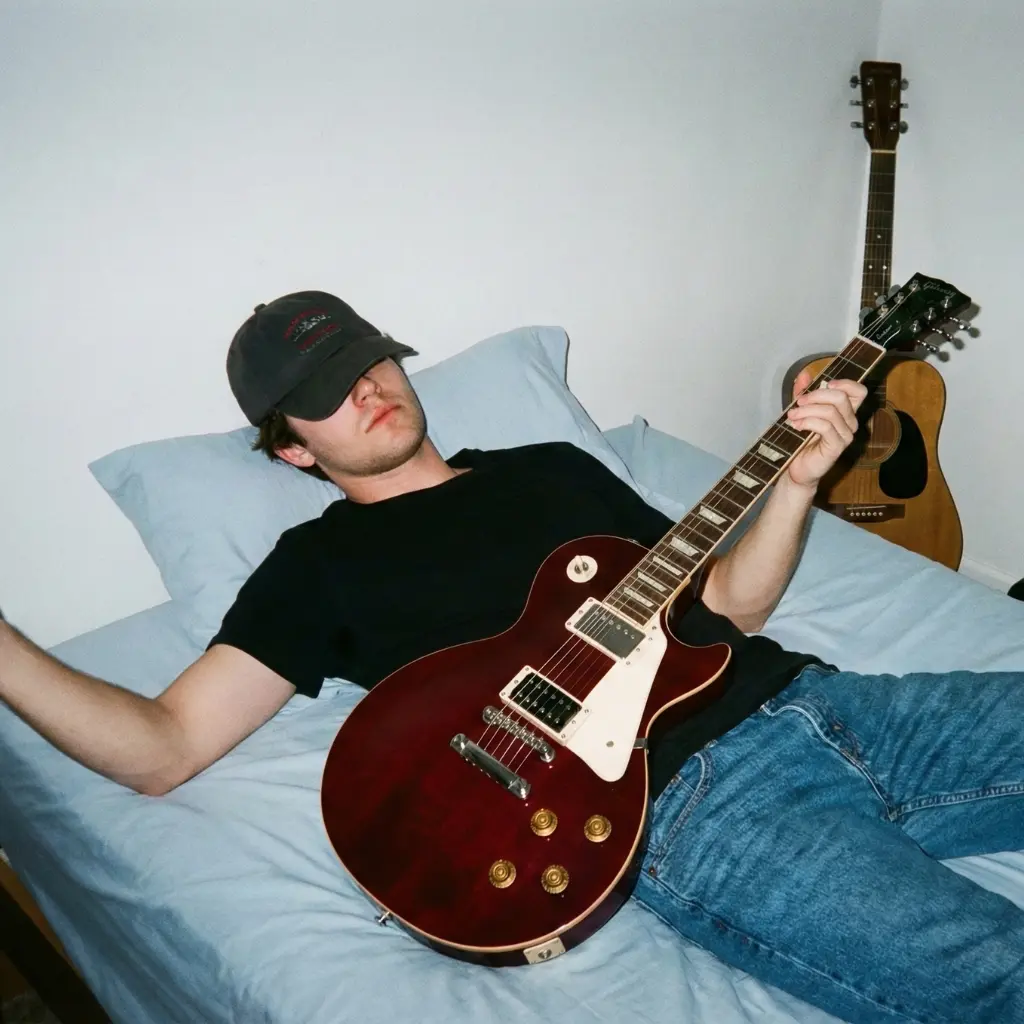
Musical Ideas: How to Generate, Capture, and Turn Them into Songs
There is a widespread myth about songwriting: that a musician's problem is not having enough ideas. That inspiration is scarce, unpredictable, and that when it doesn't show up, there is nothing you can do.
The experience of most active musicians says the opposite. Ideas come. They come on the subway, in the shower, in the middle of a rehearsal that is about something else, at eleven o'clock at night when you should already be asleep. The problem isn't that they don't show up. The problem is what happens after they arrive.
They get lost. Or they get stuck in the "idea" stage without turning into anything. Or they pile up in a voice notes folder that no one ever opens again.
That is a different problem, and it has different solutions.
The Real Problem Is Not a Lack of Ideas
If you open your phone's voice notes app right now, you will probably find recordings of hummed melodies, fragments of riffs, half-finished chords. If you have a notepad near your instrument, there are probably scribbles with incomplete lyrics or chord progressions without context.
Most musicians have more material than they can develop. The bottleneck is not in generating ideas. It is in the funnel that comes after: what you do with an idea once you have it.
There are three points where ideas usually die:
In the capture. The idea comes up and is not recorded. By the time you get to your instrument or open an app, you no longer remember exactly what it was like. Or it is recorded but in a place where you can't find it later.
In the processing. The idea is recorded but never reviewed. It lives in a limbo between "this could be something" and "I don't know what to do with this." Over time, the file loses context and becomes difficult to pick back up.
In the development. The idea exists and you know where it is, but the step from "30-second fragment" to "song with structure, lyrics, and arrangements" seems so big that you never start.
Each of these points has its own solution. Let's start at the beginning.
How to Generate Musical Ideas When You Are Truly Blank
Before talking about capture and development, we must admit that real creative block exists. Sometimes it is not that ideas get lost, but that they do not come. And when that happens, generic advice (go for a walk, listen to new music, get inspired by nature) has its limits.
What usually works best are constraints.
Limit the parameters. Instead of sitting down to compose "a song," sit down to find a four-chord progression that works in a key you don't usually use. Or write a riff that fits in eight beats. Or compose something where the bass carries the main melody. Constraint eliminates the vertigo of the blank page and forces the brain to solve a concrete problem instead of facing an infinite space.
Switch instruments. If you usually compose on guitar, sit at the piano. If you compose on piano, grab a guitar. Technical clumsiness on an unfamiliar instrument generates ideas that fluency on your usual one does not produce. When you cannot execute what you imagine, the creative process changes nature.
The first minute, unfiltered. Hit record and play for one minute without stopping and without judging anything. It does not matter if what comes out is bad. It does not matter if it makes no sense. The goal is to break inertia, not to produce usable material. In that minute, something usually appears, even if it is small, that is worth exploring.
Work from references intentionally. Not to copy, but to understand. Choose a song you admire and analyze just one thing: the chord progression of the chorus, or the rhythmic structure of the main riff, or how it resolves the transition between verse and chorus. Then try to do something that solves that same problem in a different way. It is a concrete exercise, not an invitation to imitate.
If the block is persistent and goes beyond a temporary lack of ideas, the post about the types of creative block in musicians identifies what type of block you have and what to do about each one.
How to Capture Ideas Before They Vanish
Capturing is not a creative act. It is an act of preservation. And that completely changes how you should do it.
The most common mistake is not capturing because the recording won't sound good. Or because you don't have the instrument handy. Or because the idea is not yet developed enough to deserve to be recorded.
None of those reasons carry weight against the real cost of not capturing: losing the idea forever.
A thirty-second capture with your phone microphone in a noisy room is worth infinitely more than a vague memory of what the idea was.
Some things that make capturing work as a habit:
Friction must be minimal. If you have to open three apps before you can record, you are going to lose ideas. The recording app has to be on your phone's first screen, accessible with one gesture. The time between "I have an idea" and "I'm recording" has to be seconds.
Capture the context too. A melody recording without context loses value over time. If you add a quick voice note when recording ("this goes well with the G minor progression I have in the slow song project") or a tag, the idea can be recovered weeks later. Without context, most captures become cryptic in less than two weeks.
Do not judge at the moment of capture. Capturing and evaluating are two separate moments. When you capture, you record everything. When you process, you decide what deserves to be developed. Mixing the two moments is the source of many lost ideas: the musician starts judging while recording and decides not to record because "it's not good enough."
The post about capturing musical ideas outside the studio expands on this in more detail, including how to build the capture habit in daily life.
How to Develop a Musical Idea into a Song
This is the part that almost no one explains clearly, and it is where most material gets lost.
You have a riff. Or an eight-bar melody. Or a chord progression you like. What do you do now?
The jump from "interesting fragment" to "finished song" seems huge from the outside, but in practice, it is crossed in small steps. The problem is that nobody tells you what those steps are.
Listen to what you have before adding anything. Play the capture on a loop for a few minutes, without playing anything, without trying to complete it yet. Let your brain start generating associations: what is missing, what could come before, what could come after, what emotion it holds. This step is usually skipped because it seems passive, but it is where the direction is decided.
Add a single layer. If you have a guitar riff, add only the bass. If you have a vocal melody, add only the chords backing it. Do not try to complete the whole song at once. Each new layer reveals information about what the next one needs.
Find the structure before finishing the details. A musical idea does not become a song until it has a structure: intro, verse, chorus, bridge, outro. Each section does not need to be finished. The skeleton needs to exist so you know where everything goes. An incomplete skeleton is much more useful than a perfect chorus with no context.
Let it rest and come back. This is not romantic advice about letting ideas mature. It is practical. Returning to an idea after a few days with fresh ears lets you identify what works and what doesn't much more clearly than when you are deep inside the process. Songs finished in a single session are the exception, not the rule.
Record every relevant version. As a song evolves, intermediate versions have value. Sometimes the rawest version of a section was better than the polished version that replaced it. Saving versions of the process is not collecting aimlessly: it gives you material to go back to if the direction you took doesn't work.
How to Know Which Ideas Deserve to Be Developed
Not all ideas deserve to become songs. Part of a songwriter's job is learning to distinguish which ones have potential and which ones can be let go without guilt.
There are some useful indicators:
The idea comes back on its own. If a melody or riff stuck in your head days after capturing it, without you listening to the recording again, that's a sign it has something. Ideas that don't come back on their own are usually decent but not necessary.
It works in adverse conditions. Humming a melody while doing something completely different is a brutal test. Melodies that survive that context usually have the simplicity and memorability that make a song connect.
It raises questions. A good musical idea is not complete on its own: it makes you want to know what comes before, what comes after, what lyrics would fit. If a capture makes you curious about its own development, that is a good sign.
It doesn't fit with anything you've done before. This is the most subjective criterion but perhaps the most honest: if an idea makes you a little uncomfortable because you don't know exactly what it sounds like or how it fits with your usual style, that is not a reason to discard it. It is frequently a reason to explore it.
What is not a valid criterion: that the capture sounds bad, that the fragment is short, that you don't know how to finish it yet. Those are development problems, not potential problems.
The System Connecting Generation to Result
Generating ideas, capturing them, and developing them are three distinct skills. But they only work if there is a system linking them: a place where ideas live after being captured, where you can see what has potential, what is in development, and what is ready.
Without that system, the process fragments. Captures are in one app. Ideas in development are in another. Intermediate versions are in computer folders with cryptic names. When you want to pick something back up, you have to rebuild the context from scratch.
The post about the 5-step system to organize your music explains in detail how to structure this workflow: capture, process, organize, tag, and review. It is the framework that turns loose ideas into finished songs.
Zoundroom is built to give that system a place to run. Every song is a project with its own space: audio recordings, lyrics, chords, and notes live together in the same place. Captured ideas have context. Songs in development have history. And when you want to pick something back up after two weeks, everything you need is right there.
It is not that the tool generates the ideas. It is that without a place where ideas can grow in an organized way, most don't make it to songs.
Frequently Asked Questions
How many musical ideas should I capture? All of them. Selection comes later, when processing, not when capturing. Musicians who filter themselves during capture lose material that could have been valuable. It is easier to discard ideas you already have recorded than to recover ideas you never got around to recording.
How much time should I spend developing an idea before deciding if it has potential? It depends on the idea, but a first session of twenty to thirty minutes is usually enough to know if there is something there. If after that time the idea hasn't generated any interesting direction, you don't necessarily have to discard it: it might just not be the right time. Coming back to it in another context sometimes changes everything.
Is it normal to have many ideas and few finished songs? Yes, and it is the norm among independent musicians. The gap between work-in-progress material and finished songs is almost universal. What closes it is not generating fewer ideas, but having a clearer system to decide what to develop and committing to it.
How do I overcome the fear that the recorded version will never be as good as the idea in my head? That gap exists for everyone. The recorded version is never exactly the idea you imagined, because imagination has no technical or production limitations. Accepting that as part of the process, rather than a failure, is what allows you to finish songs. The song that exists, even if imperfect, has more value than the perfect song that only exists in your head.
Should I write music every day even if I don't have inspiration? The discipline of sitting down to work every day has value, but not at any cost. Forcing songwriting when there is nothing there can generate generic material that you then have to discard. A more sustainable alternative: commit to capturing or reviewing ideas every day, even if you don't compose anything new. Keeping in touch with existing material usually generates momentum toward songwriting more effectively than sitting in front of your instrument waiting for something to happen.
Musical ideas are not the scarce resource. The time and attention to develop them are. Using them well starts with having a system that doesn't let ideas get lost before you can do something with them.
Download Zoundroom at zoundroom.com and build the space where your ideas can become songs.